Wisdom tooth extraction cost in Busan, by difficulty level.
Wisdom teeth are one of the few treatments where the Korean fee is set by the national health insurance schedule, not by the clinic — so the real question is which difficulty tier your tooth lands in, and whether you are enrolled. This guide walks the four tiers, the insured and uninsured figures, and what the X-ray decides before anyone names a number.
By Baro Dental Clinic, Seomyeon · October 2026 · 9 min read
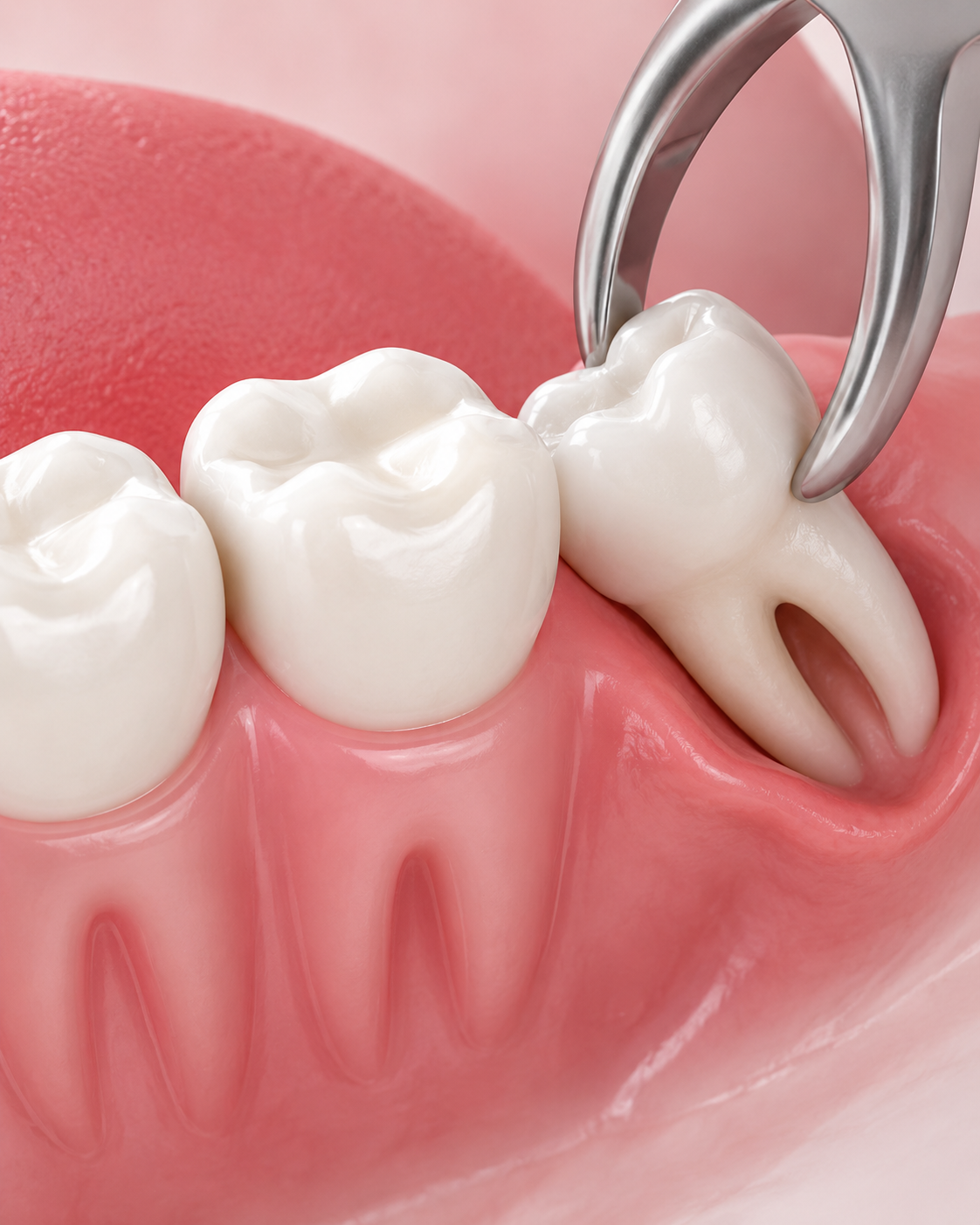
In Busan, wisdom tooth extraction is an insured-schedule procedure: the fee follows Korea's national health insurance (NHI) table, and your tooth is priced by difficulty — erupted, soft-tissue impacted, partially bony impacted or fully bony impacted — rather than by which clinic you walk into. What changes from patient to patient is enrolment. Expats and students on NHI pay a 30% share that usually stays in the tens of thousands of won; visitors without NHI pay the full schedule rate, quoted in writing at Baro Dental before anything is done. Here is how to read your own tooth into that table.
- The four difficulty tiers, and what each one means
- What you pay with Korean health insurance
- What you pay without NHI — visitors and short stays
- What the X-ray decides, and when a CT is added
- What a wisdom tooth visit in Seomyeon looks like
- Recovery, follow-up and the days around it
- When we tell you not to remove it
What people ask before booking a wisdom tooth removal
- My dentist at home quoted hundreds of dollars — is it really that much cheaper in Korea, or is there a catch?
- I have Korean health insurance through work. Does that actually apply to a wisdom tooth, and how much is my part?
- I'm only visiting Busan for ten days — can an impacted tooth come out and heal before I fly?
- Why did one clinic say ₩30,000 and another say ₩100,000 for what sounds like the same tooth?
- Do I need the CT scan, or is that an upsell?
The four difficulty tiers, and what each one means
Korea's insurance schedule does not have one price for “a wisdom tooth”. It has a ladder. Tier one is an erupted tooth — fully through the gum, upright, roots simple — removed much like any other extraction in a short visit. Tier two is soft-tissue impaction: the tooth is partly under the gum, so a small flap is opened before it comes out. Tier three is partial bony impaction, where some bone must be removed and the tooth is often sectioned. Tier four is full bony impaction — the tooth sits entirely within bone, frequently tilted or horizontal, and the surgery is longer and more deliberate.
Every tier has its own insurance code and its own fee, and the clinic does not choose the tier — the X-ray does. This matters because it explains the price spread you see online: two people describing “a wisdom tooth” can be two tiers apart, which is a severalfold difference in fee. It also means that at Baro Dental the number we write before treatment is the schedule figure for your tier, not a clinic-set price, and the same tooth would carry the same insured fee at any clinic in Busan.
Upper wisdom teeth tend to land in the lower tiers; lower ones, especially horizontal lower thirds close to the nerve canal, are the ones that climb the ladder. Our wisdom tooth treatment page explains the clinical side in more depth; this guide stays with the money.
What you pay with Korean health insurance
If you are enrolled in Korean NHI — most employed expats, long-term residents and students are — the clinic-level patient share for insured dental procedures is 30% of the schedule fee, with the remaining 70% billed to the insurer. In practice, for a wisdom tooth that puts your share of the extraction itself, with local anaesthesia and the routine X-ray included, roughly in these ranges: a straightforward erupted tooth in the low tens of thousands of won; soft-tissue impaction a little above that; partial bony impaction several tens of thousands; and full bony impaction towards the upper end of the tens of thousands.
The honest caveats: the schedule is revised annually, medication is a separate small pharmacy charge, and the only extra that is not on the insurance table is a CT scan where one is genuinely needed — ₩30,000 at our clinic, non-covered, and explained before it is taken. The written estimate you receive after the examination has your actual tier and your actual figure on it. We would rather you compare that sheet than any online range, including this one.
Enrolment is checked by your Alien Registration Card number at the front desk — there is no separate insurance card to carry. If your enrolment is through an employer and you have just started, mention it on WhatsApp so we can confirm the coverage is active on the day. Our guide to Korean health insurance for foreign patients covers the enrolment rules in full.
| Difficulty tier | Typical NHI patient share (30%) | What is involved |
|---|---|---|
| Erupted (tier 1) | low ₩10,000s | Fully through the gum; simple extraction, one short visit |
| Soft-tissue impacted (tier 2) | ₩10,000s–20,000s | Small gum flap opened; tooth removed intact |
| Partially bony impacted (tier 3) | ₩30,000s–50,000s | Some bone removed; tooth often sectioned |
| Fully bony impacted (tier 4) | ₩50,000s–90,000s | Tooth within bone, often horizontal; longer surgery |
| CT scan when indicated | ₩30,000 | Non-covered; only where roots sit near the nerve or sinus |
Illustrative ranges for the extraction, anaesthesia and routine X-ray under Korea's insurance schedule; revised yearly. Your written estimate carries the exact figure for your tier.
What you pay without NHI — visitors and short stays
Patients who are not enrolled — tourists, people on short visas, many on their first months in Korea — pay the full schedule fee rather than the 30% share. The arithmetic is simple: take the insured share above and multiply by roughly three and a third. That still places most wisdom tooth removals in Busan well below what the same surgery costs in North America, Australia or much of Europe, which is why the procedure is one of the most common things visitors book with us.
Two things we say plainly to uninsured patients. First, the uninsured figure is still the published schedule rate, not a “foreigner price” — the foreigner pricing myth gets its own guide. Second, nothing is removed before its figure is written down; the quote from the examination is the number on the receipt, and the receipt itemises in English for any travel insurer you want to claim from.
Have an X-ray or a photo already? Send it on WhatsApp with your dates and whether you are enrolled in Korean insurance — you will get an honest read on the likely tier and a written range before you decide anything. Message us on WhatsApp →
What the X-ray decides, and when a CT is added
A panoramic X-ray is the first thing taken, and it answers three questions at once: how deep the tooth sits (the tier), which way it points, and how close its roots run to the inferior alveolar nerve in the lower jaw or the sinus floor in the upper. For most teeth, the panoramic image is enough and the quote is written from it.
A CT is added only where the panoramic image leaves a real question — typically a lower tooth whose roots appear to touch or wrap the nerve canal. The 3-D image shows whether the canal passes beside, above or through the roots, which changes the surgical approach and, occasionally, the recommendation itself. At ₩30,000 it is the cheapest piece of risk reduction in dentistry; we take it when the picture demands it and skip it when it does not, and we tell you which before pressing the button.
What a wisdom tooth visit in Seomyeon looks like
The clinic is on the fifth floor of the SJ Medical Building, four minutes from Seomyeon Station Exit 2, where Lines 1 and 2 cross — about 25 minutes from Haeundae, 15 from Nampo-dong, and 40 from Gimhae Airport. The visit runs: examination and panoramic X-ray, findings on screen in English, tier and written price, your decision, and then — if you choose to proceed that day and the schedule allows — the extraction itself. Simple tiers take minutes in the chair; a full bony impaction is a longer, calmer appointment, usually under an hour including anaesthesia time.
Eat beforehand. Numbness lasts two to three hours after the procedure, and eating after waits for it to fade. If you are coming on a Tuesday or Thursday, the clinic runs to 9 PM, which many working expats use for exactly this. Written aftercare leaves with you; the WhatsApp thread stays open for the “is this normal?” messages that always come on day two.
Recovery, follow-up and the days around it
Tier one and two teeth heal fast — most people are eating normally within a day or two. Tier three and four take a week of real care: swelling peaks around day two or three, soft food for several days, no straws, no smoking, and a check at about a week to look at the socket and remove any stitches. Our day-by-day extraction recovery guide lays this out, and what to eat afterwards has the Seomyeon-specific food answer.
For visitors, this sets the planning rule: a surgical wisdom tooth needs about a week in Busan between the extraction and your flight — enough to pass the swelling peak and have the socket checked in person. An erupted tooth is far more forgiving. Tell us your flight date in the first message and we will say which of your teeth fits your window and which should wait.
When we tell you not to remove it
Not every wisdom tooth should come out, and a clinic that removes all four on principle is describing its revenue model. A fully erupted upper third molar that bites cleanly, cleans easily and has never been sore can often stay. A deeply buried lower tooth with no symptoms, no pathology around it and roots wrapped around the nerve may be a case for monitoring rather than surgery. Age matters too: teeth come out most easily in the late teens and twenties, and the case for prophylactic removal weakens as roots complete.
What we promise is the honest version of that conversation — which teeth need to go, which can wait, and which are better left — with the X-ray on screen and the insured or uninsured figure written next to each. The signs a wisdom tooth needs removing guide helps you read your own symptoms before you message; the pricing page holds every non-covered figure mentioned here.
- Your tier sets the price: erupted, soft-tissue, partial bony or full bony — the X-ray decides, not the clinic.
- Enrolled patients pay 30%: most wisdom teeth land in the tens of thousands of won for NHI members.
- Uninsured pays the schedule rate: roughly three times the insured share — still far below Western fees, never a “foreigner price”.
- CT only when it matters: ₩30,000, taken when roots sit near the nerve, skipped when they don't.
- Give a surgical tooth a week: visitors should plan the extraction at least seven days before flying.
The dentists behind every guide on this site


FAQ
You pay the full insured-schedule fee rather than the 30% share — roughly three times the insured figures for each tier, written down before treatment. For most teeth that remains well below the fee for the same surgery in North America, Australia or Western Europe, and the receipt itemises in English for a travel-insurance claim.
Clinically it is possible, but we rarely recommend it. Two on the same side in one visit is common and lets you chew on the other side while healing; four at once means a week of eating nothing comfortably. For visitors on a tight schedule we will say honestly what fits your dates and what should wait for the next trip.
Only when the panoramic X-ray leaves a real question — usually a lower tooth whose roots appear to touch the nerve canal. Then the ₩30,000 3-D image changes how the surgery is planned. When the panoramic image is clear, we skip it and say so.
Plan about a week between a tier three or four extraction and your flight: that clears the swelling peak and allows a stitch check in person. An erupted tooth is much more forgiving — a few days is usually fine. Our flying-after-treatment guide covers cabin pressure and medication details.
Most often because the two quotes assumed different tiers, or one assumed insurance and the other did not. The insured fee for a given tier is the same at every clinic in Korea; the variables are the tier, your enrolment, and any CT. Ask each clinic which tier they quoted and the difference usually explains itself.
Wisdom Tooth Removal in Busan
The treatment page — tiers, nerve mapping and the honest “leave it” cases.
Root Canal Treatment
The other insured-schedule procedure patients ask us to price.
Published Prices
Every non-covered figure in KRW, the same page for every passport.
Signs a wisdom tooth needs to come out
Related guide in this series.
Extraction recovery, day by day
Related guide in this series.
Korean health insurance and dental care for foreigners
Related guide in this series.
Read enough? Start the thread.
Send a photo or X-ray, your dates, and whether you hold Korean insurance — you will get the likely tier and a written range in English before you book anything.
Medical information in this guide is provided for general education and does not replace an individual examination and diagnosis. Prices shown are current at the time of writing; insured-schedule items follow Korea's national fee schedule and are quoted in writing at your visit. This clinic does not provide 24-hour service. Individual results vary.