
Closing gaps & spaced teeth in Busan Seomyeon — moved shut, not just filled.
Gaps between teeth have different causes and different right answers — sometimes aligners that move teeth together, sometimes resin that fills, sometimes a cause that needs treating first. This page sorts them honestly.
Ask about your gap.
Tap what fits — we’ll open WhatsApp with your message ready to send.Nothing sends until you press send in WhatsApp. A close-up photo helps us give an honest first read — resin-sized, aligner-sized, or cause-check-first.
Should a gap be moved shut with aligners in Busan — or filled with resin?
The honest rule of thumb: small, single front gaps can often be filled with resin in one visit (₩150,000); wider gaps, multiple gaps, or spacing across the arch are aligner territory (₩3,000,000–6,000,000) — because padding several teeth with resin makes them bulky, while moving them closes the spaces with your own natural enamel.
And one rule sits above both tools: the cause comes first. Gaps that appeared or widened in adult life can signal gum disease loosening the teeth’s foundations, or drift into the space a lost tooth left behind — and closing those gaps without treating the cause is decorating a moving train. The diagnosis (₩100,000, credited) names your gap’s cause before anyone picks a tool.

Why teeth have gaps — and how trays close them.
Spacing is crowding’s mirror image: more room in the jaw than the teeth fill. Sometimes the teeth are naturally small for the arch; sometimes one gap — classically between the upper front teeth, the midline diastema — comes from a low-attaching lip band (frenum) or simply how the teeth erupted. And sometimes gaps aren’t original equipment at all: they open in adulthood as teeth drift, which is a finding with its own meaning.
Closing gaps is, mechanically, aligners’ most natural work. Moving teeth together along the arch is bodily movement trays handle predictably — no space needs creating, no extraction math; the space is the problem, and the teeth themselves are the filling. Each tray walks the teeth a fraction of a millimetre toward each other until contacts close.
The part most gap pages skip: what happens at the gum when a long-standing gap closes. Gum tissue that spent years shaped around a space doesn’t instantly reshape around a contact — the “black triangle” question, which we cover honestly in its own section below, because managing expectations there is the difference between a delighted patient and a surprised one.
Six kinds of gaps — six different right answers.
Midline diastema
Move or fill — by widthThe front-and-centre gap. Narrow versions close beautifully with resin in one visit (₩150,000); wider ones are moved shut with aligners so the teeth stay natural proportions. The width measurement makes the call.
Spacing across the arch
Aligners’ natural workMultiple small gaps — teeth a size small for the jaw. Filling every gap pads every tooth; moving them together closes all the spaces with your own enamel. The textbook aligner spacing case.
Gaps that opened in adulthood
Check the gums firstTeeth that drift apart in your 30s–50s can be flagging gum disease quietly loosening their foundations. The gum exam comes first — closing gaps in inflamed bone harms the teeth you’re trying to help.
Drift into a missing-tooth space
Restore the anchorNeighbours lean and drift into the space a lost tooth left, opening gaps elsewhere. The honest plan often pairs alignment with replacing the missing tooth — close the gaps and fill the hole that caused them.
A low frenum behind the gap
Assessed at diagnosisA thick lip-band attaching low between the front teeth can hold a diastema open — and pull a closed one back apart. Where it’s a driver, the plan accounts for it honestly rather than pretending trays alone settle it.
How gap closing actually goes.
Name the cause
Scan, photos, gum check, frenum check, drift history (₩100,000 diagnosis, credited). Was the gap always there, or did it arrive? The answer routes everything after it.
Pick the tool honestly
Width and count decide: narrow single gap → resin option quoted; wider or multiple → aligner plan with 3D preview and written price. Sometimes both, sequenced — move mostly shut, finish with a whisper of resin.
Close symmetrically
Trays draw teeth together from both sides of each gap so the midline stays centred — closing a diastema by dragging one tooth across reads instantly wrong. Symmetry is planned, not hoped for.
Form the contacts
The final fractions of a millimetre matter most: teeth meet in proper contact points that hold floss with a satisfying snap — the sign of a closure that will stay closed and stay cleanable.
Retain like you mean it
Closed gaps are orthodontics’ most notorious re-openers — especially diastemas. Retention is non-negotiable here: clear retainer ₩100,000 or fixed wire ₩150,000–200,000 behind the front teeth, first-year adjustments covered.
Move, fill, or treat the cause — three tools, sorted.
| Aligners (move shut) | Resin (fill shut) | Cause-first treatment | |
|---|---|---|---|
| Best for | Wider gaps, multiple gaps, arch-wide spacing | One narrow front gap on healthy, well-positioned teeth | Gaps from gum disease or a missing tooth |
| What happens | Teeth travel together; gaps close with natural enamel | Resin added to gap-side surfaces in one visit | Gum treatment or tooth replacement first — then close |
| Timescale | Months, planned at diagnosis | One visit | Sequenced — foundation, then aesthetics |
| Published price | ₩3,000,000–6,000,000 by case | ₩150,000 (diastema closure) | By treatment — quoted in writing at diagnosis |
| Watch out for | Retention discipline — gaps love reopening | Bulky look if the gap’s too wide — we’ll say no honestly | Skipping this step is how closures fail early |
Both closing tools live at this clinic with published prices — so the recommendation you get is the one that fits your millimetres, not the one that fits a sales target. Sometimes the honest answer is both, sequenced.
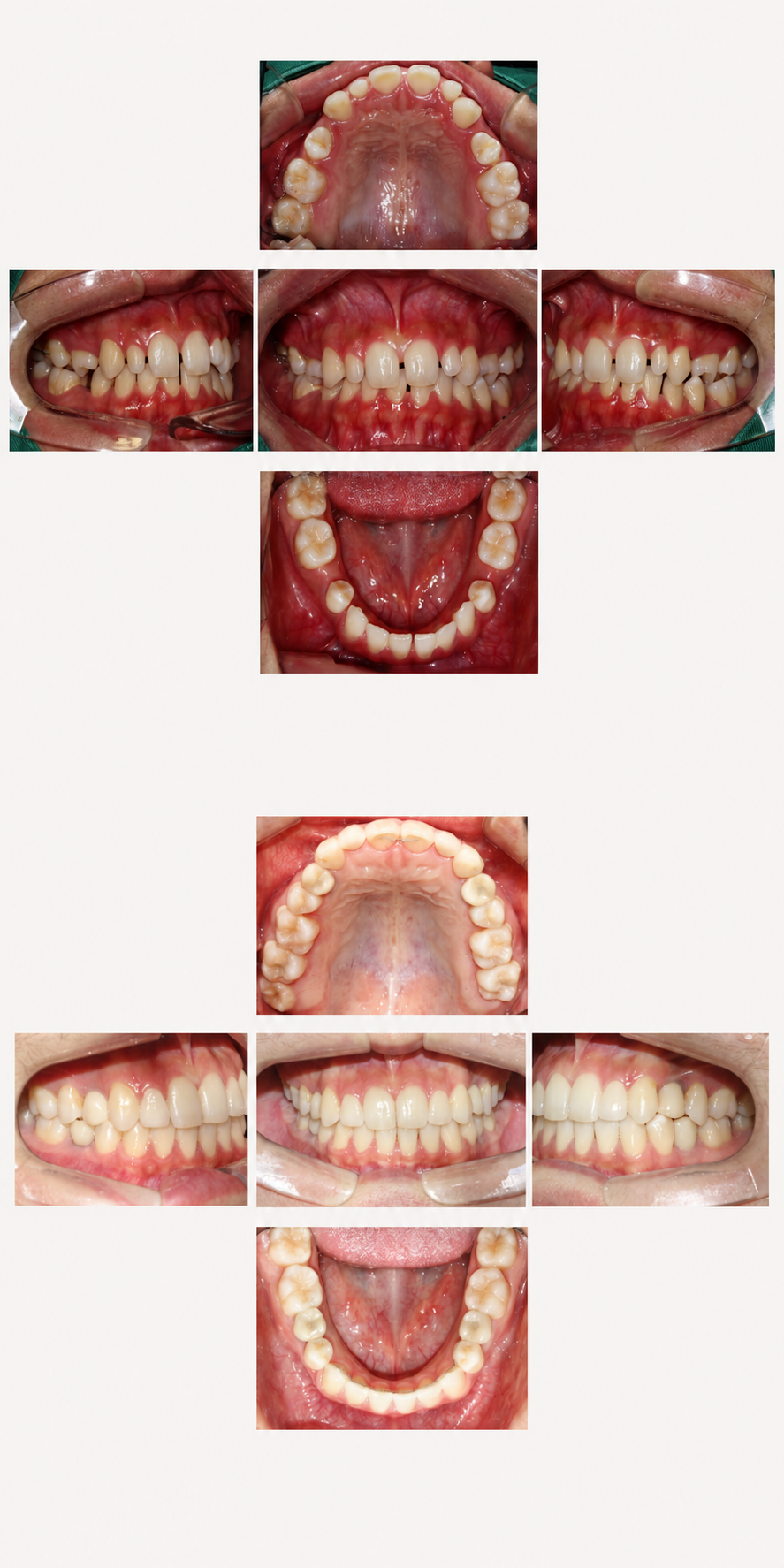
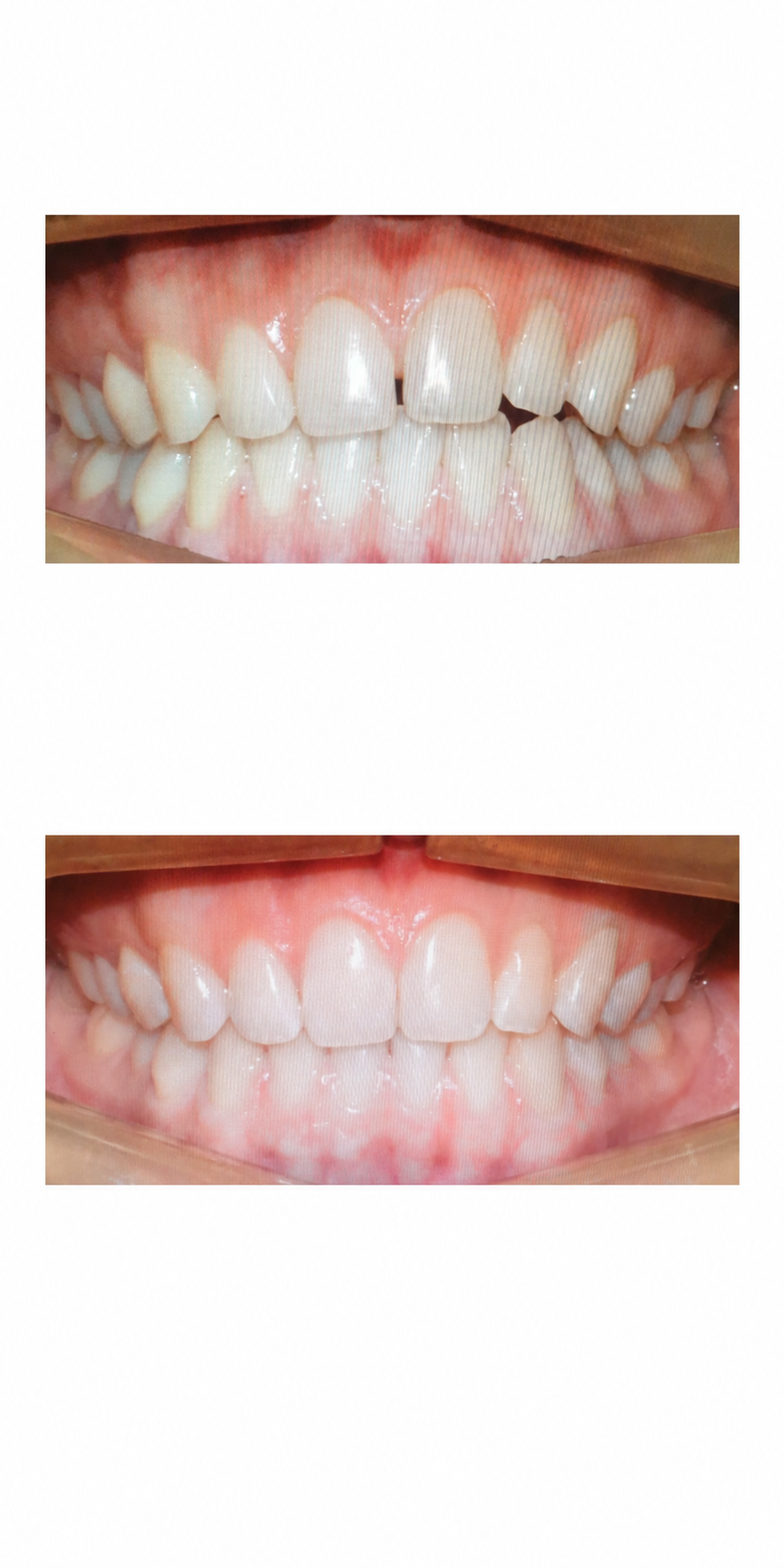
Spacing cases — before and after.
Treated at Baro Dental with clear aligners, photographed the same way before and after. Shown with patient consent; every case is individual and results vary.
The physics of a closing gap — including the black-triangle truth.
Closing space is more than teeth touching. Here’s what actually happens at the contact and the gum — the honest briefing we give every spacing patient.
Teeth converge, symmetry guarded
Gaps close from both sides so midlines stay centred. Watching a diastema narrow tray by tray is this treatment’s signature pleasure — the change is visible earlier than almost any other correction.
Surfaces meet — and must meet right
A proper contact point holds floss with a snap and shares chewing force with its neighbour. Sloppy contacts trap food and re-open; the final refinement trays exist for exactly this millimetre.
Black triangles — the honest part
Gum papilla — the little pink peak between teeth — grew around your gap’s shape. When long-spaced teeth meet, a small dark triangle can remain below the new contact where papilla hasn’t filled in. Younger, healthier gums fill better; longer-standing gaps in mature gums fill less. We show you the likelihood on your own scan before treatment — and where a triangle is likely, a whisper of resin contouring at the contact is the planned, priced answer, not an improvised save.
Retention — because gaps remember
Stretched gum fibres keep pulling toward the old space for years; diastemas are famous re-openers. A fixed wire behind the front teeth (₩150,000–200,000) or nightly clear retainer (₩100,000) is the whole difference between closed-for-now and closed. First-year adjustments covered.
Is it better to close a gap with aligners or resin?
Width and count decide, honestly: one narrow front gap → resin (₩150,000, one visit) keeps things simple; wider or multiple gaps → aligners, because padding teeth to bridge big spaces makes them bulky and square. Both tools live at this clinic with published prices, so the exam recommendation follows your millimetres — and sometimes the best plan is both: move mostly shut, finish with a whisper of resin.
Why are my teeth drifting apart as I get older?
Take this one seriously: new gaps in adult life are a finding, not a quirk. The commonest culprit is gum disease quietly reducing the bone that holds teeth steady — teeth in weakened foundations drift and fan forward. Tongue pressure and a missing back tooth shifting the bite can contribute. The gum exam comes before any closing plan, because aligning teeth in inflamed bone is treating the photo, not the patient.
What exactly is a black triangle — and will I get one?
The small dark space that can remain between teeth just below their new contact, where gum papilla hasn’t filled the corner — commonest when long-standing gaps close in mature gums. Will you get one? That’s a scan question, and we answer it before treatment, not after — showing you the likelihood, and where it’s meaningful, pricing the planned fix (fine resin contouring at the contact) into the written plan from day one.
How much does closing gaps cost in Busan?
Two published routes: resin diastema closure ₩150,000 for suitable narrow gaps, or Cerafin aligners ₩3,000,000–6,000,000 for wider and multiple-gap cases — spacing plans often sit toward the friendlier end because no space needs creating. Fixed in writing at diagnosis (₩100,000, credited). Where a cause needs treating first — gum care, a missing tooth — that’s quoted in the same sitting, so the whole sequence has one honest price picture.
Why do closed gaps re-open — and how do I stop mine?
Gum fibres stretched around a space for years keep tugging teeth back toward it — diastemas are orthodontics’ most determined re-openers, and anyone who skips this warning is selling you a repeat purchase. The defence is boring and total: a fixed wire behind the front teeth (₩150,000–200,000) or a nightly clear retainer (₩100,000), first-year adjustments covered. Worn as instructed, closed stays closed.
A tooth was extracted years ago and gaps opened everywhere — where do I start?
With the hole, usually. Neighbouring teeth lean and drift into an unreplaced space, opening gaps far from the original site — closing those gaps while the space stays open invites the drift straight back. The honest sequence is planned as one project: often upright and position the drifted teeth, replace the missing tooth so the arch has its anchor again, then close what remains. One diagnosis maps all of it, with each stage’s written price.
Care by board-certified specialists in Seomyeon
Both directors are board-certified specialists in Advanced General Dentistry, so your cosmetic treatment is planned with your overall dental health in mind.

- Board-certified specialist, Advanced General Dentistry
- M.S. in Orthodontics, Kyungpook National University
- Focus on natural, alignment-led smile improvement
- Conservative, tooth-preserving approach

- Board-certified specialist, Advanced General Dentistry
- DDS, Dankook University College of Dentistry
- Restorative & aesthetic resin filling work
- Focus: natural, durable results
Small truths about gaps.
- The diastema has fans — and that’s legitimate. Plenty of famous smiles keep their front gap on purpose. If yours doesn’t bother you and your gums are healthy, “leave it” is a recommendation we genuinely give; this page is for gaps their owners want closed.
- Gaps are self-cleaning — until they aren’t. Spaced teeth are easy to clean, which flatters them; but food-trap gaps between back teeth (often drift-made) pack at every meal and quietly feed decay on both neighbours. Front gaps are cosmetic; food traps are dental.
- Whitening pairs naturally with closing. Newly touching front surfaces show their shade honestly — many patients sequence whitening (from ₩165,000) at the finish, once positions settle.
- The floss snap is the quality test. After closure, floss should pass each new contact with a distinct snap — too loose traps food, too tight shreds floss. It’s the least glamorous, most reliable sign of a properly finished case.
- Spacing plans show progress fastest. Because gaps are visible and closure is measurable week to week, spacing patients get the most satisfying photo timelines in aligner treatment — a genuine motivation advantage over subtler corrections.
When we close gaps — and when we’ll pause first.
Closing is the right call when…
- gums are healthy — confirmed at the exam, the non-negotiable foundation
- the gap’s width and count match the tool — resin for narrow singles, trays for the rest
- black-triangle likelihood has been shown to you on your own scan, with the planned answer priced
- you’ll wear retention as instructed — because gaps remember
We’ll pause first when…
- gaps opened or widened recently in adult life — the gum exam outranks the aesthetic plan, every time
- drift traces to a missing tooth — closing around an open space invites relapse; the anchor gets planned in
- filling a wide gap with resin would make bulky teeth — we’ll show you why moving beats padding, even though resin is the cheaper sale
- a strong frenum or undersized teeth shape the picture — the plan says so up front, with the sequenced answer, not after the trays run out
Gaps & spacing FAQ.
There's no single magic number — it's proportion: resin closes a gap by widening two teeth, and past a certain share of the gap, those teeth start reading square and bulky. Narrow midline gaps suit resin well; anything wider, or gaps involving several teeth, looks better moved. The exam measures yours against your tooth proportions and shows you both previews before you choose.
The standard tray-change pressure — snug for a day or two per switch — and spacing cases are often gentler than crowding ones, since teeth travel along the arch rather than fighting for room. Most patients manage with nothing at all. The floss-contact phase at the end feels novel rather than sore: teeth touching that never touched before.
Often yes — limited plans focused on the front segment exist and price accordingly, and a narrow diastema may not need trays at all (resin, ₩150,000, one visit). The honest caveat: closing one space can shift contacts elsewhere, so even focused plans are checked against the whole bite on the scan. You'll see exactly how contained yours can be before deciding.
Usually, wait and watch — a midline gap is a normal stage of mixed dentition, and the arriving canines often close it naturally. Persistent wide gaps after the adult teeth settle, or a heavy frenum, are worth an assessment. Our children's orthodontics page covers the timing question properly; the short version is that this particular gap is one childhood finding that usually earns patience.
A stable, lifelong gap in healthy gums usually stays stable. The exception matters: gaps that are new, widening, or multiplying in adulthood suggest an active cause — gum disease, drift after tooth loss, heavy tongue pressure — and those do progress. The practical test is history: same gap since your twenties, low urgency; changing picture, book the exam.
Yes — and spacing is among the friendlier cases for international patients: resin closure is a single visit, and aligner spacing plans travel well with scheduled tray switches and WhatsApp check-ins between Busan trips. The retention fitting at the end is grouped into a visit you were making anyway; the retainer discipline afterwards travels with you.
Gap closing across visits.
Send a close-up of the gap (a coin or fingertip beside it helps scale) on WhatsApp. We’ll give an honest first read: resin-sized, aligner-sized, or cause-check-first.
Narrow single gaps can be examined and resin-closed in the same trip — often the same sitting (₩150,000), with shade matched to your teeth and no follow-up needed before flying.
Diagnosis, gum and frenum check, 3D plan with black-triangle preview, written price (₩100,000, credited). Trays switch on schedule wherever you live; progress photos flow through WhatsApp.
Contact refinement, any planned resin contouring at the contacts, and retention fitting (clear ₩100,000 / fixed ₩150,000–200,000, first-year adjustments covered) — timed to a trip you were making anyway.
Find out which answer your gap deserves.
Send a close-up photo on WhatsApp — we’ll tell you honestly whether it reads resin-sized, aligner-sized, or cause-check-first, with the published price for each route. In English.
Message us on WhatsAppBaro Dental Clinic · 5F, SJ Medical Building, 698-1 Jungang-daero, Busanjin-gu · Seomyeon Station Exit 2, 4 min
Explore the options in Busan.
Clear Aligners Hub
How Cerafin treatment works, every case type, and the full pricing picture.
Explore →Cosmetic Resin Filling in Busan
₩150,000 — the one-visit answer for suitably narrow front gaps.
Explore →Single Tooth Implant in Busan
When drift traces to a missing tooth, the arch needs its anchor back.
Explore →Gum Disease Treatment in Busan
New adult gaps get the gum exam first — foundations before aesthetics.
Explore →Medical information on this page is provided for general education and does not replace an individual examination and diagnosis. Whether your gap suits resin closure, aligner treatment or cause-first care — including black-triangle likelihood and any sequenced restorative steps — is confirmed at diagnosis. Before-and-after photographs show real patients of this clinic, published with consent; individual results vary.