Full-arch implant cost in Busan — what the total is made of.
Full-mouth fixed implants at Baro Dental run ₩15,000,000–20,000,000 for both jaws, a published range that covers the fixtures, the guided surgery and the final fixed teeth. This guide takes that total apart — how many implants per jaw, which fixture tier moves the number, what bone grafting and sinus lifts add, what a temporary denture costs, and how the two trips most patients make are scheduled.
By Baro Dental Clinic, Seomyeon · October 2026 · 11 min read
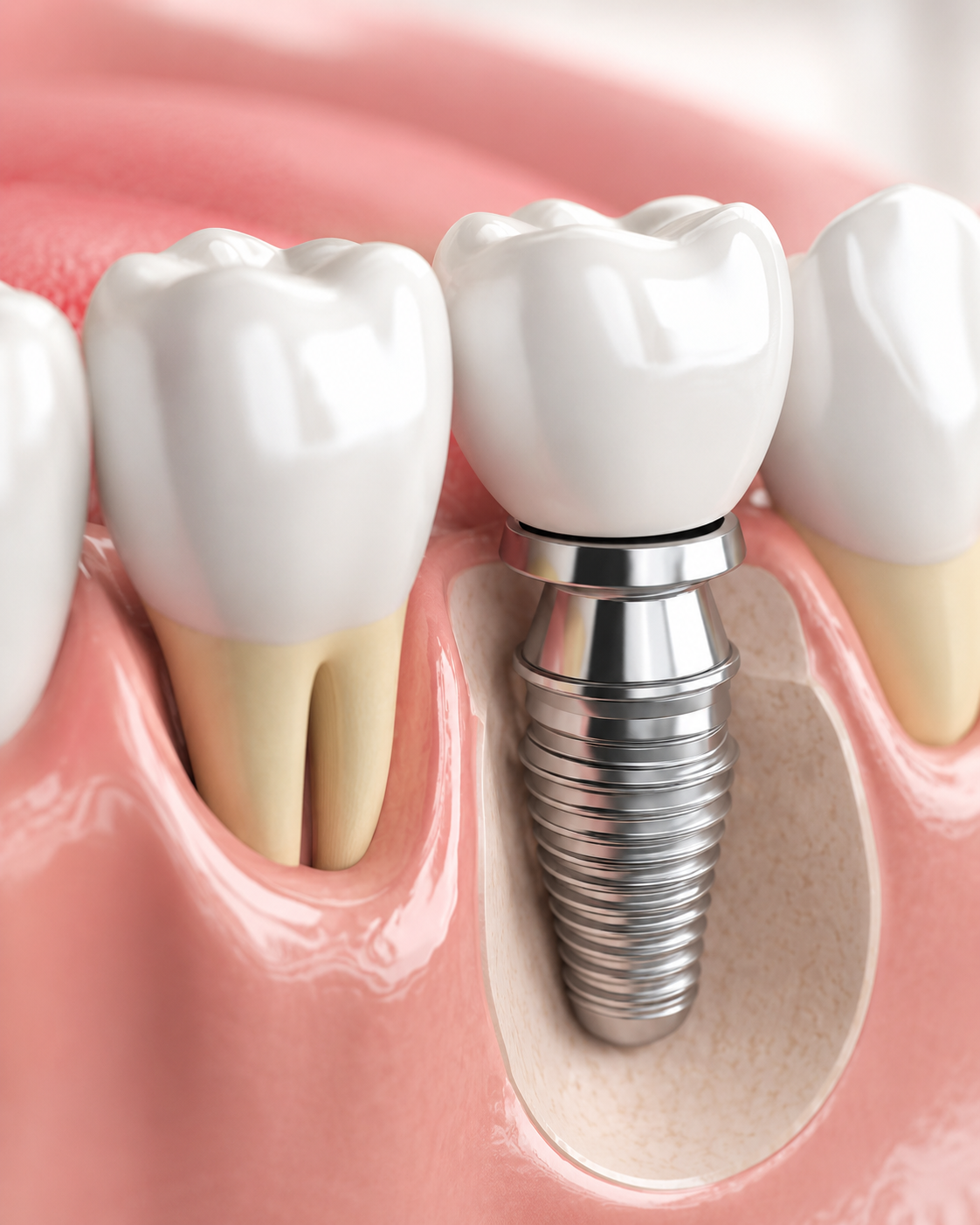
A full-arch implant reconstruction in Busan — both jaws, fixed teeth, typically seven implants in the upper and six in the lower — is published at Baro Dental at ₩15,000,000–20,000,000 including the surgical guide fee, with the fixture tier (DIO, Osstem or Straumann) deciding where in that range a case lands. Bone grafting, sinus lifts, CT imaging and a temporary denture are quoted as separate published lines so you can see what moves your total and why. Here is each line, the sequence of the two trips most patients make, and the honest comparison with the alternatives.
- The published range, and what it already includes
- Fixtures per jaw — and the tier that sets the number
- Guided surgery and the CT
- Bone grafting and sinus lifts — when they appear on the quote
- The temporary teeth between surgery and bridge
- Two trips: how the timeline is scheduled from abroad
- Full-arch vs dentures vs fewer implants
- Insurance, the 65+ rule and paying in stages
What people ask before a full-arch quote
- I was quoted a huge single number at home with no breakdown — what is actually in a full-mouth implant price?
- Why does one clinic say twelve implants and another say eight for the same mouth?
- Will I need bone grafting, and how much does that add?
- How many trips to Busan does this really take, and what do I eat with in between?
- Is a full-arch bridge worth it compared with good dentures, honestly?
The published range, and what it already includes
On our pricing page the line reads “Full-mouth fixed implants — upper 7 + lower 6, + guide fee — ₩15,000,000–20,000,000”. That figure is for both jaws, and it includes the implant fixtures, their abutments, the final fixed prostheses (the screw-retained bridges that become your teeth) and the digital surgical guide fee. A single arch is, broadly, half — the upper slightly more because it carries one more fixture and more often needs a sinus lift.
What is not inside the range, and is quoted as its own published line: bone grafting where the ridge is too thin, a sinus lift where the upper back teeth have left too little bone beneath the sinus, the CT scan, extractions of remaining teeth (insured-schedule, quoted at the visit), and a temporary denture or provisional bridge for the healing months. We separate them because they are the lines that differ between two mouths, and we would rather you see which of them apply to yours than receive one opaque total. Our full-arch implant page covers the clinical design; this guide follows the money.
Fixtures per jaw — and the tier that sets the number
The implant count is set by biomechanics, not by price: a fixed upper bridge is generally supported by six to eight fixtures and a lower by five or six, which is where our standard “7 + 6” design comes from. Clinics quoting four per jaw are usually proposing an “all-on-4” concept with tilted posterior fixtures — a legitimate design with its own trade-offs — and clinics quoting ten or twelve per jaw are often restoring tooth by tooth. Ask any clinic which design they mean; the number only makes sense alongside it.
Where our range moves is the fixture tier. Per tooth, a DIO implant with custom abutment and crown is ₩800,000, an Osstem KS ₩1,200,000 and a Straumann ₩1,750,000. Full-arch pricing is not simply thirteen times a single-tooth fee — the prosthesis is a bridge rather than thirteen crowns — but the tier logic carries through: a DIO-based reconstruction sits at the lower end of ₩15–20 million, Osstem in the middle, Straumann at the top. The Straumann vs Osstem guide sets out what the tiers actually differ in.
| Line on a full-arch quote | Published price | Notes |
|---|---|---|
| Full-mouth fixed implants, upper 7 + lower 6, incl. guide fee | ₩15,000,000–20,000,000 | Fixtures, abutments, final fixed bridges; tier sets position in range |
| Single arch (upper or lower) | roughly half the above | Upper slightly higher — one more fixture, more often a sinus lift |
| Bone graft — simple / complex | ₩300,000 / ₩500,000 | Per site, where the ridge is too thin for the fixture |
| Sinus lift — crestal / lateral | ₩500,000 / ₩700,000 | Upper back region only, when bone under the sinus is short |
| CT scan (non-covered) | ₩30,000 | Required for full-arch planning and the surgical guide |
| Temporary denture | ₩300,000 | Per arch, worn during healing where a fixed provisional is not placed |
| Extractions of remaining teeth | insured schedule | Quoted in writing at the visit; NHI members pay 30% |
Figures from our published non-covered fee list, current at time of writing. The itemised estimate after your CT shows which lines apply to your mouth.
Guided surgery and the CT
Every full-arch case here begins with a CT scan (₩30,000) and a digital scan of the mouth. From those, the fixtures are positioned on screen — length, angle, distance from the nerve canal and the sinus — and a surgical guide is printed that transfers that plan to your jaw. The guide fee is already inside the published range, which is deliberate: for a reconstruction of this scale we do not consider guided placement optional, so we do not price it as an option.
The CT is also where the rest of the quote is decided. It shows the bone height under each sinus, the width of the ridge where each fixture will go, and the condition of any remaining teeth. That is why we do not give a precise full-arch figure from a photograph — an honest range, yes, but the itemised estimate waits for the image. If you have a recent CT from home, send it; it often allows the estimate to be written before you travel.
Bone grafting and sinus lifts — when they appear on the quote
Teeth lost years ago leave a ridge that has shrunk. Where it is too thin to hold a fixture safely, a bone graft is placed — ₩300,000 for a simple site and ₩500,000 for a complex one, often at the same surgery as the implants. In the upper back region the limit is the sinus floor; where less than a few millimetres of bone remain, a sinus lift adds height — ₩500,000 by the crestal approach or ₩700,000 by the lateral approach, depending on how much is needed.
The honest framing: not every full-arch case needs grafting, and a design with tilted posterior fixtures can sometimes avoid a sinus lift altogether. Where grafting is needed, it adds a few hundred thousand won per site to a quote in the tens of millions — real money, but rarely the line that decides the case. What it does change is the timeline, because grafted sites heal longer before the fixtures take load.
Have a recent CT or panoramic X-ray? Send it on WhatsApp with a few photos of your smile and your rough dates. We will tell you honestly whether a full arch is the right design, which lines are likely to apply, and a written range — before you book a flight. Message us on WhatsApp →
The temporary teeth between surgery and bridge
Between fixture placement and the final bridge there are three to six months of healing while the implants integrate with the bone. Nobody goes without teeth for that time. The usual solution is a temporary denture at ₩300,000 per arch — removable, light, made before the surgery so it is ready the same day. In selected cases with good initial stability, a fixed provisional bridge can be attached to the implants early; that is decided at the planning stage and discussed with its own figure.
The final prosthesis — the fixed bridge included in the published range — is fabricated after healing, from a new scan, and fitted on the second trip. It is screw-retained, which means it can be removed by a dentist for maintenance without cutting it off, a detail worth asking any clinic about.
Two trips: how the timeline is scheduled from abroad
Most patients travelling to Busan for a full arch make two trips. Trip one, about seven to ten days: CT, planning, extractions if needed, guided fixture placement with any grafting, temporary denture delivered, a check before you fly. Trip two, three to six months later, about ten to fourteen days: healing confirmed, final impressions, try-in, fitting of the fixed bridges and an occlusal check a few days later. Between the trips, the WhatsApp thread carries photos and questions, and your dentist at home can be sent the specifications. The implant recovery timeline guide and two-trip implant plan set this out in detail.
Seomyeon itself makes this easier than most locations: the clinic is four minutes from Seomyeon Station Exit 2, hotels at every price are within walking distance (our hotel guide lists them), and Gimhae Airport is about forty minutes away. Daily post-surgical checks in trip one cost you a short walk, not a taxi across the city.
Full-arch vs dentures vs fewer implants
A fixed full-arch bridge is the most complete solution to a failing dentition, and the most expensive. The alternatives deserve a straight comparison. Conventional complete dentures are a fraction of the cost but rest on the gums, move, and accelerate bone loss. Implant-retained overdentures — two to four fixtures per jaw holding a removable denture — are a genuine middle path: far more stable than a plain denture, removable for cleaning, and considerably less than a fixed bridge; the fixtures are priced at the single-tooth tiers above. Our dentures vs implants guide weighs them.
Which one we recommend depends on your bone, your health, your budget and how you want to live with the result — and we will tell you if a fixed full arch is more than you need. A clinic that proposes the most expensive design to everyone is describing its business plan, not your mouth.
Insurance, the 65+ rule and paying in stages
Implants are non-covered for most patients, so the published figures above apply equally to NHI members, uninsured residents and visitors. The one exception: Korean national health insurance covers two implants per lifetime for enrolled members aged 65 and over at a 30% patient share, under the insured schedule rather than our list. Two fixtures do not fund a full arch, but for an enrolled older resident they take a meaningful piece off the total, and we apply the benefit where it is available. The insurance guide for foreign patients explains eligibility.
Payment follows the stages rather than arriving as one sum: the surgical phase is settled on trip one and the prosthetic phase on trip two, each against the written estimate you received before anything began. International cards are accepted, receipts itemise in English, and the figure on them is the figure on the estimate — the warranty terms are written down in the same way.
- Both jaws, fixed, ₩15–20 million: seven upper and six lower fixtures, abutments, final bridges and the surgical guide — published.
- The tier moves the number: DIO at the lower end, Osstem in the middle, Straumann at the top — same engineering, different fixture.
- Grafting is a separate, visible line: ₩300,000–700,000 per site when needed; the CT decides, and many cases need none.
- Plan two trips: seven to ten days for surgery, ten to fourteen days three to six months later for the final teeth.
- Ask about the alternatives: an implant overdenture may serve you well for far less; we will say so if it would.
The dentists behind every guide on this site
FAQ
At Baro Dental, fixed full-mouth implants — seven upper and six lower fixtures with final bridges and the surgical guide — are published at ₩15,000,000–20,000,000 for both jaws. Bone grafting, sinus lifts, CT, extractions and a temporary denture are quoted as separate lines where your mouth needs them.
No — and we say so plainly. Implants need three to six months to integrate with bone before the final bridge can be loaded. Most patients make two trips: the surgical trip and, months later, the prosthetic trip. Immediate-load provisional bridges exist for selected cases but still require the second trip for the final teeth.
Only the CT can answer that. Many full-arch cases need none; others need a graft at one or two sites (₩300,000–500,000 each) or a sinus lift in the upper back region (₩500,000–700,000). Send a recent CT if you have one and we will give an honest read before you travel.
For most patients, no — implants are non-covered. Enrolled NHI members aged 65 and over receive two implants per lifetime at a 30% patient share, which we apply where eligible. The rest of the reconstruction follows our published list.
Not for everyone. A fixed bridge is the most complete result; an overdenture on two to four implants per jaw is far more stable than a conventional denture, removable for cleaning, and costs considerably less. We recommend based on your bone, health and how you want to live with the result — and will tell you if the fixed design is more than you need.
Full-Arch Implants in Busan
The treatment page — design, fixture count and the healing sequence.
Digital Guided Implant Surgery
The CT-to-guide planning included in every full-arch quote.
Published Prices
Every non-covered figure in KRW, the same page for every passport.
Dental implant cost in Busan, Korea
Related guide in this series.
Dentures or implants for missing teeth?
Related guide in this series.
Implant recovery timeline
Related guide in this series.
Read enough? Start the thread.
Send your CT or X-ray and a few photos with your rough dates — the reply is an honest view of the right design for your mouth and an itemised written range, in English, before anything is booked.
Medical information in this guide is provided for general education and does not replace an individual examination and diagnosis. Prices shown are current at the time of writing; insured-schedule items follow Korea's national fee schedule and are quoted in writing at your visit. This clinic does not provide 24-hour service. Individual results vary.