
Bone graft for implants in Busan — rebuilding the ground before the building.
An implant is only as honest as the bone it stands in. When your ridge has thinned, grafting rebuilds it — simple ₩300,000, complex ₩500,000, published — and when your bone is sufficient, we’ll tell you that instead, because a graft you don’t need is the easiest thing in dentistry to sell and the last thing we will.
Ask about your bone.
Tap what fits — we’ll open WhatsApp with your message ready to send.Nothing sends until you press send in WhatsApp. A photo and any X-rays help us give an honest tier read — Straumann-warranted, or KS-sufficient.
Do I need a bone graft for my implant in Busan — and what will it cost?
Only your CT can answer the first half — bone volume is measured in millimetres, not guessed from a mirror — but the second half is already published: a simple graft is ₩300,000, a complex graft ₩500,000, decided by how much rebuilding your site needs and stated in your written plan before anything begins. Upper molar sites near the sinus are their own procedure — the sinus lift, ₩500,000–700,000 — with its own page.
The context worth knowing: needing a graft is ordinary, not ominous. Bone under a missing tooth thins as a matter of physics — unloaded bone resorbs — so long-standing gaps frequently need some rebuilding before a fixture has honest footing. Equally ordinary: not needing one. Many implant sites proceed directly, and the ₩30,000 CT exists precisely so that call is made by measurement. Grafting here is prescribed like medicine, not bundled like an airline fee.
Not a filler — a scaffold.
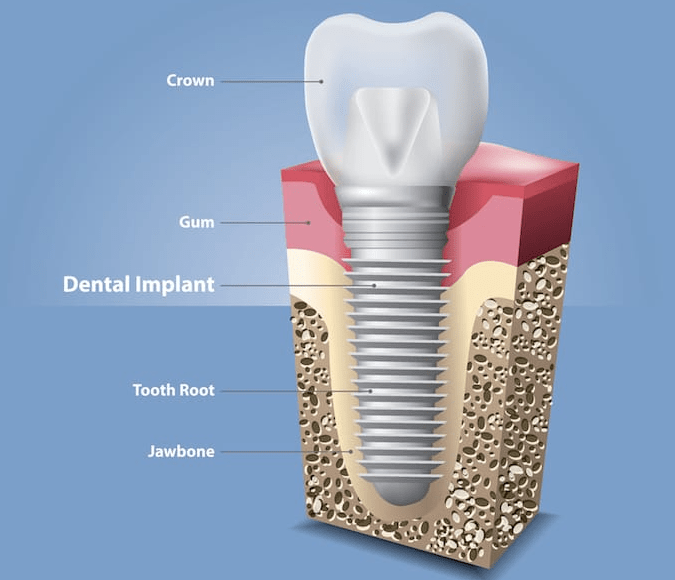
The most useful correction to make first: graft material is not artificial bone that stays in your jaw forever. It’s a scaffold — a biocompatible granular matrix placed where volume is missing, whose actual job is to hold space and invite your own bone to grow through it. Your cells do the construction; the graft is the formwork they climb.
The material is placed into or onto the deficient site — a fresh extraction socket being preserved, a thinned ridge being widened — often covered with a protective membrane that keeps faster-growing gum tissue from colonising the space before slower-growing bone arrives. Then biology takes over: blood vessels infiltrate the scaffold, bone-forming cells follow the vessels, and over a healing period measured in months your own bone progressively replaces the framework.
The end state is the point: what an implant eventually meets is not graft material but your regenerated bone — living, load-bearing, and capable of the same osseointegration handshake as bone that never went missing. Grafting doesn’t fake a foundation; it commissions one.
Six ways jawbone goes missing — and what each means for your plan.
Unemployment atrophy
The slow defaultBone keeps what chewing stimulates and resorbs what nothing loads — Wolff’s law running in reverse under every long-standing gap. The longer a tooth has been gone, the more ground has quietly left with it; the CT measures exactly how much remains.
The socket’s first year
The preventable lossThe months right after an extraction are when the ridge collapses fastest — walls that held a root fold inward once it’s gone. This is why socket preservation exists: graft material placed at extraction holds the ridge’s shape, often downgrading a future complex graft to a simple one, or to none.
Periodontitis ate it
Fire out before rebuildingGum disease destroys the bone around teeth before it takes the teeth themselves — so sites lost to periodontitis often arrive pre-excavated. The sequence is fixed: infection treated and settled first, then grafting — scaffolds built in a fire burn like everything else.
The denture’s slow press
Pressure without purposeA removable denture rests on the ridge and compresses it for years without ever loading the bone the way roots did — resorption with a lid on it. Long-time denture wearers converting to fixed implants frequently need rebuilding first, measured site by site.
Trauma & infection scars
The irregular deficitsAccidents, failed root canals and old abscesses can each take bone in uneven bites — defects with awkward shapes rather than tidy shortfalls. These are the classic complex-graft cases: more material, membrane work, staged healing — the ₩500,000 tier earning its definition.
Bone that’s actually fine
Then no graft, on recordPlenty of sites measure sufficient — and when yours does, “no graft needed” goes in your written plan as a finding, not a favour. A graft prescribed to healthy volume is the oldest padding trick in implant billing, and refusing it is a published policy here, same as our prices.
How grafting actually goes.
CT & the volume verdict
The CT (₩30,000) measures your ridge in three dimensions — height, width, density. The verdict comes with numbers: sufficient, simple graft (₩300,000), or complex (₩500,000) — and with the reasoning shown on screen if you want to see it.
Placement, usually minutes
Under local anaesthesia, the site is opened, graft material placed and shaped, membrane positioned where the plan calls for one, and the gum closed over the work. Simple grafts often ride along with another procedure — an extraction, or the implant itself.
The quiet conversion
Your bone grows through the scaffold over a healing period measured in months — nothing to do but ordinary care and patience while blood vessels and bone cells do the actual construction.
Verification, then the fixture
Follow-up imaging confirms the rebuilt volume before any implant is scheduled — the graft passes its exam or the plan adapts. Fixtures go into verified ground here, not assumed ground.
The implant story resumes
With the foundation restored, the standard sequence proceeds — placement, integration, crown, all at the published tiers (₩800,000–1,750,000, crown included). The graft’s success disappears into the implant’s.
Simple ₩300,000, complex ₩500,000 — what actually separates them.
| No graft — ₩0 | Simple graft — ₩300,000 | Complex graft — ₩500,000 | |
|---|---|---|---|
| The site | Volume measures sufficient on CT — fixture proceeds directly | A modest, contained shortfall — a socket being preserved, a small deficit alongside placement | A larger or irregular deficit — ridge widening, defect reconstruction, staged rebuilding |
| The work | None — and it goes in your plan as a finding | Material placed and shaped in one contained step, often within another procedure’s appointment | More material, membrane management, and frequently its own surgical appointment with staged healing |
| Timing vs the implant | Same visit as planned placement | Often simultaneous with extraction or placement — one healing period serves both | Usually sequenced before the fixture — the rebuild verified by imaging, then the implant scheduled |
| How common, honestly | Common — especially recent losses and well-preserved sites | The workhorse tier — most grafting at this clinic is this | The minority — long-standing loss, periodontal excavation, trauma scars |
One boundary worth knowing: rebuilding under the sinus floor for upper molars is not a graft tier but its own procedure — the sinus lift (₩500,000 crestal / ₩700,000 lateral) — and your plan will name which your site needs, never both by default.
How borrowed material becomes your own bone.
The graft’s fate is the most misunderstood part of implant dentistry — and the most reassuring once seen clearly:
The scaffold takes its position
Granular graft material fills the deficit and holds its shape — structurally useful from the first minute, biologically inert on its own. Think formwork on a construction site: essential, temporary, and never the building.
Blood vessels move in
Capillaries infiltrate the scaffold’s pores — the supply lines of all construction biology. Where vessels go, cells can follow; a graft’s early success is largely a vascular story, which is also why smoking is this procedure’s most honest enemy.
Your cells climb the framework
Bone-forming cells travel the vascular routes and begin laying down new bone along the scaffold’s surfaces — your DNA, your calcium, your architecture, guided by the shape the graft held open. The site firms progressively as framework becomes structure.
The formwork retires
Over time the scaffold material is progressively resorbed and remodelled, replaced by living bone that answers to your biology — loadable, maintainable, and ready for a fixture’s handshake. What the implant meets was grown, not installed. The graft’s greatest success is its own disappearance.
What is the graft material actually made of?
Modern grafting draws from a well-established menu — processed donor bone, purified bovine-derived mineral, and synthetic calcium-based materials — all regulated, MFDS-approved, and long-documented in implant dentistry. Which suits your site depends on defect size and biology, and we’ll tell you what we’re using and why. The unifying fact matters more than the menu: every option is a temporary scaffold whose end state is replacement by your own bone.
Does a bone graft hurt?
Less than its reputation — grafting is gentler than the word “graft” sounds. Placement happens under local anaesthesia, usually in minutes, often inside another procedure’s appointment; the days after bring manageable swelling and soreness handled by ordinary pain relief and the aftercare sheet. Most patients rank it below the extraction they’d already survived. The demanding part isn’t pain — it’s patience.
Can I skip the graft and just get a shorter implant?
Sometimes genuinely yes — and we’ll say so when the numbers support it. Shorter and narrower fixtures (including Straumann’s stronger-alloy narrow options) have widened what modest ridges can host without rebuilding. The honest boundary: engineering workarounds serve modest shortfalls; genuine deficits still need genuine volume, because a fixture in insufficient bone is a countdown, not a compromise. The CT arbitrates, and both paths get priced when both are real.
My extraction is coming up — should I graft at the same time?
This is the single highest-value timing question in implant dentistry. Socket preservation — graft material placed the day the tooth comes out — holds the ridge’s walls through the collapse-prone first months, and frequently converts a future complex graft into a simple one or none. If an implant is anywhere in your future plans, raise this before the extraction, wherever you have it done. It’s the cheapest bone you’ll ever keep.
How do I know the graft worked before the implant goes in?
By imaging, not assumption — follow-up scanning verifies the rebuilt volume and density before any fixture is scheduled, and the implant proceeds only into ground that passed its exam. In the uncommon case a site under-builds, the honest answer is honest: supplement, re-stage, or adapt the plan — decided with the pictures on screen, never discovered mid-surgery.
Why do graft quotes vary so much between clinics?
Because grafting is where implant pricing hides its flexibility: unpublished rates, per-cc material charges, “premium membrane” upsells, and grafts prescribed to bone that measured fine. Our counter is structural — two published tiers (₩300,000 / ₩500,000), the CT’s measurements shown on request, and “no graft needed” written into plans as a finding. Comparing clinics? Ask two questions: is the graft price published, and can I see the measurement that justifies it?
Care by board-certified specialists in Seomyeon
Both directors are board-certified specialists in Advanced General Dentistry, so your cosmetic treatment is planned with your overall dental health in mind.

- Board-certified specialist, Advanced General Dentistry
- M.S. in Orthodontics, Kyungpook National University
- Focus on natural, alignment-led smile improvement
- Conservative, tooth-preserving approach
- Board-certified specialist, Advanced General Dentistry
- DDS, Dankook University College of Dentistry
- Restorative & aesthetic resin filling work
- Focus: natural, durable results
Small truths about bone grafts.
- Smoking is the graft’s loudest enemy — even more than the implant’s. The scaffold’s success is a blood-vessel story, and smoking throttles exactly those vessels. If there was ever a procedure worth pausing for, it’s this one — and we’ll discuss honest odds either way.
- The graft is why “how long do implants take” has no single answer. Sites that need rebuilding add a verified healing chapter before the fixture’s own months. It’s the least skippable step in the whole story — rushed foundations are how revisions are born.
- Grafted bone is maintained like all bone — through gum health. The rebuilt ridge answers to the same periodontal rules as the original: daily cleaning plus routine scaling (₩60,000) protect the investment from the disease that often excavated it in the first place.
- Small defects sometimes ride free. Minor contour touch-ups placed during implant surgery may fold into the procedure rather than bill as a tier — your written plan states it either way, because “we’ll see” is not a price.
- Old bone loss is not a life sentence. Patients arrive convinced a decades-old gap or a periodontal past has priced them out of implants — usually wrongly. Rebuilding is routine here; the CT measures what’s actually left before anyone concludes anything.
When grafting is right — and when we’ll cross it off your quote.
Grafting earns its place when…
- the CT measures a genuine deficit — numbers on screen, not adjectives in a pitch
- an extraction is imminent and socket preservation can save the ridge cheaply now versus rebuilding it expensively later
- the ideal crown-first fixture position demands volume the site doesn’t currently have
- gum disease has been treated and settled, so the rebuild inherits peace, not fire
We’ll cross it off when…
- your bone measures sufficient — “no graft needed” goes in the written plan as a finding, and the quote shrinks accordingly
- a modest shortfall is honestly served by fixture engineering — shorter or narrower options priced against the graft path, both shown
- active periodontitis hasn’t been treated — infection control precedes construction, always
- the site is sinus territory — upper molars needing height get the sinus lift conversation instead, priced on its own page
Bone graft FAQ.
Two published tiers at this clinic: simple ₩300,000 for contained shortfalls — socket preservation, modest deficits alongside placement — and complex ₩500,000 for larger or irregular rebuilding with membrane work and staged healing. The CT (₩30,000) decides the tier by measurement, sinus lifts are priced separately (₩500,000–700,000), and sufficient bone is billed at the best price of all: nothing, stated in writing.
The graft sets the tempo, and honest clinics let it: new bone matures over a healing period measured in months, with follow-up imaging — not a calendar — confirming when the site is ready to host a fixture. Simple grafts placed alongside the implant share one healing period; complex rebuilds run their own chapter first. Your written plan maps the real sequence, and for international patients, the trips it implies.
Routine dental grafting today rarely harvests from your body — the standard materials are processed donor bone, purified animal-derived mineral, and synthetic calcium compounds, all MFDS-regulated and extensively documented. Own-bone harvesting still exists for select major reconstructions, but for typical implant-site rebuilding, the scaffold materials perform their job — holding space for your own bone to grow through — without a second surgical site. We'll tell you exactly what your plan uses.
A minority can under-build — smoking, infection, membrane exposure and health factors are the usual authors — which is exactly why we verify by imaging before any fixture is scheduled rather than assuming success. If a site comes up short, the options are unglamorous and effective: supplement the graft, extend healing, or adapt the fixture plan to the volume that grew. What never happens here is discovering a failed graft mid-implant-surgery — verification is the firewall.
Treat it as one clinic's reading, not a verdict — "not enough bone" often means "not enough for our preferred technique." Between graduated grafting tiers, sinus lifts, narrow strong-alloy fixtures and crown-first digital planning, the genuinely untreatable ridge is rarer than the diagnosis. Send us your imaging or take a fresh CT (₩30,000) here; you'll get measurements and options, including — if it's true — an honest confirmation that conservative paths suit you better.
Naturally — grafting slots into the same chaptered rhythm as everything implant-related: assessment and graft placement on one visit, the conversion months at home with WhatsApp check-ins, verification imaging and fixture placement on the return. Simple grafts placed alongside extractions or implants often add zero extra trips. The written plan doubles as your flight planner, with each visit's purpose stated — and the published tiers make the budget knowable before you book anything.
Rebuilt ground across visits.
Send photos and any X-rays or CT on WhatsApp — mention how long the tooth has been gone and any “not enough bone” verdicts you’ve received. You’ll get an honest first read on your rebuilding odds.
CT (₩30,000), measured verdict, written plan with your tier — ₩300,000, ₩500,000, or none — then placement, frequently combined with an extraction or the fixture itself to save you a trip.
Your bone climbs the scaffold wherever you live — WhatsApp check-ins, ordinary care, no required flights while the conversion runs.
Imaging confirms the rebuilt volume, then the implant story proceeds into verified ground — fixture, integration, crown, all at published prices you knew before your first flight.
Get your bone measured — not estimated.
Send a photo and any imaging on WhatsApp — we’ll tell you honestly whether your site reads sufficient, simple, complex, or sinus-territory, and what each answer costs in writing. In English.
Message us on WhatsAppBaro Dental Clinic · 5F, SJ Medical Building, 698-1 Jungang-daero, Busanjin-gu · Seomyeon Station Exit 2, 4 min
Explore the options in Busan.
Sinus Lift in Busan
₩500,000–700,000 — when upper molars need height, not just width.
Explore →Single Tooth Implant in Busan
The story the graft serves — three tiers, crowns included.
Explore →Digital Guided Surgery in Busan
Where bone volume gets measured — and grafting gets prescribed by numbers.
Explore →Gum Disease Treatment in Busan
The excavator behind most bone loss — and the step before every rebuild.
Explore →Medical information on this page is provided for general education and does not replace an individual examination and diagnosis. Whether grafting suits your site — including tier, material, timing relative to extraction or implant placement, and healing verification — is confirmed at a CT-based consultation with a written plan. Individual results vary with anatomy, health factors and maintenance.