Wisdom tooth extraction in Busan — judged tooth by tooth, not by reflex.
Not every wisdom tooth needs to come out — and the ones that do deserve CT-guided planning (₩30,000) before anyone touches them, because the lower ones share a postcode with a nerve worth respecting. Honest verdicts, imaged evidence, and removal done properly when removal is genuinely the answer.
Ask about your wisdom tooth.
Tap what fits — we’ll open WhatsApp with your message ready to send.Nothing sends until you press send in WhatsApp. A photo and any X-rays help us give an honest tier read — Straumann-warranted, or KS-sufficient.
Does my wisdom tooth need to come out — and what does extraction cost in Busan?
The honest framework: wisdom teeth are judged individually, on imaging, against criteria — not removed by reflex because they exist. Out they come when they’re causing or courting real trouble: repeated gum infections around a half-erupted crown, decay in a tooth no brush can reach, pressure damaging the healthy molar in front, or cyst risk around a deeply impacted one. They stay when they’ve erupted fully, bite against a partner, and can actually be cleaned — a functioning wisdom tooth is just a molar with a dramatic reputation.
On cost: extraction is an insured procedure in Korea, following the national fee schedule — quoted precisely at your visit, with international patients paying the non-covered rate, confirmed in writing before anything begins. The published anchor is the CT at ₩30,000, and for lower wisdom teeth it isn’t optional caution but core planning: the roots often sit near the inferior alveolar nerve — the one that supplies feeling to your lip and chin — and knowing that geography in three dimensions before surgery is the whole difference between routine and risky.
A tooth built for a jaw we no longer grow.
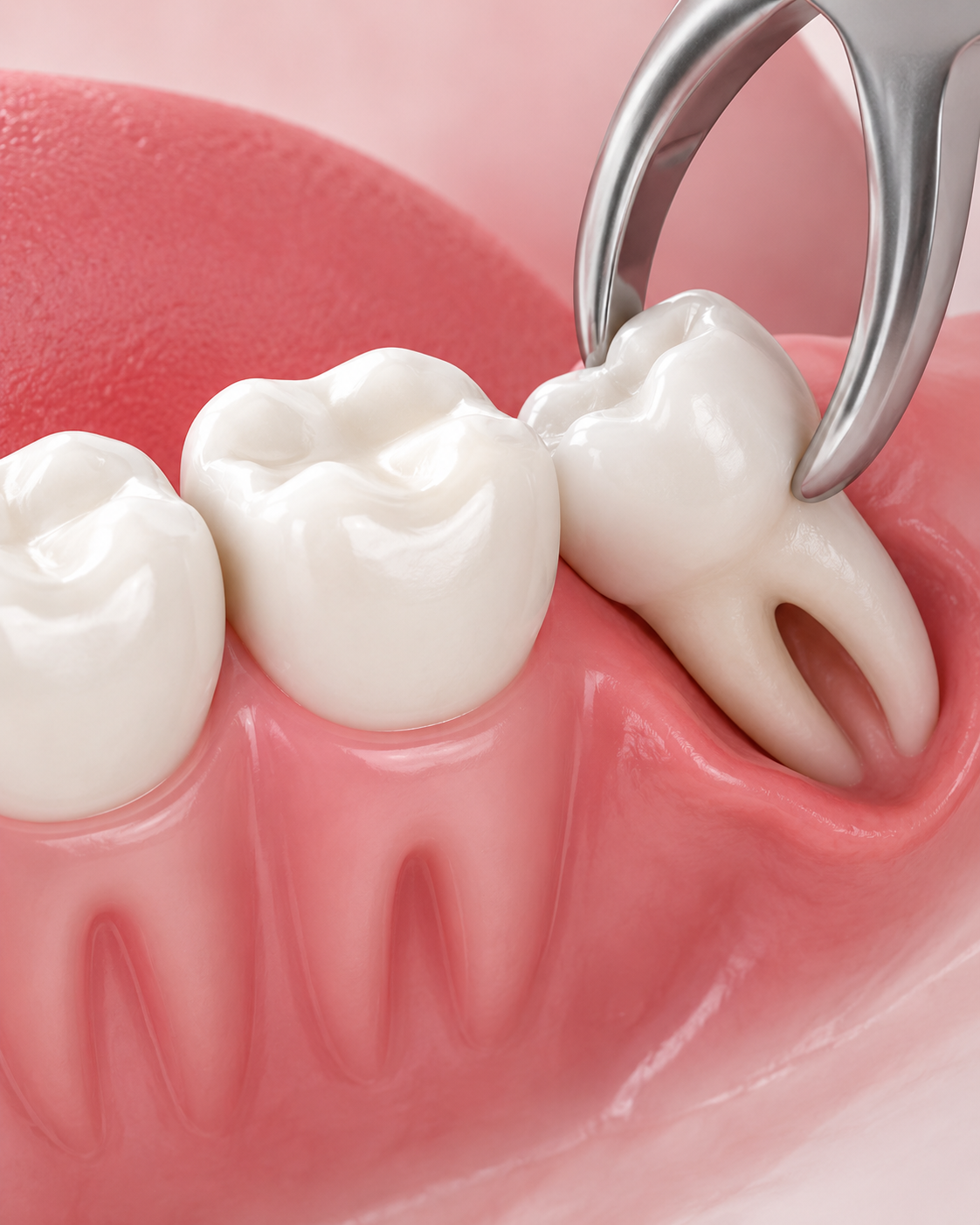
Wisdom teeth — third molars — erupt last, typically in the late teens and twenties, into whatever space the jaw has left over. In many modern jaws, that’s not enough: the tooth arrives angled, sideways, or stuck halfway under a flap of gum — impaction, in its several flavours. An impacted tooth isn’t inherently an emergency; it’s a tenancy question, and the answer depends entirely on how it’s behaving and where exactly it sits.
The behaviour worth knowing about is the half-erupted tooth’s speciality: pericoronitis — the gum flap over a partially emerged crown traps food and bacteria in a pocket nothing can clean, and flares into the swollen, aching, sometimes jaw-limiting infection that brings most twenty-somethings to this page mid-flare. Antibiotics and cleaning calm the episode; the flap’s architecture guarantees a sequel, which is why repeat pericoronitis is the classic one-way ticket to extraction.
And the anatomy that shapes everything for lower teeth: the inferior alveolar nerve runs through the jaw directly beneath (sometimes touching, occasionally wrapping) the wisdom tooth’s roots. It’s why “just pull it” is the wrong energy for lower thirds, why the ₩30,000 CT precedes every surgical plan here, and why technique choices — angles, sectioning the tooth, even deliberately staged approaches for high-risk roots — get made on the scan, not improvised in the socket.
Six wisdom teeth we meet weekly — and their honest verdicts.
The flare-up regular
Repeat pericoronitisSecond or third round of swollen gum over a half-erupted tooth — the flap’s architecture guarantees encores, and each flare is worse-timed than the last. We calm the current episode first, then schedule the extraction that retires the series.
The unreachable cavity
Decay where brushes don’t goA wisdom tooth angled at the back of the mouth decays in territory no brush honestly serves — and filling a tooth that can’t be cleaned just schedules the next cavity. Extraction is usually kinder economics than serial restoration of an unmaintainable molar.
The neighbour-damager
The expensive oneA sideways third molar pressing into the second molar’s roots — trapping food against it, decaying its back face, sometimes resorbing it. The wisdom tooth is expendable; the twelve-year molar in front is not, and protecting it is the whole verdict.
The deep sleeper
Fully impacted, silentCompletely buried, symptom-free, found on an X-ray taken for other reasons — the genuine judgement call. Many can be monitored honestly; some develop cysts around their crowns that argue for planned removal. The CT and periodic imaging make the call evidence, not anxiety.
The functioning citizen
The keeperFully erupted, upright, biting against a partner, reachable by a brush — this wisdom tooth is simply a fourth molar doing honest work, and removing it would be surgery in search of a justification. Verdict: keep, clean, monitor like any other tooth.
The pre-emptive question
“Should they all just come out?”The blanket-removal culture gets an honest answer here: prophylactic extraction of trouble-free teeth is a case-by-case debate, not a default — age, root development, position and access all weigh in, and younger patients’ unformed roots do extract more gently. You’ll get per-tooth verdicts with reasons, never a four-tooth package by reflex.
How extraction actually goes.
Image & judge
CT (₩30,000) maps the tooth, its roots and the nerve’s exact route — then each tooth gets its verdict on screen: remove, keep, or monitor, with the reasoning and the insured-schedule fee in writing.
Calm first, if flaring
Active pericoronitis gets settled — local cleaning, rinses, antibiotics where the spread warrants — because operating into an acute infection helps nobody. Surgery is scheduled into the calm window.
The extraction itself
Profound local anaesthesia, then technique chosen on the scan: simple delivery for erupted teeth; for impactions, a small gum access, often sectioning the tooth into pieces that exit gently rather than forcing one dramatic whole. Pressure and noise, not pain — and it’s usually faster than the dread predicted.
Close & brief
The socket is tidied, stitches placed where the access asks for them, gauze set, and you leave with the aftercare sheet in English, painkillers planned, and the do-not list that protects your clot — the whole recovery hinges on it.
Heal & check
Swelling peaks around day two-to-three and recedes; stitches come out or dissolve; the socket closes over weeks and fills beneath the surface for months — with a check visit to confirm the story is going to plan.
The verdict table — six situations, judged the way we judge them.
| The tooth’s situation | The usual verdict | The honest reasoning |
|---|---|---|
| Fully erupted, upright, cleanable, biting against a partner | Keep | It’s a working molar — surgery would be solving a problem it doesn’t have |
| Half-erupted with one pericoronitis flare | Judgement call | A first flare can be settled and watched — but the flap’s architecture means recurrence is the way to bet |
| Half-erupted with repeat infections | Remove | The anatomy guarantees sequels; extraction retires the series before one flares at the worst possible time |
| Decayed beyond a brush’s honest reach | Remove | Restoring an uncleanable tooth schedules the next cavity — kinder to end the cycle than to bill it |
| Pressing into or decaying the second molar | Remove, promptly | The tooth in front is the valuable one — every month of pressure is damage the wisdom tooth isn’t worth |
| Fully impacted, deep, symptom-free | Monitor — or planned removal | Judged on cyst signs, nerve proximity and age: watching is legitimate, and so is choosing surgery on your calendar instead of an emergency’s |
The pattern in the verdicts: wisdom teeth are removed for what they do, not for what they are — and the two “judgement call” rows are exactly where the ₩30,000 CT plus an honest conversation earn their keep. Four teeth can genuinely receive four different verdicts in one mouth; ours come with the reasoning attached.
Recovery, honestly mapped — and the clot that runs the whole show.
Extraction recovery has one protagonist: the blood clot that forms in the socket. Protect it and the story is boring; lose it and you meet dry socket. Here’s the real arc:
Clot formation — the do-not list era
Bite the gauze as instructed, then leave the socket alone: no straws, no smoking, no vigorous rinsing, no spitting, no tongue-prodding — every item on that list is a suction or disturbance that can pull the forming clot. Soft, cool food; sleep slightly propped; some oozing tinting your saliva is normal, a steady flow is a call-us.
The swelling summit
Cheek swelling and jaw stiffness peak around now — alarming if unexpected, textbook if expected, which is why we tell you in advance. Cold compresses in the first day, warmth after; painkillers on schedule rather than heroically late; and gentle salt-water rinses may begin, easing food debris out without pressure-washing the socket.
The one complication worth knowing by name
If the clot is lost, the socket’s bare bone announces itself around day three-to-five: pain that worsens after initially improving, often radiating to the ear, with a foul taste. It isn’t dangerous, but it is miserable and entirely treatable — a medicated dressing brings relief quickly. Smokers carry the highest risk, which is the single strongest argument for a genuinely smoke-free first days.
Surface closed, foundations filling
Stitches out or dissolved, eating back to normal, the gum sealing over — while beneath the surface the socket fills with new bone over the following months on its own quiet schedule. Travellers: build a buffer of several days between surgery and a flight, and fly when your dentist has cleared you rather than when the itinerary insists — we plan extractions around real calendars for exactly this reason.
How much does wisdom tooth extraction cost in Busan?
Extraction is an insured procedure following Korea’s national fee schedule, quoted precisely at your visit — the fee scales honestly with the tooth’s actual difficulty (an erupted upper is a smaller job than a horizontally impacted lower), and international patients without Korean insurance pay the non-covered rate, confirmed in writing before surgery. The published anchor is the CT at ₩30,000, which precedes every surgical plan for lower teeth. No number reaches you after the fact; that’s the site-wide rule and this page keeps it.
Does wisdom tooth removal hurt?
The surgery itself runs under profound local anaesthesia — you feel pressure, pushing and noise, not pain, and impacted teeth sectioned into pieces exit with less force than the dramatic single-piece extraction people imagine. The honest part is afterwards: the first days bring real soreness and swelling that scheduled painkillers manage well, peaking around day two-to-three and receding. Most patients’ verdict in hindsight: the dread was worse than the day, and the recovery was worse than the surgery — but milder than the internet promised.
Can I have all four wisdom teeth removed at once?
Sometimes, and sometimes it’s the wrong plan — honestly case-by-case. Arguments for one session: one anaesthesia, one recovery, one calendar hole. Arguments against: four sockets at once means eating and comfort take a real hit, and complex lower impactions each deserve unhurried surgical attention. Common middle path: one side at a time, two visits, so you always have a comfortable chewing side. Your CT, your teeth’s difficulty and your schedule set the plan — we’ll recommend with reasons, not with a package price’s logic.
What about the nerve? I’ve heard about numbness after extraction.
The honest anatomy: lower wisdom tooth roots can sit close to the inferior alveolar nerve, and disturbance during extraction can cause altered feeling in the lip and chin — usually temporary when it occurs, rarely persistent. This risk is exactly why the ₩30,000 CT isn’t optional here: it shows the nerve’s true relationship to your roots in three dimensions, letting technique — sectioning, angle, even a deliberately staged approach for high-risk roots — be chosen to keep distance. You’ll see your own scan and your own risk level before deciding anything.
What can I eat after extraction, and when is coffee back?
First day: cool and soft — yoghurt, smoothies eaten with a spoon (no straws, ever, in the first days), lukewarm soups, soft rice. Days after: warm soft foods graduating toward normal as comfort allows, chewing on the other side, and nothing seedy or crumbly that loves sockets. Hot coffee waits until the anaesthesia is fully gone and ideally a day beyond — heat encourages oozing — and alcohol and smoking wait longest of all, the latter being dry socket’s best friend. Busan’s porridge culture, it turns out, is excellent extraction cuisine.
My wisdom tooth doesn’t hurt — why is my dentist suggesting removal?
Because the expensive problems on this page are mostly quiet ones: decay in unreachable territory doesn’t hurt until it’s deep, pressure resorbing the second molar’s root is silent for years, and a cyst around an impacted crown grows without a single symptom. “Doesn’t hurt” and “isn’t causing damage” are different claims — the imaging tells them apart. That said, the recommendation should come with visible evidence and reasoning; if you’ve been told “they all must go” without either, our second-opinion CT is ₩30,000 and our verdicts come per tooth, with the scan on screen.
Care by board-certified specialists in Seomyeon
Both directors are board-certified specialists in Advanced General Dentistry, so your cosmetic treatment is planned with your overall dental health in mind.

- Board-certified specialist, Advanced General Dentistry
- M.S. in Orthodontics, Kyungpook National University
- Focus on natural, alignment-led smile improvement
- Conservative, tooth-preserving approach

- Board-certified specialist, Advanced General Dentistry
- DDS, Dankook University College of Dentistry
- Restorative & aesthetic resin filling work
- Focus: natural, durable results
Small truths about wisdom teeth.
- The do-not list outranks the painkillers. No straws, no smoking, no spitting, no vigorous rinsing in the first days — clot protection is the entire difference between a boring recovery and a dry-socket week. Print the list; obey the list.
- Book extractions early in a trip, not late. Give the swelling summit and the dry-socket window room before any flight — and fly when cleared by your dentist, not when the itinerary insists. We schedule around real calendars; tell us yours honestly.
- A first pericoronitis flare is a scheduling opportunity. The infection calms with treatment, but the gum flap that caused it remains — extract in the calm window on your chosen date, or wait for the sequel to choose one for you.
- Younger roots extract more gently. Wisdom teeth removed before roots fully form (typically late teens to mid-twenties) come out easier with faster healing — not an argument for reflexive removal, but a real input when a borderline tooth is being judged.
- Numbness that doesn’t fade with the anaesthesia is a message-us item. Hours of lingering lip or chin numbness after a lower extraction deserves prompt reporting — early assessment matters, and we’d always rather hear about it than have you wait politely.
When we’ll recommend removal — and when we’ll defend the tooth.
Removal is the honest call when…
- pericoronitis keeps returning — the flap’s architecture has voted, repeatedly
- decay sits where no brush will ever reach — restoration would just schedule the sequel
- the second molar is paying for its neighbour’s position — the valuable tooth wins
- a deep impaction shows cyst change on imaging — planned surgery beats emergency surgery
We’ll defend the tooth when…
- it’s erupted, functional and cleanable — a working molar doesn’t owe anyone a surgery
- “remove all four” is proposed without per-tooth evidence — verdicts here come one tooth at a time, scan on screen
- a silent deep impaction can be honestly monitored — watching with periodic imaging is a legitimate plan, not procrastination
- an acute infection is flaring — we calm it first and operate into a quiet field; urgency doesn’t improve surgery
Wisdom tooth FAQ.
Signals worth checking: pressure or dull ache at the back of the jaw, a gum flap you can feel with your tongue over a partially visible tooth, food trapping and soreness behind the last molar, recurring swelling on one side, or jaw stiffness when opening wide. But plenty of impactions produce nothing at all — the definitive answer is imaging, where the tooth's angle, depth and relationship to its neighbour and the nerve become visible facts rather than guesses. One panoramic view or CT settles what months of tongue-prodding can't.
The surgery itself commonly runs shorter than the anaesthesia and paperwork around it — simple erupted teeth exit in minutes, and even surgical impactions with sectioning are typically measured in tens of minutes per tooth rather than hours. What deserves the real planning is the recovery arc: the swelling summit around day two-to-three and the dry-socket window through day five. Book the appointment for the surgery; book the following days for yourself.
Elective extractions are generally deferred until after pregnancy — but an acute infection changes the maths, because untreated spreading infection is its own risk to carry. The practical approach: active pericoronitis gets settled conservatively (cleaning, safe antibiotics where warranted), genuinely necessary treatment is timed for the second trimester when possible, and everything is coordinated openly with your obstetric care. Tell us your stage in the first message and the plan gets built around it.
Dry socket is what happens when the protective blood clot is lost from the socket, exposing bare bone — announcing itself around day three-to-five as pain that worsens after initially improving, often radiating toward the ear. Avoidance is mostly clot protection: no straws, smoking, spitting or vigorous rinsing in the first days, and gentle salt-water rinses only when instructed. If it happens anyway, it's promptly treatable — a medicated dressing brings relief quickly — so escalating pain is a message-us-today item, not an endurance test.
Honest answer from the evidence: the old story that wisdom teeth push the front teeth crooked doesn't hold up well — crowding develops with age even in mouths that never had wisdom teeth, and studies haven't shown removal prevents it. So no, we don't recommend extraction as crowding insurance. If alignment is the actual goal, that's an orthodontic conversation — and if a wisdom tooth needs removal, it should be for the reasons on this page, each of which can be shown to you on a scan.
Yes, with honest calendar planning: the surgery fits almost any trip, but the recovery arc wants room — schedule extraction early in your stay, keep several buffer days before flying, and fly when cleared rather than when booked. Start on WhatsApp with your dates and symptoms; if the CT (₩30,000) shows a complex case that deserves more recovery time than your trip allows, we'll say so honestly and either stage the plan or stabilise you for treatment at home. An acute flare, meanwhile, gets calmed promptly regardless of your itinerary — pain relief doesn't wait for perfect scheduling.
Extraction around a real itinerary.
Describe the tooth and your dates on WhatsApp — flaring, aching, or a “been told to remove them” second opinion. You’ll get an honest read on what your trip can hold.
CT (₩30,000), per-tooth verdicts on screen, the insured-schedule fee in writing — and surgery scheduled early in your stay so recovery gets its room.
Extraction under local anaesthesia, the aftercare sheet in English, and the do-not list that runs the recovery — with WhatsApp check-ins through the swelling summit.
A check before departure confirms the socket’s story is on plan — and your records travel home in English, including the scan, for whoever sees you next.
One scan, honest verdicts — tooth by tooth.
Message us on WhatsApp — a flaring tooth, a quiet worry, or a second opinion on “remove all four.” You’ll get the CT-backed verdict per tooth, the reasoning on screen, and the fee in writing. In English.
Message us on WhatsAppBaro Dental Clinic · 5F, SJ Medical Building, 698-1 Jungang-daero, Busanjin-gu · Seomyeon Station Exit 2, 4 min
Explore the options in Busan.
Gum Disease Treatment in Busan
When gum trouble isn’t a wisdom tooth’s flap but the wider foundation.
Explore →Cavity & Fillings
From ₩50,000 — for the reachable teeth the wisdom tooth was endangering.
Explore →Scaling & Check-up
₩60,000 — where quiet wisdom teeth get monitored honestly.
Explore →Crowns & Bridges
Rescuing the second molar a sideways neighbour damaged.
Explore →Medical information on this page is provided for general education and does not replace an individual examination and diagnosis. Whether a wisdom tooth needs removal, monitoring or no action — including nerve-proximity assessment and the insured-schedule fee — is confirmed at an in-person consultation with CT imaging where indicated. Individual results and recovery vary.