You broke a tooth in Busan. Here’s what to do now.
First: most broken teeth are far more fixable than they feel in the mirror. What matters in the next hour depends entirely on what broke — a chipped corner, a lost filling, a cracked-off cusp, or the knocked-out tooth whose clock genuinely runs in minutes. The triage, the do-and-don’t list, and exactly how same-day help works at Seomyeon.
By Baro Dental Clinic, Seomyeon · August 2026 · 13 min read
The honest triage: a chipped corner or lost filling is urgent to your peace of mind but patient in reality — cover sharp edges, avoid that side, book promptly; a broken-off cusp or a tooth cracked to the point of pain wants same-day or next-day care; and a tooth knocked out entirely runs on a genuine clock — handled by the crown, kept moist (milk is the classic), reimplanted best within the hour. Every rung of the repair ladder is priced in daylight here — resin from ₩50,000, the ₩100,000 temporary crown that stabilises trip schedules, crowns from ₩450,000, and the insured-schedule root-treatment chapter where the break reached the nerve. Message the thread with a photo first: the sorting takes minutes and beats an evening of worrying every time.
What people with a just-broken tooth actually ask
- A corner chipped off — is this an emergency or can it wait until Monday?
- My filling fell out and the hole feels enormous — what do I do tonight?
- Half my molar broke off eating — why doesn’t it even hurt?
- A tooth got knocked out completely — can it actually be saved?
- I’m mid-trip — can this be fixed before my flight?
The triage — what broke decides what happens next in Busan
The chipped corner: a flake of enamel off an edge — alarming in the mirror and on the tongue, structurally minor in most cases. If it doesn’t hurt beyond a rough edge and mild temperature awareness, it’s a prompt-appointment case, not a tonight case: resin repair from ₩50,000 typically rebuilds the corner in one visit. The lost filling or crown: the crater feels enormous to the tongue and usually isn’t an emergency either — the exposed dentin may be temperature-sensitive, the walls are more vulnerable, so avoid chewing there and book within days; a dislodged crown that’s intact is worth keeping and bringing (recementing an undamaged crown is sometimes possible, honestly assessed on the spot).
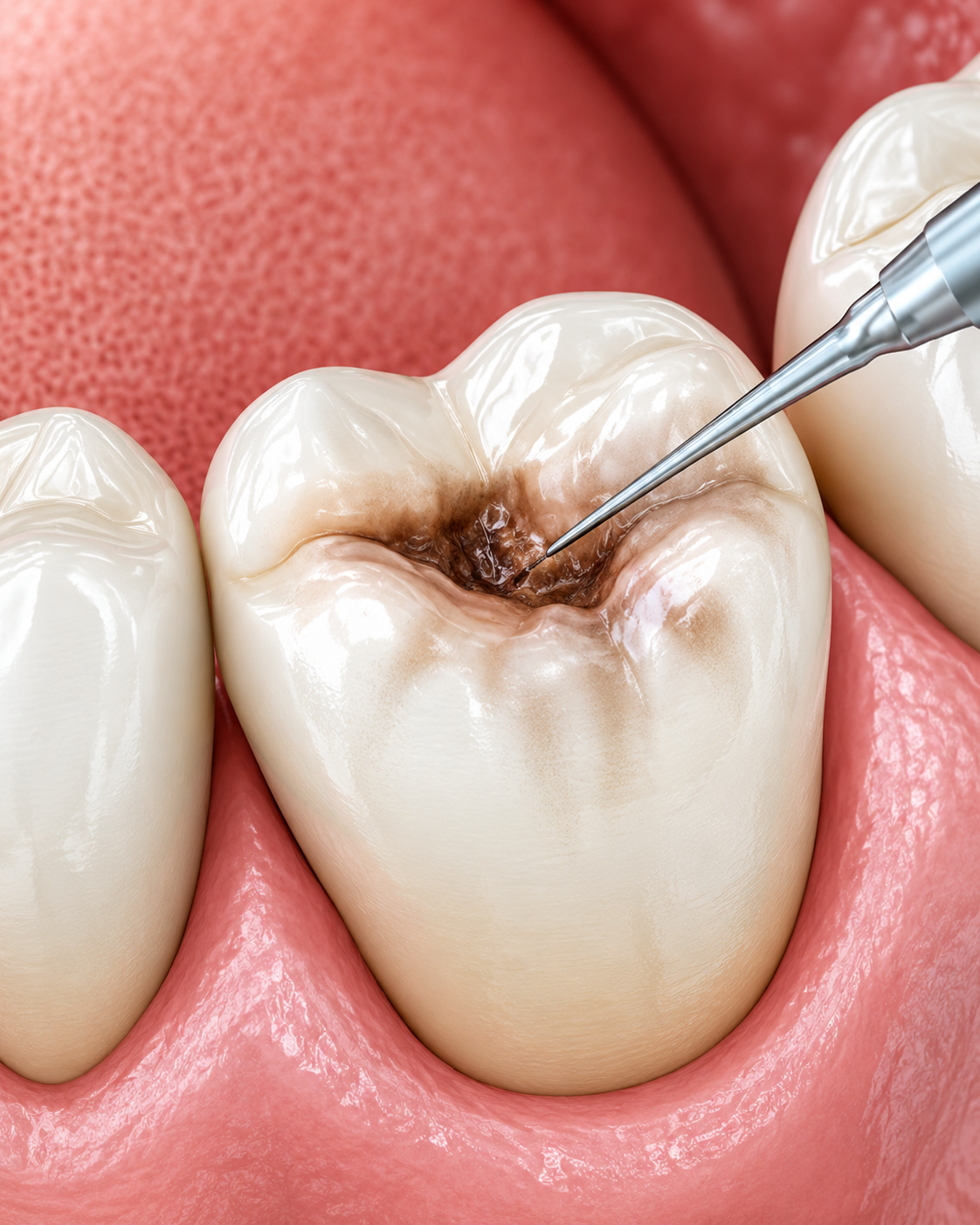
The broken cusp: a working corner of a molar shears off — classically while eating, classically from a tooth carrying a large old filling — and often with surprisingly little pain, because the fracture ran through enamel and dentin without reaching the nerve. Silent doesn’t mean patient here: the remaining walls are now overloaded and the exposed core is open to everything, so this rung wants same-day or next-day attention — typically stabilised immediately and routed up the ladder(onlay or crown territory, ₩250,000–450,000-plus, per what remains).
The crack with pain: the tooth looks whole but bites with a sharp zing or aches after — the sensitivity guide’s crack signature, upgraded to urgent when pain lingers or throbs (the nerve involvement pattern). Same-day message, honest assessment: splintable cracks graduate to crowns; nerve-reached cracks open the save-or-pull conversation with everything priced before anything proceeds. And the knocked-out tooth — the true emergency — gets its own section below, because its clock is real and its first-aid actually changes outcomes.
The rule that sorts every case in this list: send the photo first. A clear picture of the break plus one sentence — when, how, does it hurt, lingering or brief — lets the thread sort tonight-versus-tomorrow-versus-book-normally in minutes, at whatever hour the crab shell or the pavement did its work. Half the service of an emergency line is telling you honestly when something isn’t an emergency; that answer is free and it saves whole evenings.
The first hour — the do and don’t list
Do: find and keep any broken fragment in a clean container with a splash of milk or saline — larger fragments can occasionally be reattached with modern adhesion, and even when they can’t, the piece helps the repair’s shape-matching. Rinse gently with warm water; cold water on exposed dentin is its own punishment. Cover a sharp edge tormenting your tongue with sugar-free chewing gum or pharmacy dental wax — the classic traveller’s stopgap, sold at any Korean pharmacy (약국). Take ordinary analgesics that agree with you if it aches.
Don’t: don’t chew on that side — the walls that survived the break are carrying more than they were built for; don’t apply aspirin to the gum (the folk remedy chemically burns tissue and treats nothing); don’t superglue anything — fragments, crowns, or hope — because household adhesives are not tissue-safe and complicate the real repair; and don’t test the break repeatedly with your tongue or by biting “to check” — the urge is universal and the habit measurably worsens cracks.
The lost-crown special case: an intact crown that came off cleanly can often be temporarily reseated at a pharmacy’s temporary dental cement tier if you’re days from an appointment — never glue, and never force a crown that doesn’t seat easily — but the better version in Busan is simply coming in: recementing or a ₩100,000 temporary crown stabilises the tooth properly the same day, per the trip-rescue pattern the same-day guide prices.
And the pain-tier honesty: throbbing that builds, heat sensitivity that lingers, or swelling arriving alongside a break means the nerve chapter has opened — the message moves from “book me promptly” to “today, please,” and the pain guide’s triage applies in full. Breaks that hurt more each hour are telling you their direction; believe them early.
The knocked-out tooth — the one true clock
Complete avulsion — a permanent tooth out of its socket, root and all — is the single dental emergency where minutes genuinely change outcomes, so this section is a protocol, not an essay. One: handle it by the crown only — the white chewing part — never the root, whose living surface cells are the entire prognosis. Two: if dirty, rinse briefly and gently in milk or saline (seconds, not scrubbing — never soap, never wiping, never letting it dry). Three: reimplant it if you possibly can — back into its socket, right way round, held with gentle bite pressure on gauze or cloth — because the tooth’s own socket is the best transport medium on earth.
Four: if reimplanting isn’t possible — the person can’t tolerate it, the socket is damaged, it’s a chaotic scene — keep the tooth moist: milk is the classic and widely available; saline works; holding it inside the cheek works for a calm adult. Plain water is worse than milk but better than air; dry is the enemy — the root’s cells begin dying within minutes of drying, and their survival is what decides whether the reimplanted tooth reattaches. Five: move — the honest windows are best within thirty to sixty minutes, with outcomes declining steeply after; message the thread while travelling , not before leaving.
The honest expectations, so the protocol motivates without overpromising: a swiftly and correctly handled avulsed tooth reimplants with genuinely good prospects — typically splinted to its neighbours for stabilisation, usually needing root treatment in the following weeks (the nerve rarely survives even when the attachment does), and monitored over months. A tooth that spent an hour dry has honest but much slimmer odds — still often worth attempting, decided case-by-case on arrival. Baby teeth are the protocol’s one exception: never reimplanted(it risks the adult tooth developing beneath) — a knocked-out baby tooth is a see-the-dentist-soon case, not a race.
And the context where this protocol most often runs — sports, falls, bicycle weekends: the break rarely travels alone. Lips, gums and sometimes the jaw took the same hit; bleeding gums and cut lips look dramatic and usually settle with pressure; but a bite that suddenly doesn’t meet properly, or jaw pain on opening, belongs in the same urgent visit — say so in the message, because it changes what gets examined first.
Broke it an hour ago and still staring at the mirror? Send the photo now — the honest sorting (tonight, today, or book-normally) comes back in minutes, free. Message us on WhatsApp →
The triage, in one honest table
Every break, its urgency, and its honest repair rung:
| What broke | Real urgency | The honest repair rung |
|---|---|---|
| Chipped corner / flake | Prompt appointment — cover sharp edges meanwhile | Resin from ₩50,000 , same visit, shaped to disappear |
| Lost filling / dislodged crown | Days, not hours — avoid that side; keep the crown | Refill or recement; ₩100,000 temporary crown where needed |
| Broken-off cusp | Same-day / next-day — even without pain | Onlay-to-crown territory (₩250,000–450,000+), stabilised immediately |
| Crack with lingering pain | Today — the nerve pattern | Crown to splint, or the insured-schedule root chapter first |
| Knocked-out permanent tooth | Minutes — the one true clock | Reimplant · splint · root treatment in following weeks |
| Any break + swelling / can’t swallow | Hospital ED first, honestly | Definitive dental repair after the emergency is controlled |
Clinic hours: Mon/Fri 10:30–19:00 · Tue/Thu to 21:00 · Sat to 15:00 · weekday lunch 14:00–15:30 · closed Wed/Sun/holidays. This clinic does not provide 24-hour service; after-hours messages are triaged at opening.
The repair ladder — what each break costs to fix
The ladder, priced in daylight per the restoration guides: chips and small breaks → resin from ₩50,000, same-visit, shaped and polished to disappear; bigger losses with sound walls → the ₩250,000-event inlay/onlay rung , lab-made over two visits; broken cusps and structural fractures → crown territory, ₩450,000-plus, with the ₩100,000 temporary crown as the honest stabiliser that buys time or bridges a flight; nerve-reached breaks → the insured-schedule root-treatment chapter first, then the ladder resumes above it; and the unrestorable break — split roots, breaks below rebuildable levels — opens the save-or-pull fork with both futures priced in writing.
The honest sorting note that surprises people at the chair: the break’s drama and its bill correlate poorly. A spectacular-looking chip is often a same-visit resin afternoon (from ₩50,000); a hairline crack that photographs as nothing can be the expensive file. What actually prices the repair is what the ₩60,000 examination reads — how much sound structure remains, whether the nerve is involved, whether the fracture line stops where it can be splinted — which is why the written figure follows the imaging, never the mirror.
The traveller’s calendar, mapped by rung: resin repairs are same-day tier by definition — a broken corner does not have to change a single itinerary item beyond one appointment; inlay and crown rungs run the lab rhythm (impression early, fitting before the flight) with the temporary crown covering any gap; and nerve-chapter breaks want the honest multi-visit conversation against your dates — sometimes fully treatable in-trip, sometimes staged with the stabilisation here and the finish at home, decided in the thread with your ticket on the table.
And the insurance grammar, once, for completeness: repairs and crowns are published tier-two lines; root treatment and extractions are insured-schedule, written at the visit — the two-tier system this series documents, applied to the day you least feel like reading pricing pages. Everything arrives written before anything proceeds; broken teeth don’t suspend house rules.
Same-day access at Seomyeon — and your next step
How access actually works: message the thread first, with the photo — wa.me/821039399980 — and the honest sorting comes back fast: come now, come today, or book normally with the edge-covering stopgap until then. Same-day slots exist for genuine urgencies within clinic hours — Mon/Fri 10:30–19:00, Tue/Thu to 21:00, Sat 10:30–15:00 (weekday lunch 14:00–15:30; closed Wed/Sun/holidays) — and this clinic does not provide 24-hour service, stated plainly: a middle-of-the-night message gets triaged at opening, and a true after-hours emergency (uncontrolled bleeding, facial swelling affecting breathing or swallowing, jaw trauma) belongs at a hospital emergency department first, honestly said.
What the first visit does, concretely: the ₩40,000 examination and imaging reads the break’s real depth — the mirror’s verdict and the X-ray’s frequently differ in both directions — immediate needs get handled in the same sitting (sharp edges smoothed, exposed dentin sealed, the temporary crown placed, the flaring nerve settled), and the definitive plan leaves in writing: the rung, the figure, the visit count, mapped against your dates where flights are involved.
The follow-through layer breaks specifically need: repaired teeth get the honest watch-list — a deep break can involve the nerve later even when day-one testing was calm, so “here’s what would tell you the nerve chapter opened” goes home with every deep-break repair, and the thread stays open for exactly those messages. Per the records guide, imaging and repair documentation travel home with visitors — the continuity file for whoever sees the tooth next.
One message starts it — ideally with the photo already attached: what broke, when, does it hurt and how (brief or lingering), your dates if you’re mid-trip. Back comes the sorting in minutes: the true clock, the today case, or the genuinely-patient repair booked at your convenience. Most broken teeth end as good stories — fixed, invisible, forgotten; the service is getting yours onto that path tonight instead of after a weekend of worrying.
- What broke decides everything: chips are patient, cusps want same-day, lingering pain means today, avulsion runs on minutes.
- The knocked-out protocol: crown-only handling · brief gentle rinse · reimplant or milk · move within the hour.
- Silent isn’t patient for a broken cusp: the surviving walls are overloaded and the core is open — stabilise now.
- Drama and bill correlate poorly: spectacular chips are often resin afternoons from ₩50,000; hairline cracks can be the expensive file.
- Photo first, always: half an emergency line’s value is honestly telling you when it isn’t one.
The dentists behind every guide on this site


FAQ
Almost never — a chip that doesn't hurt beyond a rough edge and mild temperature awareness is a prompt-appointment case: cover the sharp edge with sugar-free gum or pharmacy dental wax, avoid biting hard things with it, and book within days. The repair is typically single-visit resin from ₩50,000, shaped and polished to disappear. Send the photo anyway — the two-minute confirmation that yours is the patient kind beats an evening of wondering.
Tonight: nothing dramatic — rinse gently with warm water, keep food out of the crater as best you can, avoid chewing on that side, and take an ordinary analgesic if it's temperature-sensitive. The hole always feels bigger to the tongue than it is. Book within days: the refill runs from ₩50,000, or the honest escalation conversation happens if the filling's departure revealed a bigger story — which is exactly what the ₩60,000 imaging reads.
It's the trickiest rung precisely because it doesn't hurt: the fracture missed the nerve (hence the silence), but the walls that survived are now overloaded and the tooth's core is open — this is a same-day or next-day case despite the comfort. Keep the fragment in milk, chew elsewhere, and message with a photo today: stabilisation is quick, and the definitive rung (onlay or crown, per what remains) gets priced in writing off the imaging.
Genuinely yes, if the protocol runs fast: handle by the crown only, rinse briefly in milk or saline if dirty (never scrub, never dry), reimplant into the socket if at all possible and hold with gentle bite pressure — or transport in milk — and move within thirty to sixty minutes, messaging the thread on the way. Swift, correct handling gives good reattachment prospects (splinting, then root treatment in the following weeks). One exception: never reimplant a baby tooth — that's a soon-appointment, not a race.
Usually, honestly mapped by rung: resin repairs are same-day; the ₩100,000 temporary crown stabilises crown-territory breaks for the flight with the definitive crown at home or next trip; and even the nerve chapter can often be settled — pain ended, tooth sealed — inside three days, with the honest staging conversation where it can't. Send the photo and your exact flight time in the first message; the plan gets built against your ticket, including the plain "this is fine to fly on" when that's true.
Resin Repairs in Busan
The from-₩50,000 same-visit rung where most chips end.
Crowns in Busan
The splinting rung for cusps and cracks — ₩450,000+.
Root Canal in Busan
The chapter a deep break sometimes opens — insured-schedule.
Published Prices
Every rung of the ladder, on the living list.
Toothache mid-trip: handling dental pain in Korea
Related guide in this series.
What a Busan dentist can genuinely do in one day
Related guide in this series.
Why your teeth are sensitive, and what actually helps
Related guide in this series.
Most broken teeth end as good stories. Get yours onto that path tonight.
Photo to the thread, one sentence on when and whether it hurts — the honest sorting comes back in minutes, the ₩60,000 imaging reads the real depth, and every rung arrives priced in writing.
Medical information in this guide is provided for general education and does not replace an individual examination and diagnosis. Prices shown are current at the time of writing; insured-schedule items follow Korea's national fee schedule and are quoted in writing at your visit. This clinic does not provide 24-hour service. Individual results vary.