An English-speaking dentist in Busan — because dentistry you don’t understand isn’t fully dentistry.
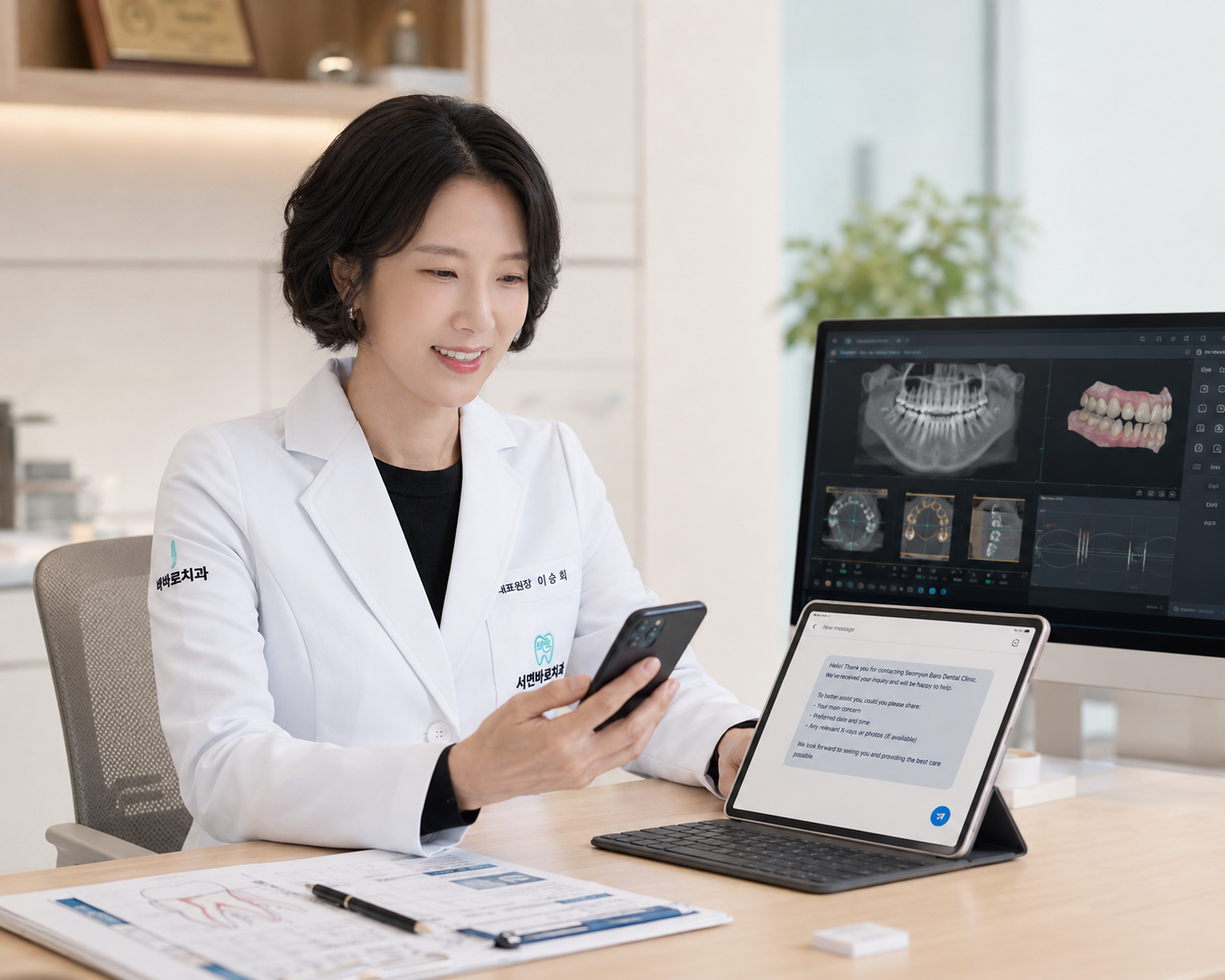
Language in a dental chair isn’t hospitality — it’s a clinical safety system: your symptoms describe the diagnosis, your consent requires comprehension, and your aftercare depends on instructions you actually understood. At Baro Dental, the entire chain runs in English — WhatsApp triage, chairside explanation on screen, written prices, and records that travel home with you.
Start the conversation.
Tap what fits — we’ll open WhatsApp with your message ready to send.Nothing sends until you press send in WhatsApp. A photo and any X-rays help us give an honest tier read — Straumann-warranted, or KS-sufficient.
Is there a foreigner-friendly, English-speaking dentist in Busan — and how does it actually work?
Yes — Baro Dental Clinic in Seomyeon runs its entire patient journey in English: you book and describe your problem on WhatsApp (wa.me/821039399980), the examination findings are shown to you on screen and explained in English, every price is published in KRW or quoted in writing before treatment, consent happens in a language you actually speak, and you leave with English aftercare instructions and English records. Four minutes from Seomyeon Station Exit 2 — the most reachable interchange in the city.
The framing worth keeping: “English-speaking” isn’t a comfort feature — it’s a clinical one. A diagnosis built on symptoms you couldn’t describe, consent to a procedure you didn’t understand, or aftercare instructions you nodded through are quality problems, not etiquette problems. The easiest first test costs ₩60,000: book a scaling and check-up, experience the whole chain once, and decide about anything bigger afterwards — no treatment plan required to walk in.
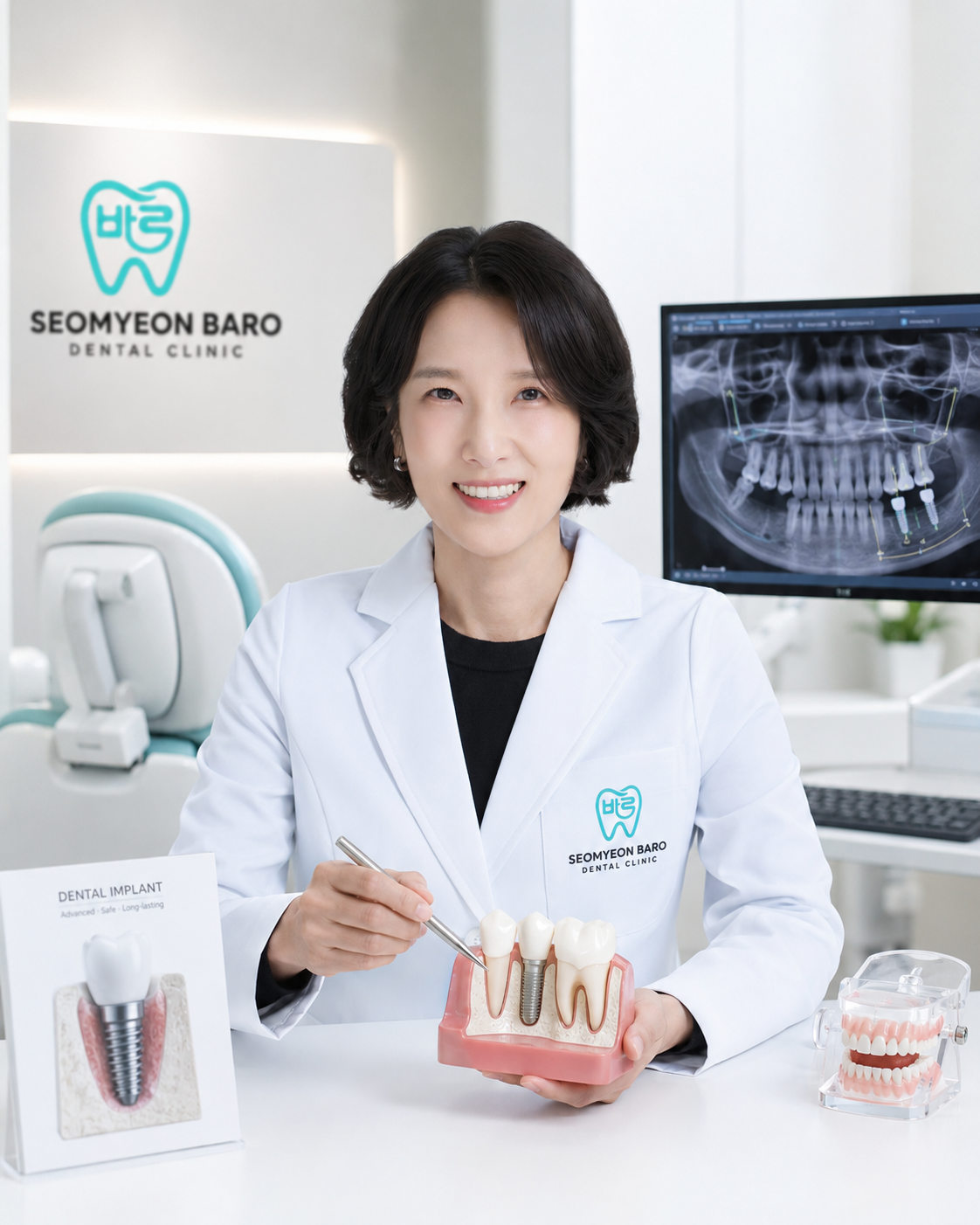
Not a translated menu — an English-native process.
Plenty of clinics can manage “hello” and a price list run through a translation app. The difference this page describes is structural: the process itself was built for international patients, not adapted for them afterwards. Booking happens on WhatsApp because that’s what visitors actually have; explanations happen on screen — your own photos, X-rays and CT slices — because images cross language barriers that words limp over; prices are published on this site in KRW because “how much will this cost” shouldn’t require negotiation skills in any language.
Honesty about the language itself: our working clinical English is strong, and we don’t pretend to be a London practice. What we commit to is comprehension in both directions — you understanding your diagnosis, options, prices and aftercare completely, and us understanding your symptoms, history and concerns completely — using plain English, screen-side visuals, written summaries, and the patience to repeat things until they’re actually clear. For patients whose English is also a second language (a large share of our international visitors), that plain-English, image-heavy style usually works better than native-speed fluency would.
And the part no translation app fixes: the paperwork. Aftercare sheets, treatment records, receipts and insurance documentation all leave this clinic in English — readable by your insurer, your dentist at home, and future-you six months later trying to remember what was done to which tooth.
Six kinds of international patients — and how the clinic fits each.
The Busan expat
Looking for a regular dentistTeachers, engineers, port and plant professionals who live here and want what they had at home: a dentist they can talk to, on a recall schedule, with no interpreter logistics. The ₩60,000 check-up is the natural first appointment; the relationship is the product.
The mid-trip tourist
Something came upA filling that surrendered to dakgalbi, a toothache that boarded the flight with you — trip problems need same-trip answers in a language you have. Triage on WhatsApp, evening slots Tuesday and Thursday, and our emergency page for the urgent end.
The planned dental traveller
Came for the dentistryHere deliberately — implants, aligners, a crown plan — because Korean clinical standards travel well and published KRW prices compare honestly. Plans get staged around flights from the first message, with the multi-visit truth told up front.
The student & working-holiday crowd
Budget-aware, insurance-curiousUniversity students and working-holiday visitors on real budgets: published prices mean no surprises, the insured-schedule items are explained honestly (including what your enrolment status changes), and the ₩60,000 entry visit fits student economics.
The some-Korean-but-not- dental -Korean case
A real and common oneDaily-life Korean that handles restaurants fine but wilts at “치수염” — medical vocabulary is its own language, and consenting to surgery in it is a different stake than ordering lunch. Here you can run the appointment in English and keep your Korean for the celebratory meal after.
The non-native English speaker
English as the bridge languageRussian, Vietnamese, Filipino, European patients using English as their second language too — a large share of our international visitors. Plain-English explanations, screen-side images and written summaries are built for exactly this: comprehension is the goal, eloquence is nobody’s requirement.
Your first visit, start to finish.
Message in English
WhatsApp wa.me/821039399980 — what you need, your dates if visiting, a photo if something hurts. Booking, triage and honest pre-answers happen right there.
Find us without stress
Seomyeon Station Exit 2, four minutes on foot — 5F, SJ Medical Building. For any taxi: 부산진구 중앙대로 698-1, SJ메디컬빌딩 5층. Show the screen; done.
Be examined, see everything
The examination’s findings go on screen — your photos, X-rays, CT where indicated (₩30,000) — and get explained in plain English until they’re actually clear. Questions are the point, not an interruption.
Decide with written numbers
Options with published or written prices, honest trade-offs included — and zero pressure to decide in the chair. Taking the plan home to think is a respected choice here, not a negotiation tactic.
Leave with paper that works
English aftercare instructions, English records, receipts your insurer can read — and WhatsApp for every follow-up question, from “is this normal?” to rebooking from another country.
Where English actually works here — the six touchpoints that matter.
| Touchpoint | How it runs in English | Why it matters clinically |
|---|---|---|
| Booking & triage | WhatsApp in English — questions answered before you commit to anything | Wrong-clinic visits and miscommunicated urgency get filtered out before a single taxi |
| Symptom-taking | Your description, in your words, with follow-up questions until it’s precise | “Sharp when biting” and “throbbing at night” point to different diagnoses — nuance is data |
| Diagnosis & options | Findings on screen — photos, X-rays, CT — explained in plain English with honest trade-offs | You can’t weigh options you only half-understood; images make the explanation verifiable |
| Consent & prices | What, why, alternatives, risks and the written KRW figure — before treatment, always | Consent without comprehension isn’t consent — and a price you didn’t understand isn’t published |
| Aftercare | Instructions in English, written — plus WhatsApp for the “is this normal?” moments after | Most preventable complications are aftercare misunderstandings wearing a disguise |
| Records & insurance | Treatment records, receipts and documentation issued in English | Your insurer, your home dentist and future-you all need to read what happened here |
The table’s honest point: “English OK” on a signboard covers row one at best. The clinical value lives in rows two through six — and a clinic’s real language capability is tested not at booking, but at the moment something needs explaining carefully. Test us at any row.
Four places language quietly becomes a clinical risk.
Why we treat English as a safety system rather than a service perk — four moments where a language gap stops being awkward and starts being medical:
The symptom that lost its adjective
Diagnosis begins with your description — and the difference between “sharp only when biting,” “throbbing that wakes me,” and “sensitive to cold for a moment” is the difference between a cracked filling, an inflamed nerve, and simple sensitivity. Squeeze that through a language gap and it flattens to “tooth hurt” — three diagnoses collapsed into one guess. Precision in, precision out.
The consent that was really just a nod
Lying back for a procedure you understood only as “fix tooth” is something no patient should accept — what’s being done, why, what the alternatives were, what it costs, and what could go wrong are the minimum contents of real consent. Screen-side images plus plain English exist here so that your yes means something; a nod produced by social pressure and vocabulary fatigue is not a yes.
The number that changed shape
Money misunderstandings are the classic cross-border medical horror story — a figure heard as total that was per-tooth, an “about” that hardened into an invoice. Our answer is structural, not linguistic: prices are published on this site in KRW, and anything not published is written down before treatment. A number on paper survives any accent; that’s the whole design.
The aftercare that evaporated at the door
Post-treatment instructions half-understood are complications on a timer — the extraction patient who rinsed vigorously because “rinse” was the only word that landed, the implant patient who chewed on the wrong side’s wrong week. Ours leave in writing, in English, with WhatsApp open for the “wait, is this normal?” message at 9 PM — which we’d far rather answer than treat the consequence of.
Do the dentists themselves speak English, or just the front desk?
The clinical explanation is the dentist’s job here, not delegated to a receptionist’s paraphrase — Dr. Lee Seung-hee and Dr. Lee Do-hoon explain findings, options and procedures in English, at the chair, with your images on screen. Honest framing rather than marketing: it’s clear, working clinical English backed by visuals and written summaries, not a claim to native-speaker theatre — and the standard we hold is comprehension, verified by your questions, not fluency performed at you.
How do prices work for foreigners — do I pay more than Koreans?
The structure, honestly: non-covered treatments — most of this site — cost the same published KRW figure for everyone, Korean or foreign (an implant at ₩800,000 is ₩800,000 for any passport). Insured-schedule items (root canal work, extractions, gum treatment) follow Korea’s national fee schedule; patients without Korean national insurance pay the non-covered rate for those, quoted in writing before treatment. No foreigner surcharge, no negotiation theatre — the price list is the price list.
Can you provide documents for my travel or dental insurance claim?
Yes — treatment records, itemised receipts and the documentation insurers typically request are issued in English as standard practice, not as a special favour. Two honest notes from experience: check your policy’s dental clause before treatment (coverage for elective work varies wildly, while emergency relief is commonly covered), and tell us at the visit that a claim is coming — paperwork written with your insurer in mind the first time beats retrofitted paperwork every time.
I don’t live in Busan — can treatment work around flights and trips?
It’s half our practice: plans are staged around real itineraries from the first WhatsApp message — what fits this trip, what waits for the next, what your home dentist can handle between visits. The honest corollary you’ll hear when it’s true: some treatments ( implants with healing phases, aligner journeys) genuinely need multiple visits, and anyone promising them inside one week is selling you a compromise. We’d rather map two honest trips than one heroic failure.
What should my very first visit be if nothing is urgent?
The ₩60,000 scaling and check-up — deliberately the cheapest full tour of everything this page claims: you’ll message in English, find the clinic, be examined with findings on screen, hear explanations, see how pricing works, and leave with English paperwork — all inside about thirty minutes and one published price. If the experience earns your trust, the bigger conversations happen naturally; if not, you’ve had a professional cleaning and lost nothing.
Is Seomyeon actually convenient if I’m staying in Haeundae or Nampo-dong?
It’s the most reachable point in the city by design — Seomyeon is where Metro Lines 1 and 2 cross, which puts us roughly 25–30 minutes from Haeundae, about 15 from Nampo-dong, and 10–15 from KTX at Busan Station, no transfers or one. Exit 2, four minutes on foot, fifth floor of the SJ Medical Building. Evening slots on Tuesday and Thursday until 9 PM mean a clinic visit doesn’t have to cost you a beach day — treatment after sunset is a legitimate itinerary move here.
Care by board-certified specialists
Both directors are board-certified specialists in Advanced General Dentistry, so your cosmetic treatment is planned with your overall dental health in mind.
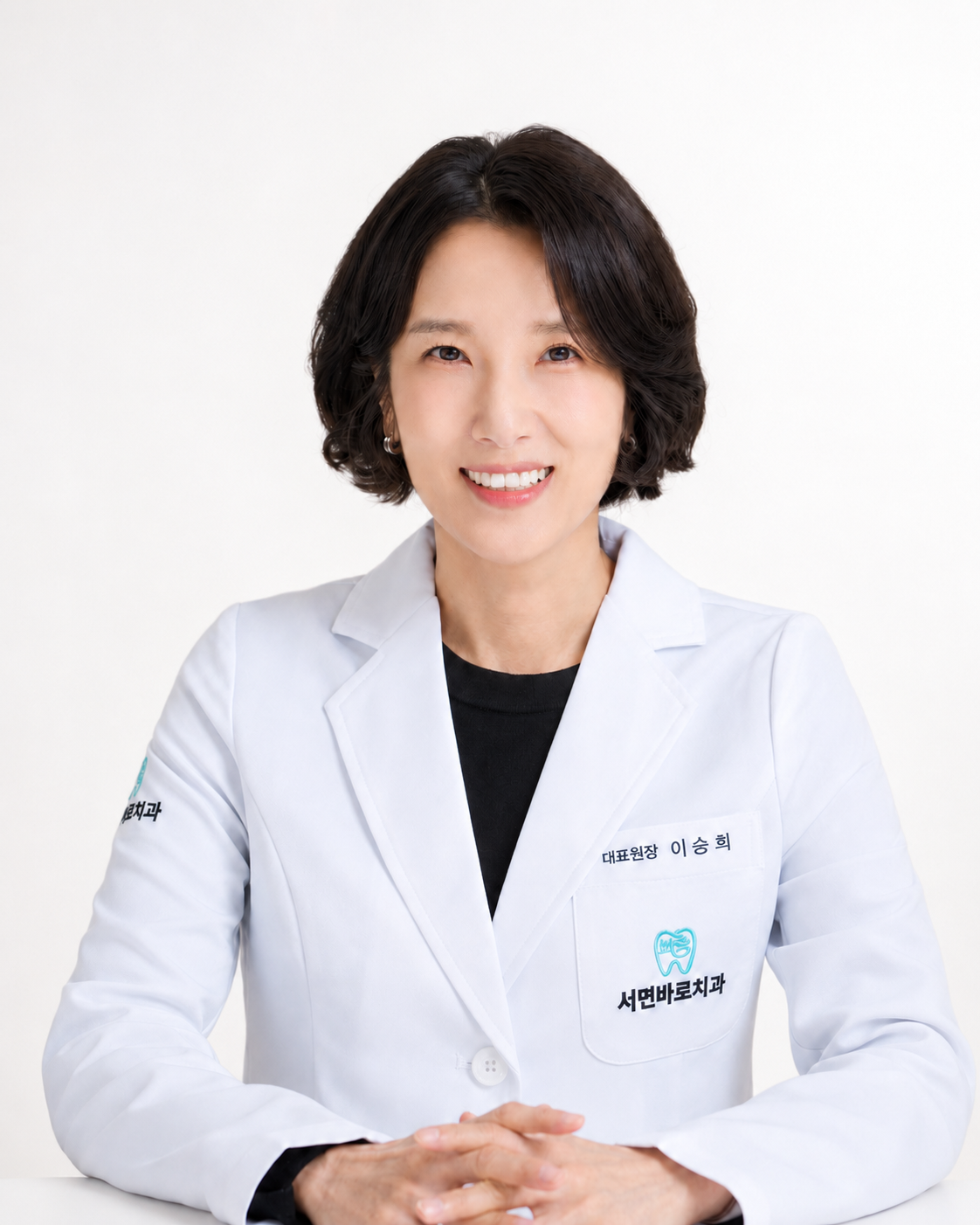
- Board-certified specialist, Advanced General Dentistry
- M.S. in Orthodontics, Kyungpook National University
- Focus on natural, alignment-led smile improvement
- Conservative, tooth-preserving approach
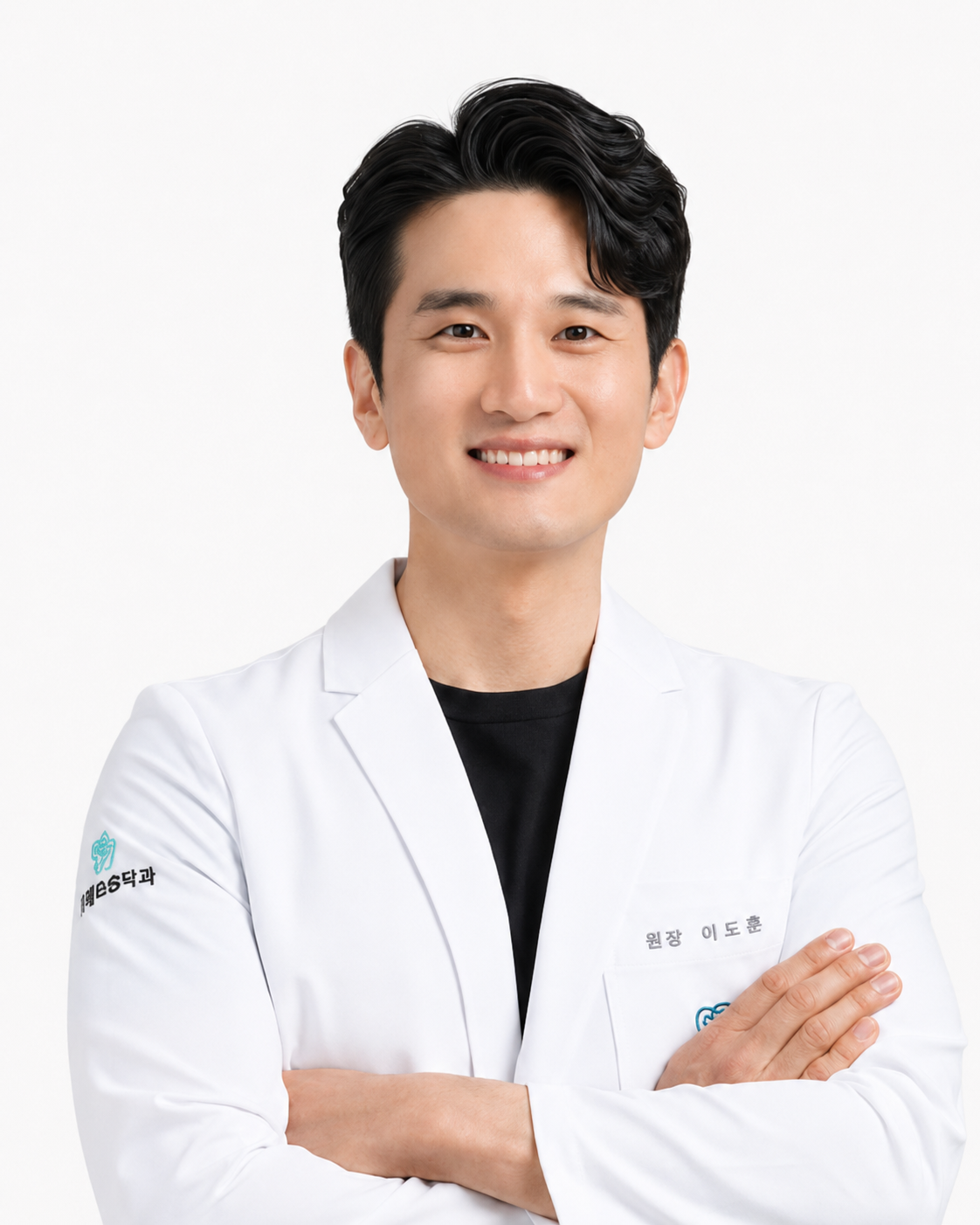
- Board-certified specialist, Advanced General Dentistry
- DDS, Dankook University College of Dentistry
- Restorative & aesthetic resin filling work
- Focus: natural, durable results
Small truths for international patients.
- This site is the pre-visit consultation. All 33 treatment pages were written in English first — with published prices, honest limits and the reasoning behind recommendations. Reading the page for your treatment before messaging makes the conversation twice as useful.
- Bring your dental history in any language. Records, X-rays or even a photo of paperwork from your home dentist — whatever exists helps, and gaps are normal. We’ve assembled histories from four countries and a shoebox; yours will be fine.
- The clinic hours worth memorising: Mon & Fri to 19:00, Tue & Thu to 21:00, Sat to 15:00, weekday lunch 14:00–15:30, closed Wednesdays, Sundays and holidays. The Tuesday/Thursday evenings are the expat-schedule feature — after-work dentistry without taking leave.
- Payment is boring on purpose. Cards (including international ones) and cash both work, receipts itemise in English, and the figure matches what was written before treatment — the entire goal is a payment moment with no news in it.
- Your WhatsApp thread is your patient file’s front door. Aftercare questions, rebooking from abroad, sending your home dentist’s follow-up question — the same thread keeps working after you fly. Messages get answered during clinic hours; overnight messages get triaged first thing.
What we promise — and what we won’t pretend.
Count on us for…
- the full chain in English — triage, chairside explanation, consent, prices in writing, aftercare, records
- published KRW prices with no foreigner surcharge — the list is the list, for every passport
- plans staged around real flights and real budgets — with the multi-visit truth told before you book anything
- the ₩60,000 low-stakes first visit — audit everything this page claims for the price of a cleaning
We won’t pretend that…
- we’re a 24-hour service — our honest hours are above, and our emergency page says plainly when a hospital ER is the right first stop
- every treatment fits one trip — implants heal on biology’s calendar, not your airline’s, and we’ll say so up front
- native-speaker fluency is the product — comprehension is; verified by your questions, backed by images and paper
- we’re the only option — for treatments we don’t offer, the honest referral is part of the service, not a defeat
English-speaking dentist FAQ.
One WhatsApp message to wa.me/821039399980 — what you need, your preferred dates, and a photo if something hurts. Booking, questions and honest pre-answers all happen in that thread, in English, before you commit to anything. No Korean phone menus, no interpreter to arrange, no forms in a language you can't check. If WhatsApp isn't your platform, the phone works too (+82-51-946-2875), but the thread beats the call for everything that benefits from a written record — which is most things.
No — anyone can be treated. What insurance status changes is the price of insured-schedule items only: enrolled residents (many expats and students are) pay the insured rate for things like root canal work, extractions and the annual basic scaling, while visitors without enrolment pay the non-covered rate for those, quoted in writing first. The published prices covering most of this site — implants, crowns, aligners, whitening, the ₩60,000 check-up — are identical regardless of any insurance, which keeps most treatment planning refreshingly simple.
You're describing a large share of our international patients — English as everyone's second language is the normal case here, not the exception. The communication style is built for it: plain words over jargon, your own images on screen doing the heavy lifting, written summaries you can re-read or run through a translation app calmly at home, and zero impatience about repetition. Bring a translation app for backup if it helps; between it, the screen and the paper, comprehension gets there every time. The goal is that you understand — the route is flexible.
Yes, and it's encouraged in both directions: records, X-rays or a referral note from your home dentist sharpen our planning before you arrive, and everything done here leaves in English documentation written for a colleague's eyes — findings, materials, specifications, and what follow-up we'd recommend. For multi-stage treatments planned across trips, that handover quality is half the treatment plan. Forward your dentist's questions through the WhatsApp thread; dentist-to-dentist clarity is a service we take seriously.
Same Korean clinical standards and materials, calmer economics and logistics: Busan runs a less saturated, less aggressively marketed dental scene than Seoul's medical-tourism districts, published prices stretch further, and the city itself is a better place to be between appointments — beaches, food and a walkable centre instead of clinic-tower corridors. For visitors, Gimhae airport puts Seomyeon 40-ish minutes from landing. None of that replaces judging an individual clinic on its merits — which is what the ₩60,000 first visit exists to let you do cheaply.
Yes — the site isn't a translated brochure; it's the same voice you'll meet in the chair. The prices published here are the prices quoted there, the honest limits written here ("we don't offer X", "this takes two trips") are repeated there, and the explanations on these pages preview the explanations you'll get with your own images on screen. If anything you read here doesn't match what you experience in person, we'd genuinely want to hear it on WhatsApp — the consistency is the product.
From first message to flight home.
Read your treatment’s page, message your situation and dates — the plan, honest trip-fit and written numbers arrive before any ticket depends on them.
Gimhae Airport → Seomyeon in about 40 minutes; from any Busan hotel, Metro Lines 1 or 2 to Seomyeon, Exit 2, four minutes. Taxi card: 부산진구 중앙대로 698-1, SJ메디컬빌딩 5층.
Everything on screen, everything in English, every price written before work begins — with evening slots Tuesday and Thursday keeping your daylight for the city.
English records and insurance paperwork in hand, the WhatsApp thread open from any country — and a recall or return-trip plan that respects your actual life.
One message in English — the rest follows in it too.
A check-up, a plan, a problem, or just questions — start the thread. Honest answers, written prices, and a clinic built for exactly this conversation.
Message us on WhatsAppBaro Dental Clinic · 5F, SJ Medical Building, 698-1 Jungang-daero, Busanjin-gu · Seomyeon Station Exit 2, 4 min · +82-51-946-2875
The natural first pages.
Scaling & Check-up in Seomyeon
₩60,000 — the low-stakes first visit that audits everything this page claims.
Explore →Emergency Dentist
Same-day help in English — and honest triage on when a hospital comes first.
Explore →Pricing
The published KRW list — every passport pays the same page.
Explore →Dental Implants
The treatment most dental travellers come for — honestly staged across trips.
Explore →Medical information on this page is provided for general education and does not replace an individual examination and diagnosis. Treatment suitability, insured-schedule fees and trip-fit are confirmed at an in-person consultation with written quotations. Same-day and evening availability depend on the day’s schedule; this clinic does not provide 24-hour service. Individual results vary.