The annual dental check-up in Busan — what one visit a year catches.
Expats skip the dentist for the same reasons everywhere — nothing hurts, the language, the not-knowing-what-it-costs — and then arrive three years later with a root canal that was a filling in year one. This guide is the case for the yearly visit, made concretely: the seven things a single examination and cleaning catches while they are still cheap, what it costs with and without Korean insurance, how it fits an expat calendar, and the records that leave with you.
By Baro Dental Clinic, Seomyeon · October 2026 · 8 min read
A yearly examination and cleaning at Baro Dental — ₩60,000 published, or a 30% share once a year for patients enrolled in Korean health insurance — is the single visit that converts most expensive dentistry into inexpensive dentistry: early decay into a small filling instead of a root canal, gum inflammation into a cleaning instead of surgery, a hairline crack into a crown instead of an extraction. Here is what the visit actually examines, what it finds in people who feel fine, the honest recall interval for your mouth rather than a generic one, how expats in Busan fit it into a year, and why the records you leave with matter as much as the cleaning.
- Why “nothing hurts” is not the same as “nothing is wrong”
- The seven things one visit catches early
- What the annual visit involves, minute by minute
- What it costs: published, insured, and what it saves
- Your recall interval, not a generic one
- Fitting it into an expat year in Busan
- The records that leave with you
- The no-selling promise
What expats say when they finally book a check-up
- I haven't seen a dentist since I moved to Korea — is it going to be a lecture?
- Nothing hurts. What would a check-up even find?
- I have Korean insurance through work — does a cleaning cost anything?
- Will the check-up turn into a treatment plan I didn't ask for?
- I might move countries next year. Is there any point starting with a dentist here?
Why “nothing hurts” is not the same as “nothing is wrong”
Teeth are badly designed for early warning. Decay is painless until it reaches the nerve — by which time the filling has become a root canal. Gum disease is painless almost to the end; the first symptom many people notice is a loose tooth. A crack in a molar announces itself only when it propagates. A failing filling leaks for years before it aches. The whole economic logic of dentistry runs on this gap: the problems that are cheap to fix are the ones you cannot feel, and the yearly examination exists to find them in that window. Our scaling and check-up page describes the appointment; this guide makes the case for it.
The seven things one visit catches early
1. Early decay, especially between the teeth where a brush does not reach — found on bitewing X-rays or by probing, and fixed with a resin filling from ₩100,000 instead of, two years later, a root canal and ₩500,000 crown. 2. Gum pockets: a probe around every tooth measures the depth of the gum attachment; 4 mm pockets are reversible with a cleaning, 6 mm pockets need gum treatment, and 8 mm pockets cost teeth. 3. Hairline cracks in heavily filled molars, visible with light and magnification before they split — a crown now rather than an extraction later. 4. Failing fillings and crowns: leaking margins, worn edges, decay underneath, caught while the tooth beneath is still sound.
5. Wear from grinding — flat facets and chipped edges that mean a night guard would save the teeth, before the damage needs restoring. 6. Wisdom teeth on the panoramic image, positioned for the decision about whether and when to remove them while roots are short. 7. The soft-tissue check — tongue, floor of the mouth, cheeks, palate — for the ulcers, patches and lumps that are usually nothing and occasionally the finding that matters most in the whole visit. None of these seven hurts at the stage we find them. All of them hurt, and cost more, at the stage they announce themselves.
What the annual visit involves, minute by minute
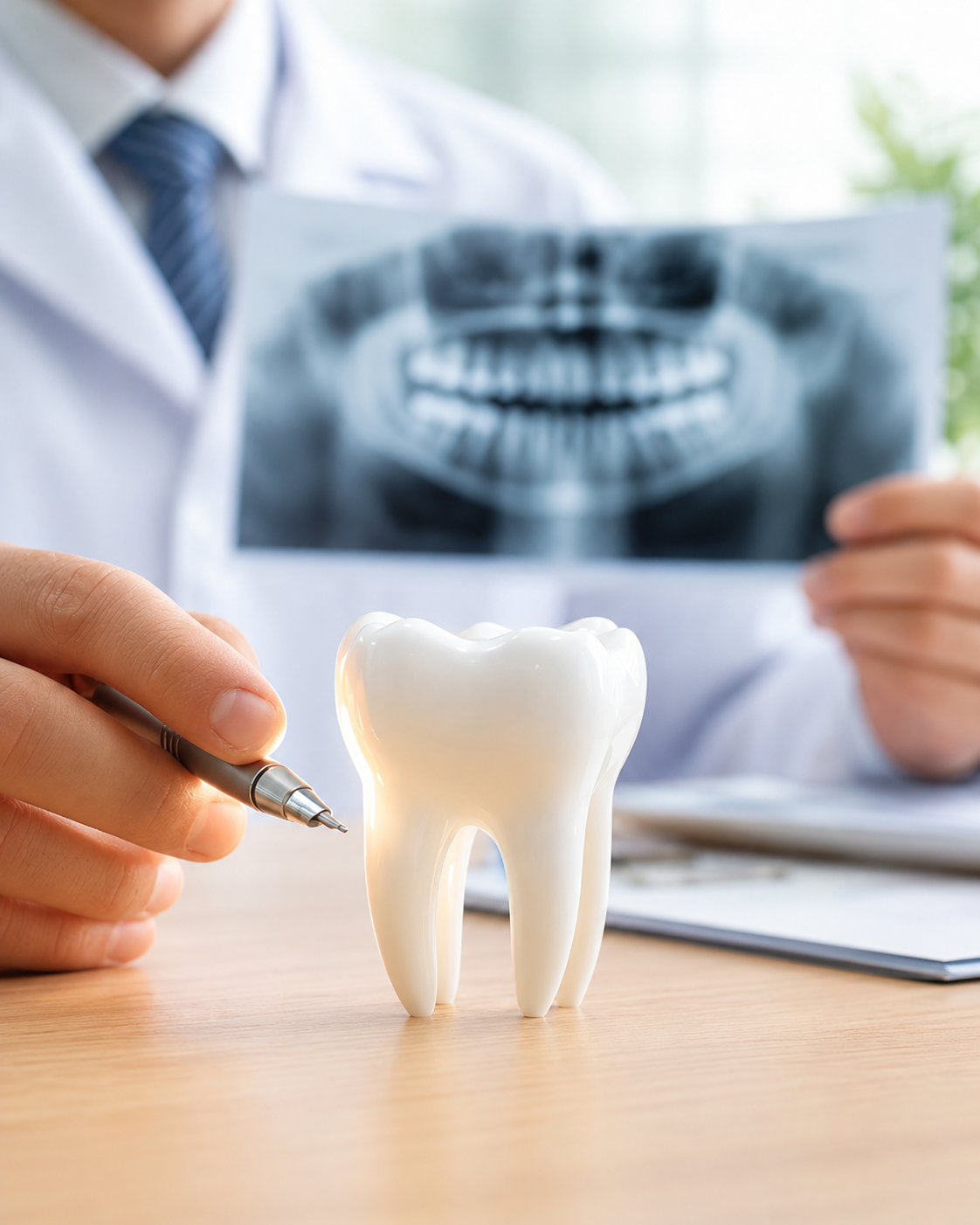
About forty-five minutes. History: anything changed, any sensitivity, medication. Examination: every tooth, every filling, the gum probe around each tooth, the bite, the jaw joints, the soft tissues. Imaging: a panoramic X-ray at a first visit and then as indicated; bitewings where decay between teeth is suspected — taken because they change the plan, not routinely. Findings on screen: your own images and photos, each finding shown and graded honestly — watch, treat soon, treat now. Scaling: the professional cleaning that removes what brushing cannot, above and just below the gumline. The debrief: brushing technique corrected where it needs it, the recall interval set, written findings and prices for anything that needs treatment — which you take home to decide on, not decide in the chair.
What it costs: published, insured, and what it saves
Three published figures cover the visit. First visit, diagnosis only, ₩40,000 — examination and imaging without cleaning. Scaling only, ₩60,000 — the cleaning with the oral check. First visit plus scaling, ₩90,000 — both together, which is what most new patients book. For patients enrolled in Korean national health insurance, one preventive scaling per calendar year is an insured item at a 30% share, which is a modest sum; the examination and X-rays are insured too. The Korean health insurance guide explains enrolment; the scaling cost guide goes into the figures.
| Option | Published price | Enrolled in Korean NHI | What it includes |
|---|---|---|---|
| First visit — diagnosis only | ₩40,000 | Insured, 30% share | Examination, panoramic & intraoral imaging, findings on screen |
| Scaling only | ₩60,000 | Insured once per calendar year, 30% share | Cleaning, oral check, chart record |
| First visit + scaling | ₩90,000 | Insured, 30% share (annual scaling) | Diagnosis and cleaning in one visit |
| Second cleaning in the same year | ₩60,000 | Non-covered beyond the annual one | Same cleaning, published price |
| Bitewing / periapical X-rays as indicated | included | Insured | Only where they change the plan |
Published prices from our fee list, current at time of writing. Insured items follow Korea's national fee schedule at a 30% patient share for enrolled members; one preventive scaling per calendar year from age 19.
What it saves is the point. A filling from ₩100,000 instead of a root canal and crown at ₩550,000 or more. A cleaning instead of gum surgery. A crown instead of an implant from ₩800,000. Across a decade, the yearly visit is the cheapest line in anyone's dental budget by a wide margin, and the pricing page lets you do the arithmetic for your own mouth.
Overdue, and not sure where to start? Say so on WhatsApp — “I haven't seen a dentist in a few years” is the most common opening message we receive. You will get a slot, the figure in writing, and no lecture. Message us on WhatsApp →
Your recall interval, not a generic one
“Every six months” is a habit, not a finding. At the end of the visit we set the interval to your actual risk: a low-risk mouth — few fillings, healthy gums, good brushing, no smoking — is often fine at twelve months; a mouth with active gum disease, heavy coffee and wine, a dry mouth from medication, or a history of frequent decay is better at three to six. The reasoning is explained rather than asserted, and it is revisited each visit. Expats who travel often get the interval set around their real calendar; a check-up every Busan summer is better than a perfect schedule nobody keeps.
Fitting it into an expat year in Busan
Three patterns work. The year-end visit, using the insured annual scaling before it resets in January. The Tuesday or Thursday evening, when the clinic runs to 9 PM and a 19:00 appointment costs no leave — the slot most working residents of Haeundae, Centum and Seomyeon use; the evening and Saturday guide explains booking it. The paired visit: if a small filling is found, it is done the same day, so the yearly visit stays one visit. The clinic is four minutes from Seomyeon Station Exit 2 on both metro lines, which from most of Busan is under half an hour door to door.
The records that leave with you
Expats move, and dental records in Korean on a clinic server in Busan do not help a dentist in Singapore. So the check-up ends with records in English: findings, the gum chart, the X-rays as image files, and a note of what was done and what was recommended — at no charge, on request, by email. Moving countries next year is therefore an argument for a check-up here, not against: you leave with a baseline your next dentist can read, and the records and X-rays guide explains exactly what we hand over. The WhatsApp thread stays open after you leave Korea for the “is this normal?” messages that do not need a chair.
The no-selling promise
The fear behind many skipped check-ups is that the visit will turn into a treatment plan. Here is the standard we hold: findings are graded honestly, including “watch” — a small early lesion we would rather monitor than drill; prices are written and taken home; nobody is paid on conversion; and a plan taken to another clinic for a second opinion is treated as a sensible thing to do. The yearly visit is an examination and a cleaning. If that is all your mouth needs, that is all the visit will be.
- Pain is a late symptom: the problems that are cheap to fix are the ones you cannot feel.
- Seven things, one visit: early decay, gum pockets, cracks, failing fillings, wear, wisdom teeth, soft tissues.
- ₩90,000 for a new patient, or your insured annual scaling: examination, imaging, cleaning, findings on screen.
- Your interval, not a slogan: twelve months for a low-risk mouth, three to six where the risk is real.
- Leave with English records: a baseline any dentist in the world can read, and a thread that stays open.
The dentists behind every guide on this site


FAQ
At Baro Dental a first visit with diagnosis is ₩40,000, a scaling ₩60,000, and both together ₩90,000. Patients enrolled in Korean health insurance receive one preventive scaling per calendar year, plus the examination and X-rays, as insured items at a 30% share.
It depends on your mouth. A low-risk mouth is often fine at twelve months; active gum disease, heavy staining, dry mouth or frequent decay call for three to six. We set the interval at the end of your visit and explain why.
Examination of every tooth and filling, a gum probe around each tooth, bite and jaw joints, the soft tissues, imaging where it changes the plan, findings shown on your own images, scaling, and written findings with prices for anything that needs treatment.
No. “It's been a few years” is the most common opening message we receive. The visit is an honest baseline and a cleaning; findings are graded, including “watch”, and anything needing treatment is written down for you to decide on at home.
Yes. Findings, the gum chart, X-ray image files and a summary of treatment are provided in English on request at no charge, by email, so your next dentist anywhere has a baseline to read.
Scaling & Check-up in Busan
The appointment this guide is about — ₩60,000, or ₩90,000 with a first-visit diagnosis.
Gum Disease Treatment
What the gum probe is looking for, and what happens when pockets are deep.
Published Prices
Every non-covered figure in KRW, the same page for every passport.
Scaling and whitening cost in Busan
Related guide in this series.
Korean health insurance and dental care for foreigners
Related guide in this series.
Your dental records and X-rays in Korea
Related guide in this series.
Read enough? Start the thread.
Tell us how long it has been and when you are free — the reply is a slot, the figure in writing with your insurance taken into account, and a visit that is an examination and a cleaning, nothing more unless you want it.
Medical information in this guide is provided for general education and does not replace an individual examination and diagnosis. Prices shown are current at the time of writing; insured-schedule items follow Korea's national fee schedule and are quoted in writing at your visit. This clinic does not provide 24-hour service. Individual results vary.