Whitening and scaling costs in Busan, in plain numbers.
Scaling at ₩60,000, professional whitening at ₩495,000 for three sessions or ₩660,000 for five, gap-closure resin at ₩150,000 per tooth surface — the entire brightening ledger, what each line honestly buys, why the cheap line comes first by design, and the shade-change expectations no honest clinic will let you skip.
By Baro Dental Clinic, Seomyeon · August 2026 · 13 min read
At Baro Dental in Busan, scaling is ₩60,000, professional whitening is ₩495,000 for the three-session course or ₩660,000 for five sessions, and gap-closure resin runs ₩150,000 per tooth surface — published figures, identical for every passport. The sequence matters as much as the prices: scaling comes first because whitening chemistry works on clean enamel, and a large share of “my teeth look dull” cases end at the ₩60,000 line without ever needing the ₩495,000 one. This guide walks the whole ledger in honest order — including who whitening genuinely serves, who it disappoints, and the expectations arithmetic that separates the two.
- The brightening ledger — four lines, honestly ordered in Busan
- What ₩60,000 actually buys — the most leveraged line in dentistry
- What whitening actually buys — chemistry, sessions and honest targets
- The complete brightening ledger, in one table
- Reading the market — the half-price ads and the triple-price spas
- Who each line serves in Busan Seomyeon — and the honest routing
What brightness shoppers ask about prices
- Is ₩60,000 scaling real, or a bait price with add-ons?
- Three sessions or five — how do I know which course I need?
- Will whitening actually work on my teeth, or am I burning ₩495,000?
- Why do some clinics quote whitening at half this — or triple?
- Do crowns and fillings whiten along with the teeth?
The brightening ledger — four lines, honestly ordered in Busan
The complete published map: scaling at ₩60,000 — professional cleaning plus the oral check and chart record that has to precede it; professional whitening at ₩495,000 for three sessions, or ₩660,000 for the five-session course for deeper staining and higher targets; and gap-closure (diastema) resin at ₩150,000 per tooth surface for the front-tooth spaces that read as a colour problem but are actually a geometry one.
The order of that list is the order of honest treatment, and it’s worth saying why. Whitening gel works on enamel it can actually touch: a surface carrying months of plaque, tartar and surface stain whitens poorly and unevenly, which is why every professional whitening plan here starts from a scaled canvas. But the same fact cuts the other way, in your favour — a meaningful share of dull-teeth complaints are surface stain, and surface stain is a ₩60,000 problem, not a ₩495,000 one. Coffee, tea, red wine and tobacco lay down a film that professional scaling largely removes; the tooth underneath was never actually darker.
That routing — cheap diagnostic step first, expensive chemistry only where the cheap step proved insufficient — is the same price-follows-preparation logic our crown cost guide runs on restorations. The ₩60,000 visit is simultaneously the cleaning, the record-keeping check, and the honest audition for whether whitening has anything left to do. Plenty of patients walk out of it bright enough and ₩270,000 richer than they planned.
And the tier-two grammar from our price-list guide applies to every line: freely priced, published, passport-blind, confirmed in writing before anything proceeds. For enrolled residents, one nuance: Korean national insurance covers one basic scaling per year at the insured rate — the ₩60,000 figure is the non-covered rate that applies to visitors and to additional cleanings; either way the number is written before the chair.
What ₩60,000 actually buys — the most leveraged line in dentistry
The scaling visit’s anatomy, since a ₩60,000 figure invites suspicion it doesn’t deserve: roughly thirty minutes covering ultrasonic removal of tartar(the mineralised deposit no toothbrush touches, and with it much of the surface stain) and the full examination — every tooth inspected, findings on screen, an English debrief, and written notes that travel. No downtime, no anaesthesia in the routine case, eat normally after.
Why so cheap, honestly answered: scaling is priced across Korea as the front door of dentistry — high volume, standardised workflow, and (for insured residents) a nationally subsidised annual habit. The ₩60,000 here isn’t a loss-leader trick; it’s the national price culture for the most routine procedure in the building. What would be a trick — and what this line never carries here — is the surprise upgrade: no “deep-cleaning” upsell mid-chair, no conversion of your cleaning into a gum-treatment invoice without a written quote first. Where the examination genuinely finds gum disease needing treatment beyond scaling, that’s an insured-schedule conversation with its own written figures — a finding explained on screen, never a bill discovered at the desk.
The brightness arithmetic that makes this the guide’s hero line: for coffee-and-tea stain — the most common dullness in adult mouths — scaling delivers the most visible change per won in all of cosmetic dentistry. It won’t change your enamel’s intrinsic shade (that’s whitening’s job, next section), but it restores the shade you actually own, and a meaningful number of patients discover the shade they own was fine.
One scheduling note that compounds the value: the scaling visit doubles as the check-up our clinic guide recommends as the lowest-stakes first visit, and — per our orthodontic cost guide — as the retainer check for finished ortho cases. One ₩40,000 slot, three jobs. The evening and Saturday grid takes it happily — the classic pairing being a Tuesday 7 PM cleaning that ends with dinner in Seomyeon and a brighter photograph of both.
What whitening actually buys — chemistry, sessions and honest targets
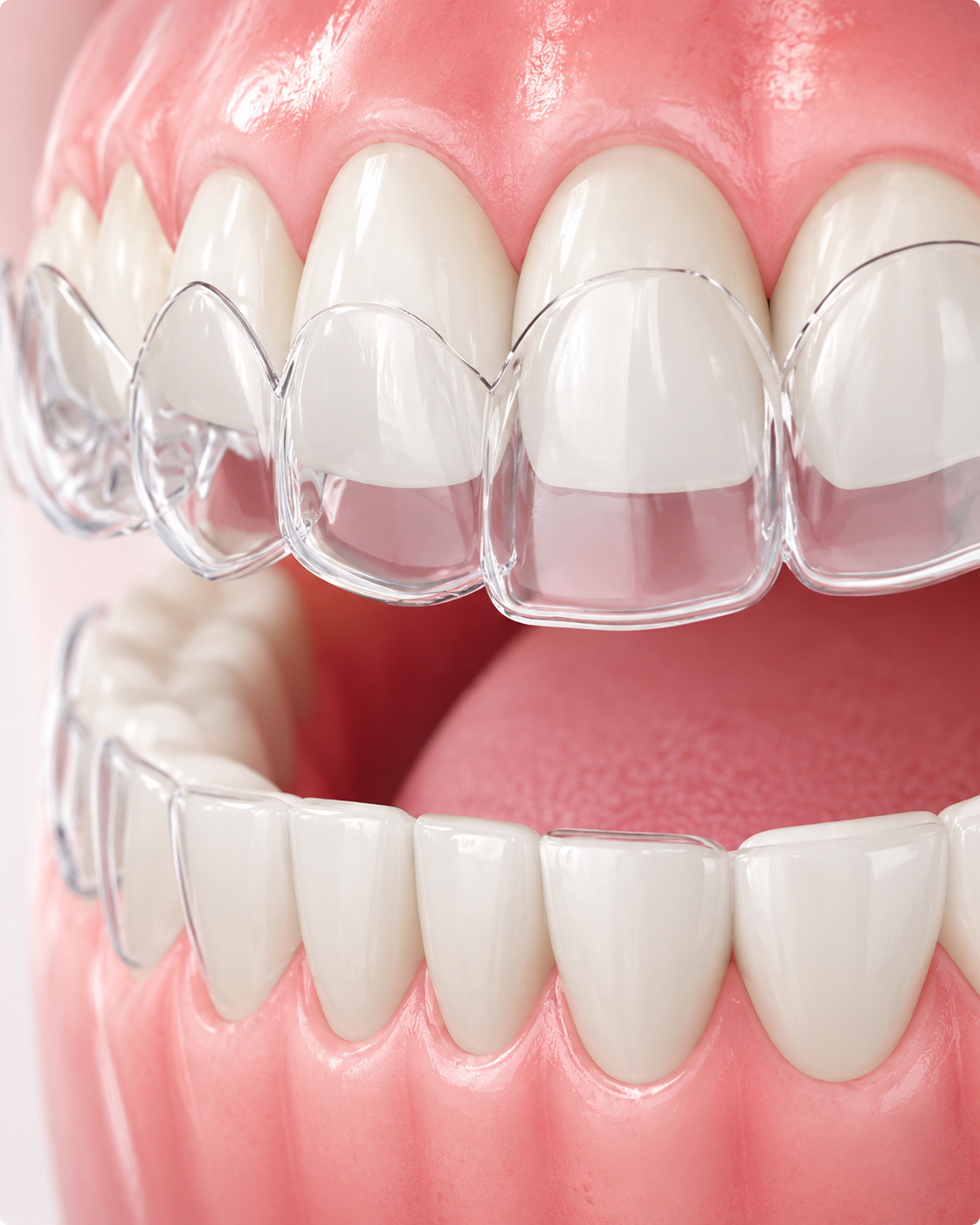
Professional whitening changes the enamel’s intrinsic shade using peroxide chemistry at concentrations and control levels home kits don’t reach — applied in supervised sessions, with your gums protected and your progress tracked against a shade guide rather than a memory. A single session runs ₩165,000 for anyone who wants to try the chemistry before committing to a course, and a take-home kit with custom-fitted trays is ₩220,000 — the option that finishes the job at home when a trip is short. The three-session course (₩495,000) is the standard journey: most patients see a clear, photographable shade lift across it, with sessions spaced to let sensitivity settle between.
The five-session course (₩660,000) exists for the harder canvases: deeper intrinsic staining, tetracycline-influenced shades, higher targets, or simply enamel that responds gradually. The honest mechanics: whitening response varies genuinely between mouths — some enamel lifts fast, some asks for more chemistry-hours — and the five-session line prices that reality instead of pretending three sessions fits everyone. Which course fits you is an examination call made at the scaled-canvas stage, with the shade guide in hand and the target agreed before the first gel touches enamel.
The expectations paragraph no honest cost guide skips: whitening lightens natural enamel and nothing else. Crowns, fillings, and resin work hold their manufactured shade — which means a whitened smile can make old front-tooth restorations read darker by contrast, a sequencing fact the consultation flags in advance (whiten first, then match any new restoration to the new shade, never the reverse). And results are honest, not miraculous: shade lift, yes; movie-poster fluorescence, no — anyone promising a specific number of “shades whiter” sight unseen is quoting the average mouth, and by now you know what this site thinks of quotes for the average mouth.
Sensitivity, since it’s the question behind the question: transient sensitivity during a whitening course is common, manageable, and part of why supervised sessions beat unsupervised strips — concentration and timing get adjusted to your response, not a box’s instructions. It settles; the session spacing exists partly for exactly that. Patients with already-sensitive teeth flag it at the examination and the protocol adapts from session one — concentration, contact time and spacing are all adjustable dials, which is most of what “supervised” means in practice.
Not sure which line your smile actually needs? That’s what the ₩60,000 gate is for — but a photo in the thread gets you an honest pre-read free, before you book anything. Message us on WhatsApp →
The complete brightening ledger, in one table
Every published line a brightness decision touches, with its honest job description:
| Line item | Published figure | The honest job description |
|---|---|---|
| Scaling & check-up | ₩60,000 | Cleaning + oral check + surface-stain removal — add the ₩40,000 diagnosis for imaging and a written plan |
| Whitening — single session | ₩165,000 | About an hour in the chair — the low-commitment way to see how your enamel actually responds |
| Whitening — 3 sessions | ₩495,000 | The standard intrinsic-shade course — supervised chemistry on a scaled canvas |
| Whitening — 5 sessions | ₩660,000 | The harder-canvas course: deeper staining, higher targets, gradual responders |
| Take-home whitening kit | ₩220,000 | Custom-fitted trays and gel — the finish-at-home option when a trip is short |
| Gap-closure resin (diastema) | ₩150,000 per tooth surface | The geometry fix whitening can’t deliver — same-visit, priced per actual surface |
| Whitening for single dark teeth | Examination first | One dark tooth is a diagnosis, not a shade — routed to its actual cause before any gel |
Whitening carries 10% VAT in Korea — every whitening figure above is the VAT-inclusive total you actually pay; scaling and resin are VAT-exempt. Figures current at time of writing; the pricing page is the living list. Insured residents: national insurance covers one basic scaling yearly at the insured rate — the figure above is the non-covered rate.
Reading the market — the half-price ads and the triple-price spas
Whitening pricing across Korea spans a comically wide band, and the band decodes with the same tools as everything else. The half-price banners usually price a single session, a lower-concentration protocol, or a self-administered tray “course” with clinical supervision only at handover — not fraudulent, but a different product wearing the same word. The question that sorts it: how many supervised sessions, at what protocol, and is scaling included or separate? A per-session arithmetic usually dissolves the discount.
The triple-price end lives mostly in beauty-clinic and spa territory: ambience, packaging, and brand-name lamp systems whose evidence premium over standard professional protocols is, put politely, debated. The lamp question is a genuine one to ask anywhere — some light-activated systems are marketing garnish on ordinary peroxide chemistry — and “what does the light add, clinically?” is a fair test of any premium quote.
Against home strips and pharmacy kits, the honest comparison: they work, mildly, slowly, on easy cases — and their real costs are unsupervised sensitivity, uneven application, and the ceiling of low-concentration chemistry. For a mild target on a patient with patience, they’re a legitimate budget path this clinic will say so about; for a real shade change on a deadline (a wedding, a trip), the supervised course is the tool built for the job. What no home kit includes, and the ₩40,000 line does: the examination that catches the cavity, the dead-tooth discolouration, or the gum problem that whitening gel would have happily ignored.
And the diastema footnote that closes the ledger: front-tooth gaps read as a smile problem that whitening intuitively feels like it should fix — it can’t; geometry isn’t colour. Gap-closure resin at ₩150,000 per tooth surface is the honest line for that job: same-visit, enamel-preserving, and priced per surface so the quote scales with the actual gap rather than a package. The examination sorts which problem your smile is actually having — frequently it’s both, occasionally it’s neither, and the ₩40,000 visit is once again where the answer starts.
Who each line serves in Busan Seomyeon — and the honest routing
The routing this clinic actually runs, stated as plainly as the consultation would. Surface-stain cases — coffee, tea, wine, tobacco film on otherwise healthy enamel — are ₩40,000 cases first, and often last. Genuine intrinsic-shade cases — enamel that’s uniformly darker than its owner wants after a professional clean — are three-session candidates, upgraded to five where the examination reads a harder canvas or a higher target. Single dark teeth are a different animal entirely: one tooth darker than its neighbours suggests an internal cause — old trauma, a root canal history — and belongs in an examination chair, not a whitening one, because bleaching around an internal problem whitens the frame and leaves the picture.
Visitors get a genuinely convenient fit: sessions are same-day-tier per our same-day guide, and a three-session course spaces comfortably across a one-to-two-week stay — scale early, whiten through the trip, fly home brighter. The five-session course wants a longer stay or a split plan, said honestly at booking. Residents simply run it on the evening grid like everything else.
Who whitening honestly disappoints, so nobody discovers it at session three: heavily restored front teeth (the contrast problem above), expectations calibrated to filtered photographs, and the single-dark-tooth cases that needed diagnosis first. Every one of those is caught at the scaled-canvas examination — before the ₩495,000 commitment, which is the entire point of the ledger’s order.
The closing arithmetic, in this guide’s house style: the cheapest line on the ledger is also the diagnostic gate for the expensive ones, so the worst-case cost of finding out where you stand is ₩40,000 and thirty minutes — and the best case is that ₩60,000 was the treatment. Ledgers that route downhill like that are rare in cosmetic anything; use this one in order.
One last honest line for the completionists: whitening results are maintained, not owned — the coffee that stained the enamel once will vote again, and top-up sessions or routine scaling visits keep the shade you paid for. The maintenance arithmetic is modest and stated at the course’s end, never sprung later; a brightness ledger that hid its upkeep line would have failed this guide’s own reading test.
- The ledger: ₩30k scaling / ₩495k three sessions / ₩660k five / ₩150k per-surface gap resin — published, passport-blind.
- Scaling first is chemistry, not upselling: gel needs clean enamel — and surface stain often ends the story at ₩60,000.
- Whitening lightens enamel only: crowns and fillings hold their shade — whiten first, match restorations after.
- Single dark tooth = diagnosis, not whitening: internal causes get found before any gel is honest.
- Three sessions fit a trip: scale early, whiten through the stay, fly home brighter — the five-session course says so honestly if it won’t fit.
The dentists behind every guide on this site
FAQ
Real, and structurally so: scaling is priced across Korea as dentistry’s front door, and the figure covers the cleaning and the full examination with findings on screen; polishing is not included. What it never becomes here is a mid-chair upgrade: if the examination finds gum disease needing treatment beyond scaling, that’s a separate insured-schedule conversation with written figures — explained on screen, never discovered at the desk.
You don’t decide it from a website, and neither should a clinic: the call is made at the scaled-canvas examination with a shade guide in hand — your starting shade, your target, and how your enamel is likely to respond. The three-session course is the standard journey most patients complete; the five-session line exists for deeper intrinsic staining and higher targets, and the choice is agreed in writing before the first gel.
No — whitening chemistry lightens natural enamel only, while crowns and resin restorations hold their manufactured shade. The sequencing rule that protects you: whiten first, then match any new front-tooth restoration to the new shade — never the reverse. Where existing front-tooth work would contrast badly against a whitened smile, the consultation says so before the course, not after.
Because the word covers different products: single sessions, low-concentration tray programs, standard supervised courses, and spa-tier packages with brand-name lamps all trade under “whitening.” The sorting questions: how many supervised sessions, what protocol, is scaling included, and what does any premium technology add clinically? Run the per-session arithmetic and the honest comparison usually emerges on its own.
The three-session course, comfortably: scaling early in the trip, sessions spaced across the week, home brighter. The five-session course wants a longer stay or an honest split plan — and the booking thread will say which fits your actual dates before anything is committed. Sessions are evening-grid friendly, so the course costs sightseeing nothing.
Teeth Whitening in Busan
The full clinical page behind both course tiers.
Scaling & Check-up in Busan
The ₩60,000 gate this whole ledger runs through.
Root Canal in Busan
Where the single-dark-tooth cases often actually belong.
Published Prices
Every figure in this guide, on the living list.
How to read a Korean dental price list without surprises
Related guide in this series.
Crown and inlay costs in Busan, itemized
Related guide in this series.
Budgeting a Busan dental trip, end to end
Related guide in this series.
Start at the cheap end. The ledger was built that way.
A photo gets the free pre-read; the ₩60,000 visit gets the real answer. Whichever line your smile needs, the figure arrives in writing first.
Medical information in this guide is provided for general education and does not replace an individual examination and diagnosis. Prices shown are current at the time of writing; insured-schedule items follow Korea's national fee schedule and are quoted in writing at your visit. This clinic does not provide 24-hour service. Individual results vary.