Gum disease treatment in Busan — the quietest way to lose teeth, and the easiest to stop early.
Gum disease fells more adult teeth than decay does — without a single day of pain along the way. The mercy is that its first stage is fully reversible, and the intervention starts as small as professional scaling at ₩60,000. This page is every other page’s foundation — literally.
Ask about your gums.
Tap what fits — we’ll open WhatsApp with your message ready to send.Nothing sends until you press send in WhatsApp. A photo and any X-rays help us give an honest tier read — Straumann-warranted, or KS-sufficient.
My gums bleed when I brush — Busan gum treatment — is that serious, and what does treatment cost?
Bleeding on brushing is never normal — and usually very fixable. It’s the signature of gingivitis: plaque bacteria inflaming the gum margin. At this stage nothing permanent has been lost, and the cure is almost anticlimactic — professional scaling (₩60,000) to clear the hardened deposits your brush can’t remove, plus a reset of home cleaning. Gums typically stop bleeding within weeks of the cause leaving.
On fees, an honest note specific to this page: deeper gum treatment (root planing and periodontal care) is an insured procedure in Korea, following the national fee schedule — so it’s quoted precisely at your visit rather than listed here, and international patients without Korean insurance pay the non-covered rate, confirmed in writing before treatment. The published anchors around it: scaling ₩60,000, CT ₩30,000 where imaging is needed. And if bleeding has already progressed to loose teeth or gum recession, this page’s later sections map that road honestly too — including where it connects to the implant conversation we’d rather help you avoid.
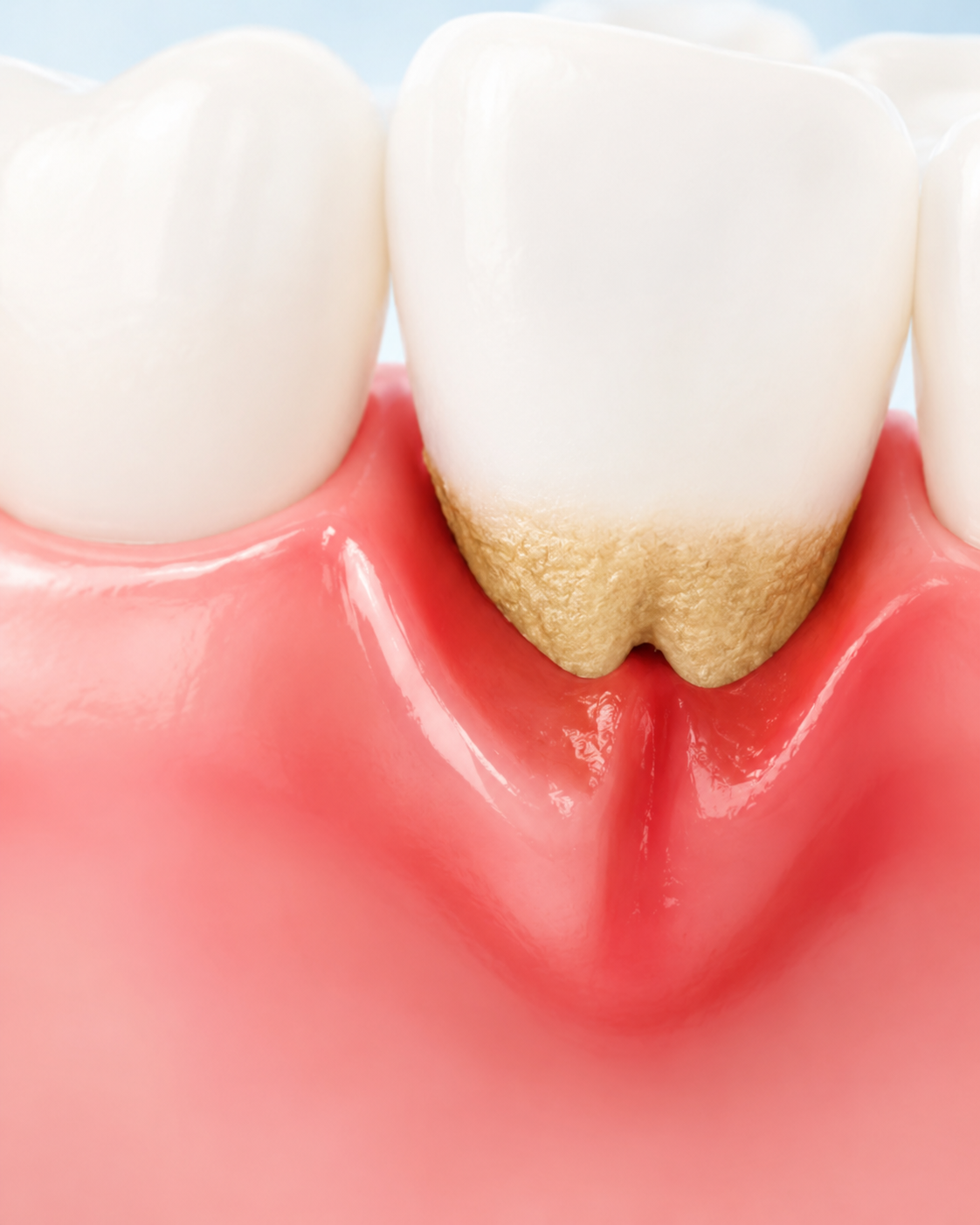
The disease isn’t in the tooth — it’s in the ground the tooth stands on.
Every tooth stands in living ground: gum sealing its neck, ligament slinging it into place, bone holding the whole arrangement. Gum disease is that ground eroding — a chronic bacterial inflammation that starts at the gum margin and, unchecked, works downward. The tooth itself can be flawless; when the ground goes, flawless teeth fall too. It’s why gum disease outranks decay as the leading cause of adult tooth loss.
The two-act structure matters enormously. Act one, gingivitis: inflammation confined to the gum itself — redness, puffiness, bleeding on brushing — with no structural loss yet. Fully reversible. Act two, periodontitis: the inflammation breaches the gum’s attachment and begins consuming ligament and bone, forming deepening pockets around the teeth. From here the disease can be arrested — stopped where it stands — but the lost bone doesn’t regrow on its own. The whole clinical game is keeping people in act one, or catching act two early.
And the reason so many people arrive late: the process is almost entirely without pain. Chronic inflammation doesn’t throb the way a tooth abscess does — it bleeds a little, recedes a little, loosens things a little, over years. Our cavity page calls “it doesn’t hurt” the least reliable sentence in dentistry; gum disease is the reason that sentence was written.
Six gums that end up in this chair — from easy reversals to honest rescues.
The pink toothbrush
Gingivitis — reversibleBleeding on brushing or flossing, puffy margins, maybe morning breath — act one, fully reversible. Scaling (₩60,000), a home-care reset, and the bleeding typically retires within weeks. The cheapest important appointment in dentistry.
The breath that won’t brush away
The hidden-deposit signalPersistent bad breath despite honest brushing usually means bacterial deposits living where brushes can’t reach — under the gum line, in forming pockets. Mints treat the symptom; professional cleaning treats the address.
The lengthening teeth
Recession & sensitivityTeeth looking “longer,” dark triangles opening between them, cold sensitivity at the necks — gums retreating from inflammation, over-brushing, or grinding. The cause gets diagnosed before the fix; exposed roots may also earn a cervical seal (from ₩50,000).
The tooth that moves
Advanced periodontitisLooseness, drifting, gaps opening where none were — the ground is going, and this is the hard-conversation card: deep treatment to arrest what’s arrestable, honest grading of what isn’t, and a plan that saves every saveable tooth before discussing replacements.
The implant’s gum
Peri-implantitis’s parentBleeding or tenderness around an implant is this disease at a new address — and implants’ gum seals are arguably more vulnerable than natural teeth’s. Our revision page covers the rescue; this page covers the prevention that makes rescue unnecessary.
The pre-treatment gate
Foundations firstNearly every page on this site sends people here: crowns, implants, orthodontics and dentures all build on gum health, and building on inflammation is building on a moving foundation. If another page routed you here, this is the short detour that makes the main treatment last.
How gum treatment actually goes.
Measure the ground
Pocket depths charted around every tooth, bleeding points mapped, imaging where bone levels need reading — the disease gets a stage, each tooth gets a grade, and you see both on screen.
Clear the shallow deposits
Scaling (₩60,000) removes plaque and hardened tartar above and at the gum line — for gingivitis-stage gums, frequently the whole treatment, and the bleeding’s retirement notice.
Clean the pockets
Where pockets have formed, root planing cleans the root surfaces beneath the gum — under local anaesthesia, usually by quadrant — removing the deposits that keep the inflammation employed. Insured-schedule fee, quoted in writing at your visit.
Re-measure & grade the response
Weeks later the pockets are re-charted: most shallow and settle, and the chart shows exactly which corners need more. Stubborn deep sites get honest options — targeted re-treatment or periodontal referral where warranted.
Maintenance — the actual cure
Arrested disease stays arrested only under maintenance: a personalised recall rhythm of professional cleaning plus the home technique that fits your mouth. Unglamorous, inexpensive, and the single highest-return habit in dentistry.
The four stages — what’s lost, what’s saveable, what it takes.
| Stage | What you’d notice | What’s been lost | The honest treatment |
|---|---|---|---|
| Gingivitis | Bleeding on brushing, puffy margins — or nothing | Nothing permanent yet — the reversible stage | Scaling (₩60,000)+ home-care reset — full recovery expected |
| Early periodontitis | Occasional bleeding, breath changes, first sensitivity | First attachment loss; shallow pockets forming | Scaling + root planing (insured schedule) — arrest with minimal footprint |
| Moderate periodontitis | Recession, lengthening teeth, food trapping | Measurable bone; deepening pockets | Quadrant root planing, re-evaluation, tight maintenance — arrestable, not reversible |
| Advanced periodontitis | Loose or drifting teeth, abscesses — often still little pain | Major bone; some teeth past saving | Deep treatment for the saveable, honest grading of the rest, then the replacement conversation — in that order |
Read the second column top to bottom and notice what’s missing: pain, at every stage. The disease’s entire strategy is quietness — which makes the third column the real alarm system, and the ₩60,000 check-up the only reliable one you can buy.
The self-perpetuating machine — why gum disease never fixes itself.
Our full-arch page describes advanced gum disease as a landslide with a flag on it. Here’s the machinery underneath the metaphor — and where professional treatment jams it:
Plaque hardens beyond the brush’s reach
Plaque you miss for a few days mineralises into tartar — a hardened, rough-surfaced deposit no toothbrush on earth removes. Its roughness is the problem’s engine: fresh plaque grips it eagerly, so every day of tartar is a better home for tomorrow’s bacteria. From this point, home care alone can slow the story but can’t rewind it.
Pockets deepen where cleaning can’t follow
Inflamed gums detach slightly from the tooth, opening a pocket — and the pocket is a trap that digs itself: bacteria colonise its depths, the inflammation deepens it further, and each millimetre gained is a millimetre further from any brush or floss. The disease literally engineers its own sanctuary as it advances.
Your own defences dissolve the bone
The cruellest mechanism: much of the bone loss isn’t bacterial digging but your immune system’s siege — chronic inflammation dissolving the very bone it’s defending, like artillery flattening the city it protects. This is why the disease progresses without infection-style pain, and why “my gums don’t hurt” carries so little information.
Professional cleaning jams the machine
Scaling and root planing remove the tartar the machine runs on and smooth the root surfaces so re-colonisation loses its grip — the one intervention that breaks the cycle rather than pausing it. Then maintenance keeps the machine dismantled: recall cleanings before new tartar matures. The landslide gets its flag; the flag gets a fence.
Is bleeding when I brush normal?
No — and the persistence of this myth costs teeth. Healthy gums tolerate proper brushing and flossing without bleeding; blood means inflamed tissue, which means bacterial deposits at or under the gum line. The good news buried in the bad: bleeding gums are usually early-stage gums, and early-stage disease is the fully reversible kind. The wrong response is brushing softer to avoid the blood — that feeds the cause. The right response is a ₩60,000 scaling visit and a technique reset.
What does gum treatment cost in Busan?
Structured honestly by depth: scaling is published at ₩60,000; deeper periodontal work (root planing, gum treatment) is an insured procedure following Korea’s national fee schedule, so it’s quoted precisely at your visit — and international patients without Korean insurance pay the non-covered rate, confirmed in writing before anything begins. CT imaging, where bone levels need reading, is ₩30,000. No page on this site treats surprise billing as acceptable, least of all the one about foundations.
Can receded gums grow back?
Honestly: no — gum tissue lost to recession doesn’t regrow on its own, and neither does the bone beneath it. What treatment genuinely does is stop the retreat: arrest the inflammation, seal sensitive exposed roots ( cervical resin, from ₩50,000), and correct the brushing or grinding that helped carve the loss. Surgical grafting exists for selected cases and we’ll say honestly whether yours is one — but the reliable win is always the same: keep what remains, permanently.
Does gum disease really affect the rest of my body?
The associations are real and well-studied: periodontitis is linked with harder-to-control diabetes (the relationship runs both directions), and with elevated cardiovascular risk markers — a chronic inflamed surface area the size of your palm, draining into your bloodstream, is not a neutral tenant. We’ll state it carefully: treating gum disease is not a heart treatment, but untreated periodontitis is a systemic inflammation burden no physician would recommend keeping. For diabetic patients especially, gum treatment belongs on the medical to-do list, not the cosmetic one.
Why do my gums bleed more during pregnancy?
Pregnancy hormones amplify the gum’s inflammatory response to the same plaque — so deposits that barely registered before now bleed enthusiastically (“pregnancy gingivitis”), and occasionally form localised swellings that alarm more than they endanger. The management is reassuringly ordinary: meticulous home care and professional cleaning, which is safe and sensible during pregnancy — the second trimester is the classically comfortable window. Untreated, severe gum disease in pregnancy is an inflammation burden worth avoiding on principle; tell us your stage and we’ll plan around it.
My teeth are loose — is it too late for me?
Too late for some teeth, possibly; too late for your mouth, almost never — and the distinction is the whole plan. Loose teeth get graded individually: some firm up meaningfully once deep cleaning removes the inflammation swelling their ligaments; some can be splinted and maintained; some are honestly finished, and pretending otherwise wastes money and bone. What you get here is that grading on screen, the fight for every genuinely saveable tooth, and — only then, only where needed — the replacement conversation with rebuilt foundations underneath it.
Care by board-certified specialists in Seomyeon
Both directors are board-certified specialists in Advanced General Dentistry, so your cosmetic treatment is planned with your overall dental health in mind.

- Board-certified specialist, Advanced General Dentistry
- M.S. in Orthodontics, Kyungpook National University
- Focus on natural, alignment-led smile improvement
- Conservative, tooth-preserving approach

- Board-certified specialist, Advanced General Dentistry
- DDS, Dankook University College of Dentistry
- Restorative & aesthetic resin filling work
- Focus: natural, durable results
Small truths about gum health.
- The floss finds what the brush polishes over. Gum disease’s favourite postcode is between teeth, exactly where bristles don’t reach — daily interdental cleaning (floss or interdental brushes) is half the entire treatment, and the half only you can deliver.
- Smoking hides the alarm while feeding the fire. Nicotine’s blood-vessel constriction means smokers’ gums often don’t bleed even while diseased — the one warning light, disabled. If you smoke, book the check-up on the calendar, not on symptoms.
- Hard brushing is friendly fire. Scrubbing harder doesn’t clean deeper — it carves recession and cervical notches. Soft bristles, small circles at the gum line, two minutes: technique beats force everywhere in this disease.
- Gum disease runs quiet through families and midlife. Genetics load the dice and the 40s–50s roll them — if a parent lost teeth “early,” your maintenance calendar deserves to know. Tell us; the recall rhythm gets set to your actual risk.
- After treatment, the gums shrink — and that’s the win. Post-treatment sensitivity and “longer-looking” teeth mean swollen tissue returning to healthy architecture. It settles, it’s manageable, and it beats the alternative by every measure that matters.
What gum treatment can do — and what we won’t pretend it does.
Treatment genuinely delivers when…
- gingivitis gets caught in act one — full reversal is the expected outcome, not the lucky one
- early-to-moderate periodontitis meets scaling and root planing — arrest is the realistic, achievable goal
- a pre-treatment gate needs clearing — implants, crowns and orthodontics all last longer on settled ground
- maintenance follows treatment — the recall rhythm is where arrested disease stays arrested
We won’t pretend when…
- lost bone and receded gums are expected to regrow — arrest is real; regeneration on its own is not, and selected surgical options get honest framing, not promises
- a hopeless tooth is being kept on sentiment — deep pockets on finished teeth are bacterial reservoirs endangering their neighbours; we’ll show you the chart
- mouthwash is proposed as the plan — rinses reach no pocket’s depths; they garnish treatment, never replace it
- treatment without maintenance is expected to hold — skip the recalls and the machine reassembles itself; we’d rather say so now than re-treat later
Gum disease FAQ.
In rough order of arrival: bleeding when brushing or flossing, red or puffy gum margins, persistent bad breath, gums that look like they're receding, new sensitivity at the tooth necks, and — much later — looseness or drifting. The catch is that the early signs are easy to normalise and the disease is comfortable staying quiet for years, which is why the most reliable "first sign" is a pocket-depth chart at a routine check-up rather than anything you'd notice in the mirror.
It's done under local anaesthesia, so the visit itself is vibration and time rather than pain — typically treated by quadrant across a couple of appointments for comfort. Afterwards, expect a few days of gum tenderness and temperature sensitivity as swollen tissue settles into healthier, slightly slimmer architecture; ordinary painkillers and lukewarm meals cover it. Patients routinely report the opposite of their fears: the mouth feels cleaner and calmer within the week, and the bleeding they'd normalised for years simply stops.
Gingivitis — genuinely cured, gone, reversible. Periodontitis — honestly framed as controlled rather than cured: treatment arrests the destruction and re-measurement proves it, but the susceptibility remains, and the disease reactivates if plaque and tartar rebuild undisturbed. That's not a treatment failure; it's the biology of a chronic condition, managed the way blood pressure is. The practical translation: treatment plus a maintenance rhythm equals decades of stable, functional teeth — which is the outcome that actually matters.
Because every treatment on this site is a structure built on gum and bone — and active periodontitis means the ground is still moving. Implants placed into infected foundations inherit the infection as peri-implantitis; crown margins finished against inflamed gums end up exposed when the swelling resolves; orthodontics moves teeth through bone that's under active demolition. Settling the foundations first isn't our caution, it's sequencing — a short detour that determines whether the main investment lasts.
Honest answer: it's individual, and setting your interval is part of the treatment. Low-risk, healthy-gummed patients commonly run annual or twice-yearly scaling; treated periodontitis patients need tighter recall rhythms, because their pockets re-colonise faster; smokers, diabetics and strong family histories tighten the interval further. What we don't do is prescribe one universal frequency for marketing convenience — your chart sets your calendar, and at ₩60,000 a visit, over-caution is affordable.
Scaling and assessment — absolutely: one visit, ₩60,000, and you leave with a full pocket chart and honest staging in English, which is valuable intelligence to carry home regardless of where treatment happens. Root planing often fits a stay too, treated by quadrant across a few days. What genuinely needs local continuity is maintenance — so for visitors we do the treatment your trip allows, document everything, and structure the recall plan around your travel rhythm or your dentist at home. Foundations travel well when the records do.
Gum health across borders.
Describe the signals on WhatsApp — bleeding, breath, looseness, or a pre-implant check — with your dates. You’ll get an honest read on what fits your stay.
Pocket charting, staging on screen, scaling (₩60,000) the same day — and the written plan with insured-schedule fees confirmed before any deeper work.
Root planing by quadrant across the days your trip allows — with re-evaluation scheduled into a return visit or handed cleanly to your dentist at home.
Your chart, staging and recall plan travel with you in English — because arrested gum disease is a maintenance story, and good records make it portable.
Bleeding gums are a message — read it early.
Message us on WhatsApp — bleeding, breath, loose teeth, or a foundations check before other treatment. You’ll get an honest staging and the written plan, starting from a ₩60,000 visit. In English.
Message us on WhatsAppBaro Dental Clinic · 5F, SJ Medical Building, 698-1 Jungang-daero, Busanjin-gu · Seomyeon Station Exit 2, 4 min
Explore the options in Busan.
Scaling & Check-up
₩60,000 — where act one gets reversed and act two gets caught.
Explore →Implant Revision in Busan
Peri-implantitis’s rescue page — this page is its prevention.
Explore →Cavity & Fillings
Cervical seals from ₩50,000 for the sensitive roots recession exposed.
Explore →Dental Implants in Busan
The conversation this page exists to postpone — on rebuilt foundations when needed.
Explore →Medical information on this page is provided for general education and does not replace an individual examination and diagnosis. Gum disease staging, treatment selection and fees — including insured-schedule procedures quoted at your visit — are confirmed at an in-person consultation with periodontal charting and imaging where indicated. Individual results vary.