Teeth whitening in Busan Seomyeon — professional, from ₩495,000.
In-office whitening performed by board-certified dentists — your enamel checked first, your shade tracked on a standard scale, and the full cost published before you sit down. In English.
Ask about your whitening plan.
Tap what fits — we’ll open WhatsApp with your message ready to send.Nothing sends until you press send in WhatsApp. A photo of your teeth in daylight helps us advise honestly on what whitening can achieve for you.
What does teeth whitening cost in Busan — and is it worth doing at a dental clinic?
At Baro Dental, professional in-office whitening costs ₩495,000 for three sessions or ₩660,000 for five — published prices, identical for foreign and Korean patients. Each session takes about thirty minutes, there is no downtime, and results typically hold one to two years.
The dental-clinic difference is not marketing: dentist-strength gel is legally stronger than anything sold over the counter, your gums are physically isolated before it’s applied, and — most importantly — a dentist examines your enamel, gums and existing restorations first and tells you honestly whether whitening will work on your discolouration at all. That last step is the one no strip, pen or beauty-shop LED can offer.
What professional teeth whitening actually does. in Busan
Teeth pick up two kinds of discolouration. Surface (extrinsic) stains from coffee, tea, red wine, curry and smoking sit in the microscopic film on the enamel — professional cleaning removes some of these. Internal (intrinsic) yellowing lives inside the tooth structure itself and deepens naturally with age; no toothpaste or scaling can reach it.
Professional whitening targets the second kind. A dentist-strength peroxide gel is applied to the enamel, where it breaks down into active oxygen that diffuses into the tooth and oxidises the pigmented molecules — chemically shrinking the stain compounds so they reflect light instead of absorbing it. The enamel itself is not drilled, etched away or thinned; the change happens to the colour molecules, not the structure.
That mechanism is also why the in-office version works where strips and LED kits disappoint: concentration and control. Over-the-counter products are legally limited to a fraction of the peroxide strength we use, and nobody isolates your gums or checks your enamel before you start. In-clinic, the gel is stronger, the soft tissue is protected, and a dentist decides whether your teeth should be whitened at all — which, honestly, is the step that matters most.
What whitening lightens well — and what it can’t. in Busan
The honest first question isn’t “how many sessions” — it’s whether your discolouration is the kind whitening treats. This is what your exam establishes before any gel touches your teeth.
Whitening responds well to…
- Yellow-toned, age-related darkening — the most common case, and the one that lightens most predictably
- Coffee, tea, wine and curry staining built up over years, including stains cleaning no longer shifts
- Smoking discolouration — nicotine yellowing responds well, though continued smoking re-stains faster
- General dullness before an event — a wedding, graduation or interview, planned so the shade settles in time
Whitening won’t change…
- Crowns, resin fillings and any ceramic work — restorations keep the shade they were made in, which is why sequence matters (whiten first, then match new work)
- Grey or banded tetracycline discolouration — it may lighten partially but rarely evens out; we tell you this before you pay, not after
- Teeth darkened by a dead nerve — a single dark tooth usually needs internal treatment, not surface whitening
- White spots and fluorosis patches — whitening can make the contrast more visible at first; these need a different plan
Six kinds of discolouration — six different answers.
“My teeth are yellow” is where the conversation starts, not where it ends. What caused the colour decides how well whitening works — here’s the honest map we use at the exam.
Coffee & black tea
Responds very wellTannins build a brown-yellow film that works its way into enamel over years. Cleaning removes the surface layer; whitening clears what has soaked in. The classic case — and the most satisfying result.
Red wine & dark foods
Responds very wellWine, cola, soy-based sauces, curry and berries stain the same way tannins do, often with a greyer cast. Whitening handles these predictably once the surface film is professionally cleaned first.
Smoking & nicotine
Responds wellNicotine and tar create stubborn yellow-brown staining that toothpaste never touches. It whitens well — the honest caveat is that continued smoking re-stains faster than any other habit.
Age-related yellowing
Responds wellEnamel thins naturally with age, letting the yellower dentine underneath show through. Whitening lightens the overall tone effectively — this is why results feel “younger”, not just whiter.
Tetracycline & grey banding
Partial at bestAntibiotic discolouration from childhood sits deep in the dentine, often in horizontal bands with a grey-blue cast. Whitening may soften it but rarely evens it out — we say this before you pay, and discuss restorative alternatives instead.
Single dark tooth
Different treatmentOne tooth darker than its neighbours usually means the nerve inside has died — often after an old knock. Surface whitening won’t reach it; it needs assessment and internal treatment, which your exam identifies immediately.
How your whitening session actually goes. in Seomyeon
Each in-office session follows the same disciplined sequence — the protection steps are what separate professional whitening from anything you can buy in a box.
Exam & shade record
We check enamel condition, gum health, cracks and existing restorations — whitening over an unfilled cavity or inflamed gums is exactly what we screen out. Your starting shade is recorded on a standard dental scale and photographed, so the change is measured, not remembered.
Clean & isolate
Plaque and surface film are cleared so the gel meets enamel, not debris. Then your gums and lips are isolated behind a protective barrier — the step that prevents the gum irritation people associate with badly done whitening.
Gel application & activation
The dentist-strength gel is applied to the front teeth in controlled cycles and activated. You’re reclined and comfortable; each cycle takes minutes, and the dentist checks tissue and comfort between cycles rather than leaving a machine to run.
Rinse, review, repeat
After the cycles, the gel is removed and your shade is compared against the record. Sessions are spaced across days — a 3-session course (₩495,000) or 5-session course (₩660,000) depending on your starting shade and target, decided at the exam, not upsold later.
Desensitise & instruct
A desensitising application closes the session, and you leave with specific instructions for the next 48 hours — what to eat, what to avoid, and what mild sensitivity is normal versus what deserves a message to us.
3 sessions or 5 — an honest comparison.
Both use the same gel, the same protection and the same dentist. The difference is how far your shade needs to travel — decided at the exam, from your shade record, not from a sales script.
| 3-session course | 5-session course | |
|---|---|---|
| Price | ₩495,000 | ₩660,000 |
| Best for | Mild–moderate yellowing, coffee/tea staining, refresh before an event | Deeper, long-standing staining; smokers; larger shade goals |
| Session length | ~30 minutes each | ~30 minutes each |
| Spacing | Across several days — fits a one-week stay | Across one to two weeks — plan travel dates with us |
| Included | Exam & shade record · gum isolation · desensitising application · written aftercare guide | |
| Per-session cost | ₩100,000 | ₩90,000 |
If your exam shows three sessions will genuinely reach your goal, we recommend three — upgrading a patient who doesn’t need it is exactly the habit this clinic was built against.

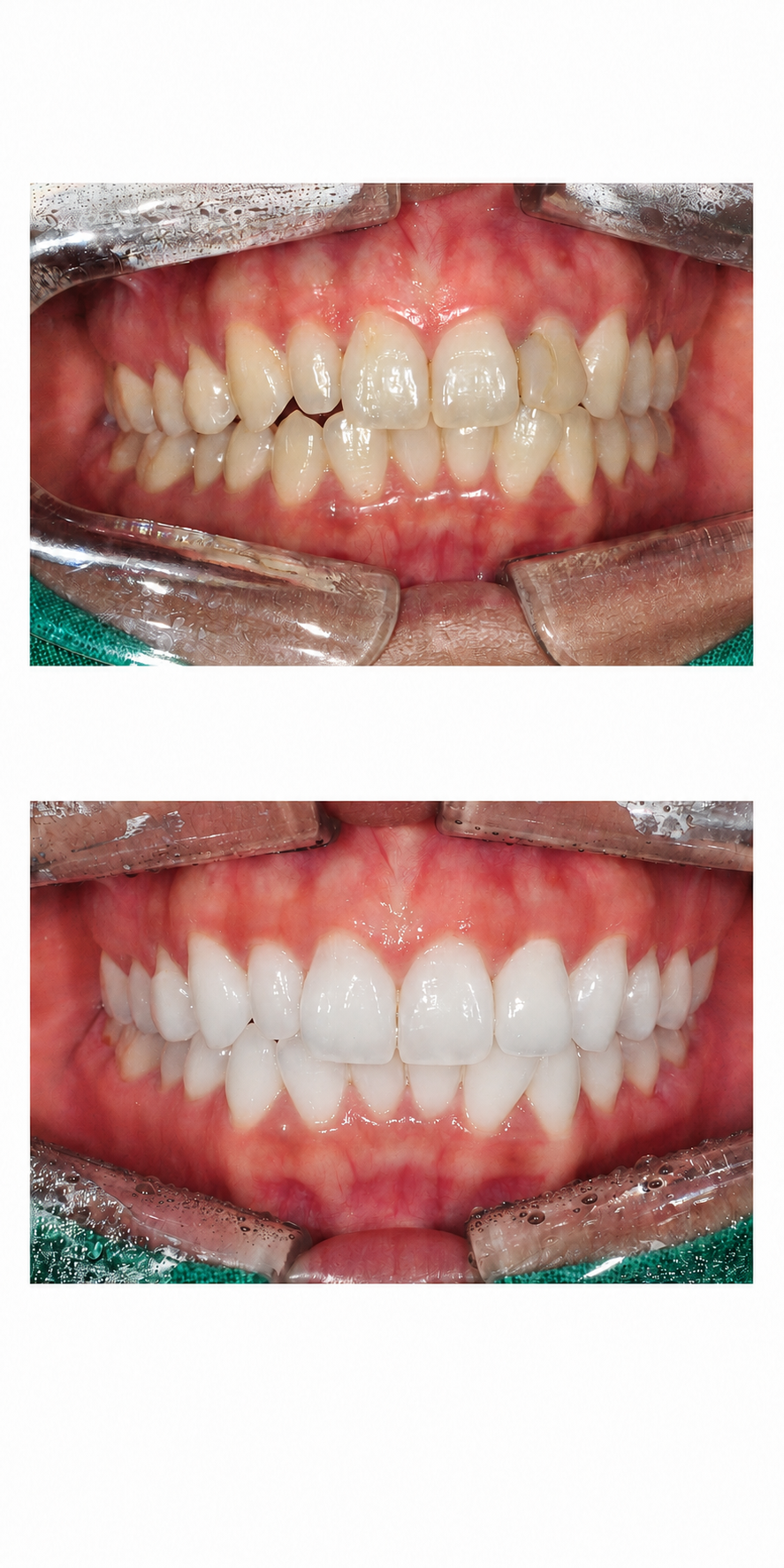
Measured on a shade scale — not on a filter.
Whitening photos are the easiest images in dentistry to fake with lighting. Ours are taken the same way before and after — same angle, same light, shade tab in frame — because a result you can verify matters more than a result that merely looks dramatic.
Most patients lighten by several shade steps across a course; how far your teeth move depends on the starting shade and stain type, which is exactly what the first exam tells us.
Shown with patient consent · results vary by individual.
Aftercare: the first 48 hours, and the months after.
Right after whitening, enamel is temporarily more porous — it re-stains and re-hydrates over the next couple of days. What you do in that window has an outsized effect on the final shade.
First 48 hours — the “white diet”
Simple rule: if it would stain a white shirt, it will stain a freshly whitened tooth. Skip coffee, black tea, red wine, cola, soy-sauce-dark dishes, curry, berries and tomato-red sauces. Choose water, milk, rice, chicken, white fish, plain yogurt. If you can’t skip coffee, drink it through a straw and rinse with water after.
Managing sensitivity
A day or two of temperature sensitivity is common and self-limiting. Use a desensitising toothpaste (potassium-nitrate type), brush gently with lukewarm water, and avoid very hot or icy drinks. Sharp, localised, lasting pain is not normal — that’s a message-us-first situation, not a push-through one.
No smoking window
Nicotine staining in the porous 48-hour window undoes the session fastest of all. If quitting isn’t on the table, at minimum hold off during the whitening course itself — and know honestly that continued smoking shortens how long the result lasts.
Keeping it bright long-term
Rinse or drink water after staining drinks, keep up regular scaling (₩60,000) so surface film never builds, and expect the shade to drift back slowly over one to two years. A short top-up course restores it — you don’t start from zero again.
What the first two weeks look like.
Brightest — and slightly dehydrated
Teeth look their whitest immediately, partly because the gel temporarily dehydrates enamel. Expect the shade to settle back half a step as teeth rehydrate over the next days — this is normal, and it’s why we never judge the final result on day one.
The white-diet window
Enamel is at its most porous. The white diet applies strictly here: nothing that would stain a white shirt. Mild temperature sensitivity is common in this window and fades on its own; a desensitising toothpaste helps.
Shade stabilises
Rehydration completes and the true shade emerges. Sensitivity should be gone; normal eating resumes, with rinsing after coffee as the one habit worth keeping forever. Between-session gaps in a course sit in this zone.
Final shade — and the photo that counts
This is when we compare against your original shade record — same light, same angle, shade tab in frame. If you’re matching a new crown or resin filling to the whitened colour, this stabilised shade is the one we match to, never the day-one flash.
How many shades whiter will my teeth get?
Most patients lighten by several steps on the standard shade scale over a full course — but the honest answer is that starting shade decides the ceiling. Yellow-toned teeth move the most; greyish tones move less. At your exam we show you the scale, mark where you are, and tell you realistically where a 3- or 5-session course can land you — before you commit to either.
Does teeth whitening hurt?
The session itself shouldn’t hurt — you may feel occasional brief “zings” of sensitivity during or after, which is the gel temporarily dehydrating the tooth, not damage. It settles within a day or two, and we apply a desensitiser after every session. If you already have sensitive teeth, tell us: we adjust gel time and spacing rather than pretending sensitivity doesn’t exist.
How long does professional whitening last?
Typically one to two years, drifting back gradually rather than switching off. The variables are yours: coffee and tea habits, smoking, and how consistently surface film gets cleaned away. A short top-up course — not the full series — restores the shade, which is why maintaining is much cheaper than starting over.
Do I have to give up coffee forever?
No — only for the 48-hour window after each session. After that, the realistic rules are the ones people actually keep: drink water alongside coffee, rinse after, and keep your scaling schedule so film never accumulates. Whitening that demands a personality change isn’t a plan; it’s a setup for disappointment.
What’s the difference between scaling and whitening?
Scaling (₩60,000) removes what sits on the tooth — tartar and surface film — and often brightens a shade by itself. Whitening changes the colour inside the tooth. That’s why the honest sequence is scaling first: sometimes it delivers enough on its own, and if not, the gel now reaches clean enamel and works evenly.
Why is dental whitening safer than a beauty-shop LED session?
Concentration and accountability. Non-dental venues are legally restricted to low-strength products, nobody examines your enamel or gums first, and nobody is responsible when gel meets an unfilled cavity. In-clinic, the gel is dentist-strength, soft tissue is isolated, and a dentist — not a technician — decides whether your teeth should be whitened at all.
How far ahead of a wedding or event should I whiten?
Finish your course two to three weeks before the date. That clears the 48-hour diet window, lets the shade stabilise past the rehydration dip, and leaves room for a touch-up session if your exam suggested one. Booking backwards from your event date is exactly the kind of planning to put in your first WhatsApp message.
Am I too old for teeth whitening?
No. Age-related yellowing is actually the discolouration that responds most reliably, because it’s exactly what oxidation reverses. What matters isn’t your age but your enamel and gum condition — which the exam checks — and realistic expectations about restorations, since older smiles often have crowns that won’t change shade with the teeth around them.
Why do teeth look whiter in some photos than others?
Lighting does half the lying in whitening marketing. Warm indoor light yellows everything; harsh flash bleaches everything. That’s why we record your shade against a physical shade tab in the same daylight-balanced light, before and after — so the change you see is the change that happened, not the change the camera invented.
Care by board-certified specialists in Seomyeon
Both directors are board-certified specialists in Advanced General Dentistry, so your cosmetic treatment is planned with your overall dental health in mind.

- Board-certified specialist, Advanced General Dentistry
- M.S. in Orthodontics, Kyungpook National University
- Focus on natural, alignment-led smile improvement
- Conservative, tooth-preserving approach

- Board-certified specialist, Advanced General Dentistry
- DDS, Dankook University College of Dentistry
- Restorative & aesthetic resin filling work
- Focus: natural, durable results
Whitening pricing.
Published fees in KRW — the same for foreign and Korean patients, decided at your exam and confirmed in writing.
When we’ll whiten — and when we’ll wait.
Good timing for whitening…
- your check-up shows sound enamel, no active decay and calm gums
- before any new crown or front-tooth resin work, so the new restoration is matched to your lighter shade
- a few weeks ahead of a big event, giving the shade time to stabilise
- combined with scaling in the same trip — clean enamel whitens more evenly
We’ll ask you to wait if…
- there’s untreated decay or gum inflammation — gel on a compromised tooth causes real pain, so health comes first, at published prices
- you’re pregnant or breastfeeding — not because harm is proven, but because there’s no need to take the question on; it can wait
- you’re under 18 — young enamel and large pulp chambers make sensitivity worse, and the shade will serve you for decades anyway
- your goal is a shade whitening can’t reach — we’d rather lose the sale than promise a tetracycline case a Hollywood result
Small truths about tooth colour.
- Natural teeth are not paper-white. Even the lightest natural shade has warmth to it — enamel is translucent and the dentine beneath is yellowish. The goal is the brightest shade that still reads as teeth , not bathroom tile.
- The whites of your eyes are the honest reference. Teeth noticeably yellower than your sclera read as stained; teeth whiter than it start to read as artificial. It’s the comparison strangers’ brains make without knowing it.
- Lipstick and clothing shift perceived shade. Blue-based reds make teeth look whiter; orange and brown tones do the opposite. Free, instant, and worth knowing while your course is underway.
- Whitening toothpaste mostly polishes. Its abrasives remove surface film — useful for maintenance, incapable of changing internal colour, and harsh with overuse. It maintains a professional result; it doesn’t create one.
- Straws genuinely help. Routing iced coffee and cola past your front teeth is unglamorous and effective — the cheapest whitening maintenance tool that exists.
Teeth whitening FAQ.
For speed and control, yes. Over-the-counter products use much weaker peroxide by law, nobody protects your gums, and nobody checks whether your discolouration is even the whitening-responsive kind. In-office treatment uses dentist-strength gel with isolation and supervision — fewer sessions, a measured result, and someone accountable for it.
Performed properly on healthy teeth, professional whitening does not soften, thin or remove enamel — the peroxide oxidises pigment molecules inside the tooth rather than abrading the surface. The genuine risks are gel on unprotected gums and whitening over untreated decay, which is precisely what the exam and isolation steps exist to prevent.
Your starting shade decides. Mild, yellow-toned discolouration usually reaches its goal in the 3-session course (₩495,000); deeper or long-standing staining benefits from 5 (₩660,000). We recommend based on your shade record at the exam — and if 3 will genuinely do it, we say 3.
You can whiten the natural teeth, but the crowns and resin will not change colour — so we plan the order carefully. If restorations are visible when you smile, the honest sequence is whiten first, let the shade stabilise, then re-match or replace the visible restorations to the new colour. We map this out before starting so there are no surprise mismatches.
Usually, yes — sessions are spaced across days, so a one-to-two-week stay comfortably fits a full course, often alongside scaling or other treatment. Message us your travel dates on WhatsApp and we'll map the sessions around them, including leaving the 48-hour aftercare window before any long flight with airport coffee temptations.
Often yes, with adjustments: shorter gel cycles, wider spacing between sessions, desensitising treatment before and after, and a potassium-nitrate toothpaste for the week around each visit. We check for the cause of the sensitivity first — exposed root surfaces and cervical lesions need protecting or treating (cervical resin ₩50,000) before any gel goes near them.
Plan your whitening before you fly.
Message us on WhatsApp with a daylight photo of your smile and your travel dates. We’ll advise which course fits your staining, reserve session slots across your stay, and send the written cost — so the plan is settled before you pack.
Comfortably fits the 3-session course: exam, scaling and first session early in the trip, remaining sessions spaced through the week. Many patients pair it with a check-up or a resin filling in the same visits.
Fits the full 5-session course with proper spacing, plus the start of the stabilisation window before you leave. If crowns or front-tooth resin are in your plan, this is the trip length that lets whitening and shade-matching happen in the right order.
Your shade record, receipts and aftercare guide travel with you. Questions later — a sensitivity worry, a touch-up plan for the next trip — go through the same WhatsApp thread, answered by the clinic, in English.
Ask what whitening can do for your shade.
Send a daylight photo of your smile on WhatsApp — we’ll tell you honestly what a course can achieve, which course fits, and the exact written cost. In English.
Message us on WhatsAppBaro Dental Clinic · 5F, SJ Medical Building, 698-1 Jungang-daero, Busanjin-gu · Seomyeon Station Exit 2, 4 min
Often planned together.
Cosmetic Dentistry
The whole conservative cosmetic picture — whitening, resin filling and gummy-smile care.
Explore →Cosmetic Resin Filling in Busan
Chips, edges and small gaps repaired in one visit — matched to your shade after whitening.
Explore →Scaling & Cleaning in Busan
₩60,000 — the smart first step so whitening gel meets clean enamel.
Explore →Zirconia Crowns in Busan
Planning a front-tooth crown? Whiten first — then we match the ceramic to your new shade.
Explore →Medical information on this page is provided for general education and does not replace an individual examination and diagnosis. Whitening outcomes vary by starting shade, stain type and enamel condition; suitability is confirmed at your consultation. Fees shown are the clinic’s published non-covered prices and are confirmed in writing before treatment.