Children’s orthodontics in Busan Seomyeon — working with growth, not against it.
Growing jaws give dentistry tools adults never get — palatal expansion, habit correction, space guidance — and a truth parents deserve up front: many children need only watching, not treating. Honest timing advice, expander ₩300,000 published, English-speaking care.
Ask about your child.
Tap what fits — we’ll open WhatsApp with your message ready to send.Nothing sends until you press send in WhatsApp. A smile photo helps us give an honest first read — treat-now, watch, or perfectly normal.
When should a child first see an orthodontic dentist in Busan — and does mine need treatment?
Around age seven is the widely used international guideline for a first orthodontic check — not because most seven-year-olds need treatment, but because that’s when the adult front teeth and first molars have arrived and jaw patterns become readable. The check itself is simple: exam, photos, growth read (₩100,000 diagnosis, credited toward any treatment).
And the second question’s honest answer: many children need no treatment at all — and many who eventually will shouldn’t start yet. Early childhood intervention earns its place in specific situations — a narrow upper jaw, an early crossbite, a space problem, a stubborn habit — where growth itself becomes the treatment tool. Everything else is often best served by scheduled watching, which costs a check-up, not a treatment plan. A clinic that recommends braces to every seven-year-old is running a business model, not a diagnosis; this page exists to show you the difference.
Growth is the tool adults don’t have.
Adult orthodontics moves teeth through finished bone — capable work, but the skeleton is what it is. A child’s jaws are still being built : the upper jaw’s two halves haven’t fully fused, growth plates are active, and the eruption of twenty-plus adult teeth is still schedulable. Children’s orthodontics is the discipline of steering that construction while it’s underway.
The clearest example is the palatal expander (RPE — ₩300,000): a small appliance seated across the upper jaw that gently widens it at the midline seam — possible precisely because that seam is still open in childhood. A too-narrow upper jaw drives crossbites, crowding and sometimes mouth-breathing patterns; widened during growth, those problems shrink or vanish before they harden into adult-sized ones. The same appliance in an adult would be asking a finished bridge to widen — which is why this tool has an age window, and why the window matters.
Around that centrepiece sit the quieter tools: habit correction while habits are still soft, space maintainers that hold a lost baby tooth’s parking spot, eruption guidance, and — frequently, honestly — the decision to do nothing yet with a scheduled recheck. Steering costs less than rebuilding; sometimes the best steering is a watchful hand hovering over the wheel.
Six things parents bring us — and what each honestly means.
Mouth-breathing & a narrow smile
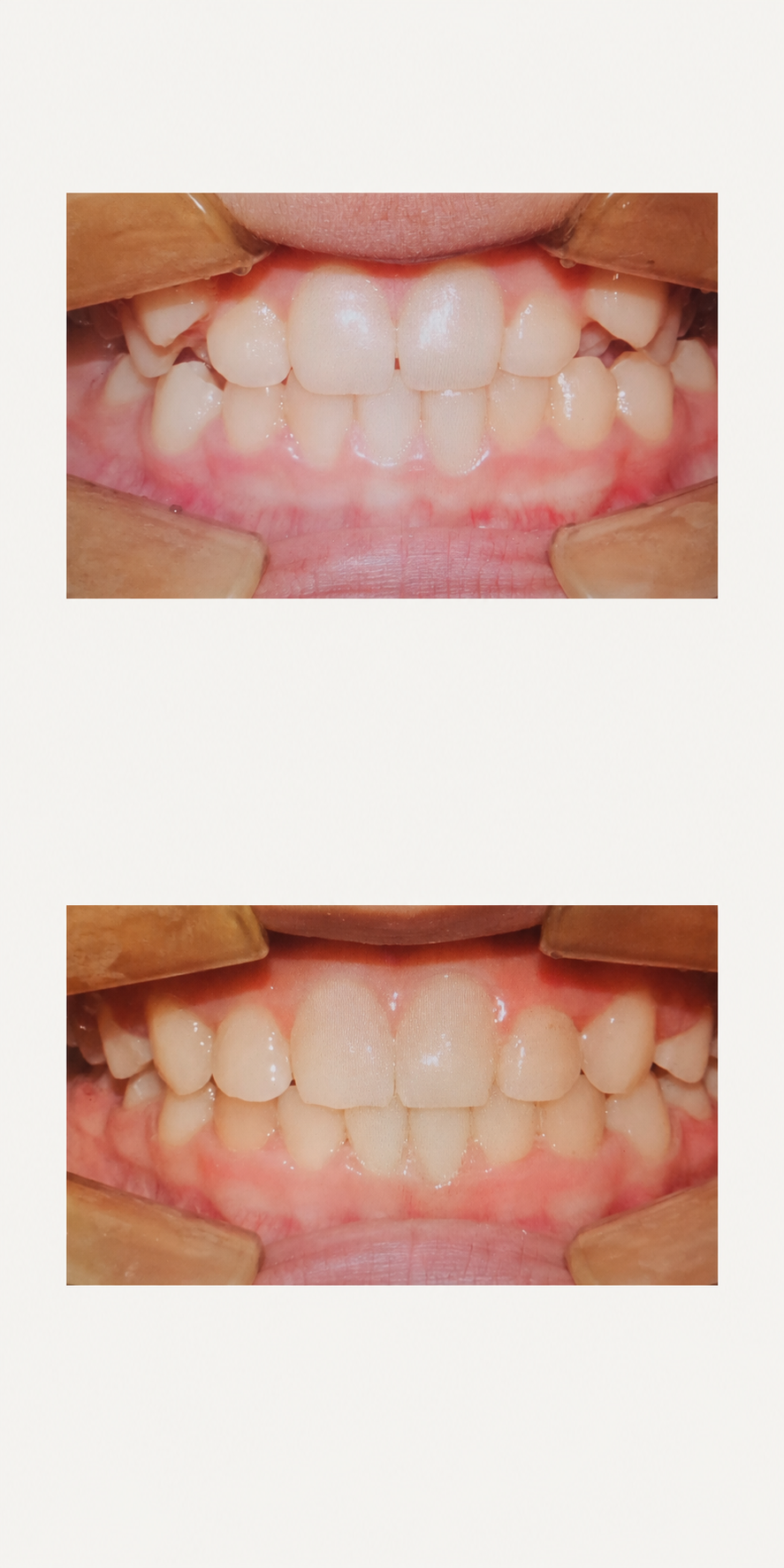
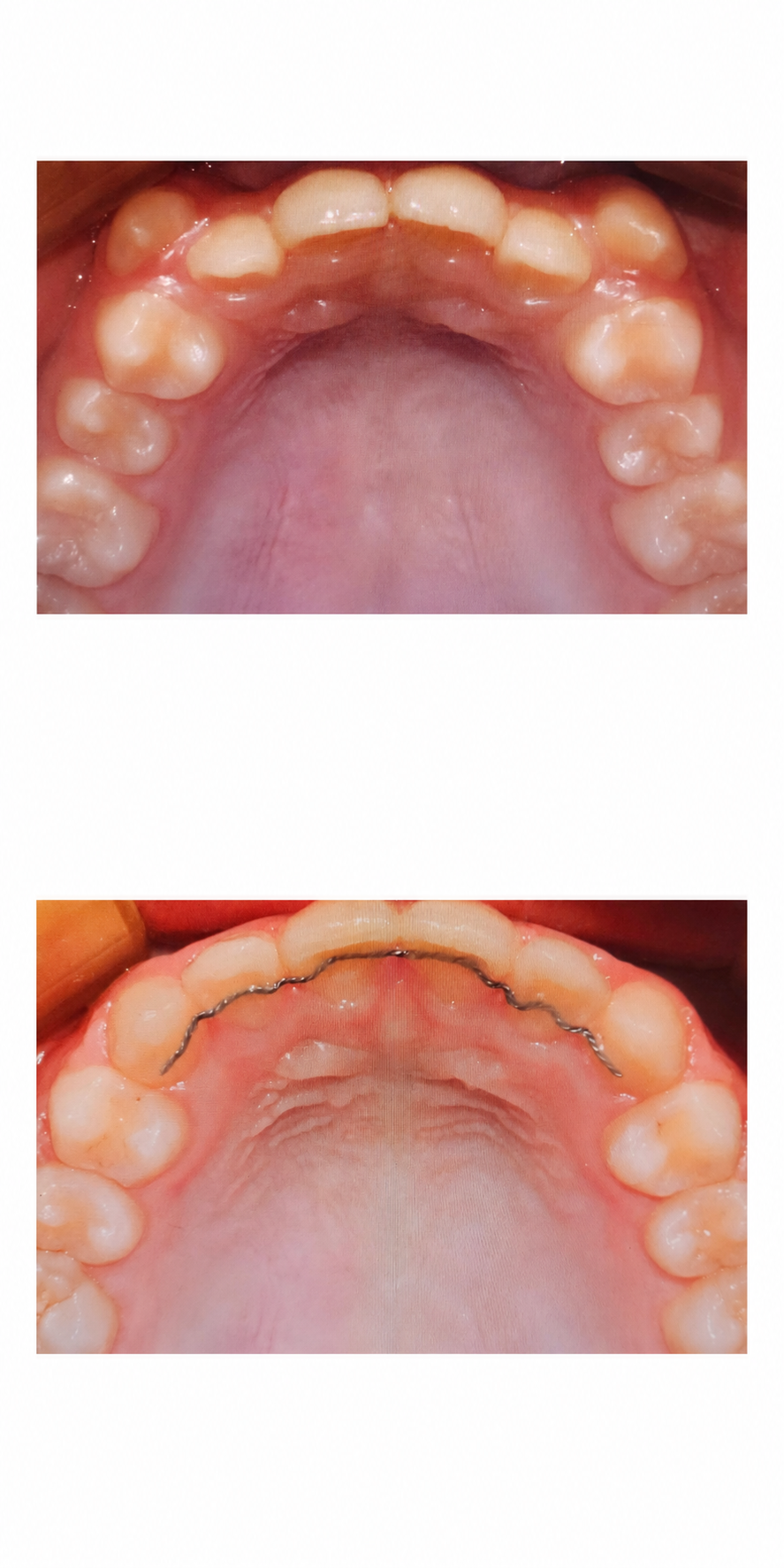
The expander’s home caseA high, narrow upper jaw often travels with open-mouth posture and a smile showing dark corridors at the sides. This is the classic RPE evaluation (₩300,000 where indicated) — and the case type in three of the four photos below.
A crossbite in a growing bite
Early correction earns itUpper teeth closing inside the lowers — front or back — can shift a growing jaw off-centre with every meal. This is one finding where acting early genuinely beats waiting, because the asymmetry it trains gets harder to untrain.
Thumb, dummy, or tongue habits
Soft habits, soft fixesSucking and tongue-thrust habits past the toddler years can hold front teeth apart or forward. Caught while the habit is young, correction is coaching and simple appliances — caught at twelve, it’s often orthodontics.
A baby tooth lost too early
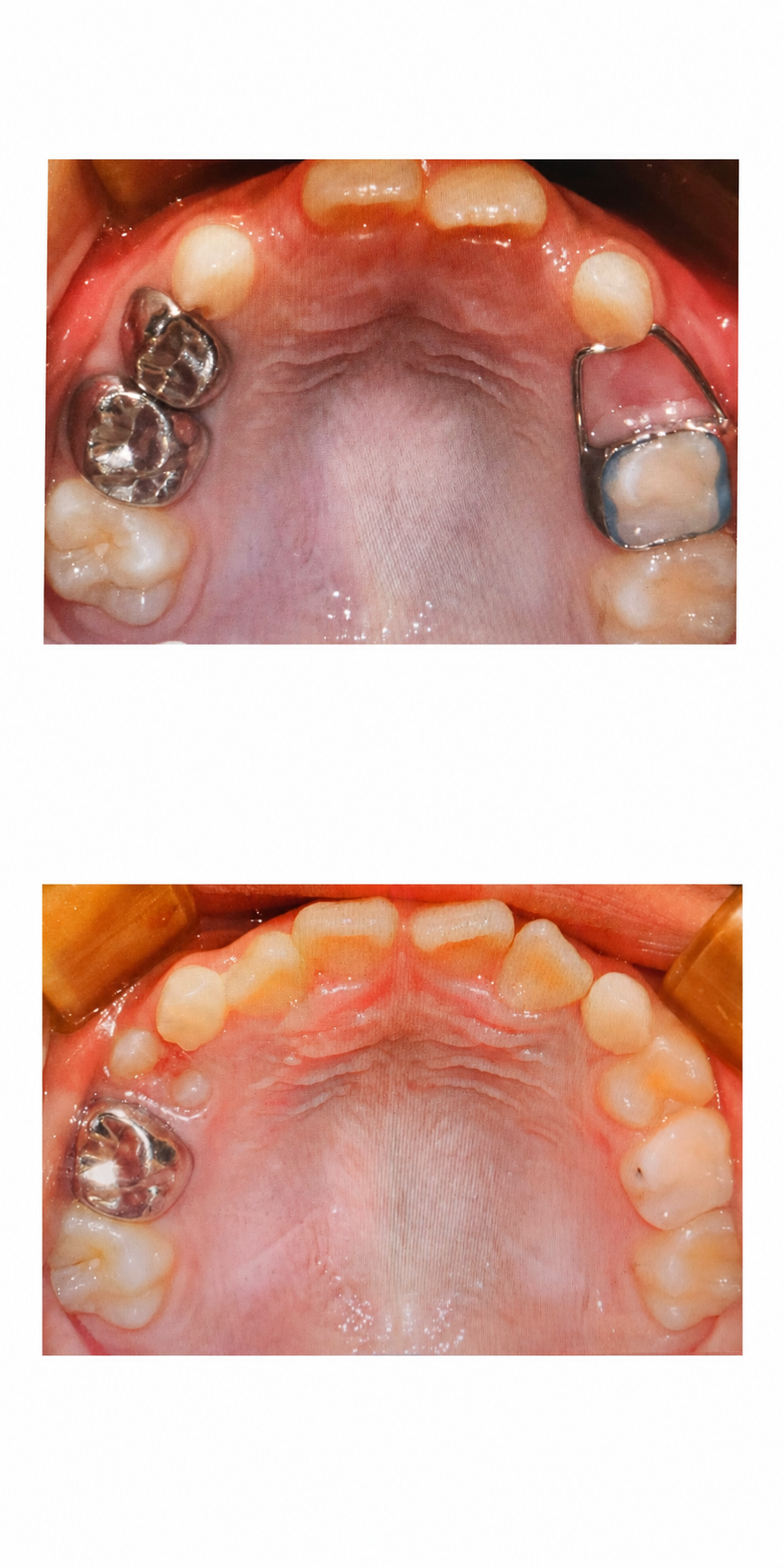
Hold the parking spotNeighbouring teeth drift into the vacancy within months, stealing the adult tooth’s space before it erupts. A simple space maintainer holds the spot — small appliance now versus crowding treatment later.
Crooked baby teeth
Usually: breatheBaby-teeth alignment predicts surprisingly little — and gaps between baby teeth are actually good news (adult teeth are wider and will want that room). The exam sorts the rare exception from the common non-issue.
“Everyone in class has braces”
Not a diagnosisPeer timing isn’t clinical timing. Some children genuinely benefit from early phases; many are best treated once, later, in the permanent dentition — and some never need treatment at all. The growth read decides, not the classroom census.
How children’s care actually goes.
The growth read
Exam, photos, and imaging where indicated (CT ₩30,000): jaw widths, bite relationship, eruption schedule, habits, airway posture. The output is a map of what’s developing — and a straight answer on whether anything needs doing yet (₩100,000, credited).
Watch, or act — said plainly
Most first visits end one of two ways: a scheduled recheck rhythm (“nothing yet — see you as the molars arrive”), or a specific, small early intervention with a specific, written reason. Never a default treatment plan.
Early-phase tools, where earned
Expander for the narrow jaw (₩300,000), crossbite correction, habit appliances, space maintainers — each targeting one growth-stage problem while growth can still help solve it. Small tools, precise jobs.
The eruption years
Between phases, the job is watching the adult teeth arrive into the room that was protected or created — periodic checks, photos for the file, and honest updates on whether the later phase is shrinking, holding, or (sometimes) cancelling itself.
Early guidance vs full treatment — two different jobs.
Children’s orthodontics runs on a two-phase logic — and the most honest sentence in it is that not every child needs Phase 1.
| Phase 1 — growth guidance | Phase 2 — full alignment | |
|---|---|---|
| When | During the mixed-dentition years, while jaws are still growing | Once the permanent teeth are in place |
| The job | Fix what growth can fix: widen a narrow jaw, correct a crossbite, break a habit, protect space | Align the finished set: straighten teeth and settle the bite |
| The tools | Expander (₩300,000), habit appliances, space maintainers — small and targeted | Braces(from ₩4,300,000) or aligners(₩3M–6M), sized to what remains |
| Who needs it | The minority with a specific growth-stage problem — named in writing, or not recommended | Those still needing alignment after eruption — often less than they would have |
| The honest risk | Over-selling: treating children who’d be fine — the industry habit this page refuses | Under-timing: missing the one window (e.g. expansion) that doesn’t reopen |
The two failure modes are opposites — treating too much, or missing the window — and the defence against both is the same: a growth read around age seven, honest words, and a recheck calendar. That’s the whole product for most families, and it costs ₩100,000, credited.
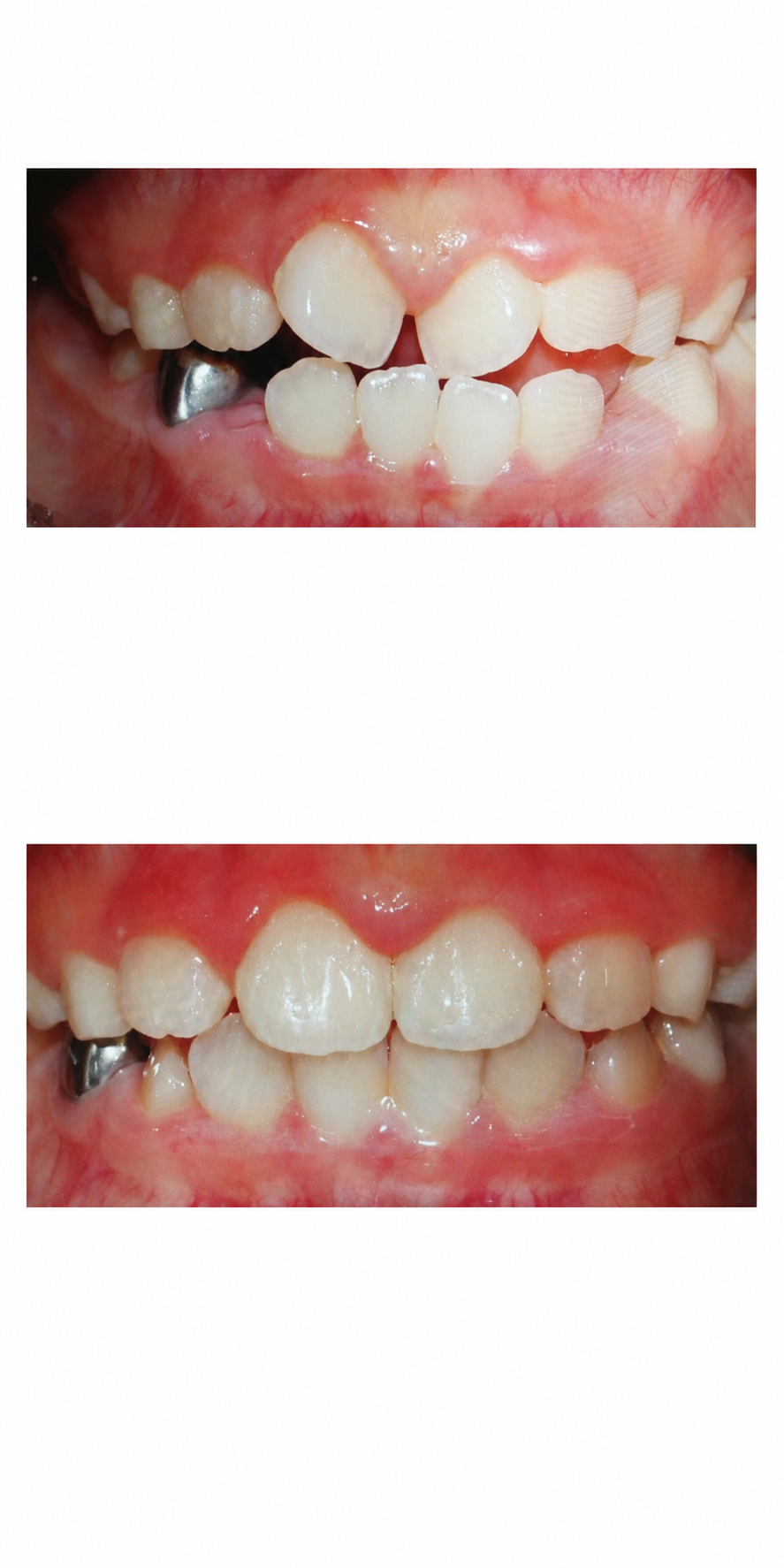
Growth-stage cases — before and after.
Children treated at Baro Dental — palatal expansion and growth-stage correction — photographed the same way before and after. Shown with parental consent; every child grows differently and results vary.
A growing bite’s calendar — what matters at each stage.
Ages are approximate — children run their own schedules — but the sequence is universal, and knowing it turns parental worry into parental watching.
Gaps are good news
A full set of twenty baby teeth, ideally with spaces between them — those gaps are pre-booked seating for wider adult teeth. The watch-list here is habits (thumb, dummy, tongue) and decay, not alignment; crooked baby teeth predict little.
The golden window opens
Adult front teeth and first molars arrive while baby molars still hold the sides — the stage where jaw patterns become readable and growth tools work best. This is why the first-check guideline points to around seven: not to treat, but to read. Narrow jaws, crossbites and space problems caught here are caught at their smallest.
Twelve teeth trade places
Canines and premolars erupt in a rush of wobbly-tooth years — the stage where protected space pays out and early corrections prove themselves. Watching visits track whether each adult tooth finds its seat; a temporary ugly-duckling middle gap here is normal and usually self-closing.
Now alignment is honest arithmetic
With permanent teeth in, whatever alignment remains is measured at its true size and treated once — often smaller for the early guidance, occasionally unnecessary because of it. The growth tools retire; standard orthodontics, at published prices, takes over only if the scan says so.
What exactly is a palatal expander, and why does it only work in children?
A small appliance seated across the roof of the mouth that gently widens the upper jaw at its midline seam — a seam that is still open and growable in childhood and progressively fuses toward adulthood. Widening through an open seam is guidance; the same appliance against a fused adult seam is a wall. That’s the whole reason this tool (₩300,000) has an age window — and why the window is worth a ₩100,000 look.
Does my child really need braces, or is the clinic selling?
The fairest test of any recommendation: does it name the specific problem, the specific window, and what happens if you wait? Legitimate early treatment answers all three in writing. At this clinic many first visits end with “nothing yet — recheck when the molars arrive,” because that’s frequently the true answer, and our prices are published precisely so recommendations don’t need to be revenue decisions.
How much does children’s orthodontics cost in Busan?
By phase, transparently: the growth read ₩100,000(credited toward any treatment), palatal expander ₩300,000, CT where indicated ₩30,000; small appliances quoted in writing at diagnosis. If full alignment is needed later, it’s the standard published menu — braces from ₩4,300,000, aligners ₩3M–6M — often at reduced scope because the early work shrank the job.
My child breathes through their mouth — is that a dental issue?
Sometimes, partly — and it’s worth the look. A narrow upper jaw and a high palate can crowd the nasal floor and travel with open-mouth posture; where that’s the pattern, expansion addresses the jaw component. The honest boundary: mouth-breathing has many causes — airways, allergies, adenoids — so we assess the dental share and say plainly when the next specialist to see isn’t a dentist at all.
Is the expander painful or hard to live with?
Gentler than its looks. Activation brings pressure at the nose bridge and mid-palate for minutes, not days; speech and eating renegotiate over the first week; and children adapt with the speed that regularly humbles their parents. The famous side-effect is the temporary front-teeth gap opening as the jaw widens — alarming-looking, textbook-normal, and it closes as the teeth settle into the new width.
We missed the early window — is it too late for my teenager?
For teeth, no — alignment works at any age, and the teenage years remain prime time for standard braces or aligners. What narrows with age is specifically the growth toolbox — expansion and jaw guidance fade as seams fuse and growth plates close. So: guilt unwarranted, urgency real. A teenager’s read is worth doing this year, not eventually.
Care by board-certified specialists in Seomyeon
Both directors are board-certified specialists in Advanced General Dentistry, so your cosmetic treatment is planned with your overall dental health in mind.

- Board-certified specialist, Advanced General Dentistry
- M.S. in Orthodontics, Kyungpook National University
- Focus on natural, alignment-led smile improvement
- Conservative, tooth-preserving approach

- Board-certified specialist, Advanced General Dentistry
- DDS, Dankook University College of Dentistry
- Restorative & aesthetic resin filling work
- Focus: natural, durable results
Small truths for watching parents.
- The ugly-duckling stage is real and normal. Around the front-teeth changeover, a middle gap with flared teeth looks alarming and usually resolves itself as the canines arrive — one of dentistry’s best examples of a problem that fixes itself if allowed to.
- Baby molars are appointment-keepers. They hold the space adult premolars will need for years — which is why a decayed baby molar is worth filling, not shrugging off as “it’ll fall out anyway.” Losing one early is how crowding gets a head start.
- The expander gap is a feature, not a fault. When a front-teeth space opens mid-expansion, the appliance is doing exactly its job — the jaw halves are moving apart as designed, and the gap closes afterward. Photograph it for the family archive; it’s temporary.
- Habit-breaking beats habit-blocking. Appliances help, but the durable wins come from coaching and timing — a habit released willingly at six beats one fought at ten. We involve the child in the plan, at child height, in plain words.
- English-speaking care includes small patients. International families in Busan get the growth read, the recheck calendar and the parent debrief in English — and children, as ever, adapt faster than anyone in the room.
When early treatment earns it — and when watching wins.
Early intervention earns its place when…
- the upper jaw is genuinely narrow — crossbite, dark smile corridors, crowding pressure — while the expansion window is open
- a crossbite is training a growing jaw off-centre — the finding where waiting actively costs
- a habit is holding teeth out of position while still soft enough to coach away
- a lost baby tooth’s space needs holding before neighbours steal it
Watching wins when…
- the finding is crooked baby teeth or the ugly-duckling gap — normal stages, not diagnoses
- no specific window is at stake — treatment that can wait for the permanent teeth usually should
- the recommendation elsewhere came without a named problem and a named reason — second opinions are what published prices are for
- the real issue is airway or ENT territory — we’ll say so and point you to the right specialist
Children’s orthodontics FAQ.
Gentler than most children expect: a look-and-count exam, photos, a bite check, and imaging only where genuinely indicated (CT ₩30,000). The dentist reads jaw widths, eruption progress and habits, then debriefs you in plain words — treat, watch, or all-clear — with a recheck rhythm if watching is the plan. The ₩100,000 fee credits toward any treatment; most first visits end without one.
Two stages: an active widening period, then a holding period while new bone consolidates in the widened seam — the holding phase matters as much as the turning phase, because bone that isn't given time to fill in gives the width back. Exact spans are set by your child's growth and response, mapped at diagnosis rather than promised on a page; removal happens when the consolidation is confirmed, not when a calendar says so.
Often yes — and that's not early treatment failing; it's early treatment doing a different job. Phase 1 fixes growth-stage problems (width, crossbites, space); Phase 2 aligns the finished teeth. The honest promise is that good early work makes the later phase smaller, simpler, and occasionally unnecessary — never that it guarantees escape. Any clinic promising "expander now, no braces ever" is selling past what growth can sign for.
Almost certainly not. Adult front teeth arrive full-sized into a child-sized face — they're meant to look too big, and mild crookedness at eruption often self-improves as the jaw grows into them and neighbours arrive. The one thing worth doing is the growth read, which separates the normal awkward phase (most cases) from the genuine space shortage (the minority) while both are still cheap to address.
For teens with permanent teeth in place, yes — aligner treatment works well and the discretion appeals at exactly that age; the honest requirement is wear discipline, which is a per-teenager conversation, not a per-age rule. For younger children in the mixing years, growth-stage tools do jobs trays can't, so the question usually isn't braces-versus-aligners yet — it's guidance-versus-waiting, answered at the check.
Yes — expat and visiting families are a natural fit for growth-stage care, which runs on periodic checks more than constant visits. The growth read and parent debrief happen in English; recheck rhythms map to your school and travel calendar; expander adjustments group into practical visits with WhatsApp photo checks between. If you're mid-treatment from another country, bring the records — we'll read them and continue honestly from where they left off.
Growth-stage care across visits.
Send a smile photo and a worry in a sentence on WhatsApp — “narrow smile,” “thumb at night,” “lost a molar early.” You’ll get an honest first read on whether it’s a check-now or a watch-item.
Exam, photos, imaging where indicated (CT ₩30,000), and the plain-words debrief: treat, watch, or all-clear — with written reasons either way (₩100,000, credited toward any treatment).
Expander fitting (₩300,000) or the indicated appliance, with adjustment visits grouped around school and travel calendars and photo check-ins on WhatsApp between them.
A recheck calendar matched to eruption milestones — the lowest-cost, highest-honesty product in orthodontics. Most families need exactly this, and we’re glad to say so.
Get the growth read — then decide with facts.
Send a photo of your child’s smile on WhatsApp with what’s worrying you — we’ll tell you honestly whether it reads treat-now, watch, or perfectly normal. In English, for parents.
Message us on WhatsAppBaro Dental Clinic · 5F, SJ Medical Building, 698-1 Jungang-daero, Busanjin-gu · Seomyeon Station Exit 2, 4 min
Explore the options in Busan.
Metal Braces in Busan
From ₩4,300,000 — Phase 2 alignment once the permanent teeth arrive.
Explore →Clear Aligners in Busan
₩3M–6M — the teen-friendly route for disciplined wearers.
Explore →Cavity Treatment in Busan
Baby molars hold adult teeth’s seats — filling them protects the schedule.
Explore →Crossbite Correction in Busan
The adult version — and why catching it in childhood is simpler.
Explore →Medical information on this page is provided for general education and does not replace an individual examination and diagnosis. Age references are general guidelines — every child’s growth runs its own schedule, and whether early treatment, an expander or watchful waiting suits your child is confirmed at an in-person growth assessment. Before-and-after photographs show real patients of this clinic, published with parental consent; individual results vary.