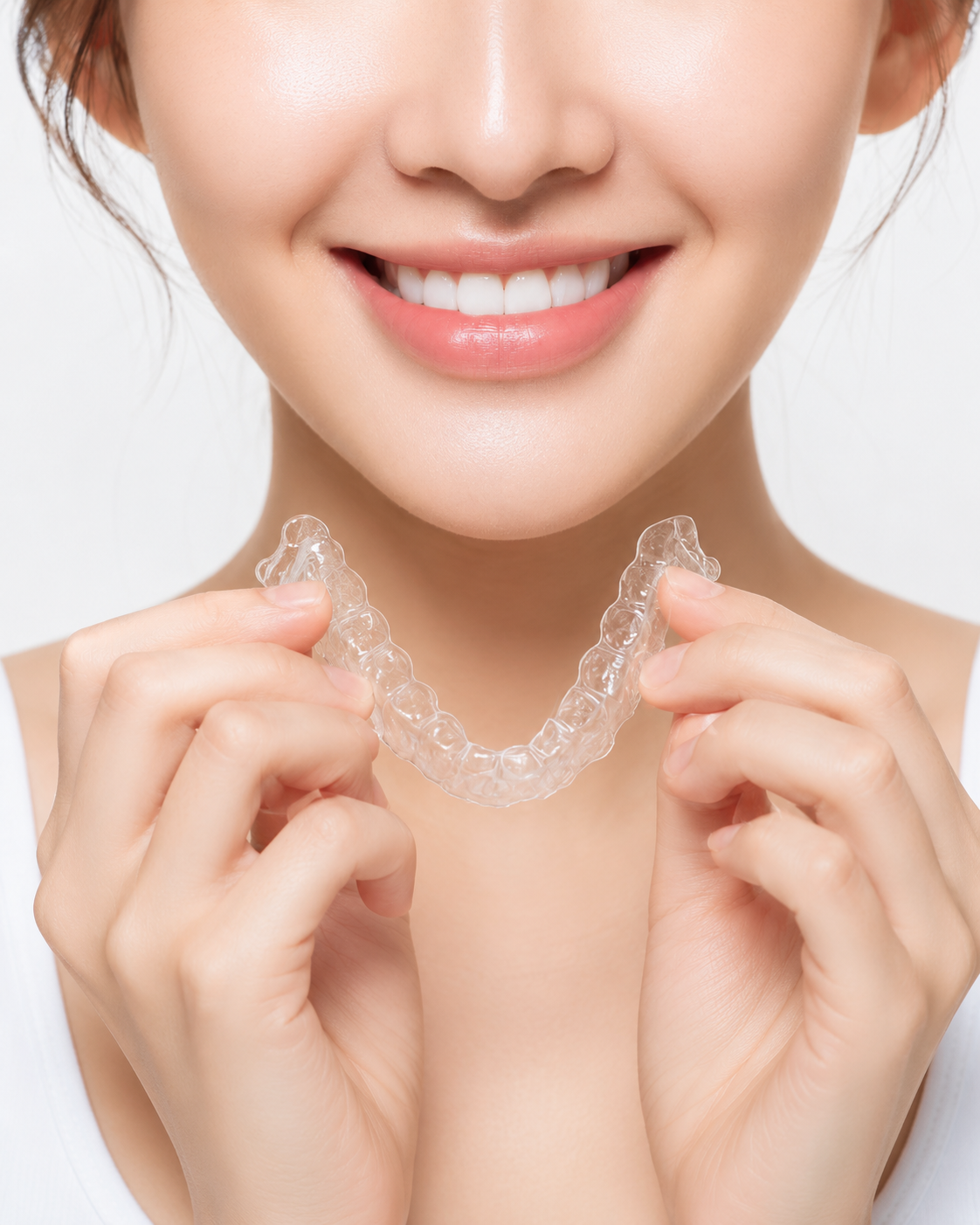
Clear aligners for crowding in Busan Seomyeon — crooked teeth, straightened quietly.
Overlapping, twisted or squeezed-in teeth are the most common case clear aligners treat — and one of the best documented at this clinic. Cerafin trays, dentist-planned, published pricing, and four real before-and-after cases on this page.
Ask about your crowded teeth.
Tap what fits — we’ll open WhatsApp with your message ready to send.Nothing sends until you press send in WhatsApp. Front and side photos help us give an honest first read — mild, moderate, or scan-needed.
Can clear aligners really fix crowded, crooked teeth?
Yes — mild and moderate crowding is exactly what aligners do best, and it’s the case type we treat most. Trays create space, unwind rotations and line the teeth up step by step; at Baro Dental the Cerafin system runs ₩3,000,000–6,000,000 by complexity, fixed in writing after diagnosis (₩100,000, credited).
The honest boundary sits at severe crowding — when there’s simply too little room in the jaw, cases may need fixed braces or, occasionally, a tooth removed to make space. Your 3D scan settles which category you’re in on day one, and the four real cases further down this page show what the achievable range looks like on actual patients of this clinic.
Why teeth crowd — and how trays un-crowd them.
Crowding is a space problem: the jaw has less room than the teeth need, so they overlap, rotate and squeeze wherever they fit. It’s partly inherited — tooth size and jaw size are dealt separately by genetics — and it often worsens gradually through adulthood, which is why teeth that were “a little crooked” at 20 can look noticeably crowded at 35.
Aligners solve it by making space first, then using it. Depending on your case, space comes from gently widening the arch form, guiding teeth backward, or interproximal reduction (IPR) — polishing fractions of a millimetre from between certain teeth, a routine and conservative step your plan specifies tooth by tooth. Once space exists, each tray rotates and aligns the crowded teeth into it, a fraction of a millimetre per tray.
And there’s a health case hiding behind the cosmetic one: overlapped teeth create tight traps that floss barely reaches, which is why crowding correlates with cavities between teeth and gum inflammation. Straightening crowded teeth is one of the few treatments that makes you look better and makes your daily brushing genuinely work better.
Six ways teeth crowd — and how aligners handle each.
“My teeth are crooked” covers very different situations. The pattern of your crowding shapes the plan — here’s the map we work through on your scan.
Lower front crowding
Aligners’ best eventThe small lower incisors squeezing and overlapping — the single most common complaint, often worsening through the 30s. Usually mild-to-moderate, and the case type aligners resolve most predictably.
Upper front overlap
Responds wellOne or both upper incisors tipped or lapped over their neighbours — the crowding everyone sees in photos. Space is created, the overlapped tooth is rotated and guided into line, and the smile line follows.
A canine standing outside the arch
Case-by-caseThe pointed corner tooth erupted high and outside the row — common where space ran out during eruption. Mild versions respond to aligners; severely displaced canines are long journeys that sometimes favour fixed braces. The scan decides, honestly.
A rotated tooth
Trays with gripA single tooth twisted on its axis — premolars especially. Aligners derotate these using attachments for grip; heavy rotations are planned early in the sequence because they’re the slowest movers.
Crowding plus a bite problem
Combined planCrowding rarely travels alone — deep bites and crossbites often ride along. Aligners can address both in one plan when the bite component is moderate; see deep bite and crossbite for those halves of the story.
Severe, jaw-level crowding
Braces territoryWhen several millimetres of space are missing per side, tray plastic reaches its limits — these cases do better with fixed braces (Clippy-C ₩5,100,000) and occasionally a planned extraction. If that’s your scan, we say it on day one, not month six.
From crowded scan to aligned finish.
Scan & space audit
Digital scan and imaging (₩100,000, credited) measure exactly how many millimetres of space your crowding needs — the number that decides everything: aligner case, braces case, or borderline.
The space plan
The 3D plan specifies where space comes from — arch development, guiding teeth back, or IPR between named teeth — and you see the projected final alignment before committing. Price fixed in writing here.
Unlock the crowding
Early trays create space and start the big rotations — the slowest movements go first. Attachments give trays grip on the teeth doing the hardest turning.
Line them up
With space open, the middle trays walk each tooth into the arch line — this is the stretch where photos start changing and colleagues can’t say what’s different.
Detail & retain
Final trays refine contact points and symmetry, then retention locks it in — clear retainer ₩100,000 or fixed wire ₩150,000–200,000, first-year adjustments covered. Crowded teeth remember; retainers make them forget.
Mild, moderate, severe — what each honestly needs.
| Mild crowding | Moderate crowding | Severe crowding | |
|---|---|---|---|
| Looks like | Slight overlap, one or two teeth a little off line | Clear overlapping, visible rotations, tight contacts | Teeth blocked out of the arch, major rotations |
| Space needed | Minimal — small refinements | A few millimetres, planned per tooth | Substantial — more than trays comfortably create |
| How space is made | Minor arch shaping, light IPR if any | Arch development + planned IPR between named teeth | Often extraction-assisted, mechanics beyond trays |
| Aligner fit | Excellent — shortest plans, lower price band | Good — the bread-and-butter Cerafin case | Honest answer: usually fixed braces |
| Price signal | Lower end of ₩3M–6M | Mid-range, fixed at diagnosis | Braces: Metal ₩4,300,000 · Clippy-C ₩5,100,000 |
Self-diagnosis from a mirror is unreliable in both directions — people with mild cases assume the worst, and vice versa. The ₩100,000 diagnosis (credited toward treatment) replaces guessing with a measured number.
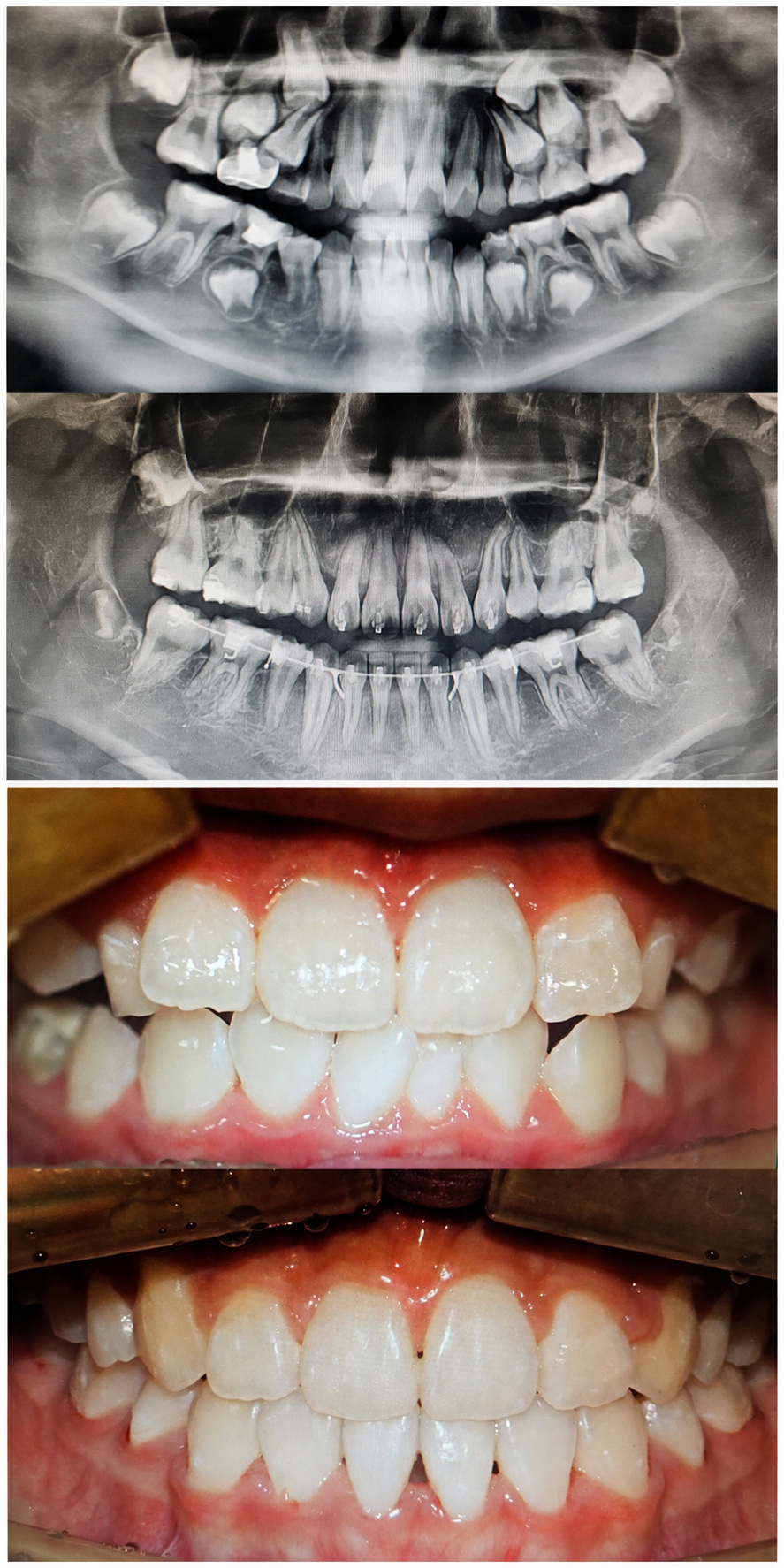
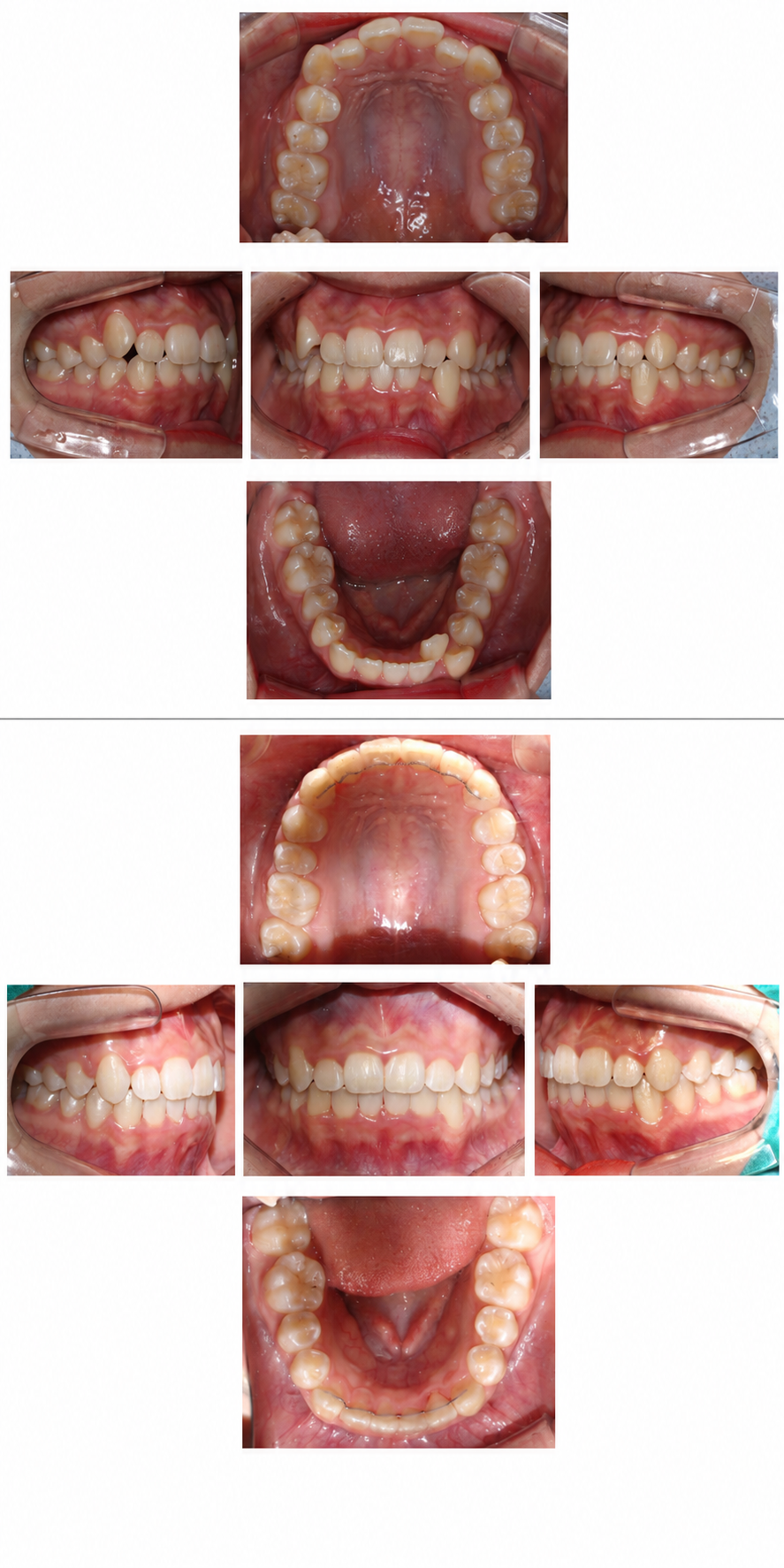
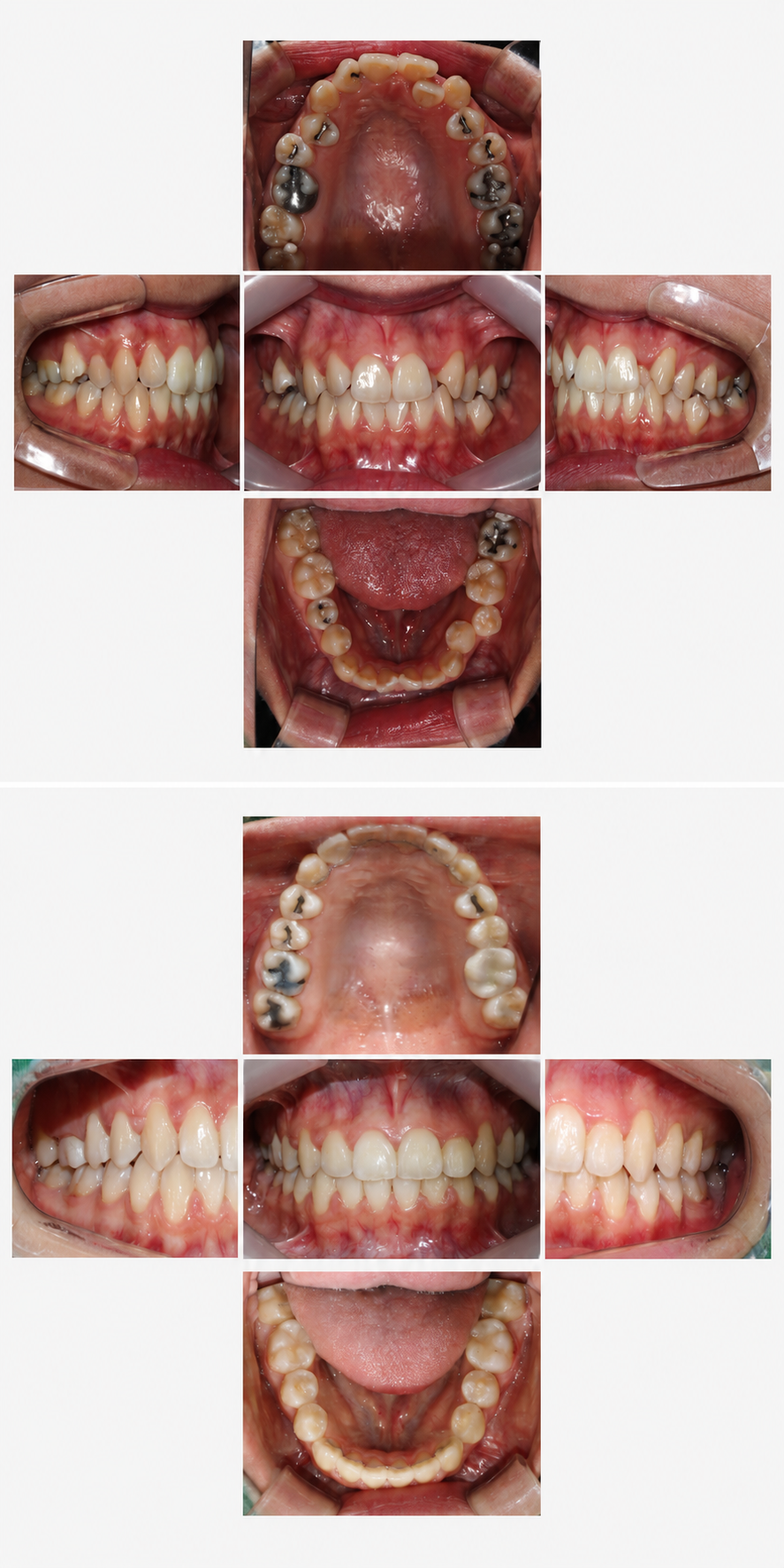
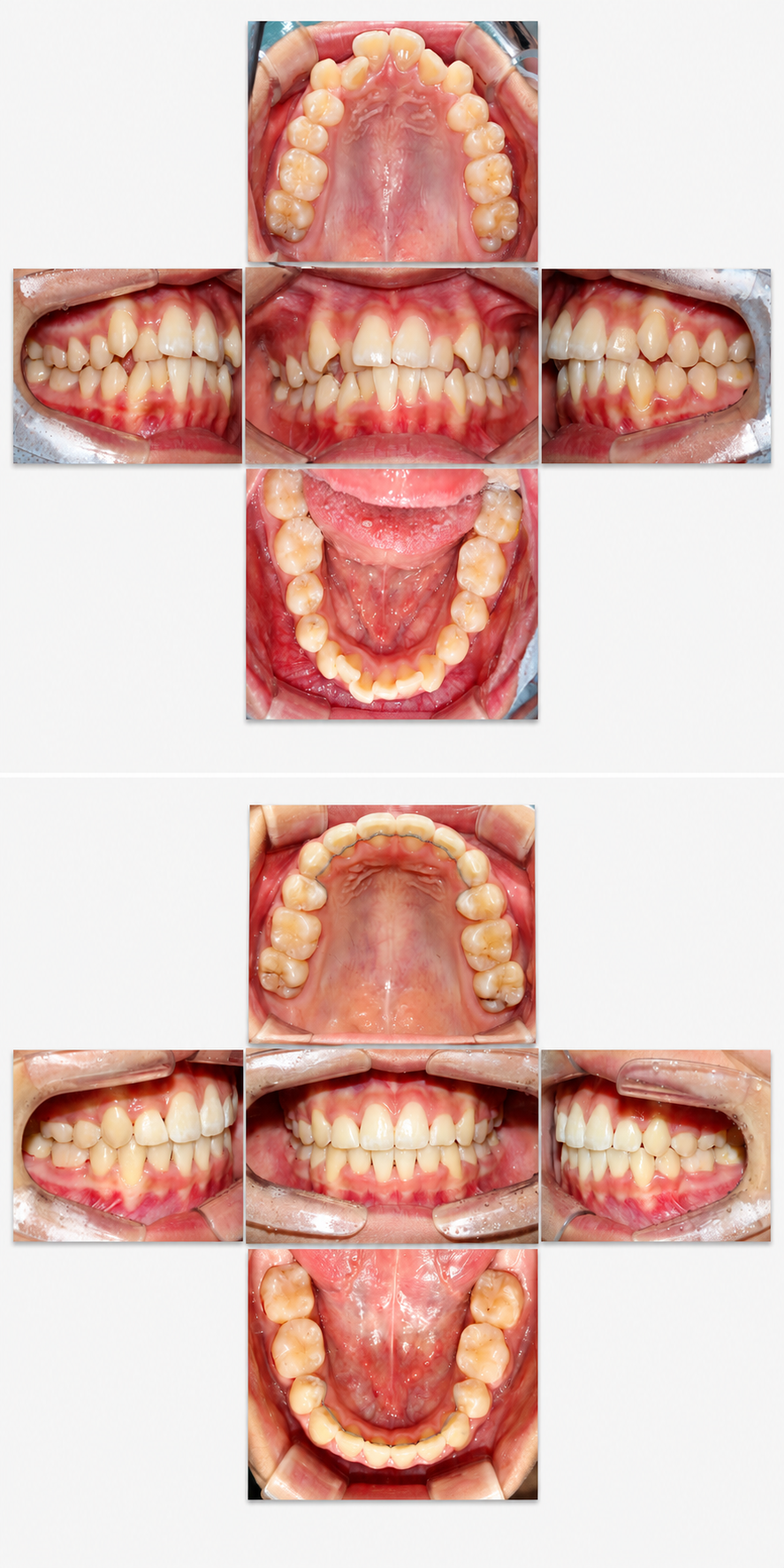
Four crowding cases — before and after.
Treated at Baro Dental with clear aligners, photographed the same way before and after. Shown with patient consent; every case is individual and results vary.
What crowding treatment asks of you.
The wear discipline
~22 hours a day, out only for meals and non-water drinks. Crowding plans front-load the hardest rotations, so early-tray discipline pays off double — a tray worn casually is a rotation that stalls, and stalled rotations are how plans get extended.
Cleaning the un-crowding teeth
As overlaps open, spaces that never saw floss suddenly exist — and briefly trap food enthusiastically. Floss the newly opened contacts daily and brush before trays go back in; your gums are about to become dramatically easier to clean, but the transition weeks need attention.
If IPR is in your plan
The polishing between teeth is quick, done without anaesthetic, and feels like nothing more than pressure and a gritty strip. Teeth may feel briefly “airy” where contact opened — that’s the space your plan just created, and the next trays begin using it.
After the last tray
Crowded teeth are the most relapse-prone in orthodontics — they spent years learning their old positions. Retention isn’t optional here: clear retainer ₩100,000 or fixed wire ₩150,000–200,000 behind the front teeth, first-year adjustments covered. Nightly wear is the whole insurance policy.
Will I need a tooth removed to fix crowding?
Usually not. Most mild and moderate crowding is resolved with arch shaping and IPR — conservative space-making, no extractions. Removal enters the conversation only in severe cases where several millimetres per side are missing, and those cases usually belong with fixed braces anyway. Your scan answers this definitively at diagnosis, before any commitment.
Why did my straight teeth get crooked in my 30s?
Two quiet forces: teeth drift forward and inward throughout adult life (dentists call it mesial drift), and the lower front teeth — the smallest, with the shortest roots — lose that squeeze first. Add relapse from teenage braces without retainers, and “my teeth moved” becomes the most common adult orthodontic story there is. The good news: later-life crowding is usually mild and sits at the friendlier end of the price range.
Is IPR safe? It sounds like damaging my teeth.
IPR polishes away fractions of a millimetre of outer enamel at planned contact points — within the enamel layer, done with measured instruments, tooth by tooth per your written plan. It doesn’t weaken teeth or increase decay risk when properly performed and cleaned. The honest comparison: it’s far more conservative than extracting a whole tooth to make space.
How much does crowding treatment cost in Busan?
Within Cerafin’s published ₩3,000,000–6,000,000 — where you land depends on how much space your case needs and how many teeth rotate. Mild lower-front crowding sits toward the lower end; combined upper-lower cases with rotations sit higher. The number is fixed in writing at diagnosis (₩100,000, credited) — and if braces would honestly serve you better, we quote those instead (Metal ₩4,300,000 / Clippy-C ₩5,100,000).
Can crowding come back after treatment?
Yes — crowding is the most relapse-prone correction in orthodontics, which is why we say it plainly rather than in the small print. Fibres around the teeth pull toward old positions for years. The counter is retention: nightly clear retainer (₩100,000) or a fixed wire behind the front teeth (₩150,000–200,000), first-year adjustments covered. Patients who wear retainers keep their result; patients who don’t, fund our relapse caseload.
Is fixing crowded teeth just cosmetic?
No — and this is the underrated half. Overlapped teeth create contact points floss can’t properly reach, which is why crowding tracks with between-teeth cavities and gum inflammation. Aligned teeth are simply cleanable teeth. The cosmetic upgrade is what you see; the hygiene upgrade is what your dentist sees at every check-up for the rest of your life.
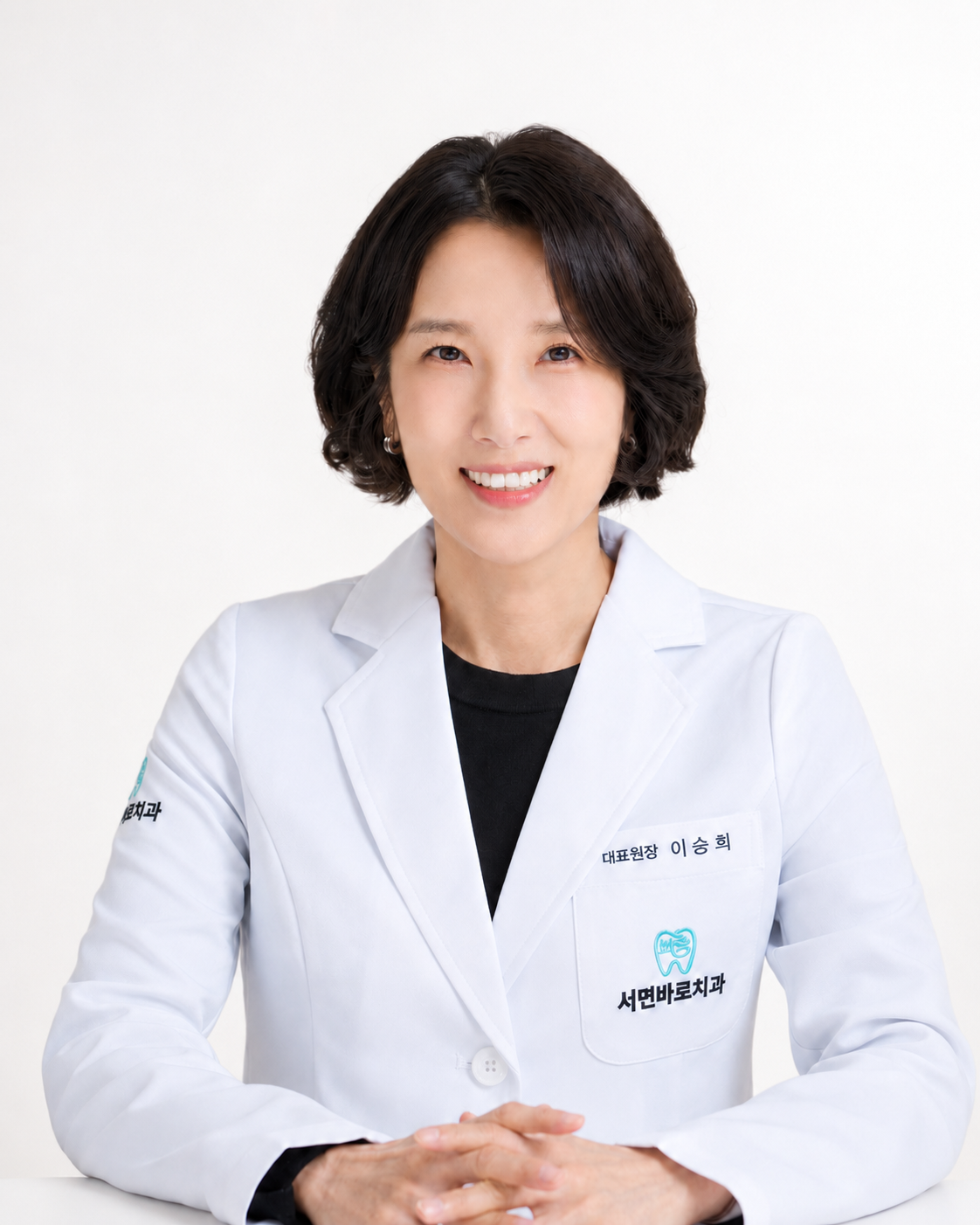
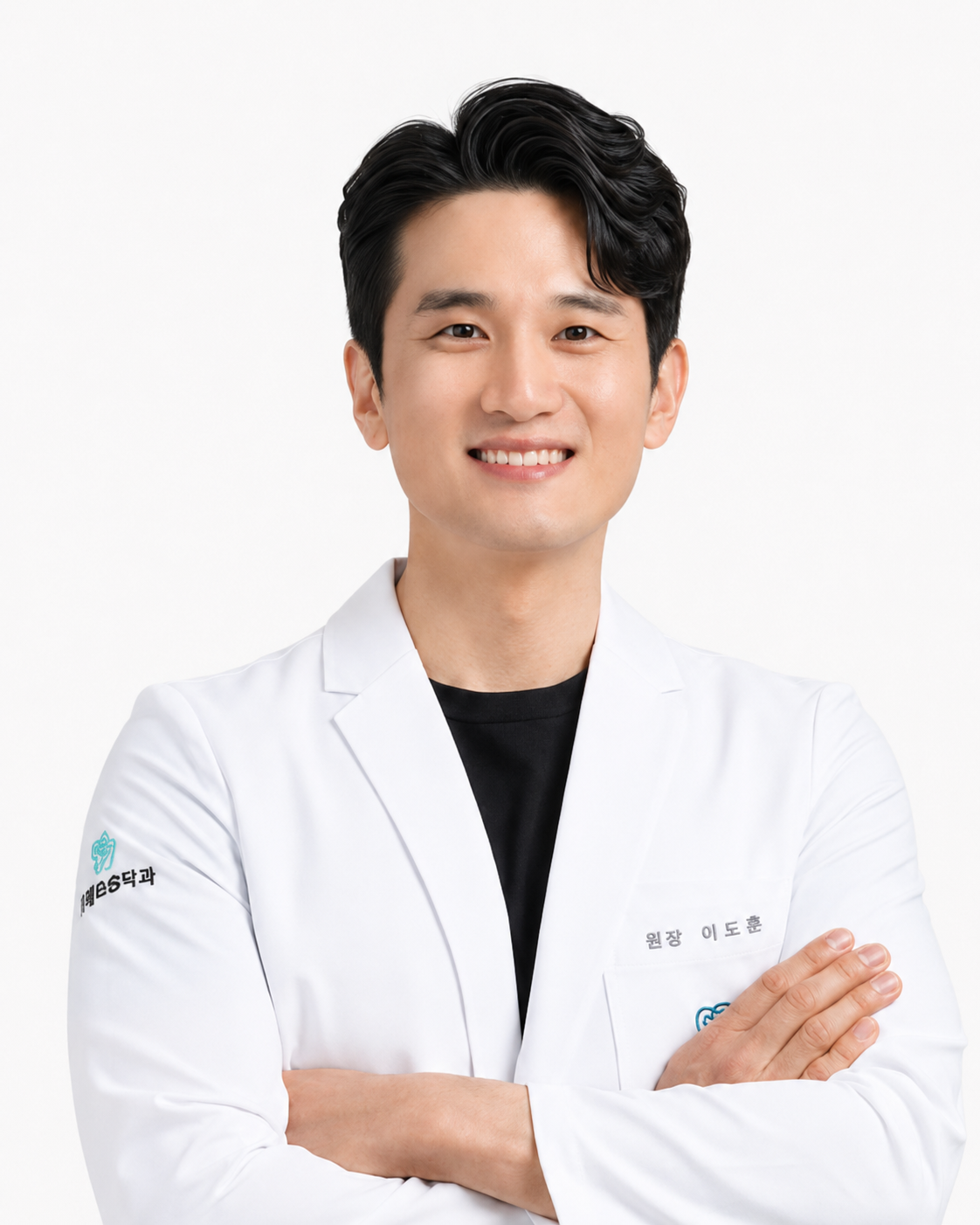
Care by board-certified specialists in Seomyeon
Both directors are board-certified specialists in Advanced General Dentistry, so your cosmetic treatment is planned with your overall dental health in mind.
- Board-certified specialist, Advanced General Dentistry
- M.S. in Orthodontics, Kyungpook National University
- Focus on natural, alignment-led smile improvement
- Conservative, tooth-preserving approach
- Board-certified specialist, Advanced General Dentistry
- DDS, Dankook University College of Dentistry
- Restorative & aesthetic resin filling work
- Focus: natural, durable results
Small truths about crowded teeth.
- Wisdom teeth probably didn’t cause your crowding. The old story blames them, but front crowding develops with or without wisdom teeth — drift and jaw-tooth size mismatch do the real work. (Whether yours need attention is a separate question: wisdom tooth page.)
- Rotated teeth are the marathon runners. Round-rooted teeth like premolars rotate slowly and relapse eagerly — which is why plans start them first and retainers matter most where rotations were biggest.
- Crowding photographs worse than it looks. Front-facing photos flatten depth, making overlap look sharper than in person — a reason people finally book after seeing a group photo. The scan measures what the camera exaggerates.
- The tongue notices alignment before the mirror does. Patients routinely report the strange smoothness of a straightening arch weeks before friends see it — a genuinely pleasant progress signal.
- Whitening lands better on straight teeth. Overlaps create shadows that read as discolouration; many patients finish alignment and whiten (from ₩165,000) after, when every surface finally faces the light.
When aligners fix crowding — and when we’ll say braces.
Aligners are the right call when…
- your crowding is mild or moderate — measured on the scan, not eyeballed in a mirror
- the space your teeth need can be made conservatively: arch shaping and planned IPR
- gums and bone are healthy — the foundation check every adult case starts with
- you can hold the ~22-hour wear, because crowding plans punish casual wear fastest
We’ll recommend braces when…
- the space shortfall is severe — several millimetres per side is wire-and-bracket work, honestly quoted ( Clippy-C ₩5,100,000)
- a canine is blocked far outside the arch — long vertical journeys favour fixed control
- your crowding rides with a bite problem beyond tray mechanics — shown to you on your own scan
- your honest wear-time answer is “probably not 22 hours” — braces work without willpower; trays don’t
Crowding & aligners FAQ.
A rough home signal: if teeth overlap slightly but every tooth is clearly in the row, that reads mild; if teeth visibly twist or lap over each other, moderate; if a tooth sits noticeably outside the line of the arch, severe. But mirrors mislead in both directions — the diagnosis scan (₩100,000, credited toward treatment) measures the actual space shortfall in millimetres, which is the number that decides the plan.
Expect pressure rather than pain — each new tray feels tight for a day or two, strongest in crowded zones where the most movement is happening. Most patients manage without anything; some take ordinary pain relief on switch days. IPR, if planned, is quick and needs no anaesthetic.
Sometimes, yes — limited plans targeting just the lower front crowding exist and cost toward the lower end of the range. The honest caveat: your bite is a system, and isolated movement occasionally needs small adjustments elsewhere to finish well. The 3D plan shows exactly how contained your case can be before you decide.
Adult teeth drift slowly forward and toward the midline throughout life, and the lower front teeth — smallest roots, tightest quarters — buckle first. It's normal biology, not something you did wrong. It also means crowding untreated tends to progress rather than hold still, which is a fair factor in the "now or later" decision.
Yes — that's the structure. The diagnosis visit (₩100,000, credited if you proceed) produces your scan, the measured space analysis, and a 3D simulation of the projected result. You review all of it, with the written price, before any tray is manufactured. If you decide it's not for you, the diagnosis was the entire cost.
Yes, with planning — aligner treatment travels well. Diagnosis and fitting happen in-clinic; between visits you switch trays on schedule wherever you are, with WhatsApp check-ins. The check-in rhythm is mapped at diagnosis around how often you're realistically in Busan; patients living abroad complete crowding cases this way routinely.
Crowding treatment across visits.
Send front and side photos of your teeth on WhatsApp. We’ll give an honest first read — likely mild, moderate or scan-needed — and what the diagnosis visit would settle.
Scan, space measurement, 3D simulation, written price. If you proceed, tray production begins and your wear-and-switch schedule is mapped to your travel pattern.
Trays switch on schedule wherever you live; progress photos and questions run through WhatsApp. IPR steps, where planned, are grouped into your Busan visits.
Final detailing and retainer fitting in-clinic (clear ₩100,000 / fixed ₩150,000–200,000, first-year adjustments covered) — timed to a trip you were already making.
Find out what your crowding actually measures.
Send photos of your teeth on WhatsApp — we’ll tell you honestly where your case likely sits, and what the ₩100,000 diagnosis (credited toward treatment) would map out. In English.
Message us on WhatsAppBaro Dental Clinic · 5F, SJ Medical Building, 698-1 Jungang-daero, Busanjin-gu · Seomyeon Station Exit 2, 4 min
Explore the options in Busan.
Clear Aligners Hub
How Cerafin treatment works, every case type, and the full pricing picture.
Explore →Aligners for Adults in Busan
Straightening around meetings, dinners and travel — the working-life guide.
Explore →Aligners for Gaps in Busan
The opposite problem — closing spaces instead of making them.
Explore →Fixed Braces in Busan
Metal ₩4,300,000 · Clippy-C ₩5,100,000 — for the crowding trays can’t reach.
Explore →Medical information on this page is provided for general education and does not replace an individual examination and diagnosis. Whether clear aligners suit your crowding — and your plan, timeline and exact fee within the stated range — are confirmed at diagnosis. Before-and-after photographs show real patients of this clinic, published with consent; individual results vary.