Partial braces in Busan Seomyeon — small problem, right-sized fix.
When only the front teeth need work — a shifted tooth, a small gap, post-braces relapse — brackets on just that section correct just that problem. ₩2,500,000 published, a fraction of full treatment, honestly limited to what it can honestly do.
Ask about partial braces.
Tap what fits — we’ll open WhatsApp with your message ready to send.Nothing sends until you press send in WhatsApp. A front bite photo helps us give an honest first read — partial-sized, full-sized, or tray-sized.
What are partial braces in Busan — and is my case small enough?
Brackets bonded only to the front six-to-eight teeth, moving only that section — the tool for problems that genuinely live there: a front tooth that shifted after old braces, minor crowding or a small gap, one rotated incisor. Published price ₩2,500,000 — roughly half of full treatment, because it’s roughly half the appliance doing a fraction of the work. Fixed in writing at diagnosis (₩100,000, credited).
“Small enough” is a bite question, not a looks question — and it’s the honest heart of this page. Front teeth can move independently only while the back bite stays untouched; the moment a case needs bite change, space from the molars, or arch-wide correction, partial becomes the wrong tool at any price. The scan makes that call at diagnosis, and if yours is a full-treatment case, you’ll hear it before a single bracket goes on — with the full options priced just as transparently.
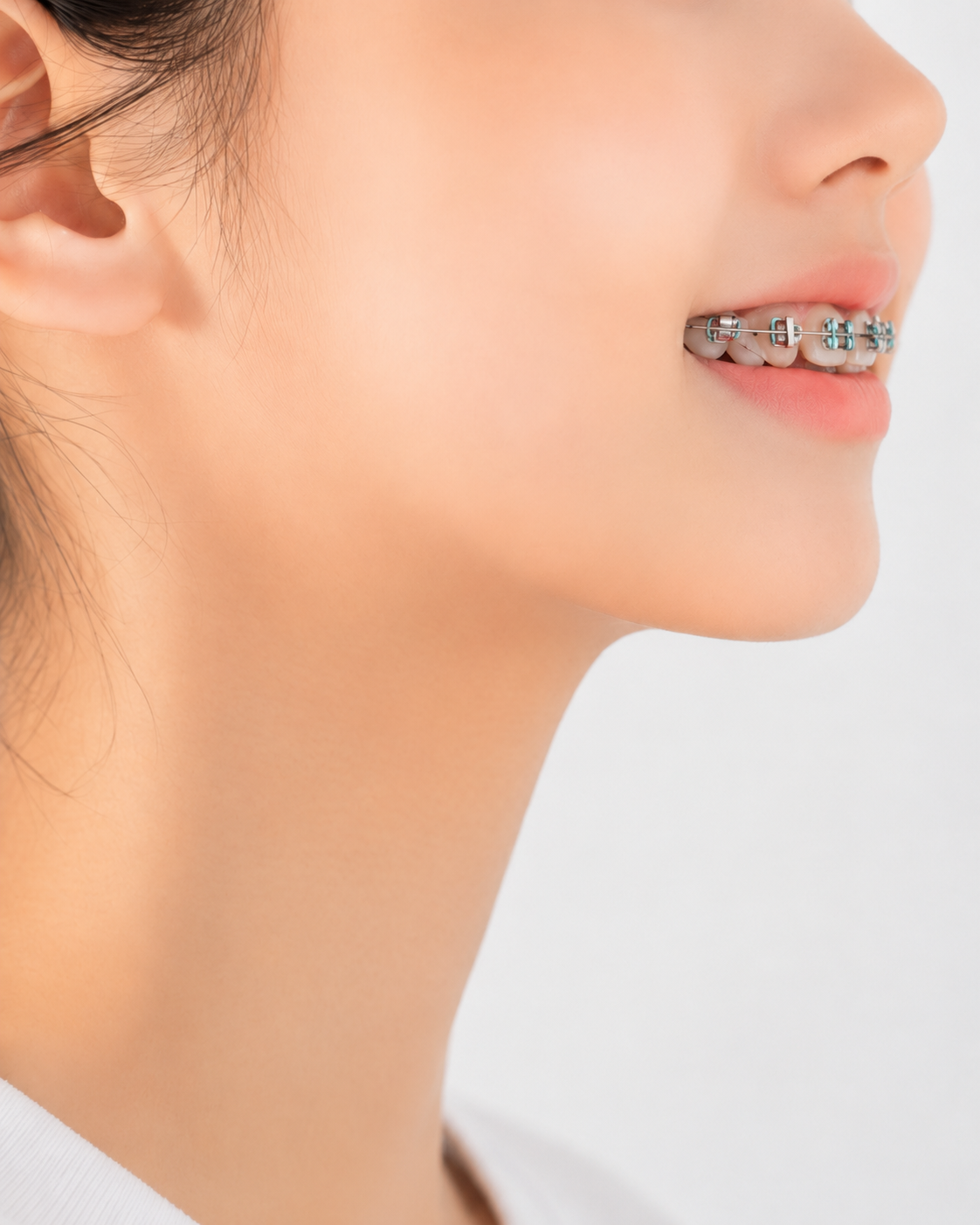
Treating the section that has the problem.
Full orthodontics treats the mouth as one system — every tooth bracketed, the whole bite rebuilt. That’s the right scale for bite problems. But a large share of adult complaints aren’t bite problems at all: they’re front-section problems — the visible six, sometimes eight, teeth between the canines or premolars, slightly out of line while everything behind them meets perfectly well.
Partial braces match the appliance to that reality. Brackets bond to the front section only; a short archwire levels, rotates and closes within it; the back teeth — and the bite they carry — stay exactly as they were. Less hardware, fewer movements, shorter plans, and a price that reflects both: ₩2,500,000 against full metal’s ₩4,300,000.
The single biggest population this serves, honestly, is orthodontic relapse: people who wore braces years ago, drifted away from their retainers, and watched the front teeth — always the first to move — slowly un-straighten while the back bite held firm. That pattern is practically partial braces’ job description, and it gets its own section further down, because understanding why relapse happens front-first is also understanding why this fix fits it.
Six front-section cases — and one honest boundary.
Post-braces drift
Partial’s #1 customerStraightened once, retainer retired, front teeth wandered while the back bite held. The correction is small because the relapse is front-loaded — and this time the retainer plan comes with enforcement built in.
One or two turned incisors
Targeted rotationA single front tooth twisted out of line in an otherwise tidy arch. A bracket on the culprit and its neighbours unwinds it without recruiting the whole mouth to the project.
Minor front crowding
Millimetres, not molesSlight overlap in the lower or upper front teeth with a healthy bite behind — the classic “it’s just these two” case. Small space needs are met within the section (light IPR where planned), not borrowed from the molars.
A modest front gap
Moved, not paddedSpacing confined to the front teeth — where it’s too wide for resin (₩150,000) but doesn’t justify full treatment. Partial brackets close it with your own enamel at section scale.
Alignment before restorations
Order of operationsFront teeth needing minor repositioning before crowns or cosmetic work — aligning the foundations first so restorations are built onto teeth standing where they should. Sequenced and priced as one plan.
A bite problem wearing a front-teeth disguise
The honest boundaryCrooked front teeth caused by deep bites, crossbites or arch-wide crowding aren’t front-section problems — they’re whole-bite problems showing up front. Partial treatment there buys a relapse; the scan catches it, and full options get quoted instead, honestly.
How partial treatment actually goes.
The boundary exam
Scan and photos answer the one question that matters: does this problem truly live in the front section, or is the bite involved? (₩100,000 diagnosis, credited; CT ₩30,000 where indicated.) The verdict is shown on your own imaging.
Section bonding
Brackets go on the front six-to-eight teeth only — a shorter, lighter appointment than full bonding, with the first flexible wire in the same visit. Back teeth stay bare.
Level, rotate, close
The short wire works the section: overlaps unwind, the gap narrows, the drifted tooth walks back into line. Small scope means visible progress comes quickly — the motivating math of partial treatment.
Check the bite didn’t move
The discipline of doing partial right: at each adjustment, the untouched back bite is verified untouched. Front movement that starts nudging the bite is the signal to pause and reassess honestly — built into the plan, not improvised.
Debond & retain — seriously this time
Brackets off, polish, and retention fitted the same day: clear ₩100,000 or fixed wire ₩150,000–200,000, first-year adjustments covered. For relapse patients especially, the retainer is the treatment’s second half.
Partial, full, or aligners — sized honestly.
| Partial braces | Full braces | Clear aligners | |
|---|---|---|---|
| Scope | Front 6–8 teeth only | Every tooth, whole bite | Whole arch — trays cover everything by design |
| Right problem | Minor front crowding, small gaps, relapse, one rotation | Bite problems, extraction cases, arch-wide work | Tray-sized cases across the spectrum — see the hub |
| Published price | ₩2,500,000 | ₩4,300,000 metal / ₩5,100,000 Clippy-C | ₩3,000,000–6,000,000 by case |
| Time scale | Shortest — small movements, small count | Longest — it’s rebuilding a bite | Case-dependent, planned at diagnosis |
| The honest limit | Cannot touch the bite — and mustn’t try | Overkill for a two-tooth problem — and we’ll say so | Extraction-level work says no honestly |
Three tools, three published prices, one clinic — so right-sizing is a diagnosis decision, not a sales decision. Mild front cases sometimes suit either partial brackets or a short aligner plan; where both genuinely work, you choose on lifestyle, with the trade-offs laid out plainly.
Partial braces — before and after.
Front-section cases treated at Baro Dental with partial braces, photographed the same way before and after. Shown with patient consent; every case is individual and results vary.
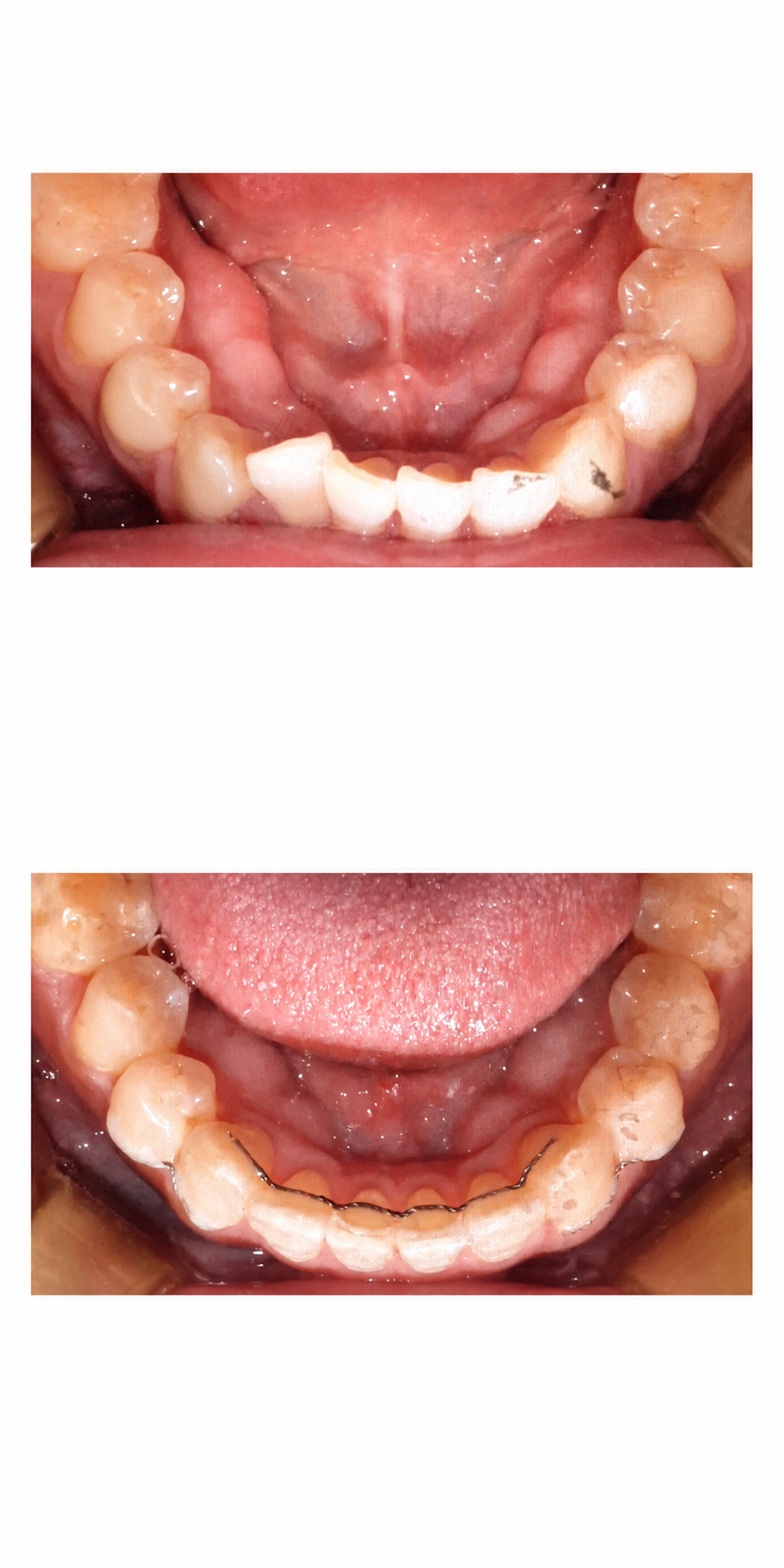
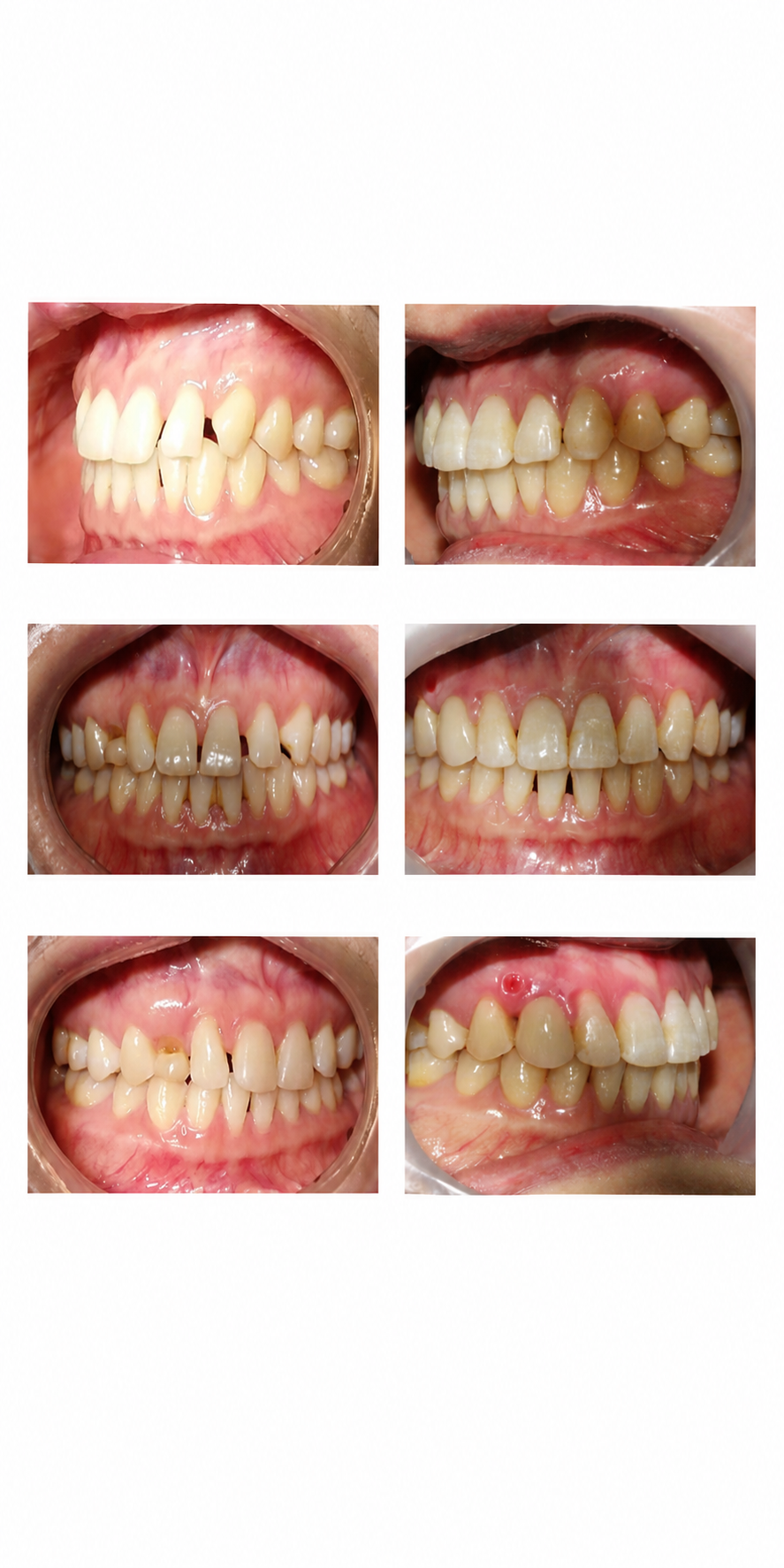
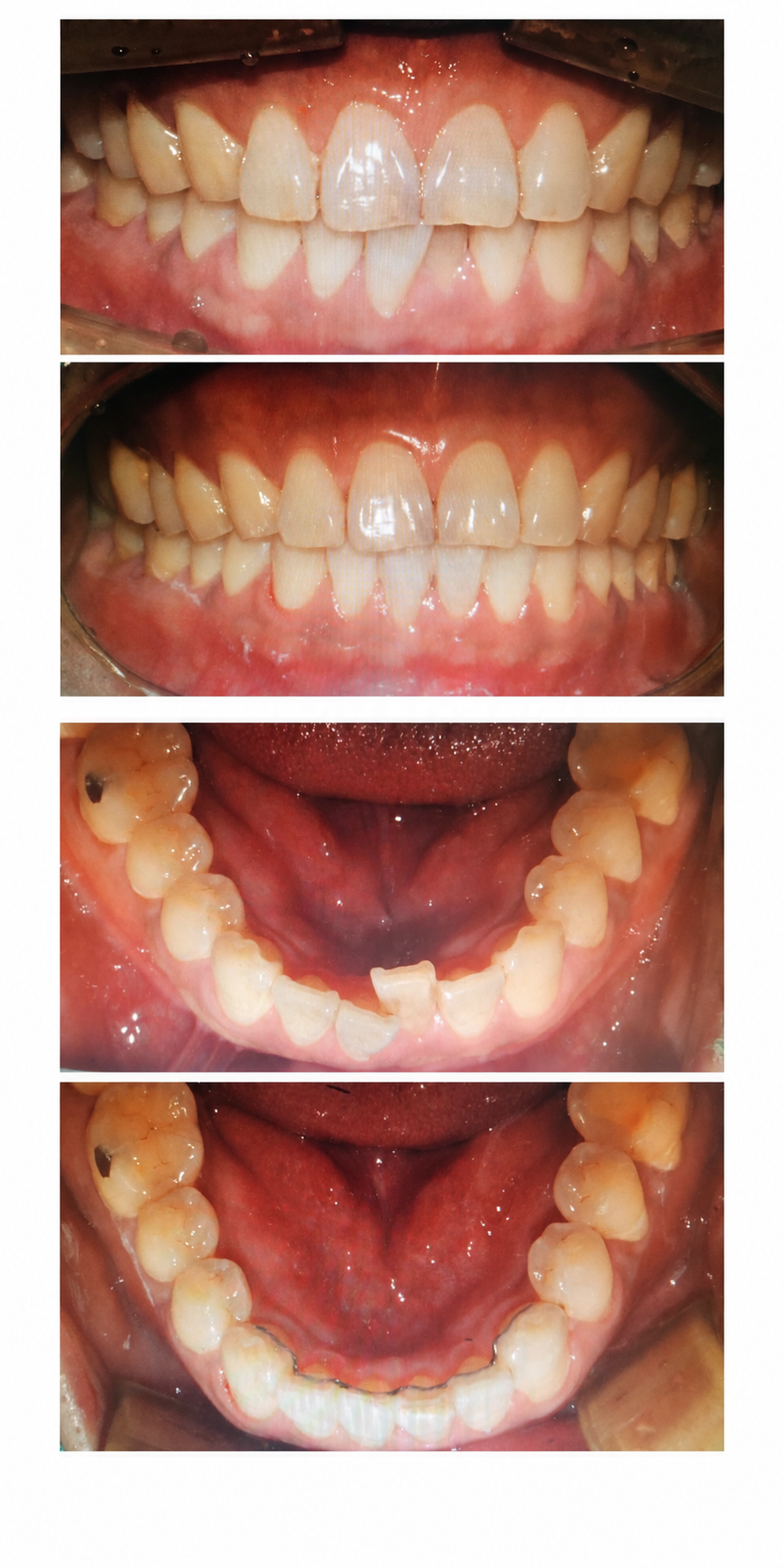
The anatomy of relapse — why old braces cases drift front-first.
If your teeth were straight once and aren’t now, this is your section. The pattern is so predictable it practically designed this treatment.
The retainer retires quietly
Nobody decides to stop — the retainer migrates to a drawer, the nightly habit thins to weekly, then to “where is it, actually?” Years one to three after braces are when the guard drops, precisely when gum fibres still remember the old positions.
The front teeth move first — by design flaw of biology
Front teeth are single-rooted, lightly held, and squeezed by lips and tongue all day; molars are multi-rooted anchors locked into a working bite. When old forces reassert, the front row folds first while the back bite barely notices — which is why relapse looks like “just my front teeth went crooked.”
Which is exactly partial braces’ shape
A front-section problem over an intact bite is the textbook partial case: the back teeth never moved, so nothing back there needs fixing — re-treating the whole mouth would bill you for correcting teeth that stayed put. ₩2,500,000 addresses what actually moved.
This time, the ending changes
The relapse taught the lesson the first orthodontist’s warning couldn’t: retention isn’t an epilogue, it’s the second half. A fixed wire behind the front teeth (₩150,000–200,000) removes the willpower variable entirely; the nightly clear retainer (₩100,000) works for those who’ve proven they’ll wear it. First-year adjustments covered — and the drawer stays empty.
How much do partial braces cost in Busan?
₩2,500,000, published — fixed in writing at diagnosis (₩100,000, credited), CT where needed ₩30,000, retention afterwards ₩100,000 clear / ₩150,000–200,000 fixed with first-year adjustments covered. For scale: full metal at the same clinic runs ₩4,300,000 — partial exists so a two-tooth problem doesn’t pay a whole-mouth bill.
My teeth shifted years after braces — do I need full treatment again?
Usually not — and that’s the good news relapse patients rarely expect. Post-braces drift concentrates in the front teeth while the corrected back bite holds, so what needs re-treating is typically just the section that moved. The scan confirms your back bite genuinely held (most did), partial brackets re-straighten the front, and the retention plan closes the loop the first round left open.
Can partial braces fix my bite too?
No — and a straight answer here protects you. Partial braces move front teeth within an existing bite; they cannot deepen, open, or shift how your back teeth meet, because they never touch them. If your front crowding is actually a bite problem in disguise — a deep bite folding the front teeth, arch-wide crowding surfacing at the front — the diagnosis says so and prices the right-sized treatment instead.
How fast do partial braces work?
Honestly: faster than full treatment, because the job is smaller — fewer teeth, shorter distances, no bite reconstruction — and visible progress arrives early, which patients find motivating. We don’t promise calendar numbers on any page, because your teeth haven’t been scanned yet; your written plan at diagnosis includes the honest expected range for your millimetres.
Partial braces or a short aligner plan — which should I pick?
For genuinely mild front cases, both can work, and then it’s a lifestyle vote: partial brackets are bonded on — zero wear discipline, visible metal on the front teeth it treats; aligners are invisible and removable but demand ~22-hour honesty. Prices overlap at the mild end (₩2,500,000 vs the lower aligner range). Where only one tool truly fits your case, the diagnosis says which — where both fit, you choose with open eyes.
Will moving my front teeth mess up my bite?
Done correctly, no — protecting the bite is partial treatment’s core discipline. The plan keeps movements inside the front section’s independent zone, and every adjustment visit verifies the back contacts haven’t changed. The rare case where front movement starts implicating the bite is exactly why that check exists: the plan pauses and gets reassessed honestly rather than pushed through. Guardrails first, always.
Care by board-certified specialists in Seomyeon
Both directors are board-certified specialists in Advanced General Dentistry, so your cosmetic treatment is planned with your overall dental health in mind.

- Board-certified specialist, Advanced General Dentistry
- M.S. in Orthodontics, Kyungpook National University
- Focus on natural, alignment-led smile improvement
- Conservative, tooth-preserving approach

- Board-certified specialist, Advanced General Dentistry
- DDS, Dankook University College of Dentistry
- Restorative & aesthetic resin filling work
- Focus: natural, durable results
Small truths about small orthodontics.
- “Just these two teeth” is a real category. Dentistry has a tool sized for it — you don’t need to be talked into whole-mouth treatment for a two-tooth complaint, and a clinic with published prices for both has no incentive to try.
- Relapse isn’t failure — it’s physics plus a drawer. Teeth drift when retainers retire; it says nothing embarrassing about you and everything predictable about gum fibres. The fix is smaller than the guilt suggests.
- Fewer brackets, same house rules. The eating caution list (hard, sticky) and the angled-brush routine apply to your six brackets exactly as they would to twenty — just less territory to patrol, with scaling (₩60,000) keeping the section honest mid-treatment.
- Partial pairs naturally with finishing touches. Newly aligned front teeth are the canvas moment: whitening (from ₩165,000) after debond, or resin (₩150,000) for a chipped corner — sequenced in one plan when you want them.
- The fixed retainer is relapse’s natural predator. A thin wire bonded behind the front teeth (₩150,000) guards exactly the section that drifts, invisibly, without asking your memory for anything. For second-time-around patients, it’s the default recommendation for a reason.
When partial is right — and when it would cheat you.
Partial is the right call when…
- the problem genuinely lives in the front section — confirmed on the scan, not the mirror
- you’re a relapse case whose back bite held — the single commonest partial patient
- a small gap or one rotation is the whole complaint — right-sized tool, right-sized bill
- front alignment is prep for restorative work — sequenced foundations first
It would cheat you when…
- the bite is involved — partial cannot touch it, and pretending buys a relapse; full treatment gets quoted honestly instead
- crowding is arch-wide surfacing at the front — treating the symptom leaves the cause loaded
- discretion is your priority and the case is mild — aligners may serve you better; we’ll compare openly
- gums aren’t ready — foundations first, at any scale of orthodontics
Partial braces FAQ.
Typically the front six — canine to canine — extending to eight when the first premolars help anchor the section. That's the zone where cosmetic complaints concentrate and where teeth can move without renegotiating the bite. Whether yours is a six- or eight-tooth plan, upper, lower, or both arches, is set at diagnosis with the written price reflecting the actual scope.
The published ₩2,500,000 plan uses metal brackets — candidly visible on exactly the teeth people see, which is partial's one aesthetic irony. Where discretion matters, ask at diagnosis: options from tooth-coloured brackets to a short aligner plan get compared openly, priced by what your case actually needs rather than upsold by default.
The per-tooth sensations are identical — first-week adaptation, a day or two of pressure after adjustments — but there's simply less of it: fewer brackets negotiating with your lips, a shorter wire, and typically fewer total adjustment rounds. Wax, soft food on wire-change evenings, and ordinary pain relief cover the standard toolkit. Most patients rate it milder than they expected.
Yes — relapse patients are the biggest group, not the only one. Plenty of adults have naturally mild front crowding or a modest gap over a perfectly functional bite, and their cases size exactly the same way: the scan checks that the problem truly lives in the front section, and if it does, partial treats it at partial's price. History matters less than geometry.
Then you'll hear it plainly, with the reasoning shown on your own scan — which teeth implicate the bite, why section-only movement would relapse — and the honestly-sized alternatives priced beside it: full metal ₩4,300,000, Clippy-C ₩5,100,000, or aligners ₩3M–6M where trays fit. The ₩100,000 diagnosis credits toward whichever treatment you choose. No one bonds brackets onto a plan that can't keep its promise.
Yes — and partial is the most travel-friendly fixed appliance we offer: fewer adjustment rounds mean fewer required Busan visits, grouped into your real travel rhythm at diagnosis. WhatsApp photo check-ins run between trips, the poke-and-repair protocol works message-first, and debond plus retention fitting lands on a visit you were making anyway.
Partial treatment across visits.
Send a front bite photo on WhatsApp — and mention if you wore braces before. Relapse patterns read clearly in photos, so you’ll get an honest partial-or-full first take before booking.
The boundary exam — scan, bite check, CT where indicated (₩30,000) — and the written verdict: partial at ₩2,500,000, or the honestly-sized alternative. Bonding can follow in the same trip (₩100,000 diagnosis, credited).
Fewer adjustments than full treatment, grouped into your Busan trips; photo check-ins on WhatsApp between them, with back-bite verification at each visit built into the plan.
Debond, polish, same-day retention (clear ₩100,000 / fixed ₩150,000–200,000, first-year adjustments covered) — the fixed wire being the relapse patient’s favourite insurance.
Find out if your problem is really front-section sized.
Send a front bite photo on WhatsApp — mention any braces history — and we’ll tell you honestly whether yours reads partial-sized, full-sized, or tray-sized, with published prices for each. In English.
Message us on WhatsAppBaro Dental Clinic · 5F, SJ Medical Building, 698-1 Jungang-daero, Busanjin-gu · Seomyeon Station Exit 2, 4 min
Explore the options in Busan.
Metal Braces in Busan
₩4,300,000 — where bite-level and arch-wide cases honestly belong.
Explore →Clear Aligners in Busan
₩3M–6M — the discreet alternative when mild cases fit either tool.
Explore →Cosmetic Resin in Busan
₩150,000 — the one-visit answer when the gap is narrow enough.
Explore →Teeth Whitening
From ₩165,000 — the classic finish on newly aligned front teeth.
Explore →Medical information on this page is provided for general education and does not replace an individual examination and diagnosis. Whether partial braces suit your case — including the front-section-versus-bite boundary decision and exact scope — is confirmed at diagnosis with appropriate imaging. Before-and-after photographs show real patients of this clinic, published with consent; individual results vary.