Digital guided implants in Busan — your surgery happens twice. The first time is rehearsal.
Every fixture here is planned in 3D on your CT scan before anyone touches you — and for complex cases, that plan becomes a printed surgical guide that physically locks position, angle and depth into the surgery. This page explains what digital guidance actually is, what the guide fee buys, and what it honestly can’t replace.
Ask about guided surgery.
Tap what fits — we’ll open WhatsApp with your message ready to send.Nothing sends until you press send in WhatsApp. A photo and any X-rays help us give an honest tier read — Straumann-warranted, or KS-sufficient.
What is digital guided implant surgery in Busan — in one honest paragraph?
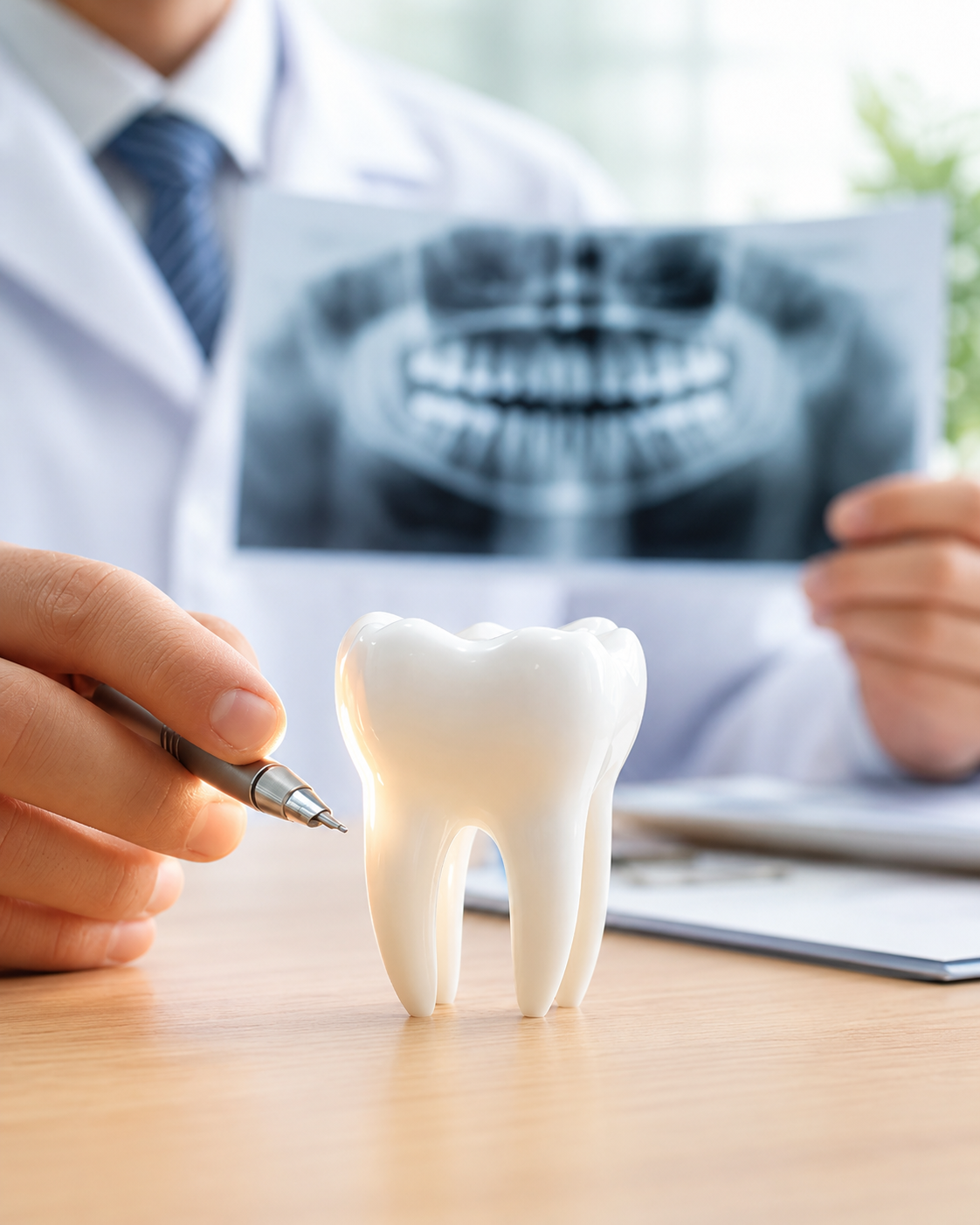
It means your implant surgery is designed in software before it’s performed in your mouth: the CT scan (₩30,000) becomes a 3D model of your jaw, the fixture is placed virtually — tested against your nerve canal, sinus floor and bone thickness where mistakes cost nothing — and for complex cases, that virtual plan is printed as a physical surgical guide that seats over your teeth and constrains the drill to the planned position, angle and depth.
Every implant at this clinic is digitally planned; the printed guide is deployed where complexity earns it — multi-fixture cases like full-arch rebuilds(where the guide fee is stated in the published price), tight nerve or sinus clearances, and aesthetic-zone angles. Where a guide adds cost, it’s named in your written plan — and where it adds nothing, we’ll say that too, because technology should be prescribed like everything else here: by the case, not by the brochure.
From scan to stencil — how a plan becomes physical.
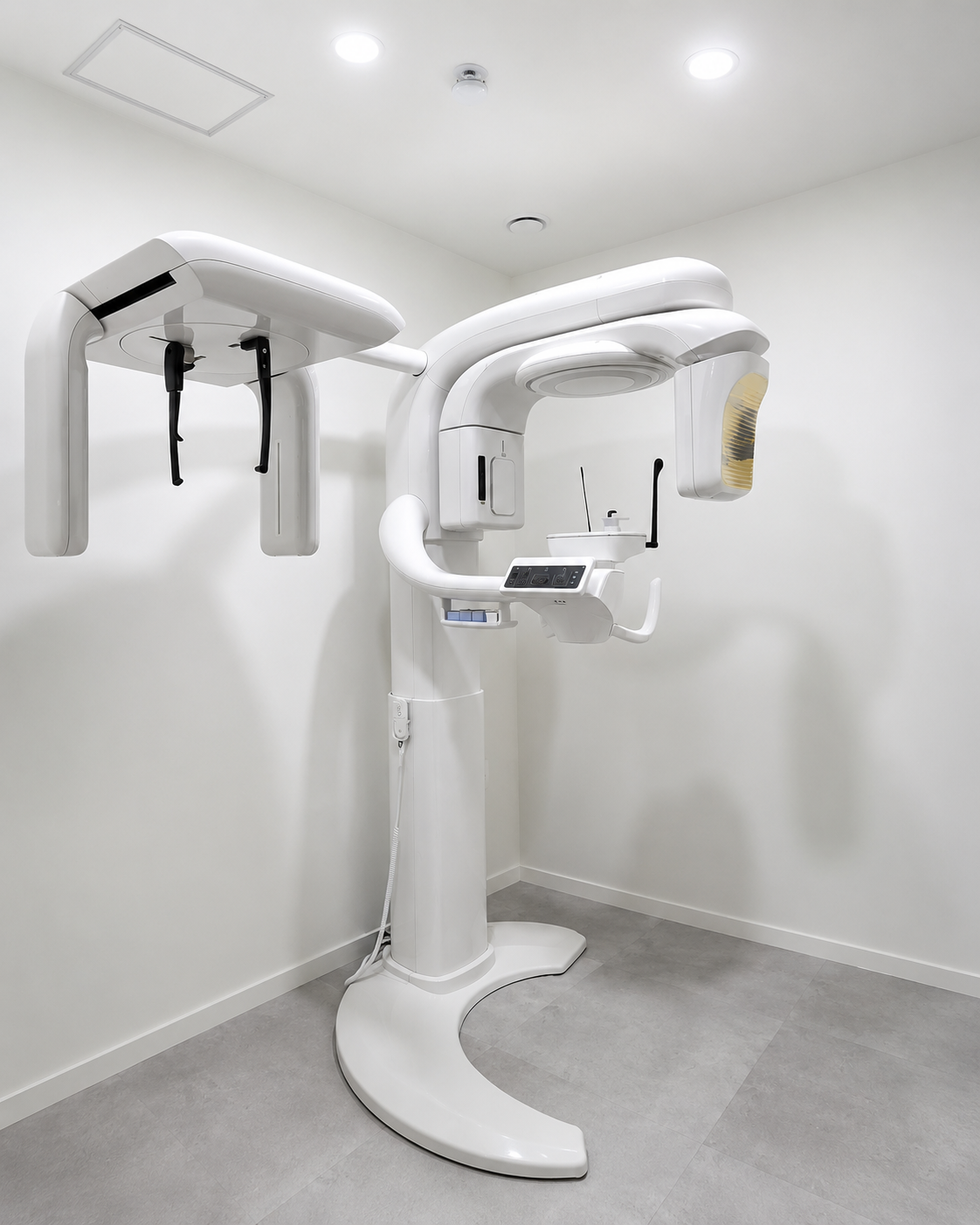
The chain has three links. First, the digital twin: your CT scan renders the jaw in three dimensions — bone density mapped in greyscale, the nerve canal traced in colour, the sinus floor outlined — anatomy that’s invisible in a mirror and decisive in surgery. Second, the virtual placement: the fixture is positioned on screen, rotated, deepened, checked against every structure, and — crucially — positioned crown-first : where the final tooth must stand dictates where the root must go, never the reverse.
Third, the guide: for cases that warrant it, the approved plan is manufactured as a custom resin template that seats positively on your teeth. Its metal sleeves accept the drill at exactly the planned entry point, exactly the planned angle, with a physical stop at exactly the planned depth. The plan stops being advice and becomes a constraint the surgery physically cannot ignore.
What guidance is not: a substitute for the surgeon. The software proposes nothing — every position is a human decision informed by training, and an Osstem AIC faculty dentist makes ours. Digital guidance is judgement, exported into plastic. The judgement still has to be good.
Five places millimetres get expensive — and one honest limit.
The nerve canal downstairs
The lower jaw’s red lineThe inferior alveolar nerve runs through the lower jaw exactly where molar implants want to live — and its clearance is measured in millimetres. The plan maps it in colour; the guide’s depth stop makes over-drilling physically impossible. This is guidance at its most literal: a hard floor above a structure you keep for life.
The sinus ceiling upstairs
Upper molar geometryRear upper fixtures negotiate with the sinus floor — sometimes millimetres away, sometimes needing a lift first. Virtual placement settles the negotiation before surgery: exact clearance known, lift decision made on measurements, no mid-surgery discoveries.
Thirteen fixtures, one afternoon
The full-arch multiplierIn a full-arch rebuild, every fixture’s position affects the shared bridge — thirteen interdependent decisions. The guide executes all of them as designed, which is why the guide fee is a stated line in the full-arch price: at that scale, it’s not an upgrade, it’s the method.
Thin ridges, no spare width
Millimetre economicsA narrow ridge offers one correct corridor and two mistakes on either side of it. Guided entry keeps the fixture centred in bone that has no margin to donate — sometimes the difference between placing directly and needing a graft first.
The aesthetic-zone angle
Where degrees become visibleA front tooth fixture a few degrees off forces the crown into contours everyone sees. Crown-first planning plus a guided angle is how the invisible root serves the visible portrait.
What no guide fixes
The honest limitA guide executes its plan with total obedience — including a bad plan. Guidance doesn’t diagnose, doesn’t judge bone quality by feel, doesn’t decide when to stop and rethink. The technology narrows execution error; the planning quality is still entirely human, which is why the credential holding the drill matters more than the plastic around it.
How guided treatment actually goes.
CT & the digital twin
The CT (₩30,000) builds the 3D model: bone volume and density, nerve canal traced, sinus mapped. Ten minutes in the chair; the working model for everything after.
Crown-first virtual surgery
The final tooth is positioned first; the fixture is planned to serve it — tested against every structure on screen, revised freely, approved only when the clearances read clean. Failure here costs nothing, which is the entire point.
Guide fabrication, where used
For guided cases, the approved plan is manufactured as your custom template — fee named in the written plan (and already stated inside the full-arch price). Simple sites may proceed on the digital plan alone, and we’ll tell you which yours is.
Surgery as re-performance
The guide seats on your teeth; the drill enters through its sleeves at the planned point, angle and depth. Guided surgeries typically run shorter and quieter — the decisions were made weeks ago; today executes them.
Verification & the usual months
Post-placement imaging confirms reality matched the plan, then the standard implant story proceeds — integration over months confirmed by testing, then the crown, included in your fixture price.
Where surgical error lives — and how the guide locks each door.
| The axis | What drifts without guidance | What it can cost | How the guide locks it |
|---|---|---|---|
| Position — where the drill enters | Entry a millimetre or two off the planned centre, especially in limited visibility | A fixture crowding a neighbour’s root, or off-centre in a ridge with no width to spare | The sleeve admits the drill only at the planned entry point — the first millimetre is decided before the motor starts |
| Angle — the trajectory | A tilt of a few degrees, invisible at the surface, magnified along the fixture’s length | A crown forced into awkward contours — costliest in the aesthetic zone — or a tip drifting toward structures | The sleeve’s bore fixes the trajectory; the drill physically cannot tilt off-plan |
| Depth — how far it goes | The hardest axis to judge by feel, in bone whose resistance varies layer by layer | Millimetres toward the nerve canal below or sinus floor above — the axis with the least forgiving neighbours | A physical stop halts the drill at the planned depth — not skill-dependent, not attention-dependent, mechanical |
The honest reading of this table: guidance converts three continuous human variables into three mechanical constants. What remains human — and remains decisive — is whether the plan those constants obey was good. Millimetre discipline in service of sound judgement is the whole product; either half alone is theatre.
Why your surgery is already over — before you sit down.
The deepest change digital planning makes isn’t precision — it’s when the thinking happens. A short tour of the timeline shift:
The jaw arrives without the patient
Your digital twin sits on a screen where it can be studied without a clock running, rotated without discomfort, measured without swelling. The scarcest resource in any surgery is unhurried attention — the digital workflow spends it before you arrive, in unlimited supply.
Every mistake is made on screen first
Virtual placement is where the fixture gets tried too deep, too tilted, too close — and revised, at zero cost. A dozen discarded versions can precede the approved one. The plan that reaches your mouth is a survivor of every error already committed somewhere consequence-free.
Judgement, exported into plastic
Fabricating the guide converts decisions into geometry — the plan becomes an object that cannot reconsider, hesitate or drift. What gets frozen is the best version of the surgeon’s thinking, made on the best day for thinking: a quiet one, weeks before.
The premiere is a re-performance
What happens in the chair is the second performance of a surgery whose first run happened in software — which is why guided appointments tend to run shorter, calmer and more predictably. You’re not attending the decision-making; you’re attending the execution. The suspense was handled in rehearsal.
Does digital guided surgery cost extra?
The digital planning itself — CT analysis, 3D modelling, crown-first virtual placement — is how every implant here is designed; it lives inside the standard process, with the CT at ₩30,000. The printed guide is the case-dependent element: stated inside the full-arch price as the named guide fee, and itemised in the written plan wherever a single or multi-fixture case warrants one. No guide cost ever appears that wasn’t named before surgery.
Is guided implant surgery safer?
It removes specific, well-understood error modes — entry drift, angular tilt, depth overshoot — and that’s genuinely meaningful near the nerve canal and sinus. The honest framing: guidance narrows execution risk substantially, while planning risk stays exactly as good as the human planning. A guide obeys bad plans too. Safety is the combination — sound judgement, mechanically enforced — and that combination is precisely what we sell.
Will the surgery feel different with a guide?
Mostly it feels shorter. The guide seats over your teeth like a firm mouthguard, the work proceeds through it, and because the deciding happened weeks ago, the appointment is execution-paced rather than deliberation-paced. Patients who’ve had both frequently describe guided placement as the quieter experience — less adjusting, less pausing, fewer of the sounds of thinking.
Do all implants need a printed guide?
No — and we’ll tell you when yours doesn’t. A straightforward site with generous bone and comfortable clearances is well served by digital planning executed freehand by experienced hands; the printed guide earns its cost where complexity multiplies — multiple fixtures, tight anatomy, aesthetic-zone angles. Prescribing the guide only where it adds value is the same honesty we apply to fixture brands: the case decides, not the catalogue.
How accurate is the guide itself?
Guided systems constrain placement to tolerances that manual judgement can’t reliably match — small fractions of the margins involved — though no honest clinician claims perfection: seating quality, anatomy and technique all contribute, which is why post-placement imaging verifies reality against plan on every case. The fair summary: guidance doesn’t make surgery perfect; it makes the error budget dramatically smaller and independently verified.
Why does “crown-first” planning matter so much?
Because the fixture exists to serve a tooth, not the other way round. Planning that starts from available bone can strand a technically successful fixture under a crown forced into odd angles or contours — integrated, and wrong. Crown-first design positions the final tooth where your bite and smile need it, then engineers the root position backward from there — recruiting grafting where the ideal position demands it, rather than compromising the tooth to dodge it.
Care by board-certified specialists in Seomyeon
Both directors are board-certified specialists in Advanced General Dentistry, so your cosmetic treatment is planned with your overall dental health in mind.

- Board-certified specialist, Advanced General Dentistry
- M.S. in Orthodontics, Kyungpook National University
- Focus on natural, alignment-led smile improvement
- Conservative, tooth-preserving approach

- Board-certified specialist, Advanced General Dentistry
- DDS, Dankook University College of Dentistry
- Restorative & aesthetic resin filling work
- Focus: natural, durable results
Small truths about guided surgery.
- You can see your own plan. The 3D model, the traced nerve, the virtual fixture — ask at the consult and we’ll walk you through your jaw on screen. Informed consent is more informative when you’ve literally seen the plan.
- The guide is yours, made once. It’s fabricated from your scan for your surgery — a single-purpose instrument, not reusable clinic stock. That’s what the fee is: custom manufacturing, not a rental.
- Digital planning helps the graft conversation too. Bone volume is measured, not eyeballed — so “you need a graft” arrives with numbers attached, and “you don’t” does as well. Measurement is the enemy of upselling.
- Guided doesn’t mean rushed. Shorter surgery is a side effect, not the goal — the integration months afterward run exactly as biology dictates, confirmed by testing like every implant here. The calendar the guide compresses is the appointment, not the healing.
- Old-school skill still shows up. Seating the guide correctly, reading bone by feel through it, knowing when anatomy disagrees with imaging — the craft doesn’t retire; it moves upstream and supervises.
What guidance buys — and what it never will.
Guidance genuinely buys…
- execution locked to plan on all three axes — position, angle, depth — mechanically, not attentionally
- decisions made weeks early, unhurried, revisable, and tested on screen where failure is free
- measured clearances from the nerve canal and sinus — safety by numbers, verified by imaging after
- shorter, calmer surgery days — execution-paced, because the deliberation already happened
Guidance never buys…
- good judgement — a guide executes bad plans with the same obedience; the planner’s credential is still the product
- skipped biology — integration takes its months and passes its tests regardless of how precisely the fixture arrived
- exemption from foundations — gum health and honest bone still decide outcomes; precision on inflamed ground is precise failure
- a reason to over-prescribe — simple sites don’t need printed guides, and we’ll say so rather than bill so
Digital guided implant FAQ.
A clear, custom-fitted resin arch — imagine a rigid sports mouthguard with precise metal-sleeved openings where each fixture will go. It seats positively on your teeth so it can't shift, the drill works through the sleeves, and it's removed the moment placement is done. Unglamorous to look at; every millimetre of its geometry is your surgical plan made physical.
Dental CT (cone-beam) uses a focused field and a dose calibrated for exactly this purpose — modern units keep exposure to a small fraction of medical body CT, and we scan once and plan from it rather than re-imaging casually. Set against what the scan prevents — drilling near an unmapped nerve canal — the risk arithmetic is decisively in the scan's favour. If you have specific concerns (pregnancy, recent imaging history), raise them at the consult and we'll plan accordingly.
Yes — guides can be designed to seat on the gum and bone architecture instead of teeth, with fixation pins holding them stable; it's standard method in full-arch work where few or no teeth remain. The digital planning is identical; only the guide's anchoring strategy changes. Your plan will state which type your case uses and why.
Then the surgeon overrules the plastic — and that override authority is why the credential matters. Imaging is excellent but bone occasionally disagrees with its picture: density that reads different under the drill, anatomy at the margin of resolution. Guided protocol includes live verification at each stage, and the standing rule is that judgement outranks geometry: better to pause, reassess or stage the treatment than to obediently execute a plan reality has amended.
The digital planning — always, and it's already how every single implant here is designed within the standard pricing (DIO ₩800,000 / Osstem KS ₩1,200,000 / Straumann ₩1,750,000, crowns included). The printed guide — case-dependent: tight nerve clearance, thin ridge, or an aesthetic-zone angle can each justify it for one fixture, while a roomy molar site may not. The written plan states which, with reasons; you'll never wonder what you paid for.
More than any other group, honestly. The planning phase runs on your CT while you're still at home — scan on an early visit or share existing imaging, approve the plan remotely, and arrive with surgery day already rehearsed. Predictable, shorter appointments suit tight travel windows, and verified placement imaging travels home with you for any local dentist. The whole workflow was practically designed for people whose time in Busan is measured in days.
Rehearsed surgery across visits.
Send photos and any existing CT or X-rays on WhatsApp — existing imaging can start the planning conversation before your first flight, and we’ll tell you honestly whether your case reads guide-worthy.
CT (₩30,000) on your first visit, then the virtual surgery happens while you’re home — crown-first design, clearances tested, plan approved, guide fabricated where your case warrants it, all itemised in writing.
The rehearsed procedure executes — typically shorter and calmer than un-guided equivalents, which matters when your Busan days are counted. Verification imaging confirms plan-versus-reality before you fly.
Integration months at home with WhatsApp check-ins, then the crown visit — included in your fixture price — timed to a return trip. Your imaging record travels with you, readable by any dentist anywhere.
See your surgery — before it exists.
Send a photo and any imaging on WhatsApp — we’ll tell you honestly whether your case is guide-worthy, what the planning will show, and what everything costs in writing. In English.
Message us on WhatsAppBaro Dental Clinic · 5F, SJ Medical Building, 698-1 Jungang-daero, Busanjin-gu · Seomyeon Station Exit 2, 4 min
Explore the options in Busan.
Full-Mouth Implants in Busan
₩15M–20M + guide fee — where guidance stops being optional.
Explore →Single Tooth Implant in Busan
Three fixture tiers, crowns included — all digitally planned.
Explore →Sinus Lift in Busan
₩500,000–700,000 — when the upstairs clearance needs building.
Explore →Front Tooth Implant in Busan
Where guided angles meet the aesthetic zone’s portrait rules.
Explore →Medical information on this page is provided for general education and does not replace an individual examination and diagnosis. Whether guided placement — and a printed surgical guide — suits your case is confirmed at a CT-based consultation, with any guide fee itemised in the written plan before treatment. Individual results vary with anatomy, bone quality and maintenance.