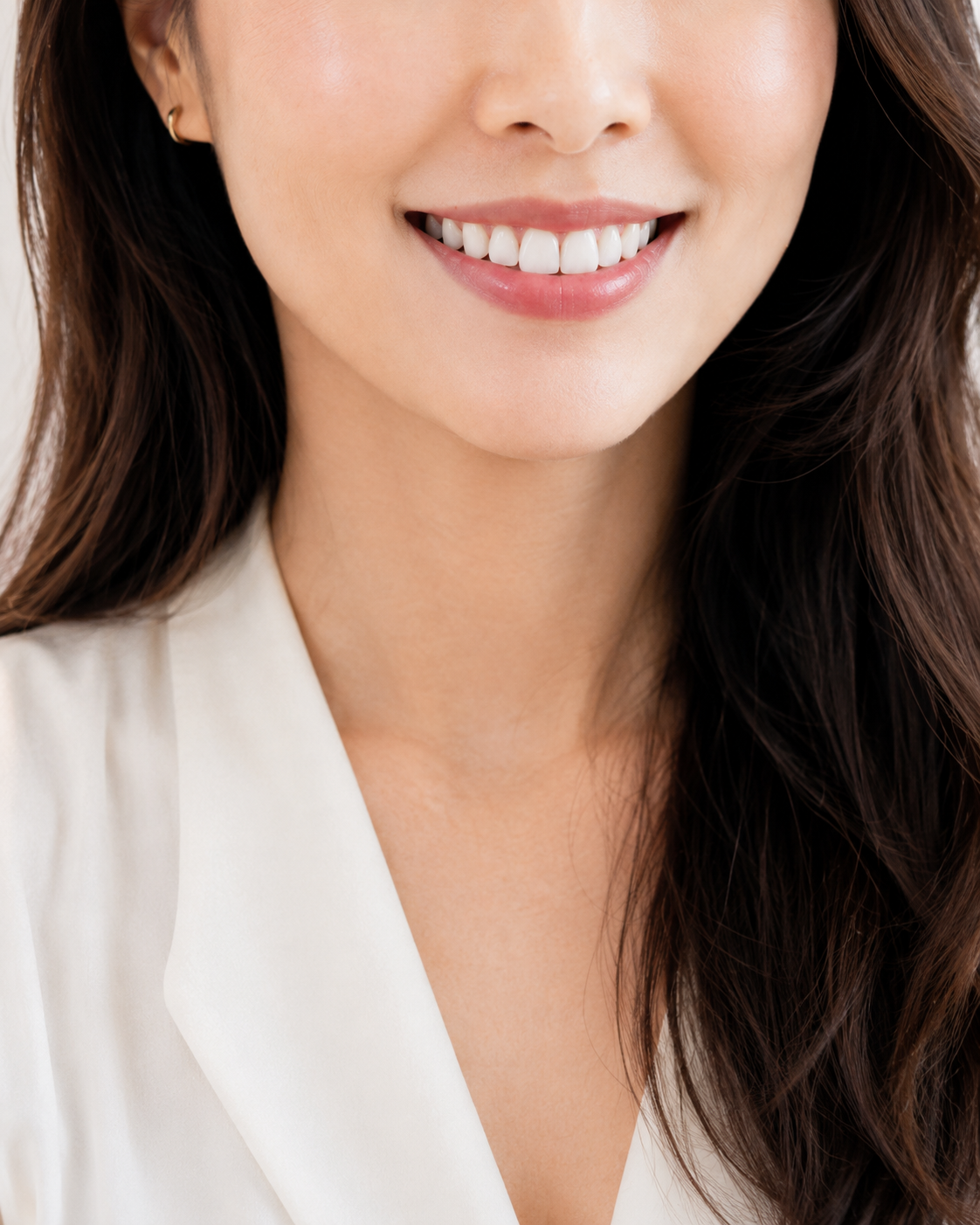
Front tooth implant in Busan — engineering that has to pass as a portrait.
A missing front tooth is the one gap the whole world sees. Rebuilding it is half surgery, half portraiture — gum line, translucency, symmetry — priced like every implant here: fixture with custom abutment and zirconia crown from ₩800,000 to ₩1,750,000, whole-tooth, published.
Ask about your front tooth.
Tap what fits — we’ll open WhatsApp with your message ready to send.Nothing sends until you press send in WhatsApp. A photo and any X-rays help us give an honest tier read — Straumann-warranted, or KS-sufficient.
What does a front tooth implant cost in Busan — and why is it its own page?
The price structure matches every implant here — DIO ₩800,000, Osstem KS ₩1,200,000, Straumann ₩1,750,000, custom abutment and zirconia crown included, CT ₩30,000, graft ₩300,000–500,000 only if your bone requires it, and a provisional crown stage (₩100,000) that keeps you smiling through healing. What’s different isn’t the price — it’s the difficulty.
A back-tooth implant succeeds when it chews. A front-tooth implant must also disappear: gum line matched to its neighbour within a millimetre, crown translucency matched to teeth that light passes through, the little gum triangle between teeth preserved. The bone here is the thinnest in the mouth and the audience is everyone you ever talk to — which is why the aesthetic zone gets its own playbook, its own patience, and this page.
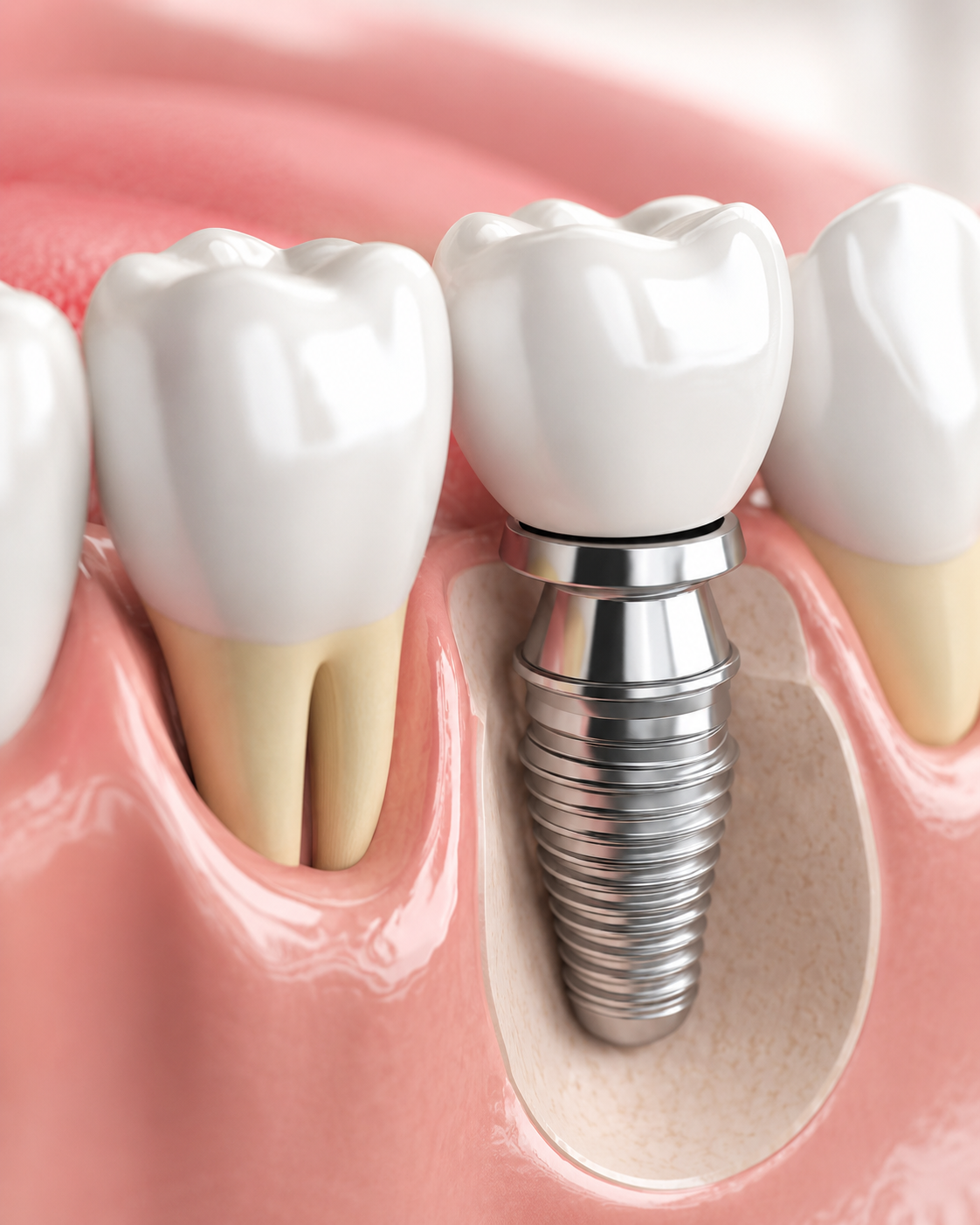
The tooth is easy — the frame is the art.
Mechanically, a front tooth implant is the same three-part build as any single implant: titanium fixture, custom abutment, zirconia crown. What changes in the aesthetic zone is that the gum becomes half the restoration. A perfect crown emerging from a receded, flat or asymmetric gum line reads instantly as false — the eye judges the frame before the picture.
So the work here is gum architecture as much as tooth replacement: preserving the thin outer plate of bone that holds the gum’s height, protecting the papilla — the small gum triangle between teeth whose loss leaves a dark gap — and then sculpting the emergence profile, the exact shape with which the new tooth rises out of the gum, using a staged provisional crown (₩100,000) as the sculptor’s tool before the final crown is ever made.
And the crown itself graduates from craft to art: front teeth transmit light, so the zirconia is layered and shade-mapped against your neighbouring teeth — their gradients, their translucent edges, even their small character marks — because a front tooth that’s too perfect is its own giveaway.
Six reasons the aesthetic zone is its own discipline.
The thinnest bone in the mouth
The engineering constraintThe outer bone plate over front-tooth roots can be paper-thin — and it’s what holds your gum’s height. Lose it during extraction or placement and the gum follows it downhill. Everything careful about anterior surgery starts with protecting this millimetre.
The gum line duet
Symmetry is unforgivingFront teeth come in pairs, and the eye audits them together: a gum margin sitting even slightly higher or lower than its twin reads as wrong from conversational distance. The plan is designed against your smile photos, not just your X-ray.
The papilla problem
Small triangle, big verdictThe tiny gum peak between teeth survives only if the bone beneath it does — lost, it leaves a dark triangle no crown can hide. Papilla preservation drives timing, technique and the shape of the provisional: the least visible structure runs the show.
Light passes through front teeth
The crown’s examMolars are opaque workhorses; incisors glow at the edges. The anterior crown is layered zirconia, shade-mapped to your neighbours’ gradients and translucency — matched under different lights, because restaurant lighting is crueller than clinic lighting.
Your smile line sets the stakes
Personalised difficultySome lips reveal every millimetre of gum; some hide it all. A high smile line raises the aesthetic bar — and we’ll tell you honestly at the consult where your case sits on the exposure-difficulty curve, because stakes should be known before surgery, not after.
Sometimes the tooth is saveable
Then we say soA front tooth with a healthy root and a broken top is often a crown case (₩500,000), not an implant case — and keeping your own root preserves the gum architecture better than any surgery. When saving is honest, it’s our first recommendation.
How a front tooth rebuild actually goes.
Photos, CT & the smile plan
The CT (₩30,000) measures the thin anterior bone; smile photos map your gum exposure and the neighbour teeth the new one must impersonate. The written plan covers fixture tier, any grafting, the provisional strategy — and what you’ll wear from day one.
Extraction with the site protected
If the failing tooth is still in, it comes out gently with the socket’s thin walls preserved — often with graft material (₩300,000–500,000) placed to hold the ridge’s shape while it heals. You leave with a temporary tooth, not a gap.
Placement, angled for the smile
The fixture is placed per the guide with the anterior rules in charge: depth and angle chosen so the crown can emerge naturally, the thin outer plate respected like the heritage structure it is.
The sculpting months
While bone integrates, a provisional crown (₩100,000) does double duty: keeps your smile whole and gently shapes the gum’s emergence profile — adjusted across visits until the frame sits exactly right. Nobody at work will know.
The portrait crown
Integration confirmed, the final zirconia crown — layered, shade-mapped, edge-translucent — is seated on its custom abutment, already inside your fixture price. The test is simple: nobody should be able to tell, including you in photos.
The aesthetic checklist — what failure looks like, and how design prevents it.
| The detail | When it goes wrong, you see… | How the plan prevents it |
|---|---|---|
| Gum line height | One tooth’s gum sitting visibly higher — the “long tooth” that photographs badly forever | Thin-plate protection at extraction, socket grafting where needed, and placement depth set against the neighbour’s margin |
| The papilla | A dark triangle between teeth that shadows every smile | Bone-first sequencing — the triangle survives if its foundation does — plus a provisional shaped to support it |
| Emergence profile | A crown that pops out of flat gum like a fence post — anatomically clean, visually false | Months of provisional-crown sculpting (₩100,000) so the gum learns the tooth’s shape before the final is made |
| Crown optics | A tooth that’s the right shape but the wrong light — flat, opaque, one shade too uniform | Layered zirconia mapped to the neighbours’ gradients and edge translucency, checked under multiple lights |
| Fixture angle | A screw-access or bulge compromise that forces the crown into odd contours | Guided placement with the crown designed first — the fixture serves the tooth’s position, never the reverse |
The honest summary: anterior failures are rarely about the implant failing to integrate — they’re about frames, triangles and light. Every row above is decided in planning, which is why the ₩30,000 CT consult and your smile photos carry more aesthetic weight than any material upgrade.
How a smile is rebuilt — without anyone noticing it’s underway.
The anterior patient’s biggest fear isn’t surgery — it’s the calendar. Here’s how the visible part of you stays whole while the invisible part rebuilds:
You never leave toothless
Whatever the stage — extraction day, placement day — you walk out with a temporary tooth in place. The forms vary by case and bite, but the rule doesn’t: the aesthetic zone is never left empty, not for a weekend, not for an afternoon meeting.
Bone integrates behind the curtain
Underneath the provisional, the fixture and bone do their handshake over a period measured in months and confirmed by testing. Socially, nothing is happening; biologically, everything is. Colleagues see a normal smile the entire time.
The gum learns its new tooth
The provisional crown (₩100,000) is adjusted across short visits, gently coaxing the gum into the emergence shape the final crown will need — the papilla supported, the margin levelled with its twin. This is the stage cheap plans skip, and it’s where natural-looking results are actually made.
The final crown changes nothing visible
By the time the layered zirconia crown seats, the gum frame is already perfect and the provisional already looked convincing — so the “big reveal” is anticlimactic by design. The best anterior implant is the one whose finish line nobody else can identify.
Will my front tooth implant look natural?
If the frame is built right, yes — convincingly enough that the common patient report is forgetting which tooth it is. The honest caveat: naturalness is decided less by the crown than by the gum line, papilla and emergence profile around it, which is why our process spends months sculpting those with a provisional before the final crown exists. Cases with a high smile line or prior bone loss carry harder aesthetic odds — and we’ll grade yours candidly at the consult.
Will I have to go without a front tooth at any point?
No — that’s a design rule, not a hope. From the first appointment onward you wear a temporary tooth through every stage: after extraction, through integration, between sculpting visits. The provisional stage (₩100,000) isn’t a courtesy add-on; it’s a working tool that keeps you socially whole while quietly shaping your gum for the final result.
I knocked my tooth out in an accident — what do I do right now?
If the whole tooth came out clean: hold it by the crown (not the root), rinse briefly without scrubbing, and keep it moist — milk is the classic courier — and get to a dentist urgently, because reimplantation of your own tooth has a real window and is always the best outcome when it works. If the tooth can’t be saved, the implant path starts with protecting the socket. Either way, message us immediately — trauma cases jump the queue.
Which fixture brand matters most for front teeth?
Less than the planning does — the anterior game is won in bone preservation and gum sculpting, not on the fixture label. That said, thin anterior ridges are one of the places Straumann’s narrow-fixture option(₩1,750,000) earns real consideration, while sound sites do beautifully on Osstem KS (₩1,200,000) or DIO (₩800,000). Your CT arbitrates; every tier includes the same layered anterior crown standard.
Why not just get a bridge for a front tooth?
Sometimes that’s the honest answer — especially when the neighbouring teeth already wear crowns. But when the neighbours are healthy, a bridge spends two untouched front teeth as anchors — ground down in the most visible real estate you own — and the bone under the gap still resorbs, slowly sinking the bridge’s middle tooth frame. An implant spares the neighbours and keeps the bone employed. Both get priced at your consult, with our reasoning shown.
I was born missing a front tooth — can implants fix that?
Congenitally missing laterals are one of the most common anterior implant stories, and often the most satisfying — a gap you’ve managed your whole life, finally closed with a tooth that matches. Two honest notes: jaws must be finished growing, so younger patients wait until early adulthood; and where the gap has narrowed over years, coordination with orthodontics may open proper space first. The CT consult maps your exact sequence.
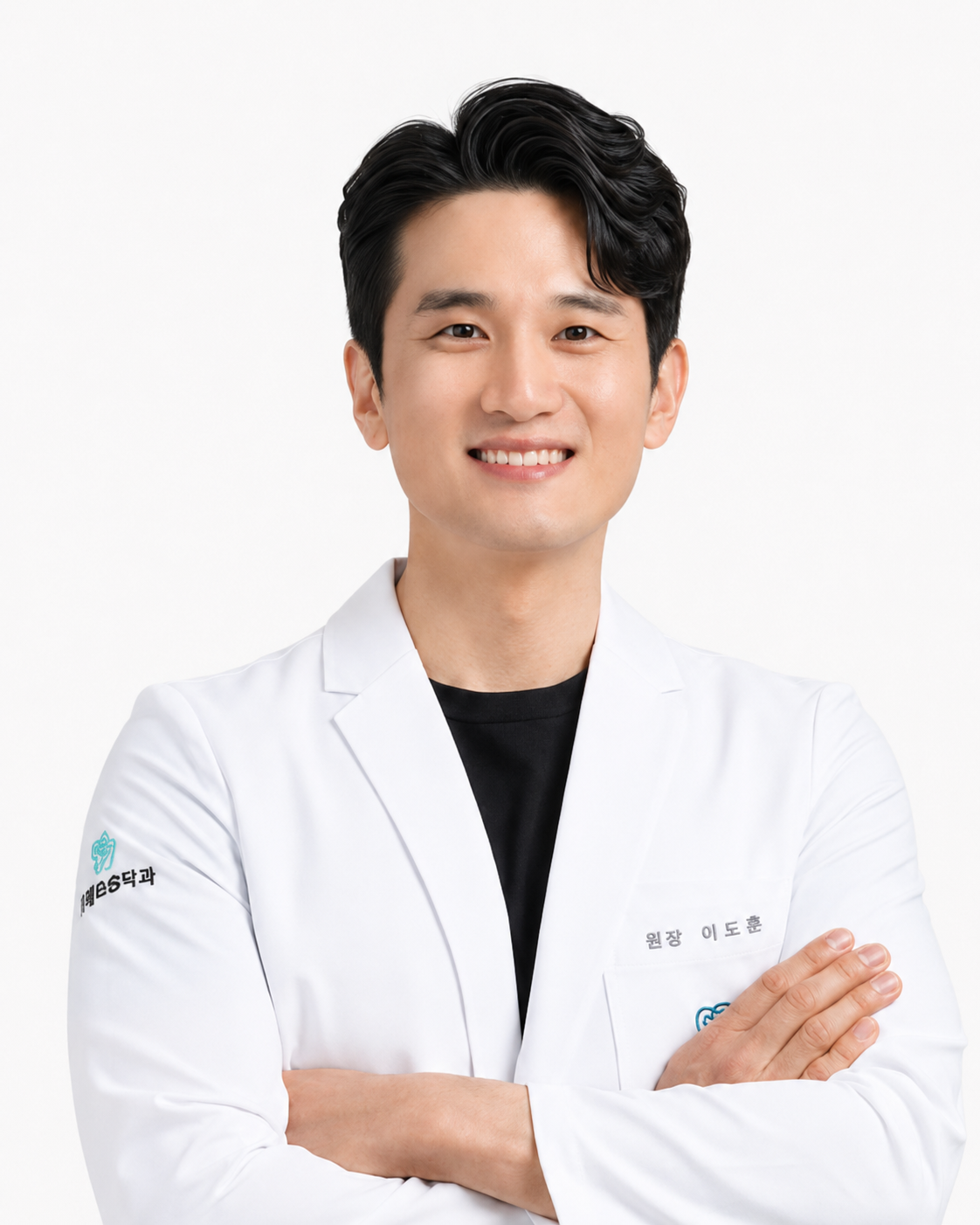
Care by board-certified specialists in Seomyeon
Both directors are board-certified specialists in Advanced General Dentistry, so your cosmetic treatment is planned with your overall dental health in mind.

- Board-certified specialist, Advanced General Dentistry
- M.S. in Orthodontics, Kyungpook National University
- Focus on natural, alignment-led smile improvement
- Conservative, tooth-preserving approach
- Board-certified specialist, Advanced General Dentistry
- DDS, Dankook University College of Dentistry
- Restorative & aesthetic resin filling work
- Focus: natural, durable results
Small truths about front tooth implants.
- Bring photos of your smile from before. Old photos showing the original tooth are design documents — its length, its angle, its little irregularities. The most natural replacements are reconstructions, not inventions.
- The provisional stage is where patience pays. Rushing gum sculpting to hit a date is the classic anterior regret — the frame sets once. A few extra weeks of shaping buys a decade of not thinking about it.
- Anterior implants chew lighter by design. Front teeth cut; molars grind. Your new incisor handles bites of apples and sandwiches fine — but bottle caps, thread-biting and shell cracking retire permanently, as they should have for the original tooth too.
- Gum health decides the long game. The beautiful margin holds only as long as the gum does — routine scaling (₩60,000) and honest home care are the maintenance plan for the frame, not just the fixture.
- Whitening comes first, not after. The crown’s shade is fixed at fabrication — if you’re considering whitening (₩495,000 for 3 sessions), do it before the final crown is shade-mapped, so the new tooth matches the smile you actually want.
When the anterior implant is right — and when we’ll steer you elsewhere.
The implant is the right call when…
- the tooth is truly unsaveable — fractured root, failed re-treatment, resorption confirmed on CT
- neighbouring teeth are healthy and deserve to stay untouched
- bone and gum are workable — directly or after honestly priced site work
- you can give the sculpting months their time — the aesthetic zone rewards patience specifically
We’ll steer you elsewhere when…
- the root is saveable — a root canal plus crown (₩500,000) keeps your own gum architecture, and nothing sculpts gum like your own root
- gum disease is active — the aesthetic zone forgives nothing built on inflammation; treatment first
- jaws are still growing — young patients get interim solutions and a properly timed plan, not an early fixture that ends up mispositioned
- the neighbours are already crowned — a bridge may honestly serve better, and we’ll price both without leaning
Front tooth implant FAQ.
The same whole-tooth structure as every implant here: DIO ₩800,000, Osstem KS ₩1,200,000, or Straumann ₩1,750,000 — each including the custom abutment and zirconia crown — plus CT ₩30,000, the provisional crown stage at ₩100,000, and grafting (₩300,000–500,000) only where your scan shows the site needs rebuilding. Anterior cases more often use the provisional stage and site preservation, so those lines appear on front-tooth plans more frequently — named and priced in writing before anything starts.
Longer than a molar's story, honestly — and on purpose. Beyond the integration period every implant needs (measured in months, confirmed by testing), the anterior adds the gum-sculpting chapter where the provisional shapes your emergence profile across visits. The trade is explicit: patience in exchange for a result that photographs as your own tooth. Your written plan maps the real sequence for your anatomy — and you wear a convincing temporary throughout.
Our protocol is staged: the socket is protected — often with graft material holding the ridge's shape — a temporary tooth goes in the same day, and the fixture is placed once the site has settled. Same-day fixture approaches exist in the field, but the aesthetic zone is precisely where gambling on an unsettled socket costs the most, because what's at stake is the gum frame you'll wear in every photo. Staged is slower to say and better to live with.
It's built to pass at conversational distance: tooth-coloured, shaped to your smile, and refined across the sculpting visits — most patients report that nobody at work noticed anything across the entire treatment. It does live under back-tooth rules: careful with hard bites, and it's a stage prop, not the final performance. The final layered crown then replaces something already convincing, which is exactly how a rebuild should end — without an audience.
Often improvable, honestly graded case by case. Crown-level issues — shade, shape, translucency — are the most fixable, sometimes transformatively so. Gum-level issues are harder: a lost papilla or receded margin involves rebuilding biology, not just porcelain, and we'd rather show you realistic outcomes than promise a reset. Bring photos to a consult or send them on WhatsApp; our revision assessment starts with what the existing fixture position makes possible.
Yes — with one honest scheduling note: the anterior's sculpting visits make it slightly more trip-hungry than a molar implant, so the plan matters more. Typical shape: assessment and placement on the first trip (temporary fitted before you fly), integration months at home with WhatsApp photo check-ins, then a return trip covering the sculpting refinements and final crown together. Whole-tooth pricing makes the budget clear from day one; the visit map is written at the CT consult.
A front tooth across visits.
Send a smile photo and any X-rays on WhatsApp — plus an old photo showing the original tooth if you have one. You’ll get an honest read on your case’s aesthetic difficulty before booking anything.
CT (₩30,000), smile mapping, written plan — then extraction and/or placement per your sequence, with your temporary tooth fitted before you leave. You fly home smiling.
Integration proceeds invisibly under a convincing provisional — WhatsApp photo check-ins watch the gum frame while bone does the quiet work. No required flights.
Sculpting refinements and the final layered crown — shade-mapped against your neighbours, seated on its custom abutment, already in your fixture price. The reveal nobody else can spot.
Get your smile graded — honestly, before surgery.
Send a smile photo on WhatsApp — we’ll tell you frankly where your case sits on the aesthetic-difficulty curve, whether the tooth might be saveable instead, and what each path costs. In English.
Message us on WhatsAppBaro Dental Clinic · 5F, SJ Medical Building, 698-1 Jungang-daero, Busanjin-gu · Seomyeon Station Exit 2, 4 min
Explore the options in Busan.
Single Tooth Implant in Busan
The three-tier foundation — DIO, Osstem KS and Straumann, crowns included.
Explore →Bone Graft in Busan
₩300,000–500,000 — ridge preservation, the anterior frame’s insurance.
Explore →Crowns & Bridges in Busan
When the root is saveable — often the better anterior answer.
Explore →Teeth Whitening in Busan
₩495,000 for 3 sessions — done before the crown is shade-mapped, not after.
Explore →Medical information on this page is provided for general education and does not replace an individual examination and diagnosis. Whether an anterior implant suits your case — including aesthetic-difficulty assessment, site preservation, provisional strategy and fixture recommendation — is confirmed at a CT-based consultation. Individual results vary with anatomy, gum biotype, smile line and maintenance.