Implant revision in Busan — when an implant fails, the cause is the patient.
Not you — the cause. A failed implant replaced without understanding why it failed tends to fail again, premium fixture or not. Our revision work starts with the investigation, proceeds case by case where re-grafting allows, and treats implants from any clinic, anywhere, without judgement — because you need a plan, not a lecture.
Ask about your implant.
Tap what fits — we’ll open WhatsApp with your message ready to send.Nothing sends until you press send in WhatsApp. A photo and any X-rays help us give an honest tier read — Straumann-warranted, or KS-sufficient.
My implant is failing in Busan — what actually happens now?
First, breathe: “failing” covers everything from a loose crown screw (minutes to fix) to a fixture that genuinely has to come out — and the mild end of that spectrum is more common than the internet suggests. The path here is fixed regardless: a CT (₩30,000) and examination establish what’s actually happening, the cause gets named before any hardware gets discussed, and you receive a written plan — rescue, repair, or staged replacement where re-grafting allows.
What we deliberately don’t do: blame-read your previous clinic’s work to your face, or reflexively quote a new premium fixture before understanding why the current one struggled. An uninvestigated cause fails replacement implants too — including Swiss ones — so the investigation isn’t a formality here; it’s the treatment’s first half. Costs follow the findings: crown-only problems price around the implant prosthesis at ₩450,000; full replacement follows the standard tiers (₩800,000–1,750,000, crown included) plus any rebuilding your site needs, all published.
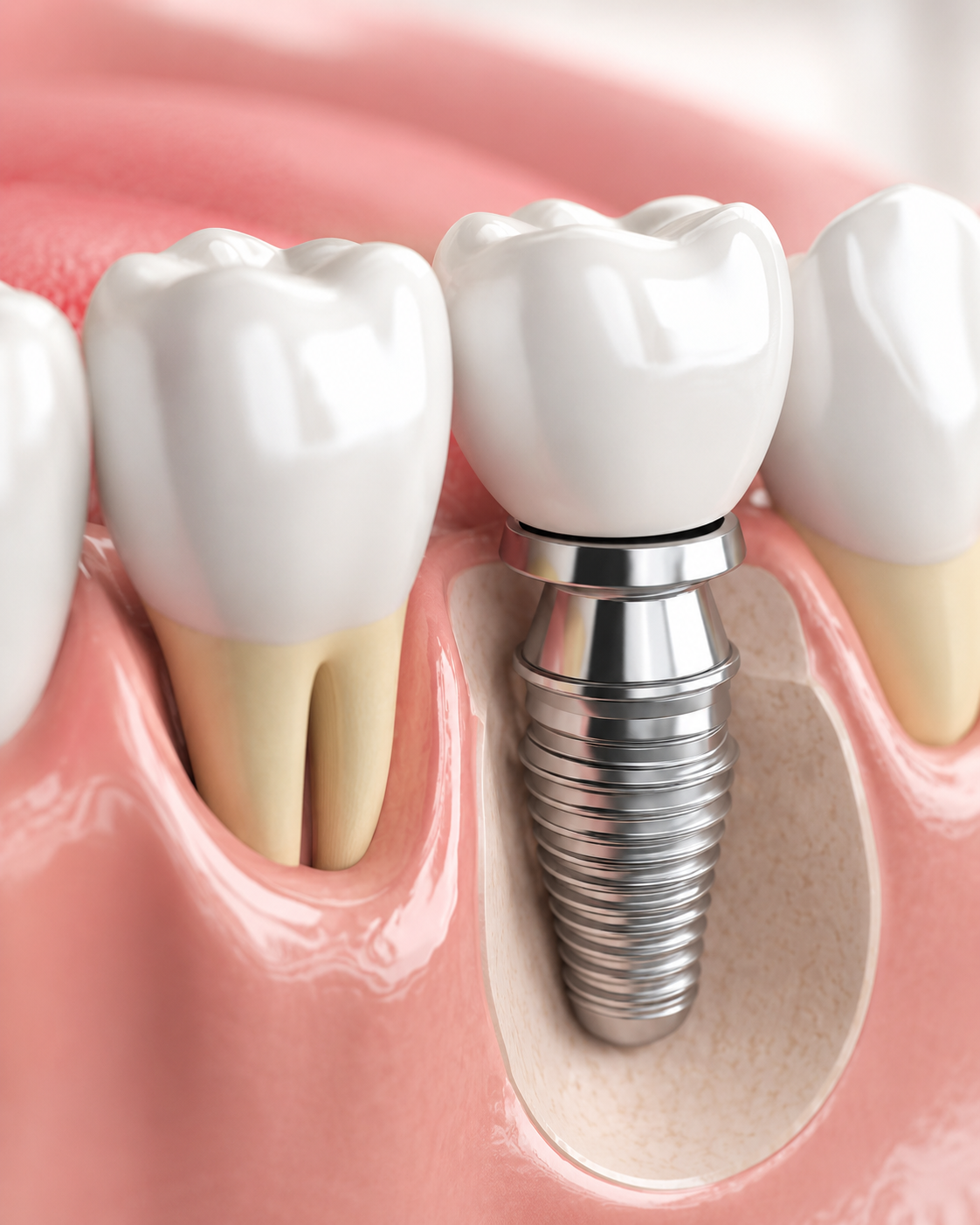
Revision is detective work — the surgery comes second.
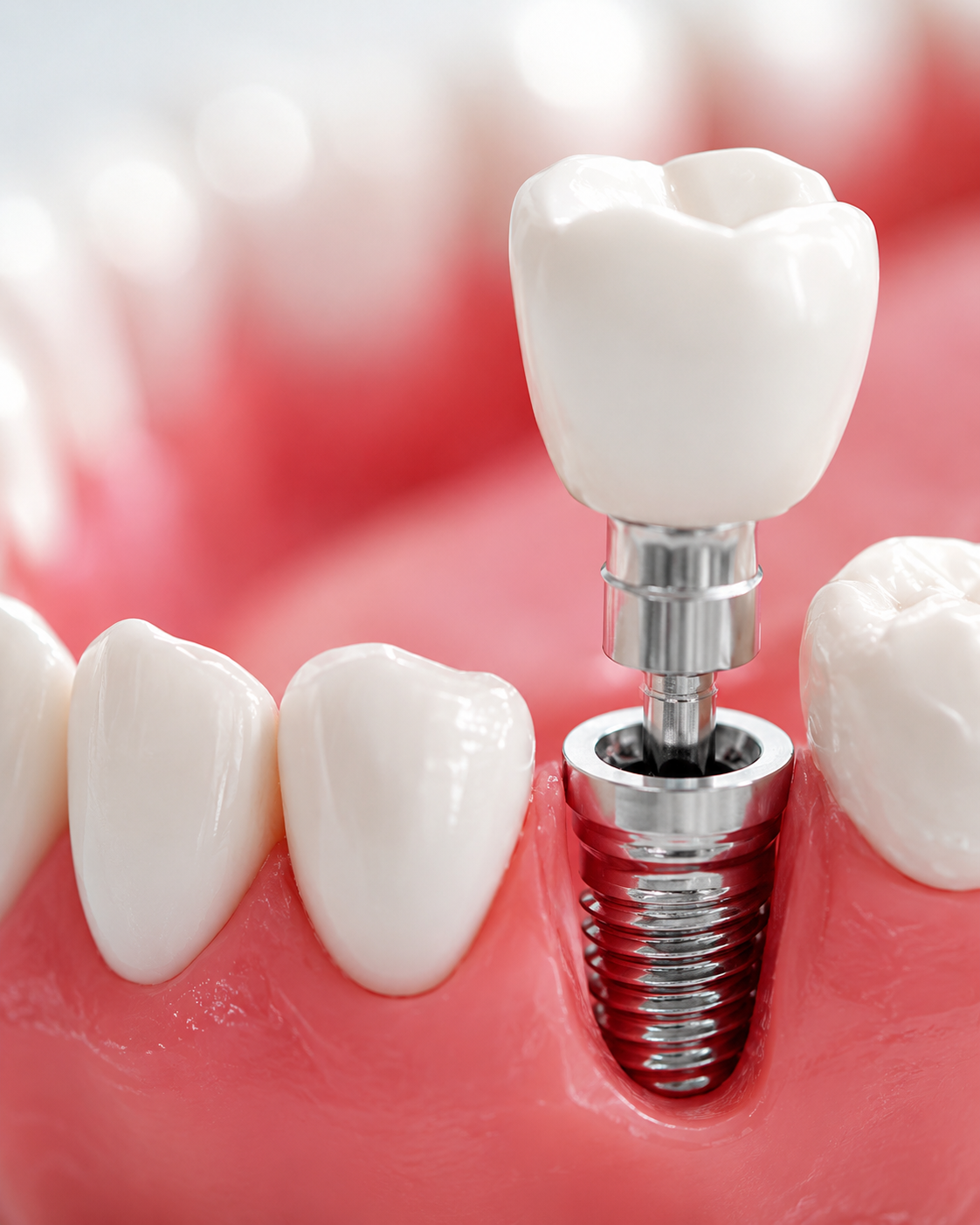
An implant is a system: fixture in bone, abutment on fixture, crown on abutment, gum sealing the whole column. “My implant failed” is a symptom report, not a diagnosis — the actual problem might live at any level of that stack, and each level has a completely different fate. A fractured crown with a healthy fixture underneath is a good day disguised as a bad one; a fixture losing its bone is a different conversation entirely.
So revision here begins the way it should: imaging and examination locate the problem’s address in the stack, and the history — when it was placed, when trouble started, what it feels like, your health picture — points to the cause. Infection, early loading, insufficient bone, untreated gum disease, smoking, bite overload, component wear: failures have authors, and naming the author is what makes the next implant’s story different from the last one’s.
And a promise worth stating plainly: implants placed anywhere are welcome here. Busan, Seoul, abroad, a decade ago — the fixture’s passport doesn’t change the medicine, and you’ll get findings and options, not commentary about choices you made years ago with the information you had.
Six ways implants get in trouble — from five-minute fixes to full restarts.
The loose-crown false alarm
Often not a failure at allA crown that wobbles or spins usually means a loosened abutment screw — alarming to feel, mechanically trivial to fix, fixture completely unbothered. The single most common “my implant failed” message we receive, and the happiest to answer. Don’t chew on it; do message us.
Early non-integration
The first-months failureA minority of fixtures never complete the bone handshake — typically declaring themselves early with mobility or persistent discomfort. The honest upside: early failures usually exit cleanly, the site heals, and re-placement into recovered bone carries good prospects once the cause is named.
Peri-implantitis, caught early
The rescue windowGum inflammation around a fixture — bleeding, redness, tenderness — is gum disease’s implant edition, and in its early chapter it’s frequently reversible: professional cleaning, decontamination, home-care reset. This card is why implant check-ups exist — the rescue window is real and it’s early.
Peri-implantitis, advanced
The hard conversationLeft to run, the inflammation excavates the fixture’s supporting bone — and past a threshold, saving the implant costs more biology than replacing it. We’ll show you the imaging, grade the loss honestly, and stage the exit-rebuild-replace sequence where that’s truly the better road.
Broken parts, healthy root
Component problemsChipped or fractured crowns, worn components, the rare abutment failure: problems above a well-integrated fixture are repair jobs, not restarts — the crown remade around the implant prosthesis price (₩450,000), the fixture never disturbed. The stack’s design is exactly this serviceable on purpose.
Integrated, but in the wrong place
The position problemA fixture can succeed biologically and still fail the tooth — angled or positioned so the crown fights its neighbours or, in the aesthetic zone, its own reflection. Options run from prosthetic camouflage to staged replacement; the honest grading depends on what the existing position makes possible.
How revision actually goes.
The investigation visit
CT (₩30,000), clinical exam, and your implant’s biography — when, where, what happened, health context. The problem gets an address in the stack and, wherever evidence allows, a named cause. Findings shown on screen, in English.
The verdict & written plan
Rescue, repair, or replace — graded honestly against your imaging, with costs from the published lists: cleaning-based rescue, crown remake (₩450,000), or staged replacement (₩800,000–1,750,000 plus any rebuilding). Second opinions welcome; the plan is yours to take anywhere.
Removal & site recovery, where needed
A fixture that must exit does so as gently as modern technique allows, and the site’s rebuild begins — usually grafting (₩300,000–500,000) to restore what inflammation or removal took, healing verified by imaging before anything new is scheduled.
Cause elimination, in parallel
Whatever authored the failure gets addressed while the site heals — gum treatment, bite adjustment, health coordination, the smoking conversation. This step is why round two ends differently.
Re-placement, where re-grafting allows
Into verified bone, with the cause retired, the new fixture is placed — tier chosen for the site’s demands (re-treatments are where Straumann often earns real consideration) — and the standard integration-then-crown story runs, this time on honest ground.
What happens to what — the failure-to-fate map.
| The problem | Does the fixture survive? | What’s actually done | The honest outlook |
|---|---|---|---|
| Loose crown / screw | Yes — it was never in danger | Re-tighten or replace the screw, check the bite that loosened it | Excellent — often a same-visit fix; recurrence prompts a bite review |
| Damaged crown | Yes — the root is fine | Crown remade — implant prosthesis ₩450,000 | Excellent — the stack was designed for exactly this repair |
| Early non-integration | No — but it exits cleanly | Gentle removal, healing, cause named, re-placement into recovered bone | Good — early failures re-treat well once the author is identified |
| Peri-implantitis, early | Usually yes — this is the rescue window | Decontamination, professional cleaning, home-care and maintenance reset | Genuinely rescuable — if caught while the bone loss is shallow |
| Peri-implantitis, advanced | Often not — graded on imaging | Staged exit, site rebuild (₩300,000–500,000 graft), replacement where re-grafting allows | Honest and case-by-case — rebuilt sites host new fixtures well, on a longer road |
| Wrong position | Biologically yes — functionally graded | Prosthetic redesign where possible; staged replacement where the position forecloses it | Ranges widely — the existing angle decides what’s achievable, and we’ll show you |
The pattern worth internalising: problems above the bone repair; problems in the bone investigate. And every row shares one entry ticket — the ₩30,000 CT that tells you which row you’re actually in, which is cheaper than guessing by several orders of magnitude.
The investigation — why we treat the cause before the crater.
Anyone can put a new fixture where an old one died. Making the new one live requires knowing what killed the first — a four-movement discipline:
Collect the evidence
Imaging shows the bone’s current testimony; your history supplies the narrative — placement date, symptom onset, what changed and when. Old records or X-rays from the original clinic help and are worth requesting; the fixture’s brand and specs, if known, join the file.
Name the author
Failures have causes with signatures: infection patterns look different from overload patterns, early non-integration different from slow bone loss. Sometimes the verdict is confident, sometimes probabilistic — and we’ll tell you which, because manufactured certainty is its own malpractice.
Retire the cause
The named author gets addressed before new hardware: gum disease treated, bite forces redistributed, health factors coordinated, habits confronted kindly. Skipping this movement is how patients end up on their third implant in the same site — the crater was treated; the cause kept its job.
Rebuild, then re-enter
The site is grafted and verified, the new fixture chosen for the site’s actual demands, and placement proceeds into ground that’s been both rebuilt and understood. Round two isn’t a rematch against the same opponent — the investigation already removed the opponent from the board.
How do I know if my implant is actually failing?
The signals worth acting on: new mobility or wobble, pain or tenderness around the fixture (integrated implants should be silent), gum bleeding, swelling or pus at the collar, a bad taste from one area, or visible gum recession exposing metal. One honest asymmetry: a loose crown usually isn’t failure, while silent, slow bone loss usually doesn’t announce itself — which is why symptoms deserve a prompt look and quiet implants still deserve periodic check-ups.
My implant was placed at another clinic — will you really see me?
Yes, genuinely and without the subtext you’re bracing for. Implants from other clinics — other countries — are ordinary work here: we assess what exists, not who placed it, and our findings go to you in plain English rather than into commentary about the past. If old records are obtainable they help; if not, the CT and exam carry the investigation. You made decisions with the information you had — our job is the information you need now.
What does implant revision cost?
It prices by findings, from published parts: the investigation itself rides on the CT (₩30,000); a rescue may cost little beyond cleaning and maintenance; a crown remake is the implant prosthesis at ₩450,000; full replacement runs the standard tiers (₩800,000–1,750,000, crown included) plus site rebuilding where needed (₩300,000–500,000 graft; sinus work ₩500,000–700,000). No revision surprise-bills here — the written plan itemises before anything begins.
Why did my implant fail when my friend’s is fine after 20 years?
Because failure is authored, not random — and the authors are knowable: infection around the collar, gum disease that predated the fixture, early loading, insufficient bone honestly assessed too optimistically, smoking’s vascular tax, bite overload from grinding, or occasionally component fatigue. Your friend’s twenty quiet years and your trouble likely differ in one of these variables, not in luck. The investigation exists to find yours — and retire it before round two.
Can a failing implant be saved, or is removal always the answer?
The stack answers differently at every level: everything above the bone — screws, abutments, crowns — repairs while the fixture sleeps undisturbed, and early peri-implantitis is frequently rescued with decontamination and a maintenance reset. What tips toward removal is advanced bone loss or true non-integration, graded on imaging you’ll see yourself. We rescue what’s honestly rescuable and say so when it isn’t — both verdicts, in writing.
How soon after removal can a new implant go in?
The site sets the tempo, and honest revision lets it: removal is followed by healing and usually grafting, the rebuild matures over a period measured in months, and imaging — not impatience — confirms readiness before re-entry. Rushing this sequence is precisely how second failures get manufactured, so we don’t. Your written plan maps the real chapters; international patients get them translated into trips.
Care by board-certified specialists in Seomyeon
Both directors are board-certified specialists in Advanced General Dentistry, so your cosmetic treatment is planned with your overall dental health in mind.

- Board-certified specialist, Advanced General Dentistry
- M.S. in Orthodontics, Kyungpook National University
- Focus on natural, alignment-led smile improvement
- Conservative, tooth-preserving approach

- Board-certified specialist, Advanced General Dentistry
- DDS, Dankook University College of Dentistry
- Restorative & aesthetic resin filling work
- Focus: natural, durable results
Small truths about implant revision.
- Speed matters more here than anywhere else on this site. Early peri-implantitis rescues; advanced doesn’t. A week of “waiting to see” costs nothing; a year of it can cost the fixture. Bleeding gums around an implant are a message-us-today symptom.
- Bring the implant’s paperwork if you have it. Brand, size and lot details from your original clinic turn component repairs from detective work into parts orders — one photo of the record card on WhatsApp can save a visit.
- Stop chewing on a loose implant — today. Whether it’s a trivial screw or a struggling fixture, load makes both worse. Shift chewing to the other side until it’s seen; it’s the one piece of advice that’s correct in every scenario.
- A failed implant doesn’t disqualify you from implants. The most common patient fear, and usually wrong: rebuilt, investigated sites host new fixtures well. What disqualifies is repeating round one with the cause still employed — which is exactly what the investigation prevents.
- Maintenance is the revision you never need. The boring ending to every story on this page: daily cleaning plus routine scaling (₩60,000) with implant checks would have prevented most of the advanced cases we see. Your new fixture’s plan includes it on purpose.
When revision makes sense — and when we’ll pump the brakes.
Revision is the right road when…
- symptoms are real and current — mobility, inflammation, pain, component damage — and the CT can name their address
- a failed fixture’s cause is identifiable and retirable — round two on understood ground
- the site can be honestly rebuilt — re-grafting verified by imaging before re-entry
- only the superstructure failed — repairs above a healthy fixture are revision’s happiest genre
We’ll pump the brakes when…
- the “failure” is cosmetic dissatisfaction with a healthy, well-positioned implant — prosthetic refinement beats surgical restart, and we’ll show you why
- the cause can’t yet be retired — active gum disease or unmanaged health factors get treated first, or round two inherits round one’s author
- rescue genuinely serves better — an early peri-implantitis case wanting a dramatic replacement gets talked into the cheaper, kinder cleaning instead
- someone else’s implant just needs someone else’s warranty — where your original clinic owes you a covered repair, we’ll say so before charging you for one
Implant revision FAQ.
Gentler than most patients expect — modern removal techniques work with controlled instruments designed to unwind or release the fixture while sparing surrounding bone, under the same local anaesthesia as placement. Struggling fixtures have often loosened their own exit already. Recovery resembles an extraction's week: manageable soreness, sensible eating, the aftercare sheet. The dread is usually worse than the appointment.
It's gum disease adapted to a new address: bacterial plaque colonises the implant's gum collar, inflammation follows, and — unchecked — begins dissolving the very bone holding the fixture. Implants can't decay, which lulls people, but their gum seal is arguably more vulnerable than a natural tooth's. Early-stage disease rescues well with decontamination and cleaning; advanced disease excavates past saving. The difference between the two stages is usually just time — which is the whole argument for implant check-ups.
The fixture itself has no expiry date — well-maintained implants run for decades, and age alone is never a diagnosis. What ages is the superstructure: crowns wear like any restoration (remade at ₩450,000 when their time comes), screws can loosen, and gum health can drift if maintenance lapsed somewhere in those fifteen years. An old implant with new symptoms deserves investigation, not assumptions — frequently the verdict is a serviceable repair on a perfectly healthy root.
Sometimes honestly yes — if your original clinic is accessible and the issue may fall under their warranty or component guarantee, that's worth checking first, and our assessment will say so when it applies. Where we earn our place: the original clinic is abroad or closed, you want an independent second opinion, or the problem needs capabilities beyond a warranty repair. Plenty of our revision patients use us for exactly that independence — findings first, allegiances nowhere.
Not once the first failure's cause is named and retired — that's the entire architecture of our revision process. A replacement placed into rebuilt, verified bone with the original author (infection, overload, gum disease, habits) addressed carries prospects comparable to first implants; a replacement placed into an uninvestigated crater inherits the crater's history. Re-treatment sites are also where premium fixture options earn genuine consideration — margins for ground with a past.
Yes — start on WhatsApp before you arrive with photos, symptoms and any records, and we'll triage honestly: same-visit fixes (loose screws, small repairs) suit short stays perfectly; bigger findings get an investigation, imaging you can carry home, and a written plan executable here across trips or shareable with a dentist wherever you live. An honest map of your options is a deliverable in itself — sometimes the most valuable one a visit produces.
Revision across borders.
Send symptoms, photos and any records on WhatsApp — implant brand and placement date if known. You’ll get an honest triage: quick-fix-shaped, rescue-shaped, or investigation-shaped.
CT (₩30,000), exam, the failure’s address and author named where evidence allows — then the written verdict: rescue, repair (₩450,000 crown remake), or staged replacement, itemised from published prices.
Where replacement is the road: removal, grafting and cause-retirement on one trip, the rebuild maturing at home with WhatsApp check-ins, verification imaging before anything new.
Re-placement into verified ground, integration months at home, crown on a return visit — round two on rebuilt, understood, honest foundations. The ending the first implant should have had.
Worried about an implant? Get findings, not lectures.
Send your symptoms and a photo on WhatsApp — wherever the implant was placed, whenever. We’ll tell you honestly whether it reads quick-fix, rescue, or investigation — and what each road costs in writing. In English.
Message us on WhatsAppBaro Dental Clinic · 5F, SJ Medical Building, 698-1 Jungang-daero, Busanjin-gu · Seomyeon Station Exit 2, 4 min
Explore the options in Busan.
Bone Graft in Busan
₩300,000–500,000 — rebuilding what failure took, before round two.
Explore →Straumann Implant in Busan
Where re-treatment sites meet the reference standard’s margins.
Explore →Gum Disease Treatment in Busan
Peri-implantitis’s parent condition — and revision’s most common author.
Explore →Single Tooth Implant in Busan
The standard story, told right — three tiers, crowns included.
Explore →Medical information on this page is provided for general education and does not replace an individual examination and diagnosis. Whether a struggling implant can be rescued, repaired or replaced — including cause assessment, site rebuilding and staging — is confirmed at a CT-based consultation with a written plan. Assessments of implants placed elsewhere describe findings only; individual results vary with anatomy, health factors and maintenance.