Sinus lift in Busan Seomyeon — raising the ceiling so the implant fits.
Upper back teeth live directly under your sinus — and when a tooth leaves, the sinus moves in downstairs. A sinus lift rebuilds the lost height: crestal approach ₩500,000, lateral approach ₩700,000, published, chosen by millimetres on your CT, not by what’s easiest to sell.
Ask about your ceiling.
Tap what fits — we’ll open WhatsApp with your message ready to send.Nothing sends until you press send in WhatsApp. A photo and any X-rays help us give an honest tier read — Straumann-warranted, or KS-sufficient.
What is a sinus lift in Busan — and why do upper implants keep mentioning it?
Your maxillary sinuses are air spaces sitting directly above your upper back teeth — and the bone between tooth and sinus is often only a few millimetres thick. When an implant needs more height than that floor offers, a sinus lift gently raises the sinus membrane and grafts new bone beneath it: the crestal approach (₩500,000) works through the implant’s own channel when the shortfall is modest; the lateral approach (₩700,000) opens a small side window when more rebuilding is needed. Your CT’s millimetres choose the route.
The part most people don’t know: the sinus is an active participant in your bone loss. After an upper molar leaves, the sinus tends to expand downward into the vacated territory — a normal process called pneumatisation — so the site loses height from above and below simultaneously. It’s why upper-rear implant sites are the most height-hungry in the mouth, and why this procedure has its own page, its own prices, and its own respect.
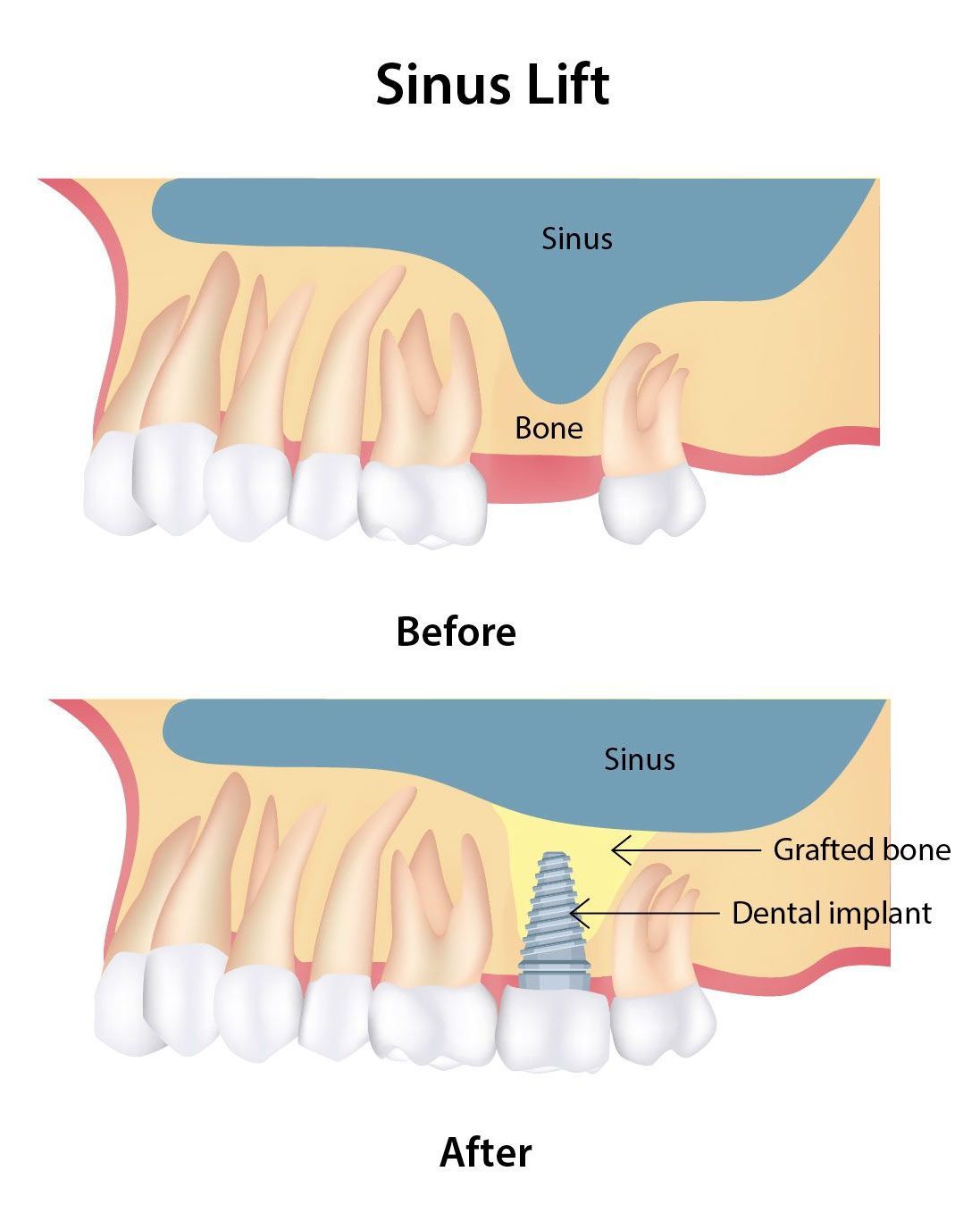
Meet your sinus — the tenant above every upper molar.
The maxillary sinus is a hollow, air-filled chamber inside your cheekbone — one on each side — lined with a delicate living tissue called the Schneiderian membrane, a layer often compared to the skin inside an eggshell: thin, flexible, and the entire procedure’s centre of gravity. Everything a sinus lift does, it does beneath this membrane without breaching it.
The mechanics are elegant: through the chosen access route, the membrane is carefully separated from the bony floor and eased upward — lifted like a tent’s fabric off its groundsheet — and the space created underneath is filled with graft material, the same scaffold principle that rebuilds ridges elsewhere. Your own bone then grows through the scaffold over the following months, and the sinus floor that was millimetres above your ridge is now comfortably higher, with solid new bone where air used to be.
The result: enough vertical bone for a full-length fixture in a region that’s otherwise the mouth’s most compromised real estate — soft bone, low ceiling, heavy chewing loads. A properly lifted site converts the hardest neighbourhood in implant dentistry into an ordinary one.
Six upper-jaw situations — and what each does to your height.
The double squeeze
Pneumatisation at workAfter an upper molar leaves, the ridge resorbs from below while the sinus expands downward from above — two processes eating the same millimetres from opposite directions. It’s why old upper-molar gaps are the classic lift cases: the ceiling didn’t just stay low; it came down to meet the shrinking floor.
The naturally low ceiling
Anatomy, not neglectSome sinuses simply run large and low by birth — even a recently lost tooth can leave too little height. No fault to assign; just a floor plan that needs raising before it can host a fixture. The CT (₩30,000) reads yours in one scan.
The fresh extraction upstairs
The strategic momentAn upper molar coming out soon is a planning opportunity: socket preservation at extraction can slow both directions of the squeeze, sometimes keeping a future lift crestal instead of lateral — or off the menu entirely. Raise it before the extraction, wherever you have it done.
The borderline millimetres
Crestal territoryWhen residual height is close-but-not-quite, the crestal lift (₩500,000) earns its keep: a modest raise through the fixture’s own channel, frequently with the implant placed in the same appointment — one surgery, one healing period, no side window.
The serious shortfall
Lateral territoryWhen most of the height is gone, the lateral window (₩700,000) gives direct visual access for a larger rebuild — more graft, more control, staged healing before the fixture. Slower, and the honest route when millimetres are genuinely scarce.
Height that measures fine
Then no lift, on recordPlenty of upper sites clear the bar without help — and when yours does, “no lift needed” goes in the written plan as a finding. A sinus lift prescribed to sufficient height is the upper jaw’s version of the padding trick, and the CT’s millimetres are the audit.
How a sinus lift actually goes.
CT & the height verdict
The CT (₩30,000) measures residual bone height to the millimetre and maps your sinus’s shape and health. The verdict names the route — none, crestal (₩500,000) or lateral (₩700,000) — in your written plan, reasons included.
Access, by the chosen route
Crestal: through the implant’s own drill channel, no separate site. Lateral: a small, precise window in the side wall under local anaesthesia. Either way, the destination is the same — the membrane’s underside.
The gentle lift
The Schneiderian membrane is eased off the bony floor and raised — the procedure’s defining minutes, done slowly and instrument-softly, because the membrane’s integrity is the whole game.
Grafting the new floor
Scaffold material fills the lifted space — the future bone’s formwork. In crestal cases the fixture frequently goes in the same visit; larger lateral rebuilds heal first and host the implant after verification.
Quiet months, then the fixture story
New bone matures beneath the raised membrane over months, confirmed by imaging — then the standard implant sequence proceeds at published tiers (₩800,000–1,750,000, crown included), on a floor that finally has room.
Crestal ₩500,000, lateral ₩700,000 — how the millimetres choose.
| No lift — ₩0 | Crestal — ₩500,000 | Lateral — ₩700,000 | |
|---|---|---|---|
| The situation | Residual height clears the fixture’s needs — stated as a finding | Height is close but short — a modest raise closes the gap | Height is substantially gone — a larger rebuild is honestly required |
| The access | — | Through the implant’s own channel — no separate surgical site | A small dedicated window in the side wall — direct visual access |
| Implant timing | Placed directly | Frequently the same appointment — lift and fixture share one healing period | Usually staged — the rebuild matures and passes imaging, then the fixture follows |
| Recovery character | Standard implant recovery | Similar to implant placement alone — most patients can’t separate the two | A gentler week than its reputation — swelling and sinus-care rules, mapped in the aftercare sheet |
| The honest note | Common — not every upper site needs help | The efficient route — but stretching it past its millimetre range trades safety for convenience, so we don’t | More procedure, more control — the right tool when the shortfall is real, and only then |
The choosing principle, plainly: the route is a measurement outcome, not a menu preference. Crestal where crestal honestly reaches, lateral where it honestly doesn’t, neither where the height was already there — each verdict written down with the millimetres that produced it.
The tent-raising — a procedure that lives or dies by one membrane.
Every sinus lift is really a story about handling something delicate without breaking it. The story, in four movements:
An eggshell’s inner skin
The Schneiderian membrane lining your sinus is fractions of a millimetre thick — living tissue that breathes, drains and defends. It tolerates being lifted; it objects to being torn. Respecting that difference is the procedure’s entire craft.
Peeling without piercing
Blunt, curved instruments ease the membrane off the bony floor in slow sweeps — tension distributed, never concentrated. It’s the least dramatic-looking part of the surgery and the reason experience is the specification: hands that have done this many times feel resistance before it becomes a problem.
Perforations happen — and have a playbook
A small membrane tear is this procedure’s known companion, more likely in thin membranes and heavy rebuilds. The honest part: it’s a managed event, not a catastrophe — small tears are patched with membrane material and the lift usually proceeds; larger ones may pause the plan to heal and re-stage. You’ll know either way, because plans that adapt out loud are the trustworthy kind.
A floor where there was air
Beneath the raised, intact membrane, the graft matures into your own load-bearing bone over the quiet months — and the sinus above carries on breathing, draining and defending, entirely unbothered. The tenant upstairs keeps its apartment; you get a proper foundation built into what used to be its basement.
Is a sinus lift painful? It sounds intense.
The name outpunches the experience — consistently. The procedure runs under local anaesthesia; crestal lifts feel essentially like implant placement, and even lateral lifts surprise patients with how ordinary the appointment is. The week after brings swelling and some congestion-like fullness managed by ordinary medication and the aftercare rules. The genuinely demanding part is behavioural, not painful: a couple of weeks of being kind to your sinus.
What are the rules after a sinus lift?
The theme is pressure management — the healing membrane dislikes pressure spikes from either side. The classics: no nose-blowing(dab instead), sneeze with your mouth open, skip straws and smoking (suction is pressure in reverse), no diving or flying until cleared, and sleep slightly elevated the first nights. Your aftercare sheet lists the full set with timeframes for your specific case — unglamorous rules protecting an elegant result.
Will a sinus lift change my breathing, voice or sinuses long-term?
No — and the reason is geometric: the lift borrows a few millimetres from the very bottom of a chamber, while the sinus keeps its openings, its lining and effectively all of its volume for breathing and drainage. Voice resonance is untouched. Once healed, the only party that knows anything changed is the implant standing on the new floor — your sinus files no complaints and notices no tenant.
I have allergies / a history of sinusitis — can I still have a lift?
Usually yes, with sequencing: what matters is the sinus’s condition at surgery, not its biography. The CT shows the membrane’s state and any inflammation; an actively inflamed sinus gets treated and settled first — sometimes with an ENT colleague’s help — because lifting an angry membrane is asking a swollen tissue to cooperate. Chronic-but-controlled allergy sufferers do fine with timing chosen sensibly. Mention your history at the consult; it shapes the calendar, rarely the verdict.
Can the implant really go in during the same visit as the lift?
Frequently, for crestal cases — when enough native bone exists to hold the fixture stable while the lifted graft matures around its tip, lift and placement share one appointment and one healing period. Lateral rebuilds usually stage: the larger graft matures first, passes imaging, then hosts the fixture. The deciding number is the residual height on your CT, and your written plan states which sequence yours is — before anything, as always.
Why do sinus lift prices vary so much between clinics?
Same anatomy as graft pricing: unpublished rates, route upsells (lateral prescribed where crestal reaches), and lifts sold to sites that measured fine. Our structure is the counter — two published routes (₩500,000 / ₩700,000), the route chosen by residual-height millimetres you can see on screen, and “no lift needed” recorded as a finding. The audit questions travel well: is the price published, and what residual height did you measure?
Care by board-certified specialists in Seomyeon
Both directors are board-certified specialists in Advanced General Dentistry, so your cosmetic treatment is planned with your overall dental health in mind.

- Board-certified specialist, Advanced General Dentistry
- M.S. in Orthodontics, Kyungpook National University
- Focus on natural, alignment-led smile improvement
- Conservative, tooth-preserving approach

- Board-certified specialist, Advanced General Dentistry
- DDS, Dankook University College of Dentistry
- Restorative & aesthetic resin filling work
- Focus: natural, durable results
Small truths about sinus lifts.
- The sinus keeps expanding whether you plan or not. Pneumatisation doesn’t pause while you decide — an upper gap’s lift tends to get bigger, not smaller, with waiting. Not an emergency; genuinely a clock, and the CT reads where yours stands.
- “Sinus-trained” is a real specification here. Membrane handling is experience-dependent craft — the procedure’s outcomes track the hands more than the materials. It’s the same placement-over-product principle that runs our whole implant page, applied to the mouth’s most delicate surgery.
- A cold on surgery day means rescheduling — cheerfully. An inflamed membrane is a poor lifting candidate, so active congestion postpones the appointment. Tell us; moving a date is free, and lifting an angry sinus isn’t.
- Smokers, this is your procedure to quit for. Between graft biology’s blood-vessel needs and the suction-pressure problem, smoking attacks a sinus lift from two directions at once. The healing weeks are the most medically justified quitting window dentistry offers.
- The lift is an investment that outlives one implant. Rebuilt height serves the site itself — if a fixture ever needs revising decades on, the bone you grew is still there. You’re not buying a procedure; you’re buying back real estate.
When the lift is right — and when we’ll leave your ceiling alone.
The lift earns its place when…
- the CT’s millimetres genuinely fall short of the fixture’s needs — measured, shown, written down
- the sinus is healthy or has been settled first — calm membranes lift; angry ones wait
- the route matches the shortfall — crestal for near-misses, lateral for real deficits, never upsold across the line
- you can honour the pressure rules for the healing weeks — the patient is part of the surgical team here
We’ll leave it alone when…
- your residual height clears the bar — “no lift needed” is a finding we’re glad to write
- a shorter fixture honestly serves the site — engineering priced against surgery, both options shown
- the sinus is actively inflamed — treatment and settling come first, with ENT help where sensible
- the tooth above isn’t actually being replaced — a lift without an implant plan is real estate bought for no building, and we’ll say so
Sinus lift FAQ.
Two published routes at this clinic: crestal ₩500,000 — the through-the-channel raise for modest shortfalls, frequently combined with same-visit implant placement — and lateral ₩700,000, the window approach for substantial rebuilding. The CT (₩30,000) measures your residual height and chooses the route, graft material works beneath the lifted membrane either way, and sufficient height gets the best quote in dentistry: nothing, recorded as a finding.
Crestal cases often skip the wait entirely — lift and fixture share the same appointment and the same healing period when residual bone can hold the implant stable. Staged lateral rebuilds let the larger graft mature over a period measured in months, verified by imaging rather than assumed by calendar, then host the fixture. Your written plan states your sequence and, for international patients, the trips it translates to.
It's the procedure's known risk, and it comes with a playbook rather than a panic: small perforations are patched with membrane material intra-operatively and the lift typically proceeds; larger tears may pause the plan — heal first, return, re-stage — which costs calendar, not outcome. Thin membranes and heavy rebuilds raise the odds; experienced hands lower them. Either way you'll be told plainly what happened and what it changes, because adapting out loud is the policy.
Not immediately — cabin pressure changes are exactly the stress a healing membrane dislikes, so flying waits until your surgeon clears it, with the window depending on your route and healing. For international patients this is a scheduling fact, not a problem: we plan the lift early in a trip or time your return flight past the clearance point, stated in the written plan before you book anything. Diving follows the same logic, with a longer leash.
Same family, different address. Both use the scaffold principle — material that your own bone grows through and replaces — but a ridge graft (₩300,000–500,000) rebuilds width or contained defects anywhere in the jaw, while a sinus lift specifically rebuilds height beneath the sinus membrane in the upper back jaw, with its own access routes and its own pressure-rule aftercare. Some sites need one, some the other, occasionally both — the CT sorts your site into the right page.
Cleanly — the procedure's chaptered nature maps onto trips like the rest of implant care: assessment and lift on one visit (crestal cases often taking the fixture the same day), the maturing months at home with WhatsApp check-ins, verification and next steps on the return. The one extra planning input is flight clearance after surgery, which we build into the trip design from the start. Published route prices mean the budget is knowable before your first booking.
A raised ceiling across visits.
Send photos and any imaging on WhatsApp — mention how long the upper tooth has been gone and any sinus history. You’ll get an honest first read: no-lift, crestal-shaped, or lateral-shaped.
CT (₩30,000), millimetre verdict, written plan — then the lift by your route, with crestal cases frequently taking the fixture in the same appointment. Return flight timed past pressure clearance, planned upfront.
New bone matures beneath the raised membrane wherever you live — WhatsApp check-ins, pressure rules honoured early on, no required flights while the floor sets.
Imaging confirms the rebuilt height, then the fixture story proceeds — placement where staged, crown where ready, all at published prices you knew before your first flight.
Get your ceiling measured — before anyone sells you a raise.
Send a photo and any imaging on WhatsApp — we’ll tell you honestly whether your upper site reads sufficient, crestal, or lateral, and what each verdict costs in writing. In English.
Message us on WhatsAppBaro Dental Clinic · 5F, SJ Medical Building, 698-1 Jungang-daero, Busanjin-gu · Seomyeon Station Exit 2, 4 min
Explore the options in Busan.
Bone Graft in Busan
₩300,000–500,000 — the scaffold principle, applied to width and ridges.
Explore →Single Tooth Implant in Busan
The fixture the new floor is built for — three tiers, crowns included.
Explore →Digital Guided Surgery in Busan
Where sinus clearances get measured — and lifts get prescribed by millimetres.
Explore →Full-Mouth Implants in Busan
Where upper rebuilds and lifts meet the biggest plans in dentistry.
Explore →Medical information on this page is provided for general education and does not replace an individual examination and diagnosis. Whether a sinus lift suits your site — including route selection, timing relative to implant placement, membrane condition and healing verification — is confirmed at a CT-based consultation with a written plan. Individual results vary with anatomy, sinus health and aftercare adherence.