
Ceramic braces in Busan Seomyeon — full braces capability, quietly.
Ceramic brackets do everything metal ones do — extraction closures, rotations, root control — in a tooth-coloured material that reads far softer at conversation distance. Self-ligating, ₩5,300,000 published, fixed in writing at diagnosis.
Ask about ceramic braces.
Tap what fits — we’ll open WhatsApp with your message ready to send.Nothing sends until you press send in WhatsApp. Bite photos help us give an honest first read — and whether ceramic buys you something real.
Are ceramic braces in Busan as good as metal — and how invisible are they, really?
Capability: equal. The bracket geometry is the same engineering in a different material — extraction closures, severe rotations and root torque all run identically. Visibility: honestly, low rather than zero. The brackets are tooth-coloured and disappear at conversation distance; the archwire running through them is still metal and shows as a fine line up close. Published price: ₩5,300,000, self-ligating, fixed in writing at diagnosis (₩100,000, credited).
Where ceramic earns its place is a specific gap: cases too complex for clear aligners, belonging to people whose work or life makes visible metal a real cost. If your case is honestly tray-sized, we’ll say so and it costs what trays cost (₩3M–6M); if metal’s look doesn’t bother you, standard brackets at ₩4,300,000 do the same work for less. Ceramic is for when both of those honest answers fail you — and then it’s exactly right.
Same engineering, different material.
A ceramic bracket is the familiar fixed-appliance design — a precision slot at a tooth-specific angle, a shape-memory archwire threaded through, the mechanics covered on our metal braces page — manufactured in a polycrystalline ceramic that takes on the colour and translucency of enamel. Bonded to the tooth, it borrows the tooth’s own shade; what your eye registers across a table is mostly the thin wire, not the hardware.
Ours are self-ligating: each bracket carries a built-in door that clips over the wire, rather than the tiny elastic rings that tie wires into traditional brackets. On ceramic this matters twice. Once for the usual reasons — lower friction, quicker adjustment visits. And once for a reason specific to aesthetics: the clear elastic rings on old-style ceramic braces were the part that stained yellow with coffee and curry, undoing the discretion patients had paid for. A door system has no elastics to stain — the weakness is engineered out rather than managed.
The honest trade-offs: ceramic is harder yet more brittle than steel, so brackets are made slightly bulkier to compensate and are treated with a little more respect around very hard foods. And the price — ₩5,300,000 against metal’s ₩4,300,000 — buys appearance, not extra movement. Both facts are on this page because you should read them here, not discover them later.
Six people who choose ceramic — and why it fits them.
The client-facing professional
The classic ceramic patientSales, consulting, teaching, medicine — work where your face does the talking. Ceramic keeps correction from joining every meeting; at conversation distance, most people simply never register it.
The complex case that wanted trays
Ceramic’s core purposeDiagnosed too complex for aligners — extraction space, severe rotation — but chose trays for their discretion. Ceramic is the honest middle: bracket capability at tray-adjacent visibility.
The one who postponed for years
The barrier was the lookAdults who’ve wanted straight teeth since their twenties but couldn’t face metal at the office. If the appearance was the whole obstacle, removing it is worth precisely ₩1,000,000 to many — a calculation only you can make, priced transparently.
The camera-facing life
Screens magnify metalPresenters, creators, anyone whose week includes lenses: video sharpens metal’s glint more than real rooms do. Ceramic photographs as texture, not hardware — with the wire’s fine line the honest remainder.
The event on the horizon
Planned around datesA wedding, a graduation, a milestone year of photos falling mid-treatment. Ceramic softens braces’ presence in the album — and the visit plan can sequence gentler phases around your dates, discussed at diagnosis.
The metal-is-fine pragmatist
Honestly: save the ₩1MIf visible brackets genuinely don’t bother you, ceramic buys you nothing metal doesn’t deliver — standard metal (₩4,300,000) is the same treatment for less. We’ll say exactly that at diagnosis if it’s true of you.
How ceramic treatment actually goes.
Diagnose & be honest about systems
Scan, photos, CT where indicated (₩30,000). If your case is tray-sized, you’ll hear it; if metal serves you identically, you’ll hear that too. Ceramic gets recommended when it’s genuinely your answer (₩100,000 diagnosis, credited).
Shade-matched bonding
Brackets are positioned with the same tooth-by-tooth precision as metal — the angles are the treatment — with the ceramic reading as part of the tooth from the first day. The first light wire goes in the same visit.
Door-system adjustments
Visits run quick: doors open, the next wire clips in, doors close. No elastic rings to replace — and none to slowly yellow between visits, which is the aesthetic point of the whole system.
The same heavy lifting
Space closure, rotations, root torque proceed exactly as on metal — the material changed, the mechanics didn’t. Progress photos track it; at conversation distance, colleagues mostly track nothing.
Debond & retain
Brackets off in one appointment, surfaces polished, retention fitted the same day — clear retainer ₩100,000 or fixed wire ₩150,000–200,000, first-year adjustments covered. Discreet treatment deserves a kept result.
Ceramic, metal, aligners — the three-way honest sheet.
| Ceramic self-ligating | Metal (standard / Clippy-C) | Clear aligners | |
|---|---|---|---|
| Published price | ₩5,300,000 | ₩4,300,000 / ₩5,100,000 | ₩3,000,000–6,000,000 by case |
| Capability ceiling | Full — every bracket movement | Full — the reference standard | High for tray-sized cases; extraction-level work says no honestly |
| Visibility | Low — tooth-coloured brackets, fine metal wire remains | Visible — and ₩1M cheaper partly because it is | Lowest — removable clear plastic |
| Removable? | No — works 24h by construction | No — works 24h by construction | Yes — which is both its charm and its discipline demand |
| Material honesty | Brittler than steel — slightly bulkier, respects hard foods | Effectively unbreakable in normal life | Plastic replaced on schedule by design |
| Right when… | Case needs brackets, life needs discretion | Case needs brackets, look doesn’t matter to you | Case is tray-sized — confirmed on your scan |
All three live at this clinic at published prices — so the diagnosis recommends what your scan and your life actually call for, not what the menu wants to sell. The ₩100,000 diagnosis fee is credited toward whichever you choose.
The anatomy of “less visible” — what shows, what doesn’t.
“Nearly invisible” is marketing; here’s the optics, piece by piece, so the mirror on bonding day holds no surprises.
Genuinely camouflaged
Tooth-coloured ceramic against enamel reads as texture, not hardware — at a metre and a half, in normal light, most people’s eyes slide past entirely. This is the component the ₩1,000,000 difference actually buys.
Still metal — said plainly
The archwire that does the moving remains a fine steel line across your teeth. Coated tooth-coloured wires exist but trade performance and chip their coating; we’d rather give you an honest thin line than a flaking compromise. Up close, the line shows. That’s the truth of it.
Conversation distance is the design spec
Ceramic’s discretion is calibrated to how humans actually see each other: across desks, tables and lecterns. Bathroom-mirror distance — thirty centimetres, task lighting — shows everything, to you alone. Judge it at the distance your colleagues use, not the one you do.
Photographs quiet, films quieter
Stills at social distance render ceramic as slight texture; the wire’s line softens into shadow at most angles. Ring-lit close-ups are the exception — light bouncing flat off the wire — worth knowing if extreme close-up is your genre, irrelevant if it isn’t.
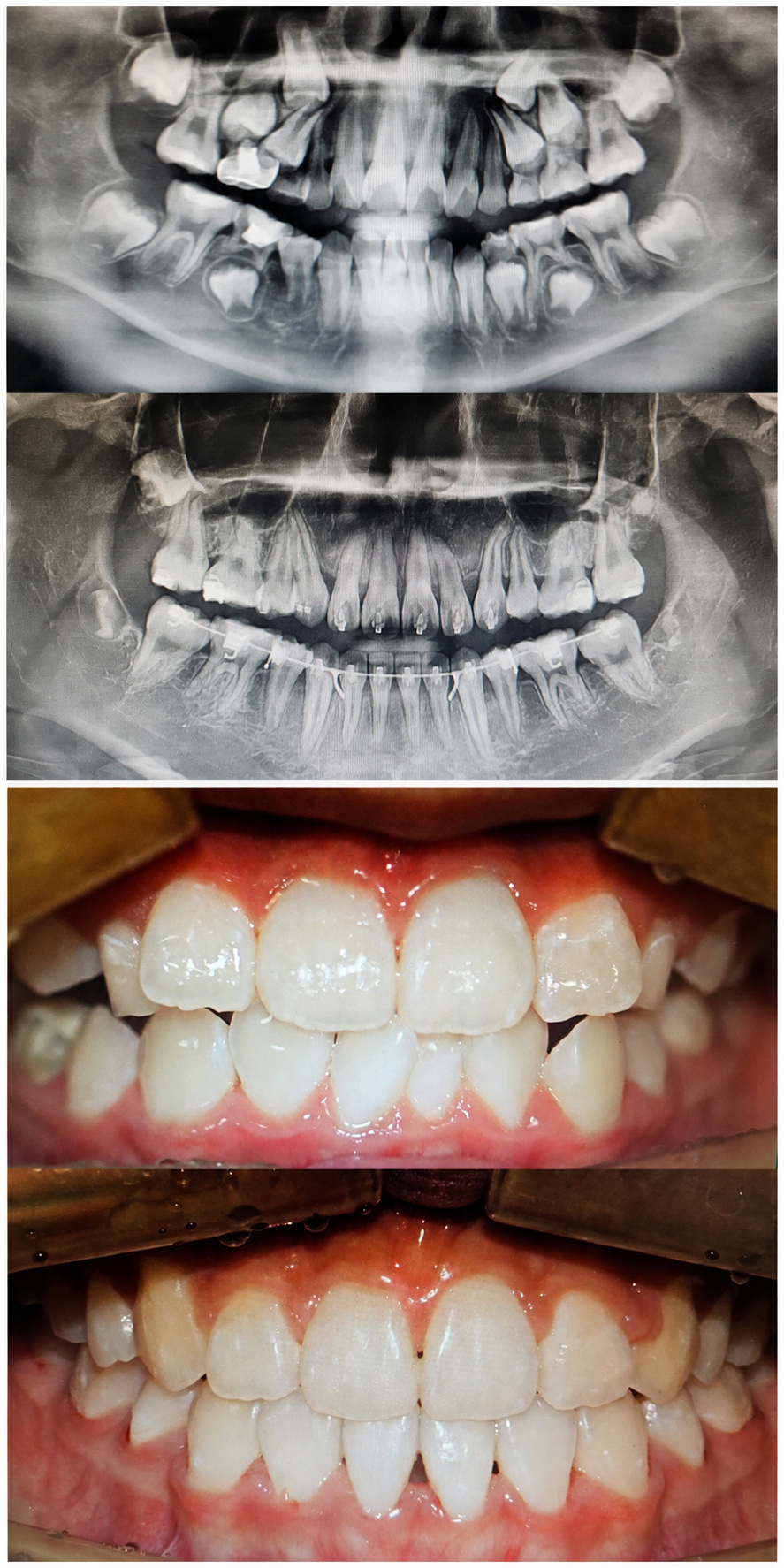
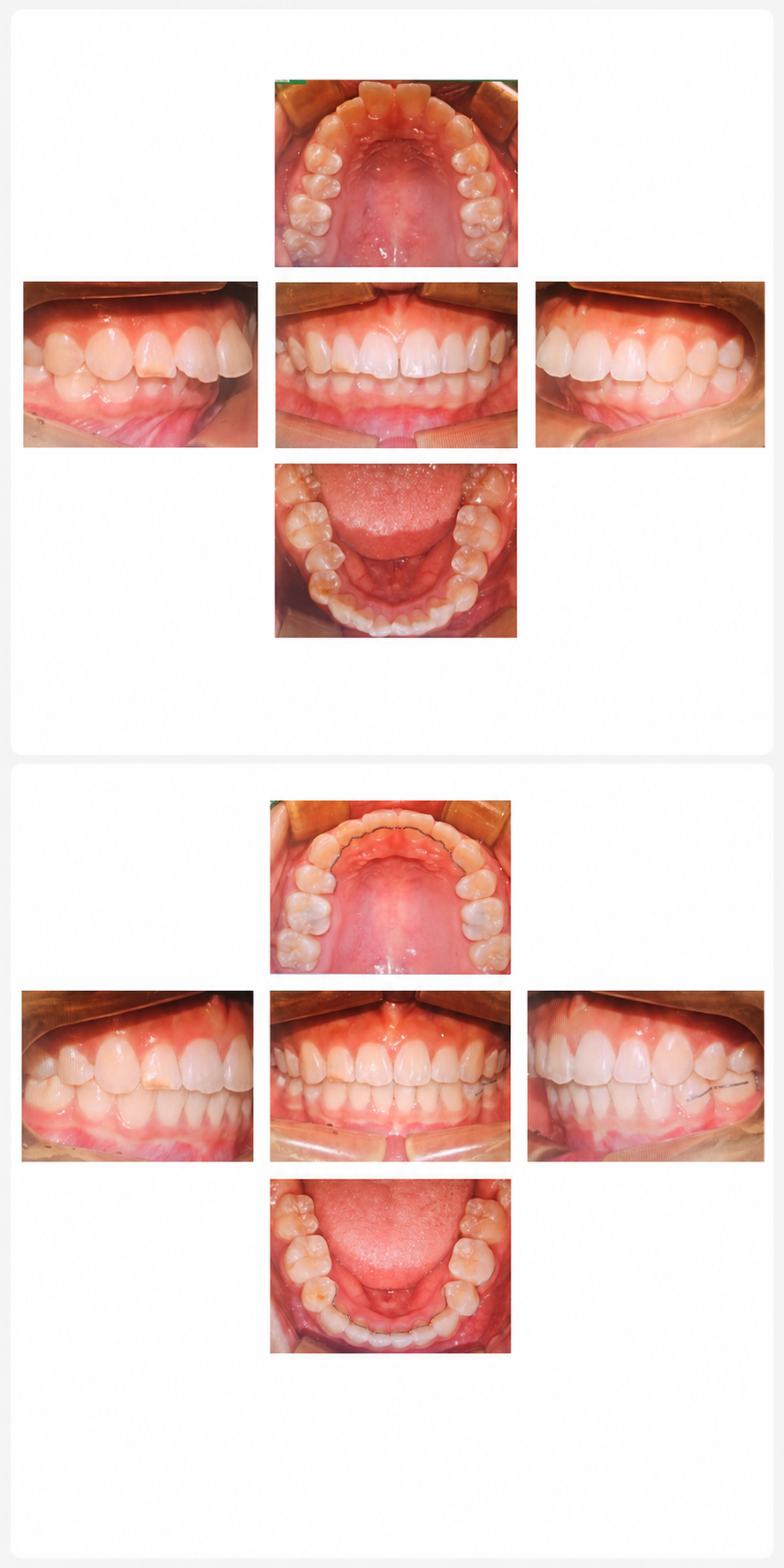
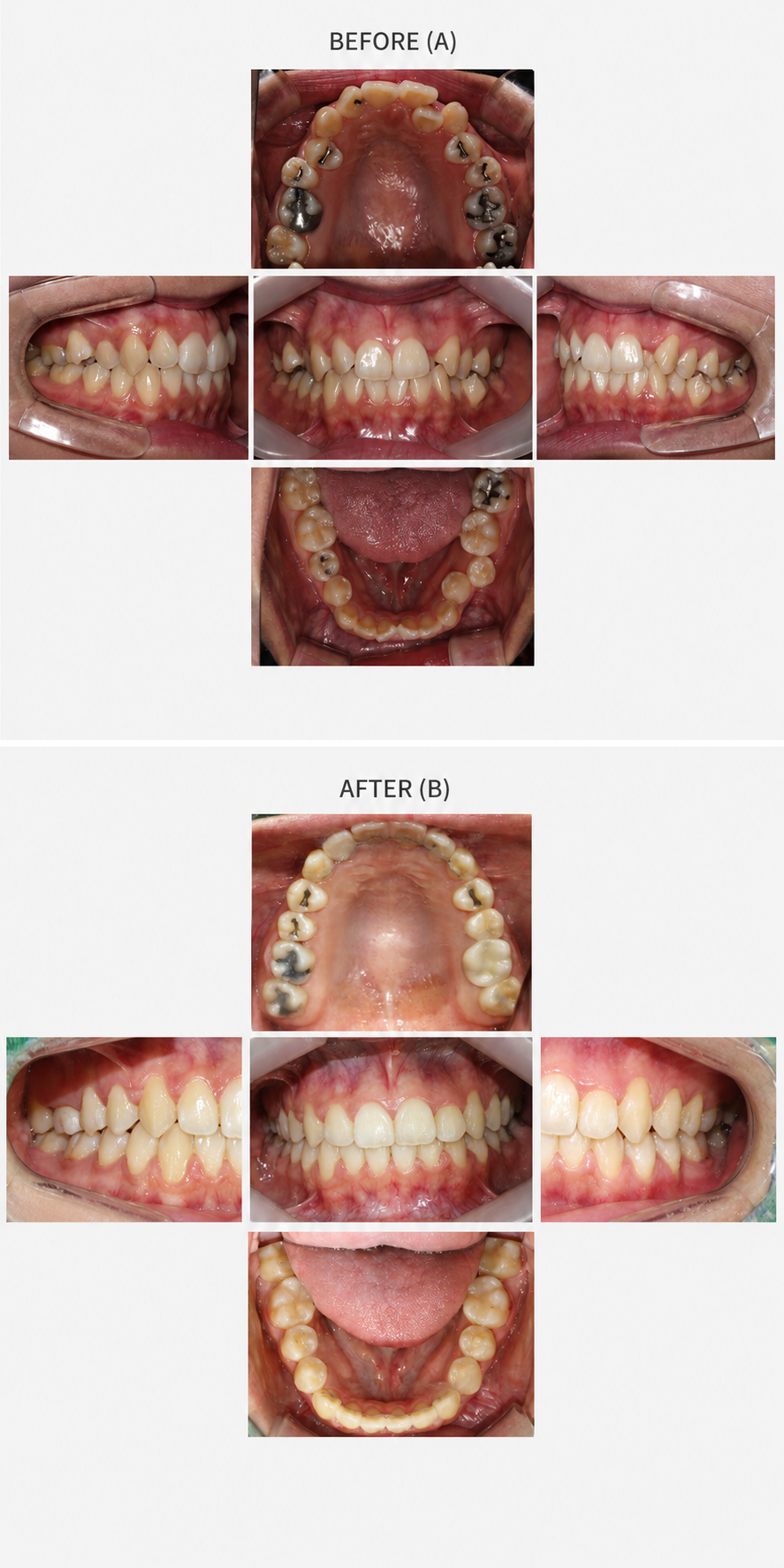
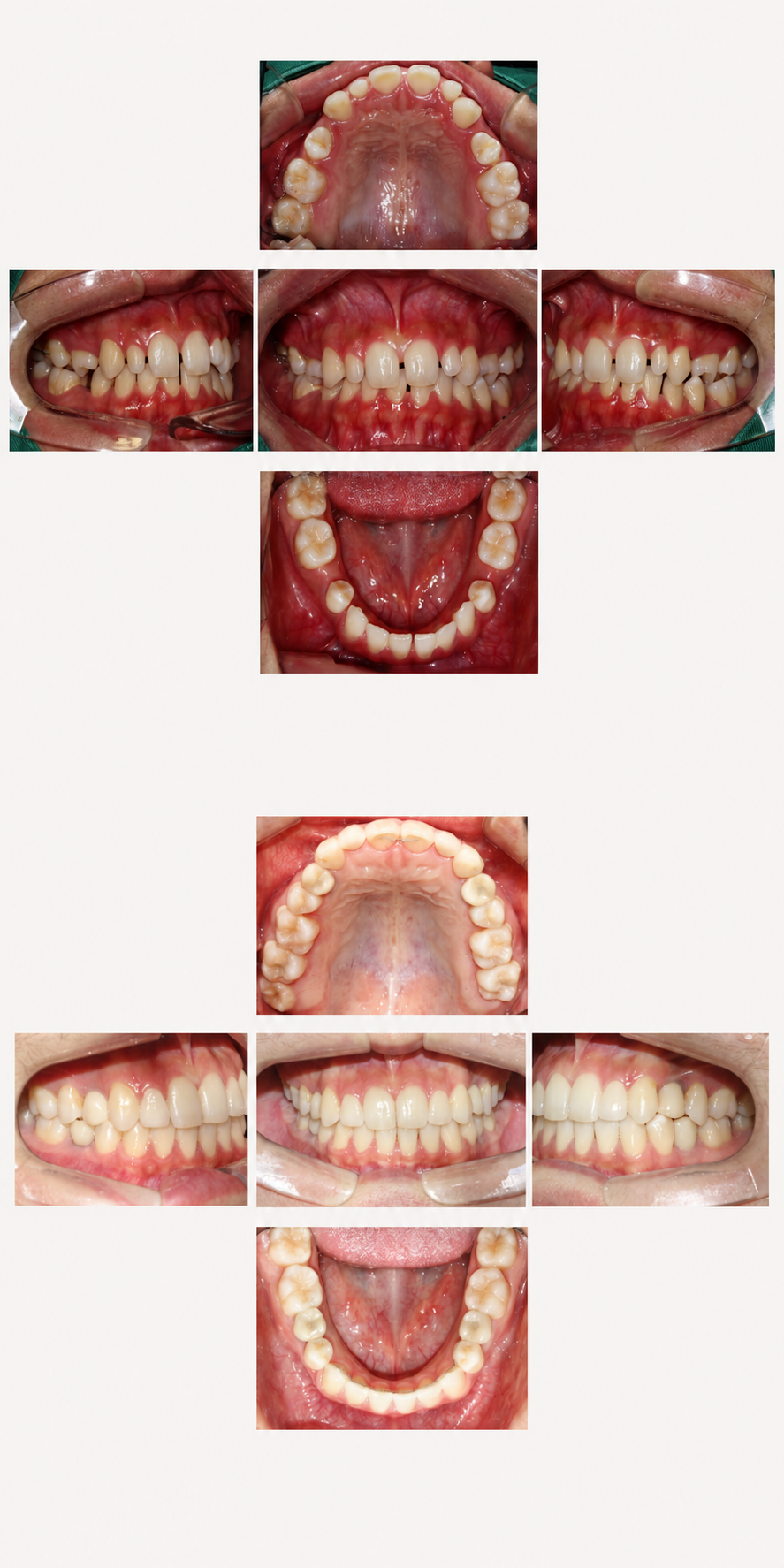
Clippy-C ceramic braces in Busan — before and after.
Treated with Clippy-C ceramic self-ligating brackets at Baro Dental, Seomyeon. Photographed the same way before and after, shown with patient consent; every case is individual and results vary.
How much do ceramic braces cost in Busan?
₩5,300,000, self-ligating, published — fixed in writing at diagnosis (₩100,000, credited), CT where needed ₩30,000, retention afterwards ₩100,000 clear / ₩150,000–200,000 fixed with first-year adjustments covered. For calibration: the same clinic’s metal runs ₩4,300,000 and aligners ₩3M–6M — all on one menu, so the comparison happens in the open.
Do ceramic braces work as well as metal ones?
Yes — the capability is the point of the design. The slot geometry that steers each tooth is identical engineering; extraction closures, severe rotations and root torque all run the same. The material differences are practical, not clinical: ceramic sits slightly bulkier, asks a little more respect around very hard foods, and in exchange disappears into the tooth’s own colour. Your teeth can’t tell the difference; your colleagues mostly can’t see one.
Can ceramic brackets break or chip?
Ceramic is harder than steel but more brittle — it resists wear, not impact. In practice brackets are built bulkier to compensate and failures are uncommon; the realistic caution list is the same one metal patients get (ice-chewing, un-cut hard foods) observed a touch more seriously. If one does fracture, it’s re-bonded in a short visit — a repair on the plan’s terms, not a crisis on yours.
Will coffee and curry stain my ceramic braces?
The brackets themselves — no; modern polycrystalline ceramic holds its colour. The yellowing horror stories come from the clear elastic rings on old-style ceramic systems, which drank coffee like fabric. Ours are self-ligating: a built-in door holds the wire, no elastics exist to stain. What still deserves care is the enamel around any bracket — cleaning discipline plus in-treatment scaling (₩60,000) keeps the teeth themselves honest.
Why choose ceramic braces over clear aligners?
You mostly don’t — unless your case does. Where a case is tray-sized, aligners win on discretion and removability, and we say so. Ceramic exists for the gap between: cases needing bracket mechanics — extraction space, heavy rotation, root control — in lives that can’t host visible metal. It’s the answer to a specific double constraint, which is exactly why the diagnosis, not the preference, should pick it.
Are ceramic braces uncomfortable against the lips?
The first-week negotiation is the same as metal’s — cheeks and lips toughening to any bracket’s presence — with one honest nuance: ceramic’s slightly bulkier profile can make that week marginally more noticeable, and its matte surface actually feels smoother to some once adapted. Wax carries everyone across either way. After the initiation, patients report the same thing metal patients do: forgetting.
Care by board-certified specialists in Seomyeon
Both directors are board-certified specialists in Advanced General Dentistry, so your cosmetic treatment is planned with your overall dental health in mind.

- Board-certified specialist, Advanced General Dentistry
- M.S. in Orthodontics, Kyungpook National University
- Focus on natural, alignment-led smile improvement
- Conservative, tooth-preserving approach

- Board-certified specialist, Advanced General Dentistry
- DDS, Dankook University College of Dentistry
- Restorative & aesthetic resin filling work
- Focus: natural, durable results
Small truths about ceramic brackets.
- The ₩1,000,000 question has a real answer. Divide the premium over ceramic’s months of daily wear at work and it prices out cheaper than a coffee habit — or expensive vanity, depending entirely on how much visible metal would cost you. It’s a personal ledger; we just publish the numbers for it.
- Lower brackets sometimes go metal on purpose. Where a deep bite makes lower brackets collide with upper teeth, tougher metal may be recommended down below while ceramic handles the visible upper row — a mixed setup that keeps discretion where eyes actually land. If your case suggests it, you’ll hear it at diagnosis with the pricing logic.
- Ceramic asks nothing extra of your toothbrush. The cleaning routine is identical to metal’s — angled brushing at the bracket line, interdental brushes under the wire, taught hands-on at bonding. The door system even removes the elastic rings that used to trap plaque.
- Debond is routine — with proper instruments. Modern ceramic brackets are designed to release cleanly at removal; surfaces are polished after, same as metal. The brittle-material horror stories date from earlier generations and other techniques.
- Whitening waits for the brackets. Bonded surfaces can’t whiten evenly — the classic sequence is debond first, then whitening (from ₩165,000) on newly straight, fully exposed enamel. Many ceramic patients book it for the same month as their retainer fitting.
When ceramic is right — and when we’ll save you the million.
Ceramic is the right call when…
- your case genuinely needs bracket mechanics — confirmed on your scan, not assumed
- visible metal carries a real cost in your work or life — you’re the judge of that
- you want set-and-forget correction — no wear-hours discipline, no tray willpower
- the wire’s fine line is a trade you accept with open eyes — this page just showed you exactly what shows
We’ll steer you elsewhere when…
- your case is tray-sized — aligners beat ceramic on every aesthetic axis, and we’ll say so first
- metal’s look honestly doesn’t bother you — standard brackets are the same treatment, ₩1,000,000 lighter
- only the front section needs work — partial braces (₩2,500,000) may fit the problem’s actual size
- gum health isn’t ready — foundations first, on any system, every time
Ceramic braces FAQ.
At conversation distance — a metre or more, normal lighting — the tooth-coloured brackets largely vanish and what remains is the archwire's fine metal line, which most eyes read as nothing in particular. Up close in a bathroom mirror, you'll see everything; your colleagues don't view you from thirty centimetres. The honest summary: discreet enough that people who weren't told usually don't notice, not so invisible that a close-up inspection finds nothing.
Not meaningfully, with modern self-ligating ceramic. Older ceramic systems had higher wire friction, which earned the reputation; door-type brackets closed most of that gap. Treatment pace is set far more by your case's movements and biology than by bracket material — and your plan's honest expectations are laid out at diagnosis, on your scan, not on material folklore.
Yes — it's a recognised setup, and sometimes our recommendation. Upper teeth carry nearly all the visibility; lower teeth hide behind them in most smiles and speech. Where a deep bite risks upper teeth striking lower brackets, tougher metal below is also the engineering-sound choice. The mixed configuration is priced and proposed transparently at diagnosis when your case suits it.
A fair question with a real answer: ceramic is harder than enamel, so a bracket that repeatedly strikes an opposing tooth can wear it. This is exactly why bite depth is checked before bonding — deep-bite cases get bite management or metal in the collision zone, planned in advance. It's a known engineering constraint handled at diagnosis, not a surprise discovered on your enamel.
Short, tidy appointments: each bracket's door opens, the next wire in your sequence clips in, doors close — no elastic rings to cut off and re-tie tooth by tooth. Progress is photographed, hygiene is checked, pokes are trimmed. For international patients, these compact visits are what makes grouping adjustments into Busan trips practical; the visit map is planned at diagnosis.
Yes, on the same honest terms as any fixed appliance: in-person adjustments are part of the system, so this suits patients with a regular Busan rhythm. Bonding and key wire changes group into your trips; WhatsApp photo check-ins run between; the poke-and-repair protocol works message-first. If your travel pattern can't support the visit map, the diagnosis will say so — and we'll talk honestly about what can.
Ceramic treatment across visits.
Send bite photos and your realistic Busan visit rhythm on WhatsApp. You’ll get an honest read — tray-sized, bracket-sized, and whether ceramic buys you anything real — before booking.
Full diagnosis (scan, CT ₩30,000 where indicated), the three-system comparison run on your own case, written price for each route (₩100,000 diagnosis, credited). Bonding can follow the same trip.
Photo check-ins on WhatsApp; compact door-system adjustments grouped into Busan trips on a visit map set at diagnosis. Pokes and rare bracket issues run message-first.
Debond, polish, same-day retention (clear ₩100,000 / fixed ₩150,000–200,000, first-year adjustments covered) — and if you’re pairing whitening, this is its trip.
Find out what discretion actually costs you.
Send bite photos on WhatsApp — we’ll tell you honestly whether your case is tray-sized, bracket-sized, and whether ceramic’s ₩1,000,000 buys you something real. In English.
Message us on WhatsAppBaro Dental Clinic · 5F, SJ Medical Building, 698-1 Jungang-daero, Busanjin-gu · Seomyeon Station Exit 2, 4 min
Explore the options in Busan.
Metal Braces in Busan
₩4,300,000 standard / ₩5,100,000 Clippy-C — the same capability, visible and cheaper.
Explore →Clear Aligners in Busan
₩3M–6M — the most discreet option of all, where cases are tray-sized.
Explore →Partial Braces in Busan
₩2,500,000 — front-section correction priced for front-section problems.
Explore →Teeth Whitening in Busan
From ₩165,000 — the classic post-debond finish on newly straight enamel.
Explore →Medical information on this page is provided for general education and does not replace an individual examination and diagnosis. Whether ceramic braces suit your case — including system choice, any mixed configurations and bite-depth considerations — is confirmed at diagnosis with appropriate imaging. Individual results vary.