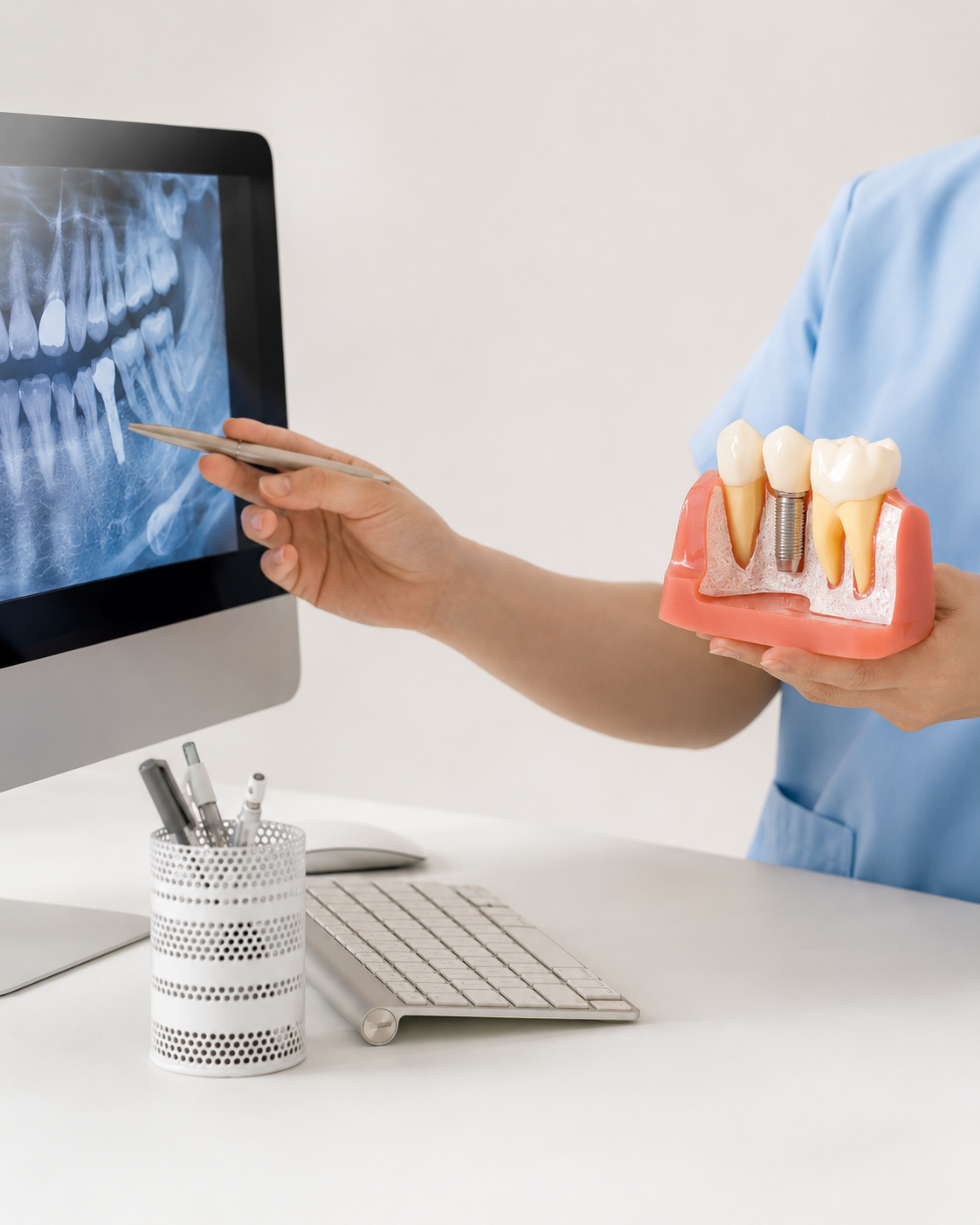
Single tooth implant in Busan Seomyeon — one tooth back, price told whole.
One missing tooth, replaced root-to-crown: fixture, custom abutment and zirconia crown in one published figure — DIO ₩800,000, Osstem KS ₩1,200,000, Straumann ₩1,750,000. No crown surprise at the end, because the crown was never sold separately.
Ask about your gap.
Tap what fits — we’ll open WhatsApp with your message ready to send.Nothing sends until you press send in WhatsApp. A photo of the gap helps us give an honest first read — straightforward, graft-likely, or gum-first.
How much does a single implant cost in Busan — all-in, no asterisks?
At this clinic, per tooth, including the custom abutment and zirconia crown: DIO ₩800,000, Osstem KS premium ₩1,200,000, Straumann premium ₩1,750,000. The add-ons that exist are the honest, anatomical kind — CT ₩30,000; bone graft ₩300,000–500,000 or sinus lift ₩500,000–700,000 only if your bone actually needs one — and they’re named in your written plan before anything is drilled, not discovered after.
The reason “implant price” confuses people everywhere: many quotes advertise the fixture alone, then bill the abutment and crown as separate line items later — turning a headline figure into roughly double at the finish. Our published prices are whole-tooth prices. What varies between the three brands, and how to choose, gets a full comparison table below — because that decision deserves information, not just a price gap.
Three parts, one new tooth.
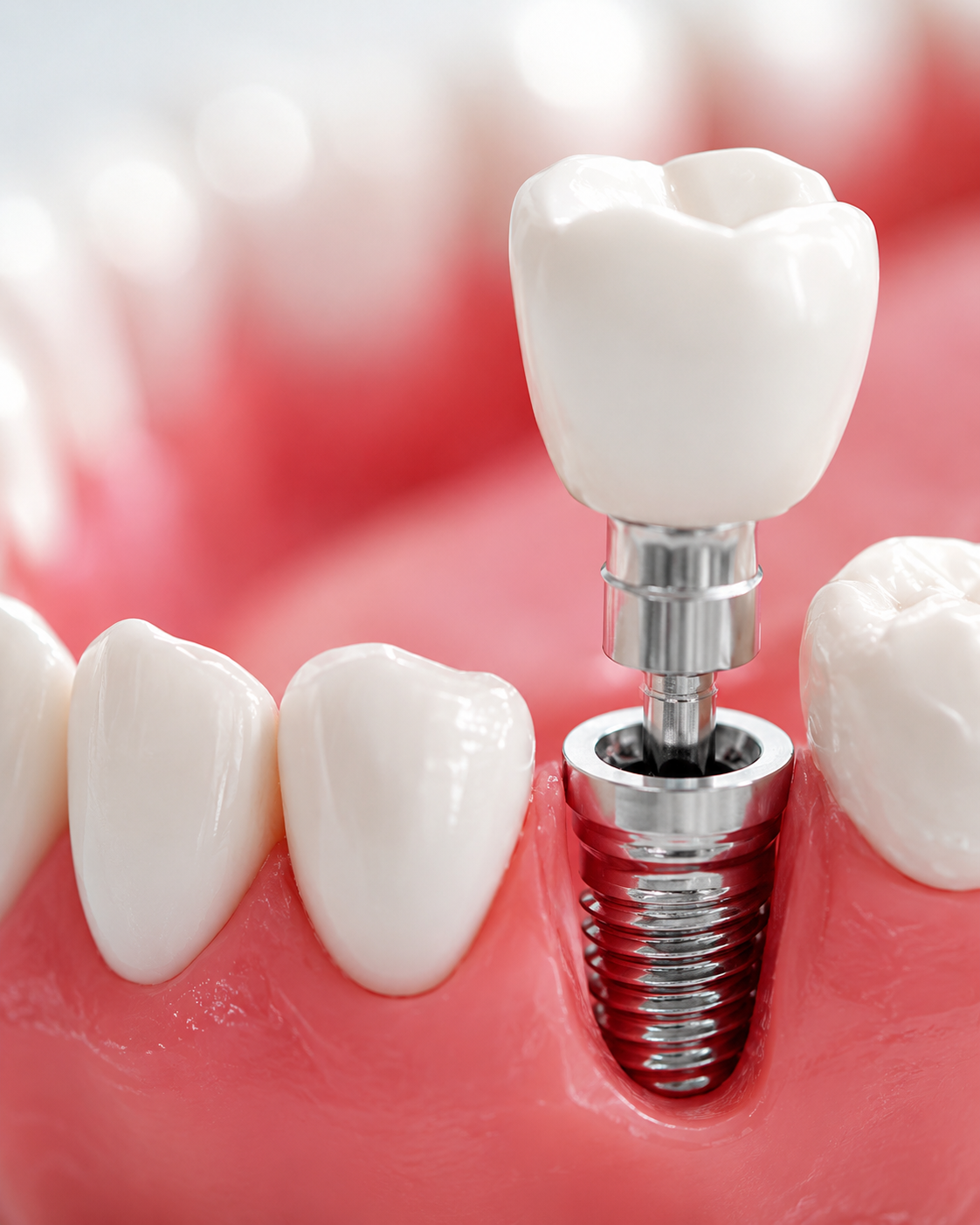
A dental implant rebuilds a tooth the way the original was built — from the root up. The fixture is a titanium root placed in the jawbone, where bone cells grow onto its treated surface until the two are structurally one (the process called osseointegration — it gets its own section below, because it’s the part worth understanding). The abutment is the custom connector rising through the gum. The crown — zirconia, shade-matched — is the tooth the world sees and your bite uses.
What makes an implant different from every other replacement is that it’s the only one that puts load back into the jawbone. Bone lives by Wolff’s law — stimulated bone stays, idle bone resorbs — and a bridge or denture, resting on neighbours or gums, leaves the bone under the gap unemployed and slowly shrinking. A fixture returns the chewing signal to the bone that held the original root; it’s a replacement that also acts as preservation.
And unlike a bridge, an implant recruits no neighbours: the teeth either side keep their enamel instead of being ground down into bridge pillars. One missing tooth stays a one-tooth problem — which is, quietly, the strongest argument on this page.
Six roads to a single implant — each with its own honest plan.
A tooth that must come out
Plan before the extractionFractured root, failed root canal, deep decay: when extraction is coming, the implant plan starts before it — the socket heals over a planned period, then the fixture goes into settled bone. Sequenced right, the gap era is short and the foundation honest.
The years-old gap
Still very treatableA tooth lost long ago, lived without since. Bone under old gaps has usually thinned — the CT (₩30,000) measures exactly how much, and a graft (₩300,000–500,000) rebuilds what’s needed. Old gaps take one extra step, not a different verdict.
The cracked molar
The workhorse caseBack teeth do the grinding and take the fractures — molars are implantology’s most common patients. A single fixture returns full chewing to the side that’s been on light duty, without touching the neighbours.
The front tooth
Aesthetics lead the planA missing front tooth is an engineering job and a portrait job — gum line, crown translucency, symmetry. It’s treated with its own playbook on our front tooth implant page.
Instead of a bridge
Sparing the neighboursThe classic fork: a bridge grinds two healthy neighbours into pillars; an implant leaves them untouched. Where both are viable we price both honestly — and the neighbour-sparing argument usually wins on its own merits.
Loss from gum disease
Foundations first, alwaysA tooth lost to periodontitis flags the ground it stood in — placing a fixture into active gum disease plants a flag in a landslide. Gum treatment comes first, stability is confirmed, then the implant — sequenced in one written plan.
How a single implant actually goes.
CT & the written plan
The CT (₩30,000) maps bone height, width and the anatomy to respect — sinus above, nerve below. Out comes the plan: fixture brand options, any graft honestly needed, and the whole-tooth price in writing.
Foundation work, if yours needs it
Thin bone gets a graft (₩300,000 simple / ₩500,000 complex); upper molars near the sinus may need a lift (₩500,000 crestal / ₩700,000 lateral). Many patients need neither — the CT decides, not a sales script.
Placement day
The fixture is placed under local anaesthesia — typically a shorter, quieter appointment than patients brace for, guided by the plan’s millimetres. Most people are surprised by how ordinary the day feels.
The quiet months
Bone grows onto the fixture’s surface — osseointegration, the biological glue that makes implants work (full story below). Nothing dramatic happens on the outside; everything important happens inside.
Abutment & crown
Integration confirmed, the custom abutment is connected and the shade-matched zirconia crown seated — already paid for in your fixture price. Bite checked, contacts refined, tooth back on duty.
DIO, Osstem KS, Straumann — what the price gap buys.
| DIO — ₩800,000 | Osstem KS — ₩1,200,000 | Straumann — ₩1,750,000 | |
|---|---|---|---|
| Who makes it | Established Korean manufacturer | Korea’s largest implant maker — premium KS line | Swiss — the global premium reference |
| What’s included | Fixture + custom abutment + zirconia crown — the whole tooth, every tier | ||
| Track record | Solid, widely placed in Korea | Deep Korean and international documentation | The most-studied implant system in the world |
| Sensible when | Sound bone, standard site, budget matters | The balance pick — premium surface at Korean pricing | Compromised bone, long-horizon planning, or simply wanting the reference standard |
| Our honest note | A well-placed DIO beats a poorly placed anything — placement quality outranks brand | The tier most of our patients land on after the CT conversation | Real advantages at the margins — not triple the implant for double the price |
All three integrate reliably in healthy bone — the honest hierarchy is that surgical planning and placement matter more than logo. Your CT and your bone quality drive our recommendation; the brand premium is explained, never assumed. Placement here is by an Osstem AIC faculty dentist — the credential that teaches other dentists implant surgery.
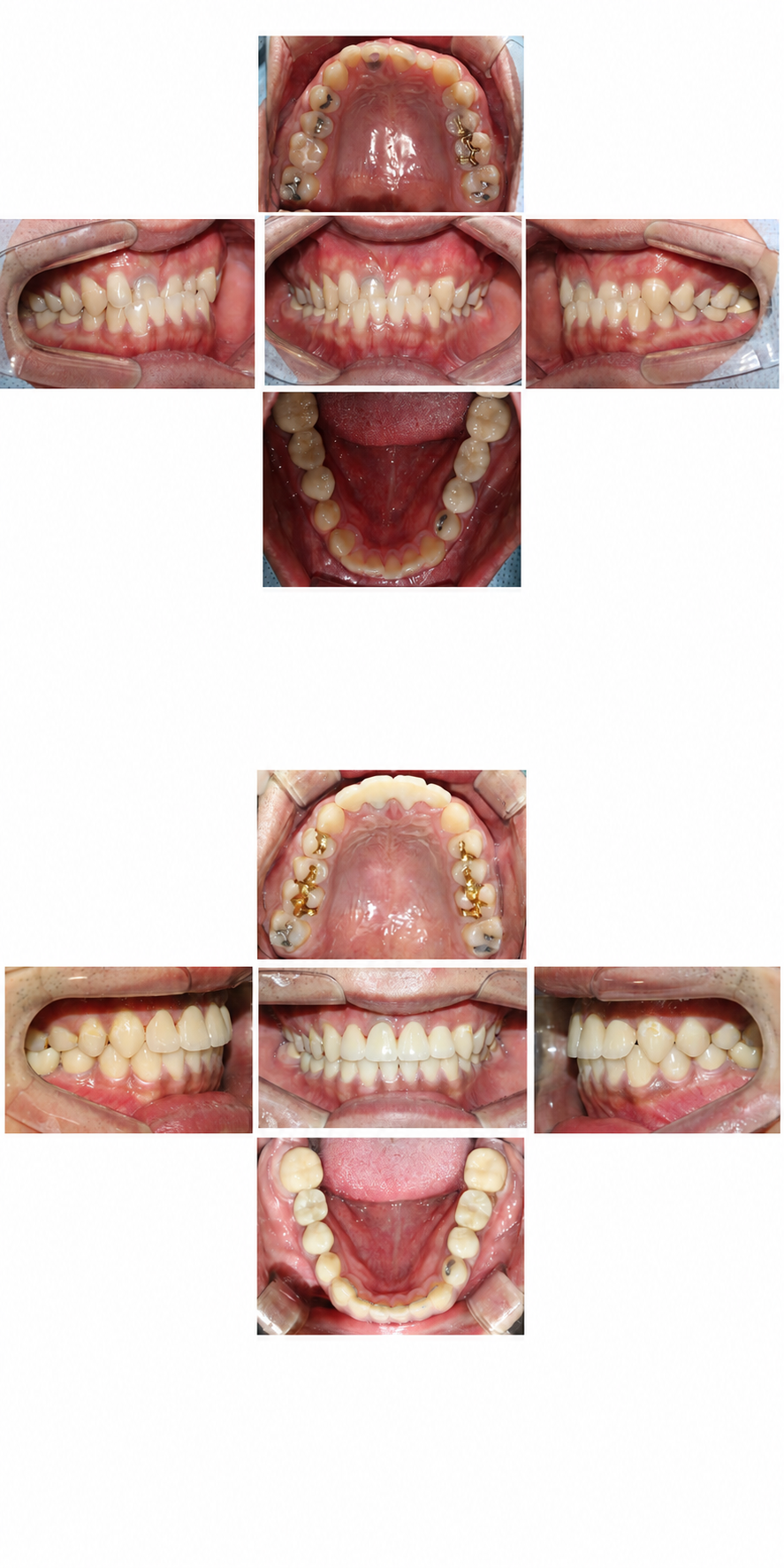
Implant restoration — before and after.
Treated and restored at Baro Dental, photographed the same way before and after. Shown with patient consent; every case is individual and results vary.
Osseointegration — how bone adopts titanium.
The reason implants work at all is a biological quirk discovered by accident: bone treats titanium as one of its own. Here’s the adoption, stage by stage.
Mechanical grip
At placement, the fixture holds by thread engagement alone — a precision screw in living bone, torqued to a measured tightness. This primary stability is engineering; biology hasn’t voted yet.
Biology takes the file
Blood proteins coat the treated titanium surface within hours; bone-forming cells arrive and — crucially — don’t wall the metal off as foreign. Titanium’s oxide layer reads as neutral to bone: the accident of chemistry the whole field is built on.
Bone grows onto the surface
New bone forms directly against the fixture’s micro-textured surface — not around it like a splinter, onto it like a graft — over a healing period measured in months and confirmed by testing, not assumed by calendar. This is why the crown waits: loading too early asks bone to hold before it has hold.
The bone goes back to work
Integration confirmed, crown seated, chewing resumes — and every meal now stimulates the bone the way the original root did, telling it to stay. The implant doesn’t just fill a gap; it re-employs the jaw that was quietly downsizing.
Why do implant quotes vary so wildly between clinics?
Mostly because of what’s inside the number. A low headline often means fixture-only — abutment and crown arrive later as separate bills, roughly doubling the total. Brand tiers, graft policies and crown materials hide in the fine print too. Our figures — DIO ₩800,000 / Osstem KS ₩1,200,000 / Straumann ₩1,750,000 — are whole-tooth prices with the zirconia crown included, which makes comparison shopping suddenly very simple: ask every clinic “is the crown in that number?”
Does getting an implant hurt?
Placement happens under local anaesthesia and most patients report it as easier than the extraction that preceded it — pressure and vibration, not pain. The days after bring manageable soreness and some swelling, covered by ordinary pain relief and the aftercare sheet. The quiet months of integration are exactly that: quiet. The step people fear most is, in practice, the least eventful.
Will I need a bone graft?
Only if your CT says so — it’s an anatomy question with a measured answer, not an upsell. Bone under long-standing gaps thins; upper molar sites sit near the sinus floor. Where volume is short, a graft (₩300,000 simple / ₩500,000 complex) or sinus lift(₩500,000–700,000) rebuilds the site — named and priced in the written plan before anything begins. Many single implants need neither.
How long do dental implants last?
The honest framing: the fixture, once integrated, is engineered for the long haul — decades-long survival is well documented across the major systems — while the crown is a wear part that may need renewal someday like any restoration (implant prosthesis ₩450,000, published). What actually decides longevity is what decides natural teeth’s: gum health and cleaning. An implant can’t decay, but its gum can inflame — which is why maintenance visits are part of the deal, not an afterthought.
Implant or bridge for one missing tooth?
The core trade: a bridge is faster and surgery-free but grinds the two neighbouring teeth into pillars — healthy enamel spent as a construction material — and leaves the bone under the gap unstimulated. An implant asks for surgery and healing months, and spares both. Where neighbours already carry large fillings or crowns, a bridge can be the pragmatic call; where they’re healthy, spending them is hard to justify. Both get priced honestly at your consult.
Can the implant be placed the same day my tooth is pulled?
Our standard protocol is staged: extraction, a planned healing period, then placement into settled bone. Same-day approaches exist in the field, but they trade healing certainty for speed and suit a narrow band of ideal sites; we’d rather your fixture meet stable bone than an ambitious timeline. The sequencing — and honest total timeline for your case — is mapped at the CT consult, so the plan runs on your anatomy, not on marketing.
Care by board-certified specialists in Seomyeon
Both directors are board-certified specialists in Advanced General Dentistry, so your cosmetic treatment is planned with your overall dental health in mind.
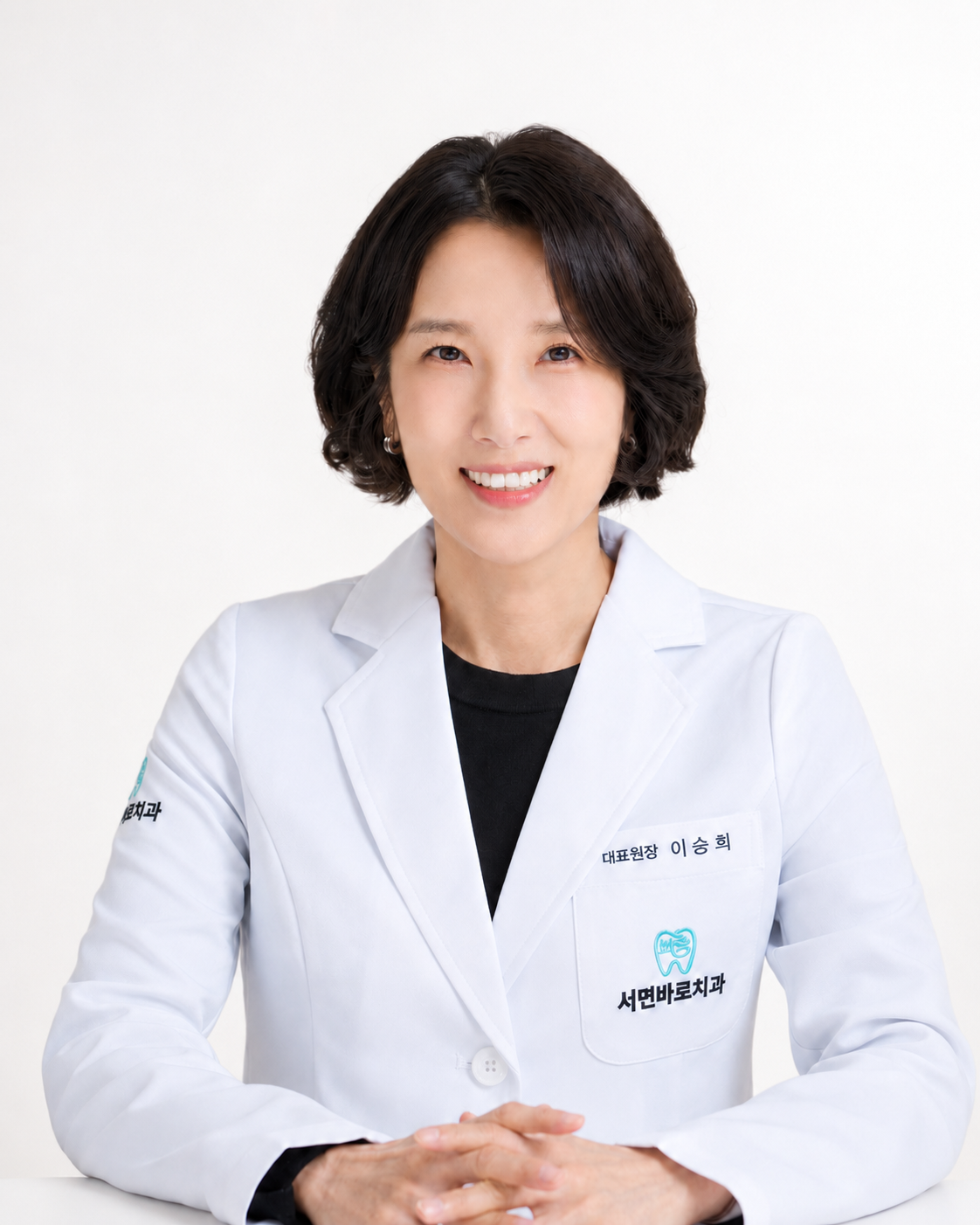
- Board-certified specialist, Advanced General Dentistry
- M.S. in Orthodontics, Kyungpook National University
- Focus on natural, alignment-led smile improvement
- Conservative, tooth-preserving approach
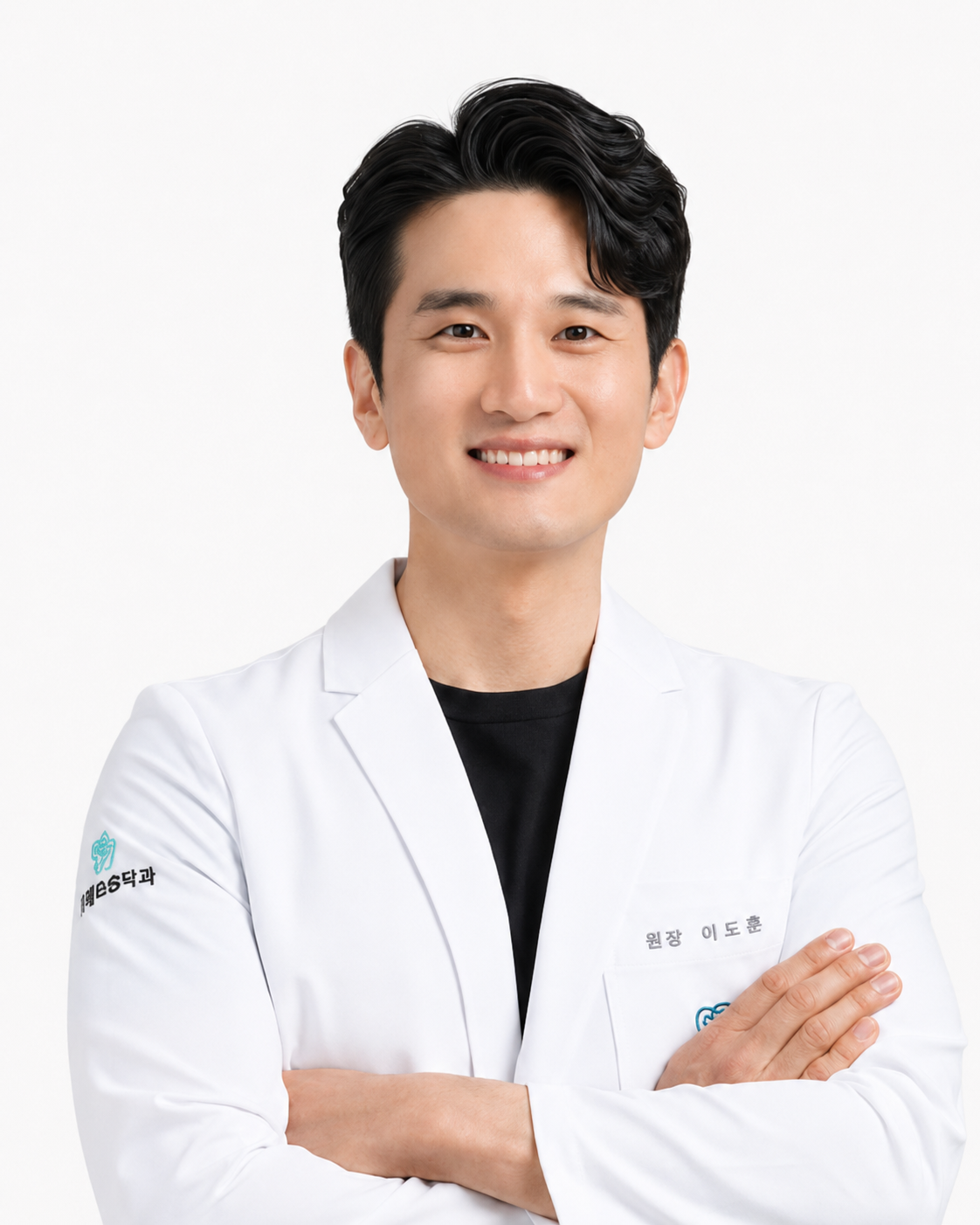
- Board-certified specialist, Advanced General Dentistry
- DDS, Dankook University College of Dentistry
- Restorative & aesthetic resin filling work
- Focus: natural, durable results
Small truths about single implants.
- The gap you ignore keeps billing you. Neighbouring teeth lean into an unfilled space and the opposing tooth over-erupts toward it — years later, the “simple implant” site needs orthodontic tidying first. Replacing sooner is genuinely cheaper than replacing eventually.
- Smoking is osseointegration’s loudest enemy. It throttles the blood supply the bone-to-titanium handshake depends on. We place implants for smokers with honest odds discussed — and the healing months are the single best quitting deadline dentistry ever invented.
- An implant can’t get a cavity — but it’s not maintenance-free. The gum collar around a fixture can inflame just like gum around teeth (peri-implantitis). The defence is unglamorous: cleaning, plus routine scaling (₩60,000) with the implant checked each visit.
- Your bite feels the new tooth for a week, then forgets it. Zirconia conducts pressure slightly differently than a living root — patients notice the newcomer briefly, then it disappears into the team. Persistent high-spot feeling is a two-minute bite adjustment, not a problem.
- The whole-price policy is also a planning tool. Because fixture, abutment and crown are one figure, and grafts are published add-ons, you can budget the entire journey from the CT consult — useful at home, essential when flying in.
When a single implant is right — and when we’ll slow you down.
The implant is the right call when…
- one tooth is missing or coming out, and the neighbours are healthy — sparing them is the point
- the CT shows workable bone — directly, or after an honestly priced graft
- gums are stable — confirmed, or treated first and then confirmed
- you want the only replacement that keeps the jawbone employed
We’ll slow you down when…
- gum disease is active — treatment precedes titanium, every time, or the implant inherits the landslide
- the socket is fresh — staged healing beats heroic timelines; your bone sets the calendar
- uncontrolled smoking or health factors stack the odds — we’ll discuss them plainly, then decide together
- a bridge honestly serves better — heavily restored neighbours can make it the pragmatic answer, and we’ll price both without leaning
Single implant FAQ.
Start from your CT, not the logo. In sound bone at a standard site, all three tiers integrate reliably — DIO at ₩800,000 is a legitimate choice, not a compromise. Osstem KS (₩1,200,000) is the balance most patients land on; Straumann (₩1,750,000) earns its premium at the margins — compromised bone, demanding sites, maximum documentation. Placement quality outranks brand every time, which is why the placing dentist's credentials matter more than the box the fixture came in.
The honest span is set by biology: placement is one visit, but bone integration runs over months and is confirmed by testing rather than assumed by calendar — rushing it is how implants fail. Add graft healing first if your site needs one. Your written plan maps the real sequence for your anatomy at the CT consult; any clinic promising a universal fast number is quoting marketing, not bone.
"Fine" is the gap's best disguise. Chewing quietly shifts to the other side, neighbours lean in, the opposing tooth drifts down, and the unloaded bone thins — all slow, all silent, all more expensive to fix later. Not an emergency; genuinely a clock. A CT (₩30,000) shows exactly where your gap is on that timeline, and sometimes the honest answer is "you have time" — measured, not guessed.
Upward, effectively no — healthy seniors integrate implants well, and restored chewing pays its biggest dividends in later decades. What matters is health context: bone quality on the CT, gum stability, medications (some bone drugs need a conversation with your physician), healing capacity. Downward, yes: jaws must be done growing, so implants wait until early adulthood. The assessment is individual, honest, and mostly good news.
The candid list: a small percentage of fixtures fail to integrate (usually early, usually re-treatable after healing); gum inflammation around the fixture can develop over years if cleaning lapses; and crowns, like all restorations, can chip or need renewal (implant prosthesis ₩450,000, published). Planning quality, honest bone assessment, and boring maintenance are the countermeasures — the failure modes are known, and known things get planned for.
Yes — implants suit international patients unusually well, because the treatment is naturally staged: CT and planning on one visit, placement on the next (or the same trip where the plan allows), the integration months spent at home with WhatsApp check-ins, and the crown visit timed to a return you were making anyway. The whole-tooth pricing makes the budget flyable from day one; the visit map is written at the CT consult.
One implant across visits.
Send a photo of the gap and any X-rays you have on WhatsApp. You’ll get an honest first read — straightforward site, graft-likely, or gum-first — and a realistic visit count before booking.
CT (₩30,000), bone and gum assessment, brand recommendation with reasons, and the written whole-tooth plan — fixture, any graft, crown, all priced. Placement can follow in the same trip where the plan allows.
Integration happens wherever you live — photo check-ins on WhatsApp, local X-ray shared if convenient, zero required flights while bone does its quiet work.
Integration confirmed, abutment connected, zirconia crown seated and bite-tuned — already included in your fixture price. One tooth back, on a visit you were making anyway.
Get the whole-tooth price — before anything else.
Send a photo of the gap on WhatsApp — we’ll tell you honestly whether it reads straightforward, graft-likely, or gum-first, and what each brand tier would cost, crown included. In English.
Message us on WhatsAppBaro Dental Clinic · 5F, SJ Medical Building, 698-1 Jungang-daero, Busanjin-gu · Seomyeon Station Exit 2, 4 min
Explore the options in Busan.
Implants Hub
Every fixture, graft and full-arch option — the whole implant menu, priced.
Explore →Bone Graft in Busan
₩300,000–500,000 — rebuilding thin sites so fixtures meet honest foundations.
Explore →Front Tooth Implant in Busan
The aesthetic-zone playbook — gum line, translucency, symmetry.
Explore →Crowns & Bridges in Busan
The alternative path — and when it’s honestly the pragmatic one.
Explore →Medical information on this page is provided for general education and does not replace an individual examination and diagnosis. Whether an implant suits your site — including brand recommendation, any grafting and the treatment sequence — is confirmed at a CT-based consultation. The before-and-after photograph shows a real patient of this clinic, published with consent; individual results vary.