Crossbite correction in Busan Seomyeon — when teeth bite on the wrong side.
A crossbite means some upper teeth close inside the lowers — in front, at the back, or both. Left alone it wears enamel unevenly and can shift the jaw off-centre; corrected with Cerafin aligners, teeth meet the way they were designed to.
Ask about your bite.
Tap what fits — we’ll open WhatsApp with your message ready to send.Nothing sends until you press send in WhatsApp. Bite-together photos help us give an honest first read — dental, functional, or imaging-needed.
Can clear aligners fix a crossbite — or an underbite?
Tooth-level crossbites — yes, and they’re treated routinely. When the problem is tooth position — an upper tooth tipped inward, a segment biting inside the lowers — aligners guide the teeth across into correct overlap. Cerafin treatment runs ₩3,000,000–6,000,000 by complexity, fixed in writing after diagnosis (₩100,000, credited).
The honest split is where the crossbite comes from. When lower front teeth sit ahead of the uppers because the teeth are tipped — a dental anterior crossbite, what many people call an underbite — aligners often correct it. When the jaw bone itself is positioned forward — a skeletal underbite — moving teeth alone can’t relocate a jaw, and we say that at the first consultation, not after months of trays. The diagnosis, with CT where needed (₩30,000), tells you which one yours is.
What a crossbite actually is.
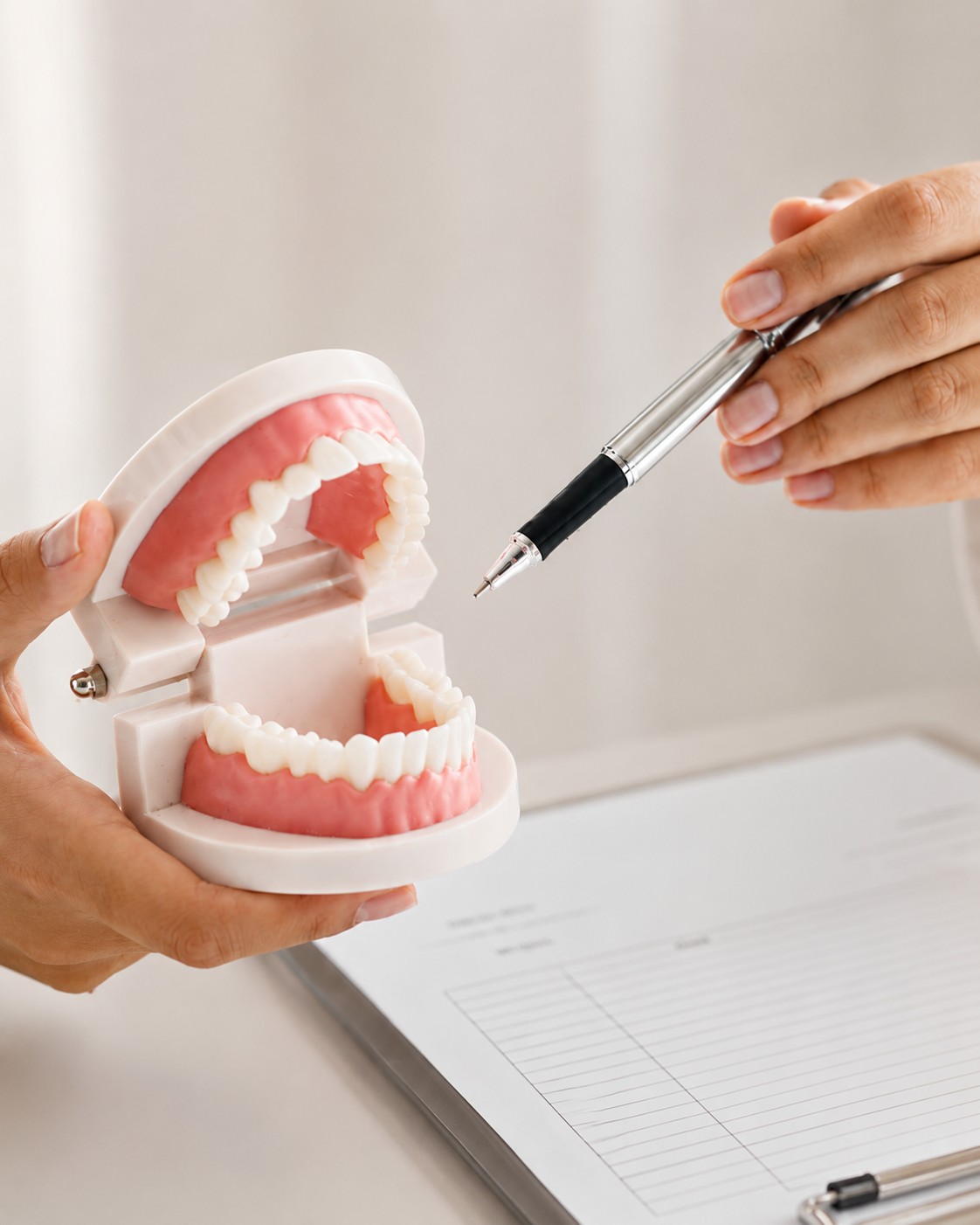
In a correct bite, the upper teeth close slightly outside the lower teeth — like a lid sitting over a box. A crossbite reverses that relationship somewhere in the mouth: one tooth, a group of teeth, or a whole side closes inside the lowers instead. In front, it looks like a lower tooth standing proud of the uppers; at the back, it’s often invisible in the mirror and found at a check-up.
Why it matters is mechanics. Teeth are built to take vertical chewing force; a crossbite loads them sideways — edge grinding on edge — which wears enamel in the wrong places and strains the gum and bone around the crossed teeth. Many crossbites also force a functional shift: the jaw slides sideways or forward to find a comfortable closing position, so the muscles memorise an off-centre bite that can gradually pull the smile and even the chin off midline.
Aligners correct the tooth-level version by tipping and guiding the crossed teeth across the bite line — upper teeth outward, lowers inward where needed — sometimes using small bite ramps to hold the jaw open millimetres while teeth cross over. It’s one of the corrections where patients feel the change functionally, not just see it: chewing simply starts working on both sides.
Six patterns of crossed bites — and what each honestly needs.
Single tooth in crossbite
Cleanest aligner caseOne upper tooth erupted inside the arch, biting behind its lower partner — often a front tooth. Aligners tip it across the bite line and settle it into place; among the most direct corrections trays perform.
Anterior crossbite (dental underbite)
Often treatableLower front teeth sitting ahead of the uppers because of tooth tipping — the version of “underbite” that lives in the teeth, not the jaw. Aligners procline the uppers and upright the lowers to restore normal overlap.
One-sided back crossbite
Watch the shiftMolars on one side biting inside the lowers — frequently paired with a functional jaw slide toward that side. Correcting it early matters precisely because the slide, left alone, trains asymmetry into the bite.
Both-sides back crossbite
Arch-width questionBoth molar sides crossed usually means the upper arch is narrow overall. Mild widening is aligner work; genuinely constricted arches may need more than trays — the scan measures which, and we quote accordingly.
Crossbite with a jaw slide
Function firstWhen closing forces the jaw sideways to fit, the displayed “asymmetry” is often the slide, not the skeleton. Removing the tooth interference frequently lets the jaw close centred again — assessed carefully at diagnosis.
Skeletal underbite
Beyond trays — said honestlyWhen the lower jaw itself is positioned forward, no tray moves a bone. We’ll show you the distinction on your own imaging and explain the realistic options — including that some skeletal cases sit beyond what tooth movement alone should promise.
How crossbite correction actually goes.
Locate & classify
Scan, photos and — where jaw position needs checking — CT (₩30,000): which teeth are crossed, whether a functional slide exists, and crucially whether the cause is dental or skeletal. Everything downstream depends on this call.
Plan the crossing
The 3D plan maps each crossed tooth’s route over the bite line — uppers outward, lowers inward, in what order. You see the projected bite before committing; price fixed in writing (₩100,000 diagnosis, credited).
Clear the interference
Early trays may include bite ramps — small platforms that hold the back teeth apart millimetres — so crossing teeth can pass each other instead of colliding on every swallow. Odd for a week, effective throughout.
Cross over & settle
The moment a tooth crosses the bite line, chewing force flips from working against the correction to holding it — the bite itself becomes the retainer’s first ally. Later trays settle the contacts evenly.
Finish & retain
Final refinement evens left-right contact, then retention protects the result — clear retainer ₩100,000 or fixed wire ₩150,000–200,000, first-year adjustments covered. Crossed-over teeth are stable teeth, but retention seals it.
Dental, functional, or skeletal — the three-way call.
Every crossbite consultation turns on one classification. This table is the honest version of that conversation.
| Dental crossbite | Functional (with jaw slide) | Skeletal underbite | |
|---|---|---|---|
| What’s wrong | Teeth tipped across the bite line | Tooth interference forces the jaw to slide to close | The jaw bone itself sits forward or narrow |
| Telltale sign | Crossed teeth, jaw closes centred | Chin or midline shifts as you bite down | Profile shows it; teeth may even look straight |
| Aligner fit | Good — core Cerafin territory | Often good — remove the interference, the slide resolves | Honest answer: tooth movement alone can’t relocate bone |
| What we do | Plan & treat, ₩3M–6M fixed at diagnosis | Treat the dental cause; monitor the shift resolving | Show you the imaging, explain realistic routes, refer where needed |
| Decided by | The diagnosis: scan + photos + CT where indicated (₩30,000) — ₩100,000, credited toward treatment | ||
Most adult crossbites are dental or functional — genuinely skeletal cases are the minority, and identifying them before treatment is exactly what the imaging step is for. A clinic that promises every underbite to trays is selling; a diagnosis that classifies yours is medicine.
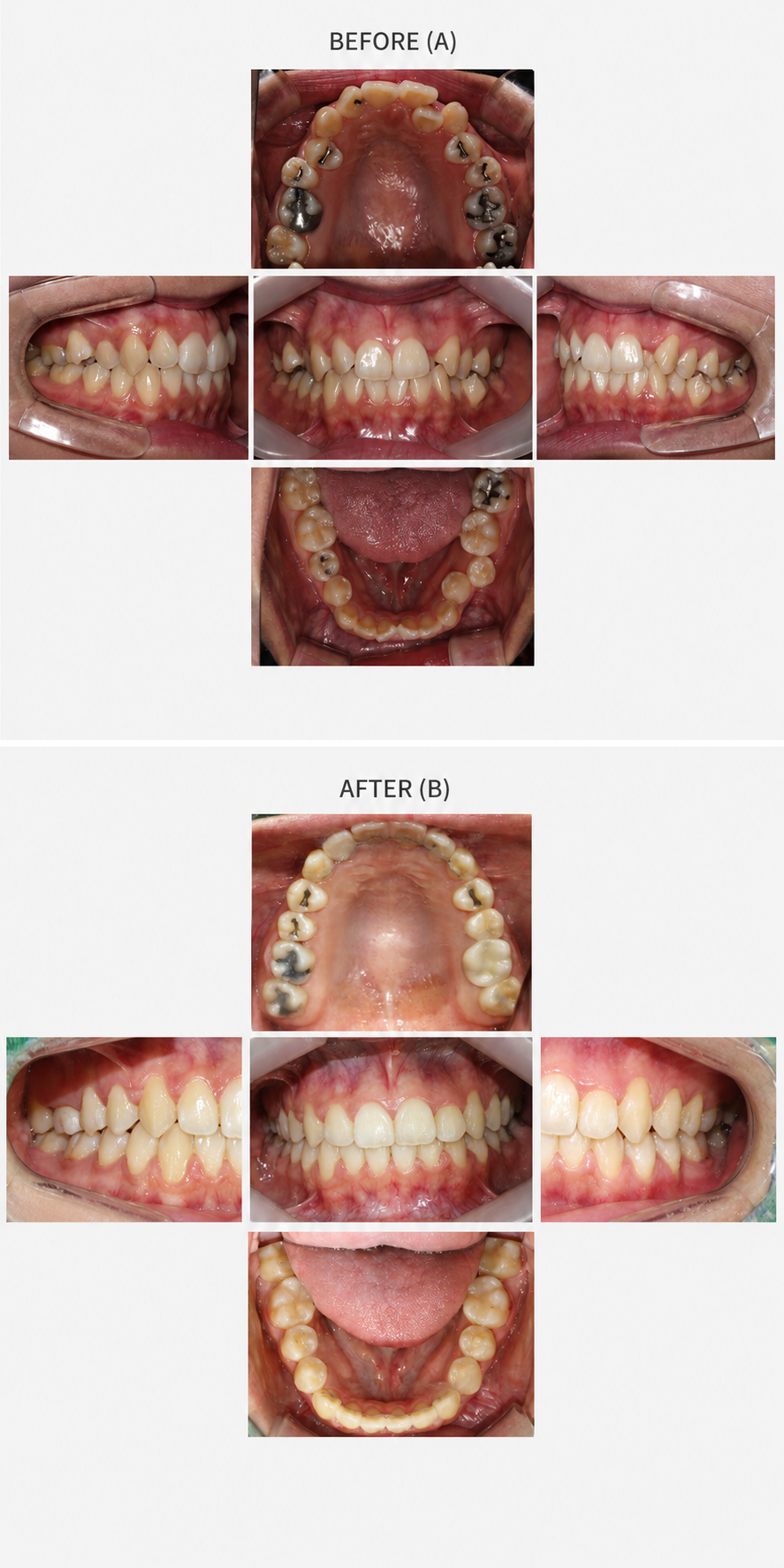
Crossbite cases — before and after.
Treated at Baro Dental with clear aligners, photographed the same way before and after. Shown with patient consent; every case is individual and results vary.
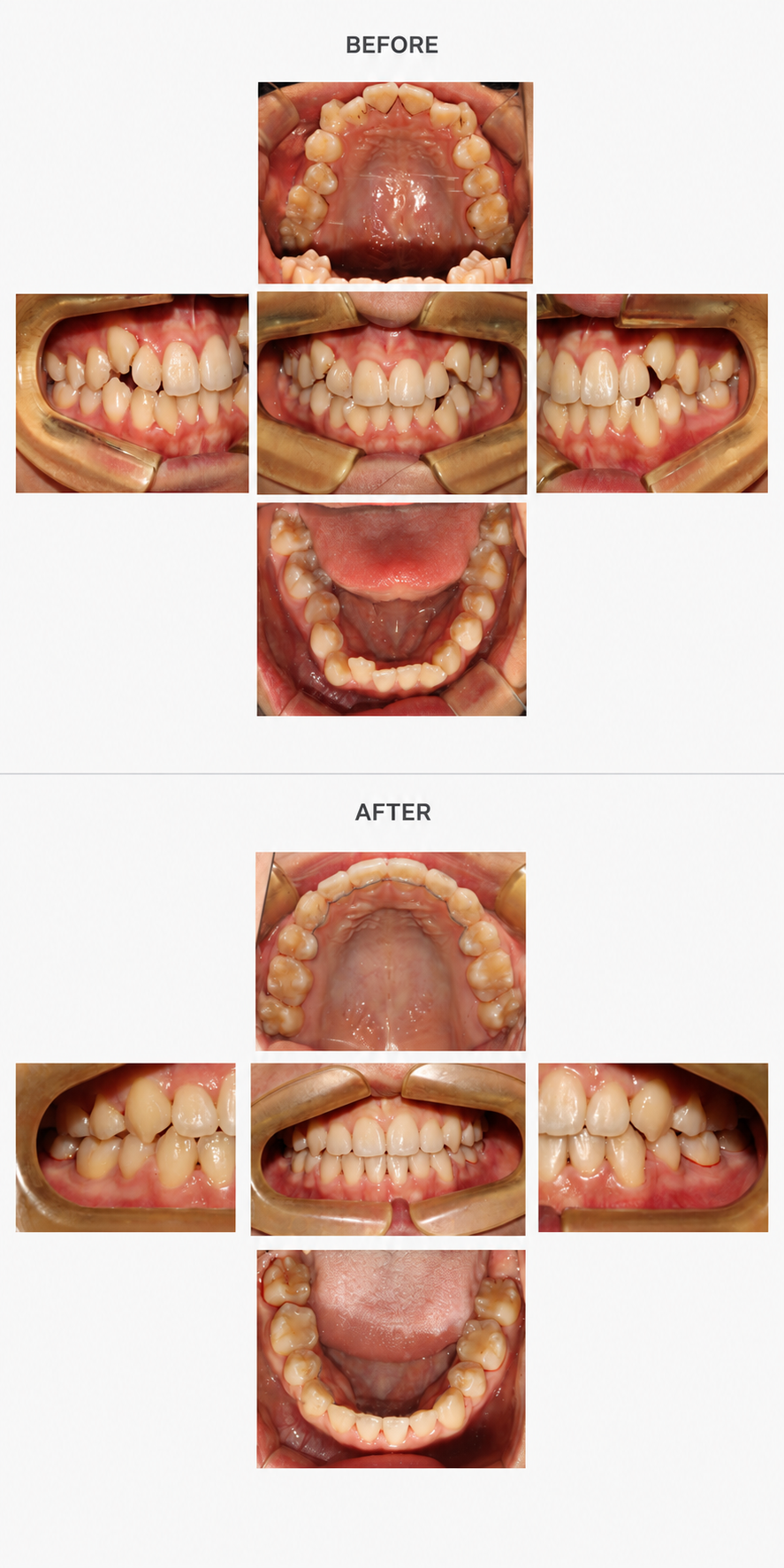
What an untreated crossbite does — over the years.
Not scare copy — mechanics. A crossbite is a machine assembled slightly wrong; here’s how the wear pattern typically unfolds when nothing is done.
Silent, symptom-free, working
The bite functions — humans adapt remarkably. The crossed teeth take sideways force at every meal, but enamel is thick and nothing hurts. Most crossbites live here for years, which is exactly why they go unaddressed.
Edges flatten where they shouldn’t
Edge-on-edge grinding shows up as chipped or flattened patches on the crossed teeth — wear a dentist spots instantly because it’s in the wrong place for a normal bite. Sensitivity can start as enamel thins.
The loaded tooth’s gum gives ground
A tooth pushed sideways at every bite strains the thin gum and bone on its pressured side — recession on a crossed lower front tooth is a textbook finding. Gum that recedes doesn’t grow back on its own.
The slide becomes the posture
Where a functional shift exists, years of closing off-centre train muscles and joints into the displaced position — jaw asymmetry that began as a removable tooth interference gradually stops being removable. Earlier correction is simpler correction; that’s the honest whole of it.
Is a crossbite the same as an underbite?
They overlap. An anterior crossbite — lower front teeth ahead of the uppers — is what most people mean by “underbite.” The medical distinction that matters: when tooth tipping causes it, it’s a dental crossbite and aligners often correct it; when the lower jaw bone itself sits forward, it’s a skeletal underbite and tooth movement alone can’t fix the foundation. Your diagnosis makes that call with imaging, not guesswork.
How much does crossbite correction cost in Busan?
Within Cerafin’s published ₩3,000,000–6,000,000, set by how many teeth cross and whether arch widening is involved — single-tooth corrections sit toward the lower end, full posterior crossbites higher. The figure is fixed in writing at diagnosis (₩100,000, credited), and CT where needed is ₩30,000. If your case honestly needs fixed braces instead, we quote those: Metal ₩4,300,000 / Clippy-C ₩5,100,000.
My jaw shifts to one side when I bite — is that a crossbite?
Very possibly — that’s the classic sign of a functional crossbite: a tooth interference forces the jaw to slide sideways to find a closing position. The encouraging part: when the interference is removed and the crossed teeth corrected, the slide often resolves because it was never a bone problem — it was a detour. The diagnosis distinguishes a sliding jaw from a truly asymmetric one.
Can a crossbite cause gum recession?
Yes — it’s one of the best-documented mechanical causes. A tooth loaded sideways at every meal stresses the thin gum and bone on its pressured side, and lower front teeth in anterior crossbite are the textbook victims. If recession has started, correcting the bite removes the cause; the gum itself is then assessed for what it needs. Recession is a reason to correct sooner, not a reason it’s too late.
Why does my crossbite only affect one tooth?
Single-tooth crossbites usually trace to eruption — the tooth ran out of room or angle as it came in, and settled inside the arch. It’s also the most efficiently corrected version: one tooth tipped across the bite line, often early in the tray sequence. Small problem, small plan, lower end of the price range — and fixing it protects that tooth’s enamel and gum for decades.
Do bite ramps hurt or affect eating?
They feel strange, not painful — small platforms on the trays hold your back teeth a few millimetres apart so crossing teeth can pass instead of colliding. Chewing feels different for about a week while you adapt; speech is barely affected. They’re temporary scaffolding: once teeth cross over, the ramps’ job is done and later trays retire them.
Care by board-certified specialists in Seomyeon
Both directors are board-certified specialists in Advanced General Dentistry, so your cosmetic treatment is planned with your overall dental health in mind.

- Board-certified specialist, Advanced General Dentistry
- M.S. in Orthodontics, Kyungpook National University
- Focus on natural, alignment-led smile improvement
- Conservative, tooth-preserving approach

- Board-certified specialist, Advanced General Dentistry
- DDS, Dankook University College of Dentistry
- Restorative & aesthetic resin filling work
- Focus: natural, durable results
Small truths about crossed bites.
- Back crossbites hide from mirrors. Anterior crossbites announce themselves in photos; posterior ones are routinely discovered at check-ups by a dentist looking at wear patterns. If you’ve never been told you have one, a check-up (scaling ₩60,000) is how they surface.
- The lid-over-box rule is easy to self-check. Bite together and look: upper teeth should close slightly outside the lowers all the way around. Anywhere the relationship flips, that’s the crossbite — a thirty-second mirror test worth doing once.
- Crossbites and chewing sides are linked. Many people unconsciously chew away from a crossed side for years — if you’ve “always been a right-side chewer,” the left side sometimes has a reason.
- Corrected crossbites are mechanically stable. Once a tooth crosses the bite line, normal chewing force helps hold it there — unusually for orthodontics, the bite itself joins the retention team. (You still wear the retainer.)
- Wear marks are evidence, not just damage. The flattened facets on crossed teeth tell the diagnosis story precisely — which teeth collide, in which direction — and your dentist reads them like skid marks at the exam.
When aligners correct crossbites — and when we’ll tell you otherwise.
Aligners are the right call when…
- the crossbite is dental — teeth tipped across the line, confirmed on your scan
- a functional slide exists but resolves when the tooth interference is corrected
- one tooth or a small segment is crossed — the most efficient cases trays treat
- mild arch narrowing is involved — within the widening trays genuinely deliver
We’ll tell you otherwise when…
- imaging shows a skeletal underbite — tooth movement can’t relocate a jaw, and pretending otherwise wastes your years and money
- the arch constriction exceeds what trays widen — fixed braces take those honestly
- heavy wear or recession needs treating alongside — the bite plan sequences with gum care first where the gum demands it
- a child’s developing crossbite is the question — growing jaws are a different toolbox: see children’s orthodontics
Crossbite correction FAQ.
You can suspect, but not confirm, at home: if you can slide your lower jaw back so the front teeth meet edge-to-edge, a functional or dental component is likely; if your profile shows a prominent lower jaw regardless of how you bite, skeletal factors may be involved. The real answer comes from the diagnosis — scan, photos and CT where indicated (₩30,000) — which is exactly what the ₩100,000 consultation settles before any treatment talk.
Pressure rather than pain — the familiar tray-change tightness, concentrated on the crossing teeth. Bite ramps, if your plan uses them, add a week of "chewing feels odd" rather than discomfort. Most patients manage with nothing; ordinary pain relief covers switch days for the rest.
For dental crossbites, no — teeth move at any age over healthy bone, and adults correct decades-old crossbites routinely. What decades add is wear and sometimes gum recession on the crossed teeth, which the plan addresses alongside. The one age-related truth: jaw growth guidance is a childhood-only tool, so skeletal patterns in adults have fewer options — another reason the dental-versus-skeletal call matters.
Honestly: modestly, if at all — and we'd rather undersell this. Correcting an anterior crossbite changes how the lips are supported and can soften the "lower-teeth-first" look; resolving a functional slide can let the chin sit centred again. What tooth movement does not do is reshape jawbones. Anyone promising a new profile from trays is describing surgery they don't mention.
The relationship is real but not automatic — many crossbites never cause joint symptoms, and many jaw-pain cases have no crossbite. Where a functional slide loads the joint asymmetrically for years, it can contribute. If you have jaw pain now, that's assessed in its own right — see our TMJ page — and the bite correction decision is made on its full merits, not sold as a pain cure.
Yes — the structure matches other aligner treatment: diagnosis and fitting in-clinic, tray switching on schedule wherever you live, WhatsApp check-ins between Busan visits. Crossbite plans front-load the crossing movements, so the early months matter most for wear discipline; we map the check-in rhythm around your realistic travel pattern at diagnosis.
Crossbite correction across visits.
Send bite-together photos from the front and each side on WhatsApp. We’ll give an honest first read — dental-looking, slide-suspected, or imaging-needed — before you book anything.
Scan, photos, CT where indicated (₩30,000), classification, 3D plan and written price (₩100,000 diagnosis, credited). The dental-functional-skeletal call is made here, in front of you, on your own imaging.
Trays switch on schedule wherever you are; crossing progress is monitored via photos on WhatsApp. Bite-ramp phases and refinements are grouped into your Busan trips.
Final contact-settling checks and retainer fitting in-clinic (clear ₩100,000 / fixed ₩150,000–200,000, first-year adjustments covered) — timed to a visit you were making anyway.
Find out which crossbite yours actually is.
Send bite-together photos on WhatsApp — we’ll tell you honestly whether it reads dental, functional or imaging-needed, and what the diagnosis would settle. In English.
Message us on WhatsAppBaro Dental Clinic · 5F, SJ Medical Building, 698-1 Jungang-daero, Busanjin-gu · Seomyeon Station Exit 2, 4 min
Explore the options in Busan.
Clear Aligners Hub
How Cerafin treatment works, every case type, and the full pricing picture.
Explore →Deep Bite Correction in Busan
The vertical bite problem — when uppers cover too much of the lowers.
Explore →Children’s Orthodontics in Busan
Developing crossbites in growing jaws — a different, earlier toolbox.
Explore →Fixed Braces in Busan
Metal ₩4,300,000 · Clippy-C ₩5,100,000 — for arch corrections beyond trays.
Explore →Medical information on this page is provided for general education and does not replace an individual examination and diagnosis. Whether your crossbite is dental, functional or skeletal — and whether clear aligners suit it — is confirmed at diagnosis with appropriate imaging. Before-and-after photographs show real patients of this clinic, published with consent; individual results vary.