Dental inlays & onlays in Busan — the rescue between a filling and a crown.
When damage outgrows a filling but the tooth’s walls are still strong, grinding it down for a crown wastes good structure. The middle answer is an E-max ceramic inlay or onlay — ₩300,000, currently ₩250,000 on event pricing — lab-made to fit your cavity like a puzzle piece, conserving every wall worth keeping.
Ask about your cavity.
Tap what fits — we’ll open WhatsApp with your message ready to send.Nothing sends until you press send in WhatsApp. A photo and any X-rays help us give an honest tier read — Straumann-warranted, or KS-sufficient.
What is an inlay or onlay in Busan — and when does it beat both alternatives?
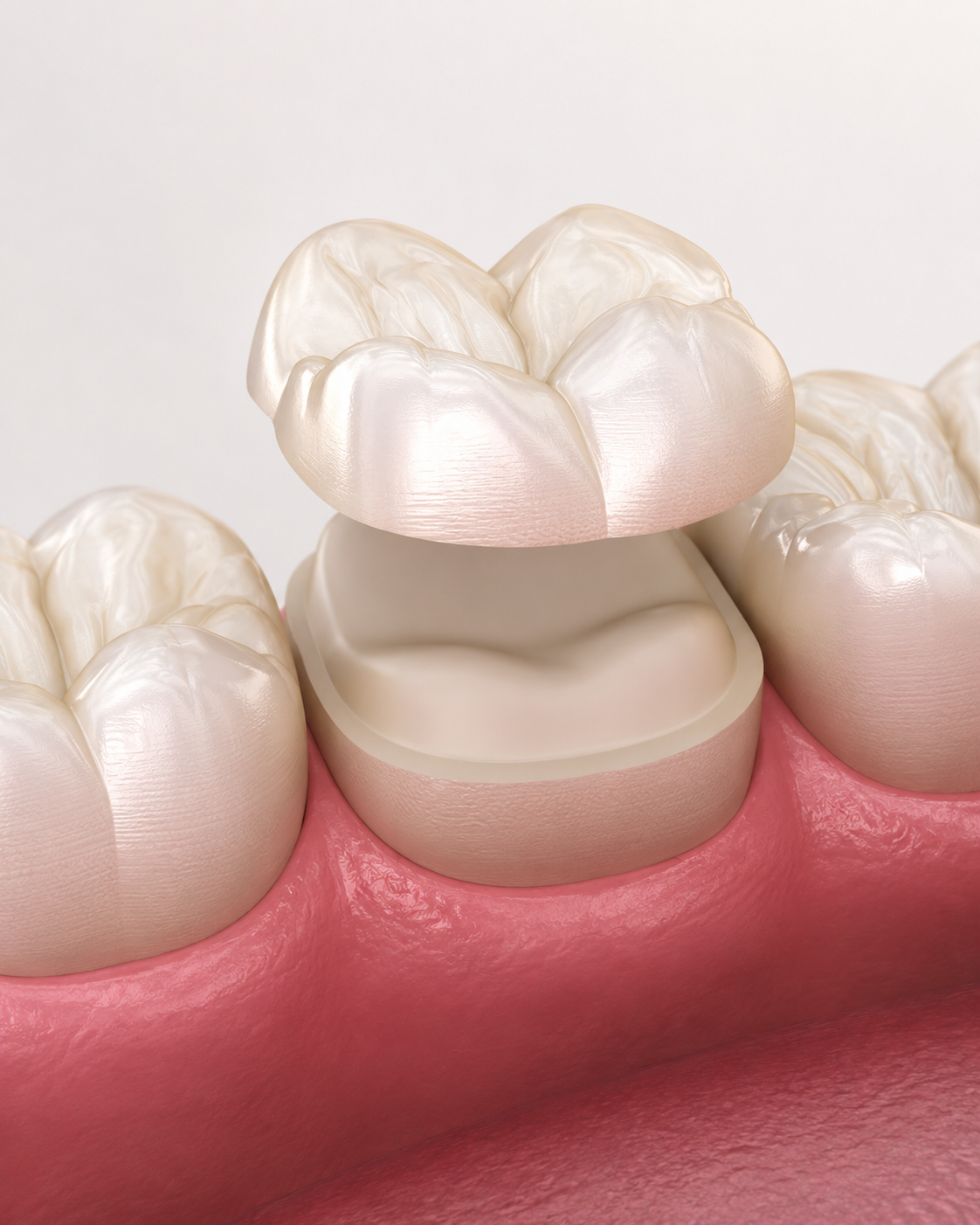
An inlay is a lab-fabricated E-max ceramic piece, made to fit precisely inside a cleaned cavity and bonded in place; an onlay is its bigger sibling, extending over one or more chewing cusps when a corner of the tooth has gone. Both cost ₩300,000 — currently ₩250,000 on event pricing — and both exist for the middle case: damage too large for a direct resin filling (from ₩50,000) to serve reliably, but with walls too good to grind away for a crown (₩450,000+).
The logic is conservation economics: every millimetre of your own enamel kept today is restorative capacity banked for the decades ahead — teeth get re-treated over lifetimes, and each round consumes structure. The inlay’s job is to rescue the tooth this round while spending as little of it as possible, which is why we route smaller cavities down to resin and hollowed-out teeth up to crowns, and reserve this page’s treatment for the tooth it genuinely fits.
A puzzle piece, cut by a laboratory.
The defining word is indirect. A filling is built directly in your mouth, layer by layer, in the minutes an appointment allows; an inlay is manufactured outside it — your cleaned cavity is captured in a precise impression, and the E-max ceramic piece is pressed and finished in a laboratory, then bonded into place at a second visit. Same destination as a filling; radically different manufacturing conditions.
Those conditions are the product. In the lab, the ceramic cures completely with no rush and no saliva, the chewing surface is sculpted into real anatomy rather than what a mirror-and-instrument angle permits, and the fit is refined against a model until it seats like machinery. E-max — a lithium disilicate glass-ceramic — brings strength that direct resin can’t match in large cavities, with tooth-like translucency that disappears into the row.
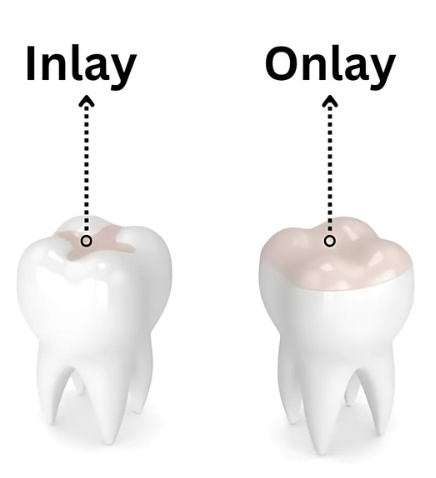
Inlay versus onlay is simply a coverage question: an inlay lives within the cusps, filling the excavated interior; an onlay extends over one or more cusps, capping a corner that fractured or was undermined — a partial crown that stops exactly where the damage stops, instead of continuing around a tooth that didn’t ask.
Six teeth in inlay country — with signposts out in both directions.
The cavity that outgrew resin
The core caseDirect resin shines in small-to-moderate cavities and struggles in large ones — shrinkage stress, wear under heavy chewing, contact points that are hard to build by hand. When the excavation crosses that line but the walls stand strong, the lab-made piece takes over.
The retiring amalgam
The upgrade generationOld metal fillings reaching the end of their careers — leaking margins, cracked corners, or simply their owner’s patience — leave large, inlay-shaped excavations behind. The replacement is tooth-coloured, precisely fitted, and frequently the tooth’s best restoration ever.
The broken cusp
Onlay territoryOne chewing corner sheared off — a popcorn kernel’s signature move — while the rest of the tooth stands sound. The onlay caps the lost cusp and stops there, saving the intact walls a crown would sacrifice for symmetry’s sake.
The filling that keeps failing
Breaking the cycleA spot where direct fillings chip, leak or fall out repeatedly is usually a mechanics problem — the cavity’s size and load exceed what hand-built resin holds. The indirect piece changes the mechanics instead of repeating the experiment a fourth time.
The smaller cavity
Signpost down: resinModest decay with straightforward geometry is resin filling territory (from ₩50,000) — one visit, conservative, entirely sufficient. Selling an inlay to a resin-sized cavity is over-treatment, and we route those cases down the hall ourselves.
The hollowed-out tooth
Signpost up: crownWhen walls are thin, undermined or already cracked, bonding ceramic to compromised structure builds on sand — the honest answer is a crown (₩450,000) that resets the engineering. We’ll show you the walls on the photo and let the structure make the argument.
How an inlay actually goes.
Assessment & the size verdict
Exam and imaging grade the cavity honestly: resin-sized, inlay-sized, or crown-sized. The verdict comes with the photo evidence and the written price — ₩300,000, currently ₩250,000 on event terms.
Excavation & impression
Under local anaesthesia, decay and failed old restorations are removed completely, the cavity refined into clean geometry, and the impression captured — the exact negative the laboratory will fill.
The temporary interval
A temporary seals the cavity while the lab presses and finishes your E-max piece — gentle chewing rules apply for its short career, and Busan’s softer menu is excellent anyway.
Bond day
The piece is tried in, contacts and fit verified, then bonded with a full adhesive protocol — the step where ceramic and tooth become one structure. Bite tuned in fractions; polish; done.
Back to anonymity
A day of new-surface awareness, then the tooth returns to the unremarkable middle of your bite — cleaned like any tooth, checked at routine visits, doing quiet decades of work.
Filling, inlay/onlay, crown — three sizes of rescue, honestly mapped.
| Resin filling — ₩50,000–150,000 (by surface area · cervical included) | Inlay / Onlay — ₩300,000 (event ₩250,000) | Crown — from ₩450,000 | |
|---|---|---|---|
| The damage | Small to moderate decay, straightforward geometry | Large cavity or a lost cusp — walls still strong | Walls thin, cracked or gone — structure needs a reset |
| How it’s made | Directly, in your mouth, in one visit | Indirectly — lab-pressed E-max ceramic, bonded at a second visit | Indirectly — full-coverage cap over a shaped core |
| Tooth structure spent | Minimal — only the decay itself | Minimal-plus — the decay plus clean geometry; every sound wall kept | Substantial by design — the whole tooth is shaped into a core |
| Character under load | Excellent at its size; shrinkage and wear limit it in big cavities | Ceramic strength with anatomical chewing surfaces — built for the loads resin resigns from | Maximum protection — the armour option, when armour is honestly needed |
| We’ll route you here when… | The cavity is honestly small — and we’ll say so happily | The middle case is genuinely yours — this page’s whole reason to exist | The structure asks for it — shown on the photo, not asserted in a pitch |
The honest pattern: price tracks tooth structure spent, and the right column is the one your tooth — not your quote — selects. Our bias runs conservative: the smallest restoration that reliably serves is the one we recommend, because your enamel is the only material on this table nobody can manufacture.
Why it’s made outside your mouth — the indirect advantage.
“Why two visits and a laboratory for something a filling does in one?” is the right question — and the answer is a tour of what a mouth denies a dentist:
A mouth is a terrible workshop
Direct fillings are built in a dark, wet, moving cavity through a mirror, against a clock — and resin shrinks slightly as it cures, layer by layer, pulling at the walls of big cavities. Skilled hands manage all of this brilliantly at small scale; physics taxes them harder as the excavation grows.
The lab has none of those problems
On the bench, your cavity exists as a dry, still, perfectly lit model. The E-max is pressed as one homogeneous piece — no layers, no cure-as-you-go shrinkage — and the chewing anatomy is sculpted with time and visibility no live appointment offers. The manufacturing moved; the quality moved with it.
Bonding makes two things one
Modern adhesive protocols don’t just glue the ceramic in — they couple it to the tooth so the assembly shares loads as a single structure. A well-bonded onlay doesn’t sit on the tooth like a patch; it reinforces it like a laminated beam.
Where the extra visit goes
The payoff of indirect manufacturing lives in the years: contact points that hold floss properly, margins that seal, chewing surfaces that meet their opposites correctly, ceramic that shrugs at loads which retire large resins early. The second visit isn’t inconvenience — it’s where the longevity is manufactured.
How much does an inlay or onlay cost in Busan?
₩300,000 per tooth at this clinic for E-max ceramic — currently ₩250,000 on event pricing — inlay or onlay alike, since the lab work is comparable. For context on the spectrum: a resin filling runs ₩50,000–150,000 by surface area and a zirconia crown from ₩450,000, and which tier your tooth belongs to is a structural verdict shown to you on the photo, not a menu decision. The written figure comes before any drilling, as with everything here.
Is an inlay really better than a big filling?
In the large-cavity range, honestly yes — and it’s physics, not marketing: pressed ceramic doesn’t shrink on curing, wears against opposing teeth more like enamel, and carries chewing loads that stress large hand-built resins toward chipping and leakage. In the small -cavity range the advantage evaporates and resin (from ₩50,000) is the right economics — which is exactly why we grade the cavity first and route both directions without prejudice.
What’s the difference between an inlay and an onlay?
Coverage. An inlay fits within the tooth’s cusps — a shaped piece filling the excavated interior. An onlay extends over one or more cusps, capping a chewing corner that fractured or lost its support — think of it as a partial crown that stops precisely where the damage stops. Same material, same price (₩300,000 / event ₩250,000), same two-visit rhythm; the tooth’s damage pattern picks which one it needs.
Should I replace my old amalgam (silver) fillings?
Not reflexively — an intact, well-sealed amalgam doing its job can honestly stay on duty, and we’ll tell you when yours is. The replacement conversation starts when the filling itself flags: leaking margins, cracks in the metal or the tooth around it, recurrent decay underneath, or fracture lines the old rigid filling has been wedging open. Those retirements usually leave inlay-sized cavities — and the upgrade in fit and appearance is genuinely dramatic.
Does getting an inlay hurt?
It feels like a filling appointment with better bookkeeping: excavation runs under local anaesthesia (vibration and time, not pain), the temporary phase asks only for slightly considerate chewing, and bond day is the easy visit — fitting, cementing, polishing, done. Some days of temperature sensitivity afterward are normal as the tooth settles under its new ceramic, then the whole episode fades into the anonymity good dentistry aims for.
How long do E-max inlays last?
The honest frame we use for every restoration: they’re long-career wear parts, not permanent installations — and the variables that write the actual number are the bond’s quality, your bite’s habits, and the margins’ daily hygiene, more than the ceramic itself. Heavy grinders shorten any restoration’s story (a night guard, ₩300,000 is cheap insurance); clean margins and routine check-ups extend it. Indirect ceramics’ track record in large cavities is precisely why the category exists.
Care by board-certified specialists in Seomyeon
Both directors are board-certified specialists in Advanced General Dentistry, so your cosmetic treatment is planned with your overall dental health in mind.

- Board-certified specialist, Advanced General Dentistry
- M.S. in Orthodontics, Kyungpook National University
- Focus on natural, alignment-led smile improvement
- Conservative, tooth-preserving approach
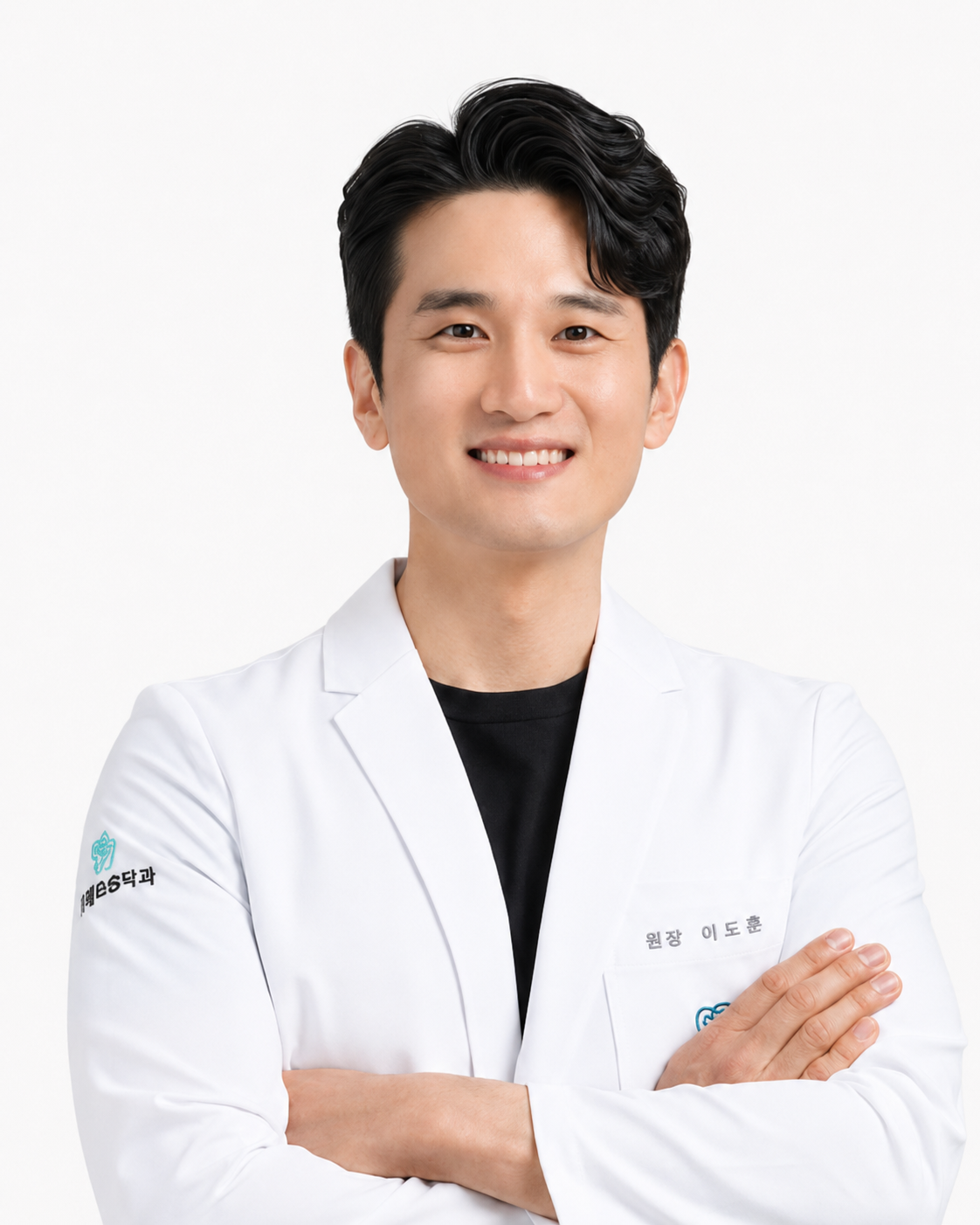
- Board-certified specialist, Advanced General Dentistry
- DDS, Dankook University College of Dentistry
- Restorative & aesthetic resin filling work
- Focus: natural, durable results
Small truths about inlays & onlays.
- The event price is a genuine window. E-max inlays and onlays currently run ₩250,000 against the standard ₩300,000 — same lab, same material, same protocol. If your tooth has been waiting for a reason, this is an honest one.
- Between visits, chew like a diplomat. The temporary seals well but isn’t built for toffee, ice or absent-minded pen-biting — a week of gentle manners protects the geometry the lab is matching.
- Floss is the margin’s bodyguard here too. The bonded seam where ceramic meets enamel is this restoration’s only vulnerable real estate — daily cleaning along it is what converts good lab work into long careers.
- Cold sensitivity has a settling period. A newly restored tooth reporting temperature for some days is normal recalibration, not a problem — persistent or bite-triggered pain is different, and worth a message.
- One tooth’s inlay is sometimes two teeth’s warning. The decay pattern that outgrew a filling often has siblings brewing nearby — the assessment visit checks the neighbourhood, because catching the next one at resin size (from ₩50,000) is the cheapest dentistry there is.
When the inlay is right — and when we’ll route you past it.
The inlay/onlay is right when…
- the cavity has genuinely outgrown direct resin — size, load or repeated failures say so
- the walls are strong and worth keeping — conservation has something real to conserve
- a single cusp is lost but its neighbours stand — the onlay caps exactly what broke
- an old large filling is retiring and the excavation deserves better than its predecessor
We’ll route you past it when…
- the cavity is resin-sized — from ₩50,000 and one visit is the honest prescription, and we make it gladly
- the walls are thin, cracked or undermined — a crown resets structure ceramic bonding can’t rescue
- the nerve is involved — deep decay reaching the pulp needs the root canal conversation before any restoration decision
- active gum disease surrounds the site — margins bonded beside inflamed gums inherit the inflammation; foundations first
Inlay & onlay FAQ.
You're paying for a second manufacturing venue: laboratory pressing of E-max ceramic, a technician's finishing work, the impression precision that makes it possible, and a second fitting visit — none of which a direct filling involves. The ₩300,000 (event ₩250,000) versus ₩50,000–150,000 gap is the indirect process itself, and it buys its keep specifically in large cavities where direct resin's physics run out. In small cavities it buys nothing, which is why we don't sell it there.
Two visits with a lab interval between — excavation and impression first, bonding second — which compresses comfortably into a single Busan stay when we know your dates in advance: preparation early in the trip, bond day before you fly. Send your travel window with your first WhatsApp message and we'll tell you honestly whether the lab calendar fits inside it, before you book anything.
Yes — E-max's translucency is much of its reputation: the ceramic transmits light the way enamel does, and the shade is matched to your tooth before fabrication, so the finished piece disappears into the chewing surface rather than announcing itself. One sequencing note borrowed from our crown page: if whitening is in your plans, do it before the shade-match — the ceramic keeps the colour it was pressed with.
Rarely, and each failure mode has an honest cause: debonding traces to bond-day protocol or margin hygiene, fracture to extreme point loads — ice-crunching, unlucky seeds, heavy untreated grinding. The countermeasures are unglamorous: full adhesive protocol at cementation (our job), sensible bite habits and clean margins (yours), and a night guard (₩300,000) where grinding is part of your biography. If one ever does loosen, keep the piece and message us — re-bonding is sometimes possible.
For this restoration class, E-max is the balance we back: strong enough for the loads inlays face, translucent enough to vanish, and bondable in the way that makes tooth and ceramic one structure — which is the inlay's whole engineering trick. Gold inlays remain legitimate old-school engineering for unseen molars in heavy bites, and full-coverage cases move to zirconia crown territory. If your case sits near a boundary, you'll get the comparison with reasons, not a default.
Possibly both — the crown-versus-onlay boundary is a genuine judgement zone, and conscientious dentists weigh wall thickness, crack lines and bite forces differently. What you're entitled to either way is the evidence: photos of the walls, the reasoning, and both prices. Our bias runs conservative because tooth structure is unmanufacturable, but bias isn't dogma — where your walls honestly can't carry an onlay, we'll say crown too, and show you why on the screen.
An inlay within one trip.
Send a photo of the tooth and your travel dates on WhatsApp. You’ll get an honest size verdict — resin, inlay/onlay, or crown territory — and whether the two-visit rhythm fits your stay.
Assessment, the verdict on screen, then excavation and impression with your temporary sealed in — the lab clock starts while Busan starts happening.
The lab presses your E-max piece while you eat considerately and tour inconsiderately — we’re one WhatsApp message away if the temporary complains.
Bond day: fit verified, adhesive protocol, bite tuned, polish — and a restoration built to be forgotten, at a price you knew before your first flight (₩300,000; event ₩250,000).
Get your cavity sized — resin, inlay, or crown.
Send a photo on WhatsApp — we’ll tell you honestly which tier your tooth belongs to and what it costs in writing, including the current event price. In English.
Message us on WhatsAppBaro Dental Clinic · 5F, SJ Medical Building, 698-1 Jungang-daero, Busanjin-gu · Seomyeon Station Exit 2, 4 min
Explore the options in Busan.
Cavity & Resin Filling
From ₩50,000 — the one-visit answer when the cavity is honestly small.
Explore →Crowns & Bridges
From ₩450,000 — the structural reset when walls can’t carry ceramic.
Explore →Root Canal in Busan
When decay reached the nerve — the rescue that precedes restoration.
Explore →Night Guard in Busan
₩300,000 — the grinder’s insurance policy for every restoration on this site.
Explore →Medical information on this page is provided for general education and does not replace an individual examination and diagnosis. Whether an inlay or onlay suits your tooth — including the resin-versus-inlay-versus-crown grading and visit planning — is confirmed at an in-person consultation. Event pricing is current at the time of writing and confirmed in your written plan. Individual results vary.