Metal vs ceramic braces, compared honestly.
Same wires, same movements, same months — the brackets differ, and the ₩1,000,000 between metal (₩4.3M) and self-ligating ceramic (₩5.3M) buys exactly one thing: how the treatment looks while it works. The honest anatomy of that purchase, the Clippy-C middle tier, the staining and durability truths, and who each bracket genuinely serves.
By Baro Dental Clinic, Seomyeon · August 2026 · 13 min read
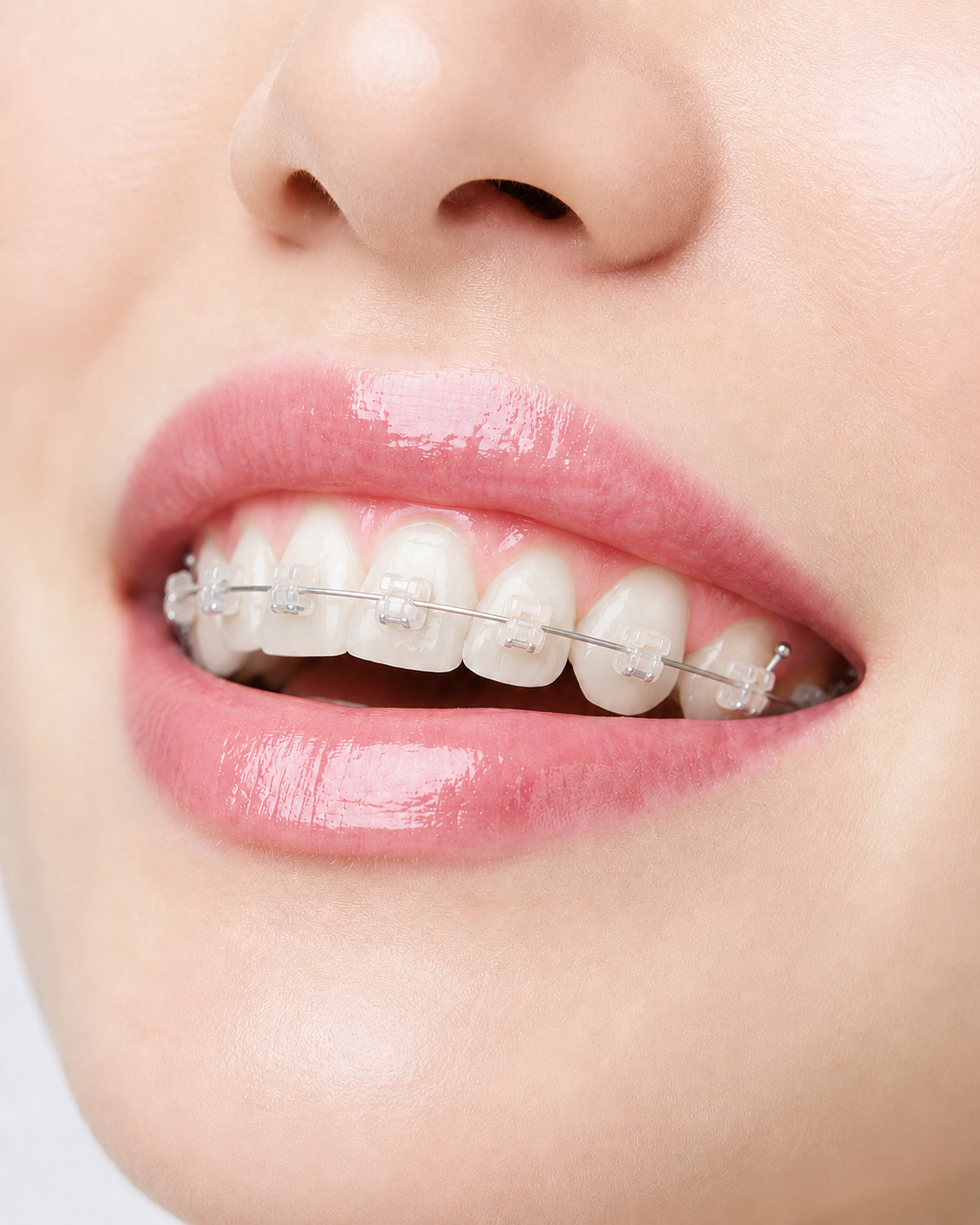
The honest core: metal (₩4,300,000) and self-ligating ceramic (₩5,300,000) move teeth identically — same wires, same forces, same treatment months, same M.S.-Orthodontics planning — and the ₩1,000,000 gap buys visual quietness for the treatment’s duration: tooth-coloured brackets that read far softer at conversational distance. Between them sits Clippy-C self-ligating metal (₩5,100,000), buying mechanism rather than looks. This guide prices all three honestly — what ceramic actually changes, what it never changes, the staining and durability truths the brochures skip, and the simple question that usually settles the choice.
- One machine, three casings in Busan
- What ceramic actually changes — and the truths brochures skip
- The Clippy-C middle tier — what ₩5.1M’s mechanism honestly buys
- The three tiers, in one honest table
- Who genuinely benefits from each — and the mixed-arch option
- The practical layer in Busan Seomyeon — visits, timeline, and your next step
What bracket choosers actually ask
- Does ceramic work as well as metal, or is it beauty over function?
- Is ₩1,000,000 for looks alone actually worth it?
- Do ceramic brackets stain yellow like forums claim?
- What exactly does the Clippy-C tier at ₩5.1M buy?
- Do ceramic braces take longer or break more?
One machine, three casings in Busan
Start with what unites the tiers, because it’s most of the story: every braces case here runs the same treatment machine — the same archwires supplying the forces, the same adjustment rhythm, the same movement biology, the same monitoring, and the same M.S.-Orthodontics diagnosis upstream of everything. The bracket is the wire’s handle on each tooth; changing what the handle is made of changes how the mouth photographs, not where the teeth finish.
The three casings on the menu: conventional metal at ₩4,300,000 — stainless brackets, elastic ties, orthodontics’ reference hardware, unglamorous and unmatched for track record; Clippy-C self-ligating metal at ₩5,100,000 — brackets whose built-in sliding doors replace the elastic ties, cutting friction along the wire; and self-ligating ceramic at ₩5,300,000 — the same sliding-door mechanism in tooth-coloured polycrystalline brackets that read far quieter on camera and across a meeting table.
Notice the menu’s honest geometry: the first ₩800,000 (metal→Clippy-C) buys mechanism; the next ₩200,000 (Clippy-C→ceramic) buys the material’s optics. There is no tier that buys a different orthodontist, a different plan, or a different finish line — the sentence this site applies to implant fixtures and ceramics applies verbatim to brackets: hardware tiers vary the component, never the standard.
Which frames the real question this guide answers: not “which bracket is better” — they finish the same — but “what is treatment-duration visibility worth in your actual life?” For a student it’s often worth little; for a client-facing professional spending eighteen months in meetings, it’s frequently the whole decision. Both answers are correct when they’re yours.
What ceramic actually changes — and the truths brochures skip
What it changes: conversational-distance visibility, substantially. Tooth-coloured brackets against enamel read as texture rather than hardware; the archwire remains a fine metal line (frosted variants exist, carrying their own honest trade-offs in friction and finish), and the overall effect moves treatment from “announcement” to “noticeable on inspection.” For photographs, presentations and client work, the difference is real and daily — the ₩1,000,000 buys eighteen-odd months of it, which priced per month is the honest way to weigh it.
Truth one the brochures skip — staining: modern polycrystalline brackets themselves resist discolouration well; what stains are the elastic components and the resin adhesion points around brackets, in mouths running heavy coffee, tea, curry and red wine. Self-ligating design helps precisely here — fewer elastic parts to yellow — and the residual truth is behavioural: ceramic’s aesthetic advantage is maintained, not installed, and the ₩60,000 scaling habit plus sane beverage timing keeps it. A ceramic case that never cleans is a beige case by month six.
Truth two — durability: ceramic brackets are harder but more brittle than steel — they fracture rather than bend under abuse, and a fractured bracket means a repair visit. In practice the difference is modest with normal eating discipline (the same food list both tiers already carry), but heavy-contact sport mouths and bracket-chewers hear it stated plainly, along with the mouthguard conversation that protects any bracket material on the field. Truth three — the lower-arch nuance: ceramic’s hardness can wear opposing enamel where deep bites bring upper front teeth onto lower brackets — one honest reason mixed prescriptions exist (ceramic upper for the visible arch, metal lower where nobody looks and bites land), an option the consultation raises wherever bite depth suggests it, often saving money and enamel at once — the unglamorous prescription bracket marketing never shows and honest treatment plans use constantly.
And the removal footnote for completeness: ceramic brackets debond with a slightly more careful technique at treatment’s end — a few extra minutes in the final appointment, not a risk conversation, and the enamel underneath emerges the same either way. The finish line looks identical across every tier; it always did — brackets were only ever the scaffolding, and scaffolding, by design and on schedule, always comes down.
The Clippy-C middle tier — what ₩5.1M’s mechanism honestly buys
Clippy-C deserves its own honest paragraph because it’s bought for different reasons than ceramic. The mechanism: self-ligating brackets hold the wire in a sliding door instead of elastic ties, reducing friction as teeth travel along the arch — which can smooth certain movement phases and typically makes adjustment visits quicker and gentler (no tie-changing ritual). Patients feel the visit difference more than the movement difference — a quicker chair, no tie ritual, a gentler wire change — and honest reporting keeps the claim exactly that size.
What the marketing claims and the honest literature says: Clippy-C-style systems have been sold on faster treatment and fewer extractions — claims the independent evidence treats far more cautiously than the brochures do. The fair summary this clinic gives: outcome quality and total treatment time track the operator and the case far more than the bracket; self-ligation’s reliable purchases are friction mechanics and appointment comfort, and ₩800,000 for those is a legitimate knowing purchase, not a speed upgrade. Anywhere selling Clippy-C as months-off-your-treatment is selling past the evidence.
Where Clippy-C fits the menu’s logic: for the patient who wants fixed hardware’s full capability with the smoothest possible visit rhythm and doesn’t need ceramic’s optics — the engineer’s tier, chosen for how it works rather than how it looks. And since the ceramic tier here is also self-ligating, the ₩200,000 step from Clippy-C to ceramic isolates the optics purchase cleanly: the menu was built so each won buys one nameable thing.
The tier question the consultation actually asks, in order: does your case need fixed hardware at all (the aligner comparison’s territory)? If yes, does treatment-duration visibility matter in your life (the ceramic question)? If it does, ceramic; if visit mechanics matter more, Clippy-C; if neither premium earns its keep in your actual life, metal at ₩4.3M remains the reference answer with the widest track record — the tier this clinic recommends without embarrassment, regularly — a hardware menu is only honest if its cheapest line gets prescribed as often as findings vote for it.
Not sure the visibility premium earns its keep in your week? Send photos and one line about your Tuesdays — meetings, sport, budget — and the honest tier logic comes back free, before any records. Message us on WhatsApp →
The three tiers, in one honest table
Everything the hardware menu varies — and the machine underneath that doesn’t:
| Dimension | Metal — ₩4,300,000 | Clippy-C — ₩5,100,000 | Ceramic — ₩5,300,000 |
|---|---|---|---|
| What the tier buys | The reference — widest track record, steel durability | Self-ligating mechanism — lower friction, quicker gentler visits | Same mechanism + tooth-coloured optics — conversational-distance quiet |
| Visibility | Metal, honestly | Metal, honestly | Reads as texture, not hardware — the ₩1M’s entire job |
| Durability nuance | Bends before breaking — the abuse-tolerant tier | As metal | Harder but brittle — fractures under abuse; fine with normal eating discipline |
| Staining truth | N/A | Fewer elastic parts to yellow | Brackets resist stain; surrounds need the maintained-mouth habit |
| Movement & finish | Identical — same wires, same biology, same finish line | Identical — evidence doesn’t support speed claims | Identical — optics never touched the physics |
| Genuinely serves | Students, budgets, sport mouths, reference-hardware temperaments | Visit-comfort buyers, eyes open on evidence | Client-facing lives, aligner-vetoed adult cases, photo-heavy seasons |
All tiers share the journey ledger: ₩100,000 diagnosis credited forward, mini-screws ₩150,000 each where needed, retainers ₩100,000–200,000 per arch at the finish. Mixed prescriptions (ceramic upper, metal lower) priced per case.
Who genuinely benefits from each — and the mixed-arch option
Metal at ₩4,300,000 genuinely serves: students and anyone whose daily life doesn’t price visibility; budget-anchored plans where the ₩1,000,000 has better uses (a whitening course after debond, say, with change); heavy-contact sport and bracket-hostile habits where steel’s bend-don’t-break durability earns its keep; and the temperament that simply wants the reference hardware with the longest track record. Choosing metal is never settling — it’s the instrument every other tier is measured against.
Ceramic at ₩5,300,000 genuinely serves: client-facing professionals, presenters, and anyone for whom eighteen months of conversational-distance quietness is a daily-life purchase — priced per month of treatment, often the most defensible aesthetic spend in this site’s whole catalogue; adult patients whose case vetoed aligners but whose work vetoes visible metal (the exact population the aligner comparison routes here); and photograph-heavy seasons — weddings, launches, the season of being photographed — falling squarely mid-treatment.
Clippy-C at ₩5,100,000 genuinely serves: the visit-comfort buyer and the friction-mechanics appreciator, eyes open about what the evidence does and doesn’t promise. And the mixed prescription serves the pragmatists: ceramic upper, metal lower — the visible arch quiet, the hidden arch economical and bite-safe — a combination the consultation prices per case and one more reason the tiers are a menu, not a ladder.
The choosing heuristic that settles most cases in one sentence: count the meetings. If your average week puts your smile in front of people whose impression matters professionally, ceramic’s per-month arithmetic usually clears; if it doesn’t, metal’s ₩1,000,000 savings usually speaks louder. Either way the teeth finish in the same place — which is the one sentence of this guide worth remembering after everything else fades. And if the count changes mid-treatment — the new job, the promotion into meetings — bracket swaps exist, priced honestly, though the cheaper version of that story is counting forward at the diagnosis.
The practical layer in Busan Seomyeon — visits, timeline, and your next step
What every tier shares operationally, so the choice carries no scheduling surprises: the same adjustment rhythm on the same evening-and-Saturday grid working patients run entire treatments on; the same one-to-three-year active timeline that the case — never the bracket, whatever any brochure implies — determines; the same itemised ledger around the headline figure — the ₩100,000 diagnosis credited forward, mini-screws at ₩150,000 each where anchorage genuinely needs them, and the retainer chapter (₩100,000–200,000 per arch) that ends every case regardless of what straightened it.
The comfort truths, shared across tiers with one nuance each: adjustment weeks ache for a few days on any bracket — moving teeth is moving teeth, and no tier repeals it; cheek-side friction in the early weeks answers to orthodontic wax, a soft-food fortnight and simple adaptation; Clippy-C’s visits run quicker; ceramic’s debond runs a few minutes longer. None of it changes the decision; all of it belongs in an honest guide — because comfort surprises, unlike price surprises, can’t be prevented by paper, only by paragraphs like this one.
The visitor honesty, restated once because comparison-shoppers arrive here from abroad: active braces treatment is a residence pattern — adjustment visits need a reachable chair for the duration, per the orthodontic cost guide’s structural answer. Busan residents and long-stay expats get the full menu; pure visitors get the world-class ₩100,000 diagnosis to carry home, and the honest “this treatment fits lives, not itineraries” where that’s the truth.
Next step, one message: photos (front and both sides), one line on what your weeks actually look like — meetings or not, contact sport or not, the budget’s honest shape, any photograph-heavy season ahead — and the tier logic for your actual life comes back plainly, before any records or commitment. Three casings, one machine, one finish line, one honest menu: buy the one casing your actual, unglamorous Tuesdays will genuinely live with for the whole duration, and let the ₩100,000 diagnosis do the rest in writing.
- One machine, three casings: same wires, same movements, same finish — the tiers change how treatment looks and feels, never where it ends.
- The menu’s clean geometry: ₩800k metal→Clippy-C buys mechanism; ₩200k Clippy-C→ceramic buys optics — each won buys one nameable thing.
- Ceramic’s truths: brackets resist stain (surrounds need maintenance); brittle under abuse; occasionally metal-lower is the smart mix.
- Clippy-C’s honest purchase is visit comfort, not speed — the evidence doesn’t back months-off claims.
- Count the meetings: visibility priced per treatment-month either clears in your week or it doesn’t — both answers are correct when they’re yours.
The dentists behind every guide on this site


FAQ
Yes — identically, by design: the same archwires supply the same forces on the same schedule, and the finish line doesn't know what colour the brackets were. The honest differences live elsewhere: ceramic's brittleness under abuse, the maintained-mouth requirement for its aesthetics, the slightly longer debond. Movement capability and treatment months belong to the case and the planning, never the casing.
Priced honestly: it buys conversational-distance quietness for your treatment's duration — divide ₩1,000,000 by your expected months and weigh the per-month figure against how often your smile sits in front of people professionally. Client-facing lives usually find it clears easily; student lives usually find metal's savings speak louder. The mixed prescription (ceramic upper, metal lower) splits the difference where bites permit — ask at consultation — the upper arch carries most of a smile's public duty, and pragmatism is a legitimate aesthetic.
The brackets themselves resist discolouration well — modern polycrystalline ceramic holds its shade. What yellows are elastic components and the adhesion surrounds, in heavy coffee-tea-wine mouths that skip maintenance; self-ligating design removes most elastic parts, and the ₩60,000 scaling habit plus sane beverage timing protects the rest. Ceramic's aesthetic is maintained, not installed — budget the small habit alongside the hardware, and the tier keeps its promise.
Reliably: lower-friction wire mechanics and quicker, gentler adjustment visits — the sliding-door bracket skips the tie-changing ritual. Cautiously: the faster-treatment and fewer-extraction claims in Clippy-C marketing are treated far more sceptically by independent evidence than by brochures, and this clinic says so plainly. ₩800,000 for visit comfort and mechanism is a legitimate knowing purchase; months off your treatment is not what the evidence sells.
Yes, and it's often the pragmatist's best answer: the upper arch carries most of a smile's visibility while the lower hides behind it, so ceramic-upper-metal-lower buys most of the aesthetic benefit at a fraction of the premium — and sidesteps the deep-bite wear question where upper teeth land on lower brackets. The consultation prices the mix per case; it's a menu here, not a ladder.
Braces in Busan
The full clinical page behind all three hardware tiers.
Clear Aligners in Busan
The other answer to the visibility question — where cases permit.
Orthodontics Hub
The whole map, including the ₩100,000 diagnosis.
Published Prices
Every tier and ledger line, on the living list.
What braces and clear aligners cost in Busan
Related guide in this series.
Clear aligners or braces? A dentist's straight answer
Related guide in this series.
Whitening and scaling costs in Busan, in plain numbers
Related guide in this series.
Three casings, one machine. Buy the one your Tuesdays can live with.
Photos and one line about your week get the honest tier logic free; the ₩100,000 diagnosis — credited forward — puts the whole plan in writing. The finish line is identical; the journey's look is yours to price.
Medical information in this guide is provided for general education and does not replace an individual examination and diagnosis. Prices shown are current at the time of writing; insured-schedule items follow Korea's national fee schedule and are quoted in writing at your visit. This clinic does not provide 24-hour service. Individual results vary.