Clear aligners for adults in Busan Seomyeon — straighten quietly, live normally.
Removable, nearly invisible Cerafin trays designed for working adults — no brackets in your meetings, no food rules at your dinners, and a plan you see digitally before you commit. Published pricing, English-led planning.
Ask about aligners for your case.
Tap what fits — we’ll open WhatsApp with your message ready to send.Nothing sends until you press send in WhatsApp. Photos of your teeth help us give an honest first read — aligner case or not.
Am I too old for teeth straightening — and can it fit a working life?
No, you’re not too old — adult teeth move at any age as long as the gums and bone supporting them are healthy, which your exam confirms first. And yes, aligners were practically designed for working life: nearly invisible in meetings, removed for meals and coffee, cleaned in a minute at your desk.
At Baro Dental, adult aligner treatment uses the Cerafin system at a published ₩3,000,000–6,000,000 depending on case complexity — your exact figure is fixed in writing after diagnosis (₩100,000, credited toward treatment if you proceed). You’ll see your projected result as a 3D simulation before committing a single won to the trays.
How clear aligners move adult teeth.
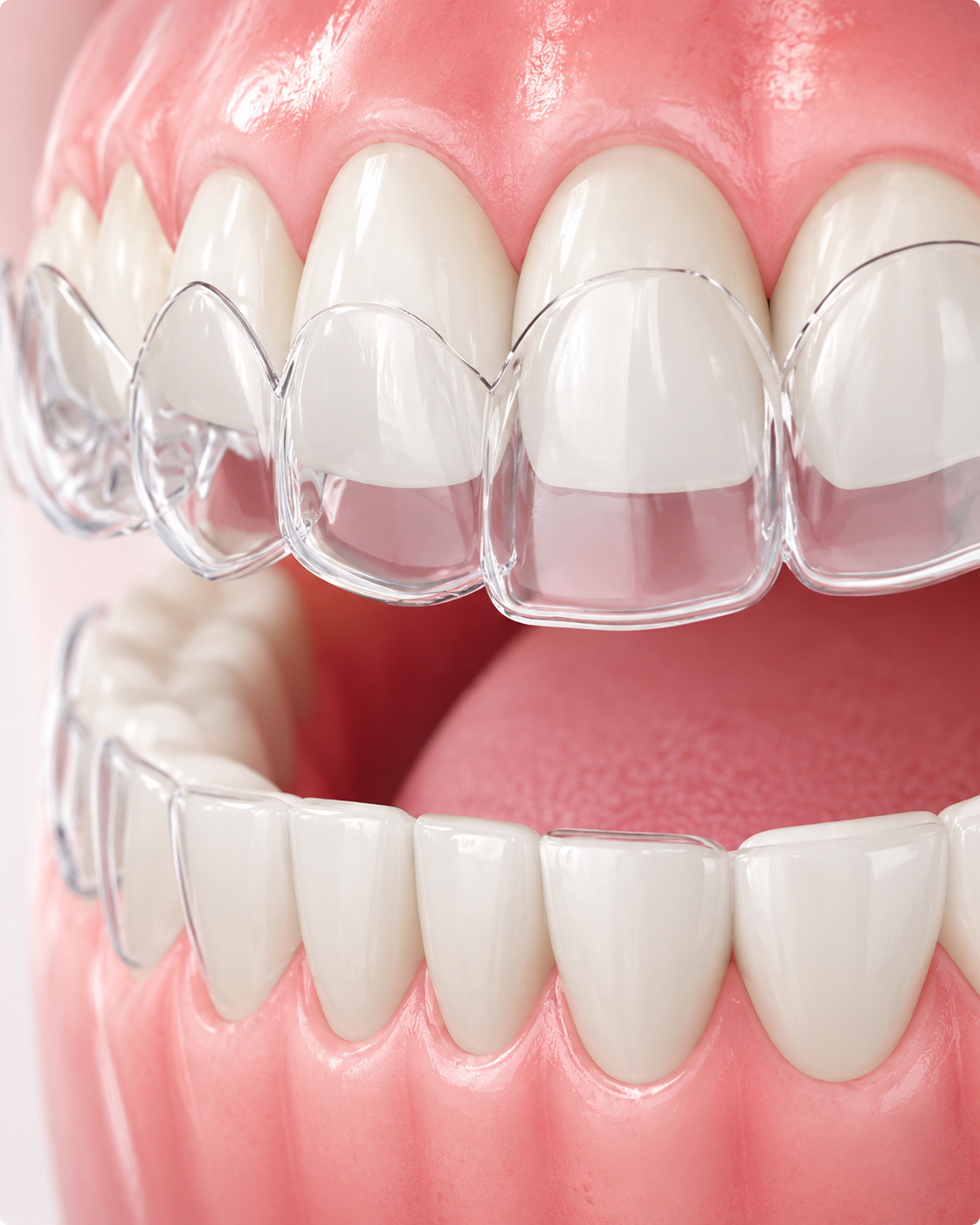
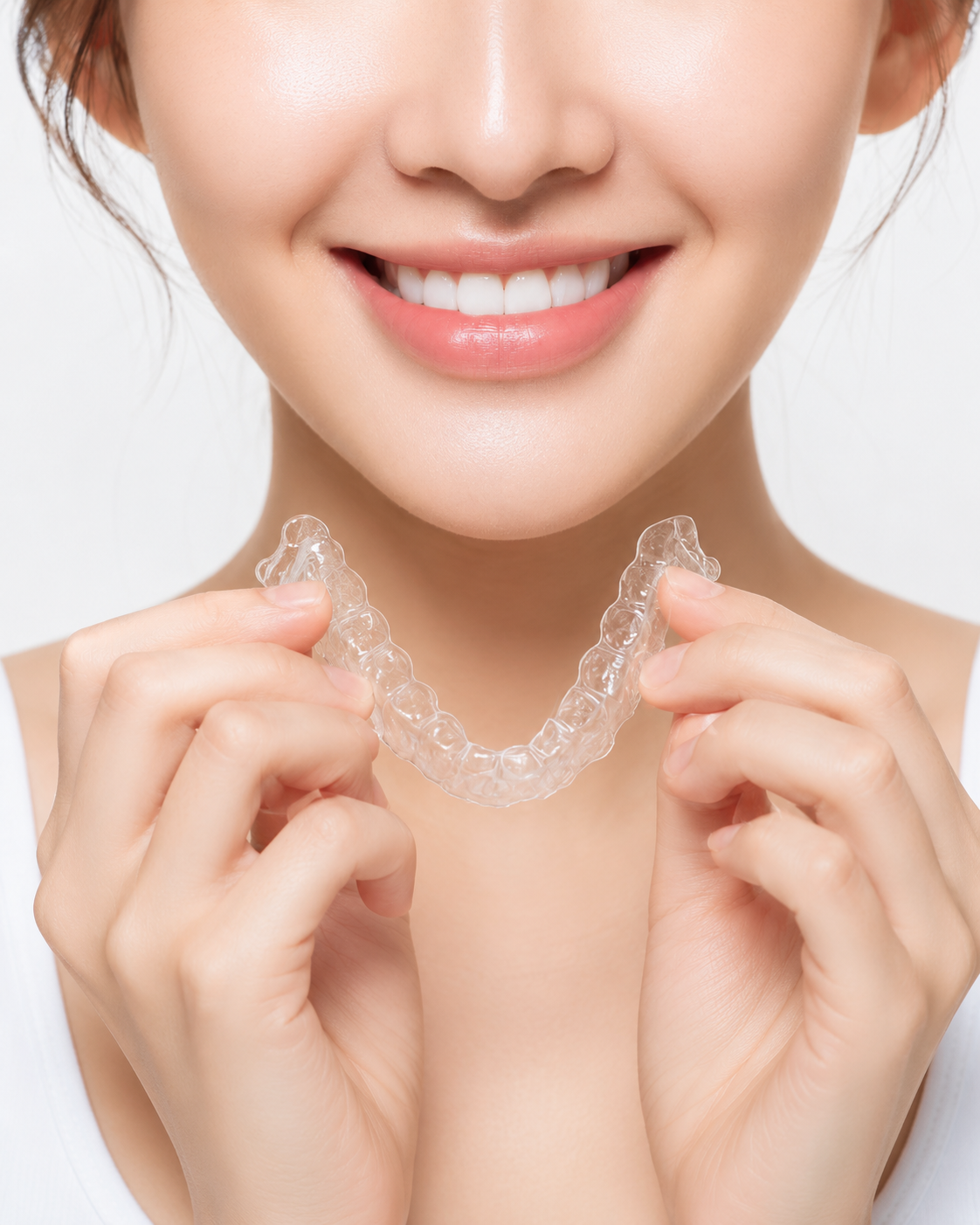
Each aligner is a precision-made transparent tray, shaped not to your teeth as they are, but a fraction of a millimetre ahead of them — toward where they should be. Worn about 22 hours a day, the tray applies gentle, continuous pressure; bone remodels around the moving roots, and after one to two weeks you switch to the next tray in the series. Tray by tray, the plan advances.
The adult-specific truth: tooth movement doesn’t expire with age. The biology that moves a teenager’s teeth — bone resorbing on the pressure side, rebuilding on the other — works identically at 30, 45 and 60. What changes with age is the checklist before starting: adult mouths more often carry gum issues, old restorations or missing teeth, so the diagnosis stage matters more, not less.
That’s also why the digital step earns its place. Your teeth are scanned, the movement is planned tooth by tooth, and you see the projected end result in 3D at the consultation — a level of before-you-commit clarity that fixed braces never offered your generation the first time around.
Six reasons adults put it off — and what’s actually true.
Most adults considering aligners have wanted straighter teeth for years. What stopped them is usually one of these — and each has an honest answer.
“I’m in meetings all day”
Aligners’ home turfThe trays are transparent and sit tight to the teeth — at conversation distance, most people simply don’t notice. Presentations, client calls, video meetings: this is precisely the case aligners were built for.
“I thought it was too late”
Biology says otherwiseHealthy adult teeth move at any age. What the exam checks is the foundation — gums and bone. If they’re sound, age itself is not a barrier; if they need care first, we treat that first and tell you why.
“I had braces as a teen — it relapsed”
Very common, very fixablePost-braces drift is one of the most frequent adult cases — often milder than the original problem, and well suited to aligners. This time, the retainer plan (₩100,000 clear / ₩150,000–200,000 fixed) is part of the deal from day one.
“I can’t give up coffee and dinners”
You don’t have toTrays come out for meals and anything but water — eat what you like, then brush and wear again. The honest trade: the ~22-hour daily wear target is yours to keep. The trays only work while they’re on your teeth.
“I travel for work constantly”
Plan the rhythmAligners travel well — you carry the next trays with you and check in on a planned rhythm rather than monthly emergencies. International patients do this routinely; we map the tray schedule around your trips at diagnosis.
“My case might be too complex”
Sometimes true — we’ll say soSome rotations and bite corrections genuinely do better with fixed braces (Clippy-C ₩5,100,000). The diagnosis tells us which tool your case needs — and if aligners would be the slower, worse option for you, that’s exactly what we’ll say.
From first scan to last tray.
Diagnosis & foundation check
Digital scan, photos and imaging (₩100,000, credited toward treatment) — plus the adult-specific check: gum health, bone support, existing crowns and fillings. Treatment starts on a sound foundation or it doesn’t start.
3D plan & written price
Your movement is planned tooth by tooth, and you review the projected result in 3D. The exact fee inside the ₩3M–6M Cerafin range is fixed in writing here — before any tray is made.
Fitting & the first weeks
Trays are fitted and checked; small tooth-coloured attachments may be placed to help specific movements grip. The first days feel snug — pressure, not pain — and speech adapts within about a week.
The rhythm
Wear ~22 hours daily, switch trays on your planned interval, check in on the schedule set at diagnosis — spaced deliberately, because adult calendars are real. Travellers carry tray sets and check in around trips.
Finish & retain
When the plan completes, retention begins — clear retainer ₩100,000 or fixed wire ₩150,000–200,000, with the first year’s adjustments covered. Retention is what makes this the last time you pay for straightening.
Aligners or braces at 35 — compared where it matters.
Both straighten teeth. The difference is what they cost your daily life — compared here through an adult’s week, not a brochure’s.
| Cerafin clear aligners | Fixed braces | |
|---|---|---|
| In a meeting | Effectively invisible at conversation distance | Visible; ceramic brackets (₩5,300,000) soften but don’t hide it |
| Business dinner | Trays out, eat anything, brush, trays in | Food rules apply — and greens check their reflection after |
| Comfort pattern | Pressure for a day or two per new tray | Adjustment soreness; occasional bracket irritation on cheeks |
| Your responsibility | ~22 hr/day wear discipline — the honest catch | None — it works whether you cooperate or not |
| Check-in rhythm | Planned intervals; travel-friendly | Regular adjustment visits |
| Published price | ₩3,000,000–6,000,000 by complexity | Metal ₩4,300,000 · Clippy-C ₩5,100,000 · Self-lig ceramic ₩5,300,000 |
| Best at | Mild–moderate crowding, spacing, relapse cases | Complex rotations and bite corrections |
The diagnosis decides which column fits your teeth; this table decides which fits your life. When both would work, we’ll say so and let you choose — and when only one would, we’ll tell you that plainly, whichever it is.
Living with aligners — honestly.
The 22-hour deal
Trays out for meals and coffee, in for everything else — including sleep. The arithmetic is unforgiving in the best way: three meals plus two coffees, done efficiently, still leaves 22 hours. Long grazing lunches and all-evening dinners are where hours quietly leak; adults who treat meals as sessions, not marathons, stay on schedule.
Coffee, wine and the trays
Hot drinks warp trays and dark drinks stain them — so anything but water means trays out. The realistic workflow: remove, enjoy, rinse your mouth, trays back in. Many adults find their coffee count drops on its own; consider it a side benefit you didn’t order.
Cleaning that takes a minute
Rinse trays when they come out, brush them gently (no hot water, no coloured mouthwash soaks), and brush your own teeth before trays go back in — sealing sugar against enamel for hours is the one genuinely bad habit. A travel brush in your bag makes office life easy.
Speech, spares and slips
A slight lisp for the first days is normal and fades as your tongue adapts — practise your presentation out loud once and you’re fine. Keep the previous tray as a backup; if a tray is lost mid-trip, wear the previous one and message us — the plan bends, it doesn’t break.
An adult’s aligner journey — stage by stage.
Diagnosis day
Scan, photos, foundation check, 3D simulation, written price — one visit (₩100,000, credited if you proceed). You leave knowing whether aligners fit your case, what they’d cost, and what the end result is projected to look like.
The adjustment fortnight
First trays feel snug; speech has its brief lisp phase; you learn the meal rhythm. This is the only genuinely awkward stretch — and it ends faster than most adults expect.
Quiet progress
Trays change on your interval; check-ins follow the schedule set at diagnosis. Colleagues who don’t know, still don’t know. Somewhere in this stretch, photos start looking different — the change creeps up on you tray by tray.
Finish & protect the investment
Last tray done, retention begins — clear retainer (₩100,000) or fixed wire (₩150,000–200,000), first-year adjustments covered. Teeth remember old positions for a long time; retention is what keeps the result yours.
How much do clear aligners for adults cost in Busan?
₩3,000,000–6,000,000 with the Cerafin system — the published range at Baro Dental, identical for foreign and Korean patients. Where your case lands depends on complexity: how many teeth move, how far, and whether bite correction is involved. Your exact figure is fixed in writing at diagnosis (₩100,000, credited toward treatment) — before any tray is manufactured.
Is 40 (or 50, or 60) too old for aligners?
No. The bone biology that moves teeth works at every age — what changes is the pre-flight check. Adult mouths carry more history: gum recession, old crowns, the odd missing tooth. The diagnosis maps all of it, treats what needs treating first, and plans movements around restorations. Age alone has never been the reason we’ve declined a case.
Will people at work notice?
At conversation distance, almost never — the trays are transparent and hug the teeth without wires or brackets. What colleagues occasionally notice instead: you disappearing to brush after lunch, and your teeth gradually looking better in the quarterly team photo. Attachments, if your plan uses them, are tooth-coloured and subtle.
How long does adult aligner treatment take?
Honestly: it depends on your case, and anyone quoting months before seeing a scan is guessing. Mild relapse and small-gap cases sit at the shorter end; fuller corrections take longer. What we commit to: your projected timeline comes from your actual 3D plan at diagnosis, and wear discipline — that 22-hour target — is the single biggest factor you control.
What happens if I had braces years ago and my teeth drifted back?
You’re in the most common adult category there is. Relapse cases are often milder than the original problem and respond well to aligners — frequently at the lower end of the price range. The lesson gets built in this time: retention is planned from day one (clear ₩100,000 / fixed ₩150,000–200,000, first-year adjustments covered), so the second straightening is the last.
Can I do aligner treatment while living abroad or travelling?
Yes — aligners are the most travel-compatible orthodontics there is. You carry your upcoming tray sets, follow the wear schedule anywhere, and check in on the rhythm planned at diagnosis. Busan-based expats, frequent flyers and even patients who split time between countries run this successfully; message your situation on WhatsApp and we’ll tell you honestly whether your calendar supports it.
Care by board-certified specialists in Seomyeon
Both directors are board-certified specialists in Advanced General Dentistry, so your cosmetic treatment is planned with your overall dental health in mind.
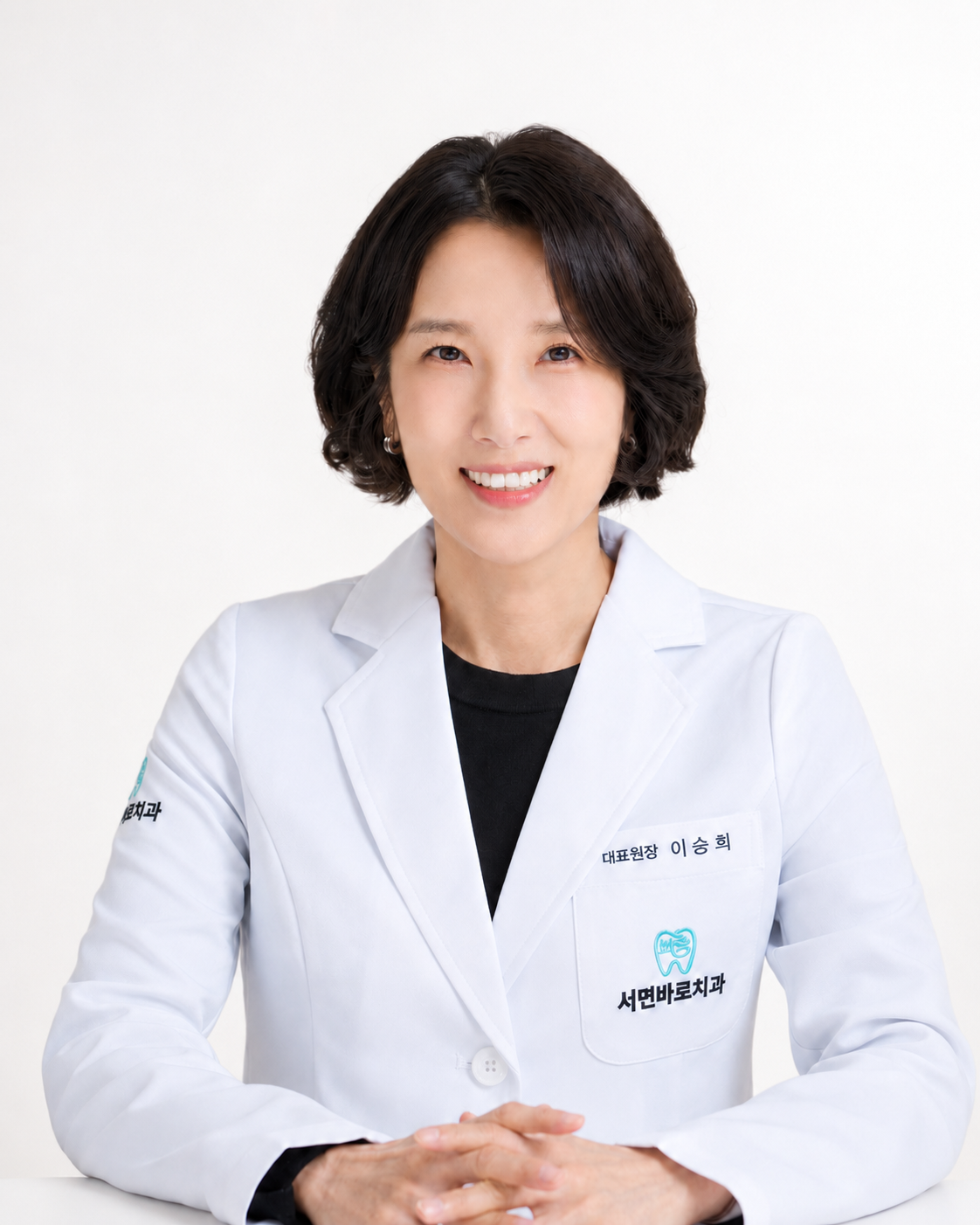
- Board-certified specialist, Advanced General Dentistry
- M.S. in Orthodontics, Kyungpook National University
- Focus on natural, alignment-led smile improvement
- Conservative, tooth-preserving approach

- Board-certified specialist, Advanced General Dentistry
- DDS, Dankook University College of Dentistry
- Restorative & aesthetic resin filling work
- Focus: natural, durable results
Small truths about adult straightening.
- Straight teeth are easier to keep clean. The adult case for orthodontics isn’t only cosmetic — aligned teeth trap less plaque between them, which your gums will appreciate for decades.
- The lisp is real, and it’s brief. Almost everyone has two to five days of slight “s” softness with new trays. Reading aloud for ten minutes speeds the adaptation dramatically.
- Trays are a free night guard preview. Many adults discover they grind at night when trays show wear marks — useful intelligence for planning a proper night guard (₩300,000) after treatment.
- Whitening can ride along. Timing matters and your dentist plans it, but many adults finish treatment with teeth that are both straighter and — via whitening sequenced around trays — brighter.
- The case photo that convinces most adults is their own scan. Seeing your teeth in 3D, then seeing the projected end state, reframes the decision from “someday” to a concrete before-and-after with a written price attached.
Aligners suit you when — and when they honestly don’t.
A strong adult candidate…
- has mild-to-moderate crowding, spacing or post-braces relapse — the movements aligners handle best
- can genuinely hold the ~22-hour daily wear — discipline is the treatment
- has healthy gums and bone, or is willing to treat them first
- values discretion at work and flexibility around meals and travel
We’ll recommend differently when…
- your case needs complex rotations or bite correction that fixed braces handle better — we’ll show you why on your own scan
- gum disease is active — moving teeth in inflamed bone harms them; treatment comes first, always
- your honest self-assessment says trays will live in your pocket — braces work without cooperation; aligners don’t
- the concern is one small gap or chip — sometimes cosmetic resin (₩150,000) solves in one visit what doesn’t need months of trays
Adult clear aligners FAQ.
Expect pressure, not pain — each new tray feels snug for a day or two as it starts moving teeth, similar to muscle ache after a workout. Most adults manage with nothing at all; some take ordinary pain relief on switch days. Sharp or persistent pain is not part of the deal and deserves a message to us.
Water is the only tray-in drink. Coffee stains and warps trays — so it comes out for your americano, and back in after a quick rinse. In practice adults batch their coffee with meals rather than sipping all day, which protects both the trays and the 22-hour wear count.
Small tooth-coloured resin bumps placed on certain teeth to give the tray better grip for specific movements — think door handles for plastic. They're subtle at conversation distance, removed cleanly when treatment ends, and not every plan needs them. Yours will show exactly which teeth get them, decided at the 3D planning stage.
Cerafin is the clear-aligner system Baro Dental works with — Korean-made trays planned and supervised by our own dentists. What matters clinically isn't the logo on the box: it's the diagnosis, the movement plan and the dentist checking your progress. You see the published price (₩3M–6M) and your 3D plan before committing, which is more transparency than most big-name quotes offer.
Wear your previous tray to hold position and message us the same day — depending on where you are in the plan, we'll advise moving to the next tray early or continuing on the backup until you're home. This is a solved problem, not an emergency; it's exactly why we tell adults to keep the last tray in their travel bag.
Honestly — retention is a long-term relationship, and anyone who says otherwise is selling relapse. Teeth drift back toward old positions for years; nightly retainer wear is what keeps your result. The clinic's terms are published: clear retainer ₩100,000 or fixed wire ₩150,000–200,000, with the first year's adjustments covered. Most adults find a nightly retainer a small tax on keeping the result they paid for.
Aligner treatment across borders — how it’s planned.
Message photos of your teeth and your situation — where you live, how often you’re in Busan. We’ll give an honest first read on whether your case and calendar suit aligners, and what the diagnosis visit involves.
Diagnosis day: scan, foundation check, 3D simulation, written price (₩100,000, credited). If you proceed, tray manufacturing begins — and your wear schedule is mapped around your travel pattern.
You carry your tray sets and switch on schedule wherever you are. Questions and progress photos go through WhatsApp; the check-in rhythm is set at diagnosis to match how often you’re realistically in Busan.
Final checks and retainer fitting (clear ₩100,000 / fixed ₩150,000–200,000) happen in-clinic, with the first year’s retainer adjustments covered — timed to a trip you were making anyway.
Find out what your case actually needs.
Send photos of your teeth on WhatsApp — we’ll tell you honestly whether aligners fit your case and your calendar, and what the diagnosis visit would map out. In English.
Message us on WhatsAppBaro Dental Clinic · 5F, SJ Medical Building, 698-1 Jungang-daero, Busanjin-gu · Seomyeon Station Exit 2, 4 min
Explore the options in Busan.
Clear Aligners Hub
The full picture — how Cerafin treatment works and every case type it treats.
Explore →Aligners for Crowding in Busan
Overlapping front teeth — the most common adult case, in depth.
Explore →Aligners for Gaps in Busan
Spacing and drifted-apart teeth — when moving beats filling.
Explore →Fixed Braces in Busan
Clippy-C ₩5,100,000 — the right tool when your case needs more control.
Explore →Medical information on this page is provided for general education and does not replace an individual examination and diagnosis. Whether clear aligners suit your case, and your projected treatment plan and timeline, are confirmed at diagnosis. Fees shown are the clinic’s published non-covered prices; your exact fee within the stated range is confirmed in writing before treatment begins.