Deep bite correction in Busan Seomyeon — when upper teeth swallow the lowers.
In a deep bite, the upper front teeth cover far too much of the lowers — hiding them when you smile, wearing their edges flat, sometimes biting into the gum behind. Cerafin aligners open the bite to healthy proportions, tray by tray.
Ask about your deep bite.
Tap what fits — we’ll open WhatsApp with your message ready to send.Nothing sends until you press send in WhatsApp. A teeth-closed photo helps us give an honest first read — how deep, and whether wear has started.
Can clear aligners fix a deep bite in Busan — and is mine “too deep”?
Yes — deep bite correction is established aligner territory, and trays are genuinely well suited to it: the plastic covering the back teeth acts as a built-in bite platform while the front teeth are guided to healthier levels. Cerafin treatment runs ₩3,000,000–6,000,000 by complexity, fixed in writing at diagnosis (₩100,000, credited).
As for “too deep”: some vertical overlap of the front teeth is normal and healthy. It reads as a problem when the uppers cover most of the lowers, when lower edges are wearing flat against the backs of the uppers, or when the lower front teeth bite into the gum behind the uppers. The diagnosis measures your overlap precisely — and if wear or gum impingement has started, that’s a reason to correct sooner, because deep bites are the one bite problem that tends to deepen itself over time.
What a deep bite actually is.
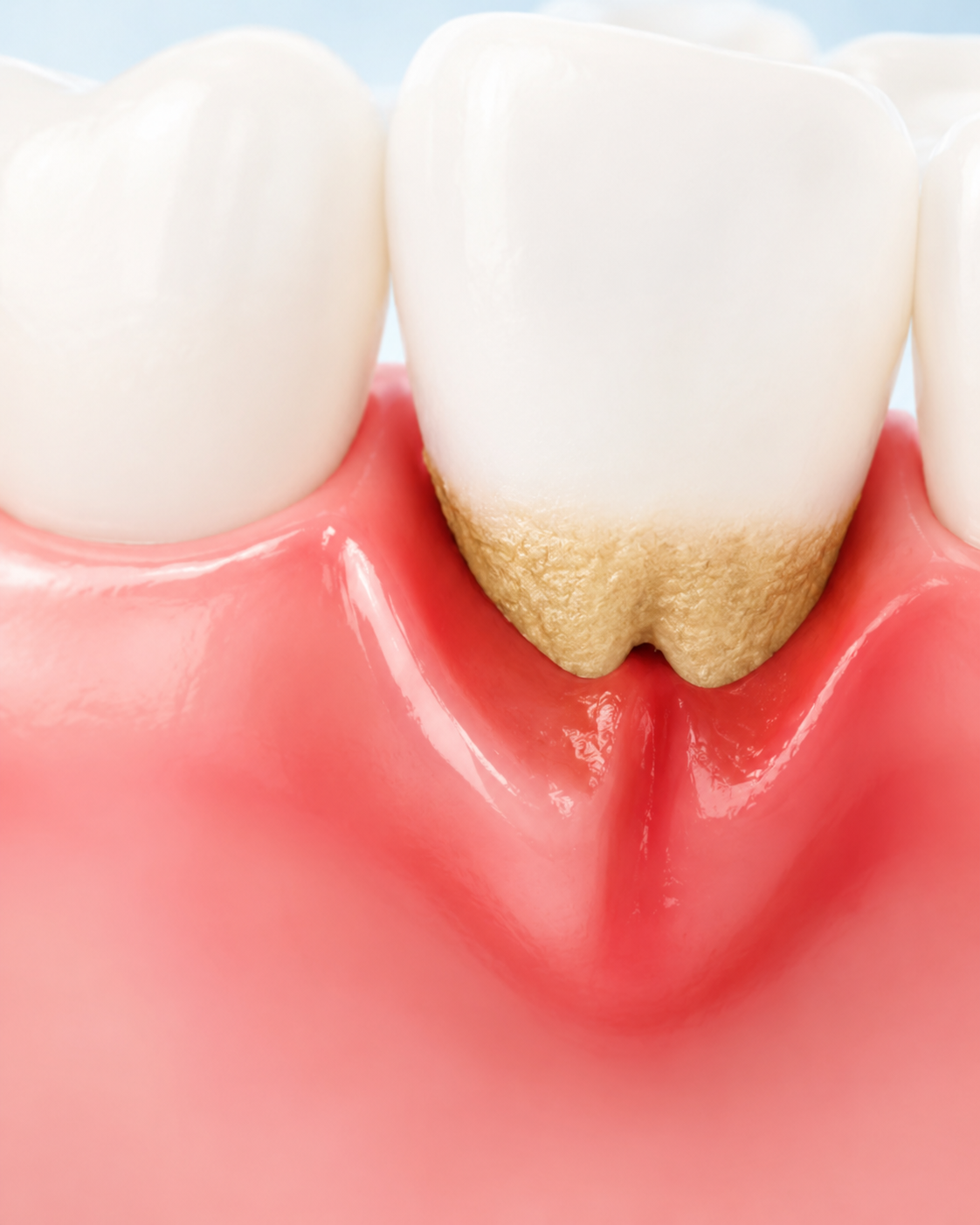
Bite problems come in two directions. Horizontal ones — crossbites, protrusion — are about front-to-back and side-to-side position. A deep bite is the main vertical one: when you close, the upper front teeth overlap the lowers far more than the healthy fraction, in severe cases hiding them completely. Dentists also call the same spectrum an excessive overbite.
Where it comes from varies — tooth eruption patterns, a strong bite musculature, front teeth tipped inward, or simply how your jaws grew. Why it matters is consistent: a deep bite concentrates chewing force onto the front teeth’s edges instead of distributing it across the molars. The lower incisors grind against the backs of the uppers at every meal, wearing both; in deeper cases the lower edges reach past the uppers entirely and press into the gum of the palate — the impingement that makes deep bites occasionally painful , not just structural.
Aligners correct it with an elegant mechanical advantage: the tray material itself sits between the back teeth, acting as a thin platform that discourages the bite from slamming fully closed, while the plan levels the front teeth — guiding lower incisors down and adjusting the uppers — until the overlap lands in the healthy range. It’s one of the corrections where the tray isn’t just a carrier for force; the plastic is part of the mechanism.
Six faces of a deep bite — which is yours?
Deep bites announce themselves differently — some cosmetic, some structural, some painful. Here’s the map we work through at your exam.
Lower teeth vanish when you smile
Classic aligner caseThe cosmetic signature: upper teeth curtain the lowers so the smile shows one row. Levelling the bite brings the lower teeth back into the picture — a change people read as “younger” without knowing why.
Lower edges wearing flat
Correct, then restoreLower incisors grinding the backs of the uppers wear both surfaces — flat, shiny edges are the tell. The bite is corrected first; worn edges can then be rebuilt ( cosmetic resin) onto teeth that will no longer destroy the repair.
Biting into the gum behind
The urgent versionIn deep cases the lower edges press into the palate gum behind the upper teeth — soreness, marks, sometimes real injury at meals. This impingement is the strongest medical reason to correct a deep bite rather than watch it.
Deep bite plus crowding
Combined planVertical and space problems love company — deep bites often arrive with crowded lower teeth. One aligner plan sequences both: level the bite while the crowding unwinds.
The returning deep bite
Relapse-prone — said honestlyDeep bites are among orthodontics’ most determined relapsers — strong bite muscles keep voting for the old position. Correctable, yes; but the retention plan (clear ₩100,000 / fixed ₩150,000) is non-negotiable here, and we say so up front.
Skeletal deep bite patterns
Measured, then told straightSome deep bites live in jaw proportions rather than tooth positions — strong-muscled, short-lower-face growth patterns. Trays improve the dental component; what’s skeletal stays skeletal, and your diagnosis will draw that line honestly on your own imaging.
How bite-opening actually goes.
Measure the overlap
Scan and photos quantify exactly how much the uppers cover the lowers, where wear has started, and whether gum impingement exists (₩100,000 diagnosis, credited; CT ₩30,000 where jaw assessment is needed).
Plan the levelling
The 3D plan choreographs which teeth intrude, which arch levels, and in what order — you see the projected open bite before committing, with the exact price fixed in writing.
The platform effect
From the first tray, the plastic between your back teeth interrupts the full-depth close — the bite can’t slam home while the plan works. Some plans add pressure spots or ramps behind the upper front teeth to direct the levelling.
Level, tray by tray
Front teeth are guided to healthier levels a fraction of a millimetre per tray — the slowest, most demanding movement in aligner dentistry, which is why deep-bite plans reward disciplined 22-hour wear more than any other.
Settle & retain hard
Final trays settle even contacts across the molars, then retention begins in earnest — deep bites relapse eagerly, so the retainer plan (clear ₩100,000 / fixed ₩150,000, first-year adjustments covered) is enforced, not suggested.
Deep bite, healthy bite, open bite — one vertical spectrum.
Vertical overlap runs on a single scale, and problems live at both ends. Seeing the whole spectrum makes your own bite easier to place.
| Deep bite | Healthy overlap | Open bite | |
|---|---|---|---|
| Front teeth relationship | Uppers cover most or all of the lowers | Uppers overlap the lowers slightly — a visible sliver of both rows | Front teeth don’t meet at all — a vertical gap when closed |
| Signature problem | Edge wear, gum impingement, hidden lower teeth | — | Biting into food with front teeth fails; speech effects |
| Force distribution | Overloads front-teeth edges | Shared across the arch as designed | Overloads back teeth — the only ones touching |
| Aligner approach | Level and open the bite — this page | — | Close the vertical gap — see protrusion & open bite |
| Published price | Cerafin ₩3,000,000–6,000,000 by complexity · diagnosis ₩100,000, credited | ||
Opposite problems, same physics: bites work when force spreads across many teeth. Both extremes concentrate it on a few — deep bites on the front edges, open bites on the back molars — and both are corrected by restoring the spread.
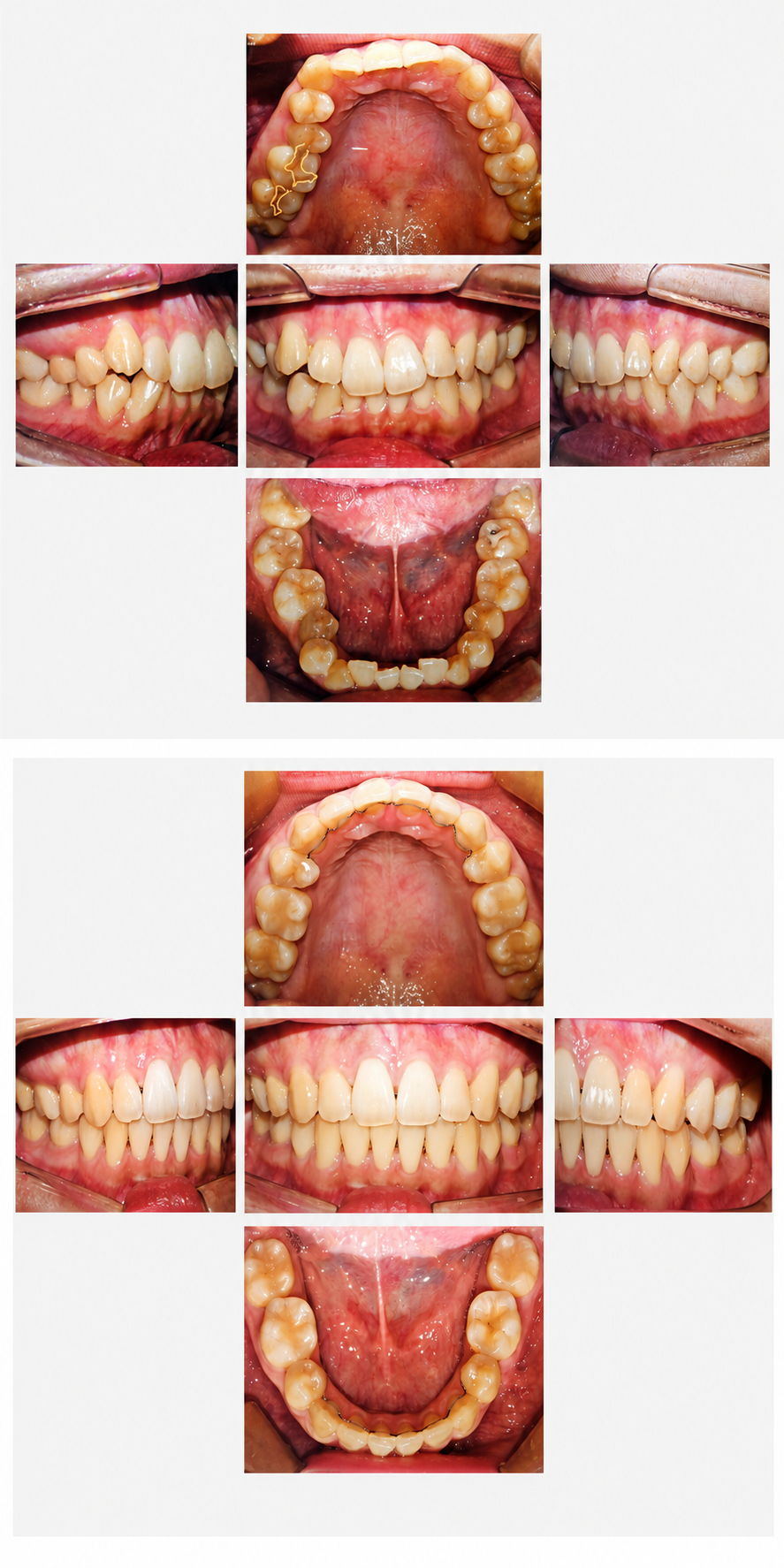
Deep bite — before and after.
Treated at Baro Dental with clear aligners, photographed the same way before and after. Shown with patient consent; every case is individual and results vary.
Why deep bites get deeper — the mechanics of the spiral.
Most bite problems hold steady for decades. Deep bites are the exception — they contain a feedback loop, and understanding it explains the “sooner is simpler” advice better than any sales copy could.
Edges meet where they shouldn’t
The deep overlap puts the lower incisor edges in contact with the backs of the upper front teeth at every close — thousands of micro-collisions a day that a healthy bite’s geometry avoids.
Wear shortens the front teeth
Enamel grinds off both surfaces — lower edges flatten, upper backs hollow. Shorter front teeth mean less vertical “stop” in the bite… so the jaw closes a fraction deeper than before.
Deeper close, faster wear
The deeper close increases the overlap and the collision force — the loop feeds itself. This is why a deep bite noticed at 30 is often measurably deeper at 45 while a crossbite, say, mostly just persists.
The repair space disappears
Eventually the overlap consumes the very room a dentist needs to rebuild the worn edges — restorations placed into a deep bite get chewed off by it. Correcting the bite reopens that space, which is why the honest order is always: level first, restore second.
Is a deep bite the same as an overbite?
Nearly — and the terms tangle. Technically every bite has some overbite (vertical overlap); a deep bite is an excessive overbite. In everyday speech “overbite” often means upper teeth protruding forward — which is actually overjet, a horizontal issue covered on our protrusion page. If your uppers cover the lowers too much vertically, this page is yours.
How much does deep bite correction cost in Busan?
Within Cerafin’s published ₩3,000,000–6,000,000 — deep-bite plans involve the slowest movements in aligner dentistry (levelling front teeth), so purely cosmetic-mild cases sit lower and heavy-wear, combined-crowding cases higher. Your figure is fixed in writing at diagnosis (₩100,000, credited). If fixed braces would honestly level your case better, we quote those instead: Metal ₩4,300,000 / Clippy-C ₩5,100,000.
My lower teeth bite into the roof-of-mouth gum — how urgent is that?
That’s gum impingement — the deep bite’s most medical symptom, and worth addressing rather than enduring. Repeated pressure injures the palatal gum behind the upper teeth, and unlike enamel wear it hurts in real time. It doesn’t make correction an emergency, but it moves “someday” to “this year” honestly — and it’s a finding we photograph and track from the first exam.
Why do deep bites relapse more than other corrections?
Because the forces that made them don’t retire. Strong closing muscles and the memory of the old tooth positions keep voting for depth after treatment ends — deep bites are orthodontics’ most persistent relapsers, and we’d rather you hear that from us than from your mirror in five years. The counterweight is retention taken seriously: clear retainer ₩100,000 or fixed ₩150,000, first-year adjustments covered, worn as instructed.
Can my worn-down front teeth be fixed at the same time?
In the right order, yes — and the order is the whole trick. Rebuilding worn edges inside an uncorrected deep bite hands the new restorations to the same collision that wore the originals. The honest sequence: level the bite first, then rebuild the edges — cosmetic resin for smaller wear, crowns (₩500,000 front) where more structure is gone — onto teeth that finally have room.
Will fixing my deep bite change how my smile looks?
Usually yes, in a specific way: your lower teeth rejoin the smile. Deep bites curtain them behind the uppers; levelling restores the two-row smile that reads as balanced and — because deep bites deepen with age — often as younger. What we won’t promise: facial or profile transformation. Tooth levelling changes the smile’s interior, not the architecture around it.
Care by board-certified specialists in Seomyeon
Both directors are board-certified specialists in Advanced General Dentistry, so your cosmetic treatment is planned with your overall dental health in mind.

- Board-certified specialist, Advanced General Dentistry
- M.S. in Orthodontics, Kyungpook National University
- Focus on natural, alignment-led smile improvement
- Conservative, tooth-preserving approach

- Board-certified specialist, Advanced General Dentistry
- DDS, Dankook University College of Dentistry
- Restorative & aesthetic resin filling work
- Focus: natural, durable results
Small truths about deep bites.
- The mirror test takes ten seconds. Bite together naturally and look straight on: if you can see at least a sliver of your lower front teeth, your overlap has company in the healthy range. If the lowers vanish entirely, that’s the deep-bite signature worth an exam.
- Flat, shiny lower edges are the receipt. Worn incisal edges catch light differently — a glassy flatness dentists spot across the room. If your lower front teeth stopped looking rounded years ago, the bite has been quietly billing you.
- Deep bites hide behind good-looking teeth. Rows can be perfectly straight and still overlap too deeply — it’s the least photogenic orthodontic problem, invisible in smiles and obvious only when teeth close. Check-ups catch what selfies can’t.
- Night grinding and deep bites are bad roommates. Grinding accelerates exactly the edge wear the deep bite already causes — if you grind, a night guard (₩300,000) protects the front teeth before, during and after correction.
- Aligners have a home advantage here. The tray plastic between back teeth naturally discourages full-depth closing — a structural head start fixed braces don’t get. Deep bites are one case where the “removable plastic” is a mechanical feature, not a compromise.
When aligners level deep bites — and when we’ll say more.
Aligners are the right call when…
- the deep bite is dental — tooth levels, not jaw proportions, measured on your scan
- wear or gum impingement has started — correcting the cause before repairing the damage
- crowding rides along — one plan sequences both problems
- you can hold the ~22-hour wear — levelling is the movement that punishes casual wear most
We’ll say more when…
- the pattern is skeletal — short-lower-face, strong-muscle growth types get the dental improvement and the honest ceiling, shown on imaging
- heavy wear needs rebuilding — the plan sequences bite first, restorations second, and we’ll map both costs up front
- severe cases would level better in fixed braces — quoted honestly (Clippy-C ₩5,100,000) if that’s your scan’s verdict
- retention discipline isn’t realistic for you — a deep bite corrected without retention is a deep bite on layaway, and we’d rather lose the case than pretend otherwise
Deep bite correction FAQ.
A modest vertical overlap is normal — problems begin when the uppers cover well over half of the lowers, and the severe end is full coverage with the lowers touching gum. Home mirrors give a rough read; the diagnosis (₩100,000, credited) measures the actual millimetres and, importantly, whether wear or impingement has already started — which changes the advice more than the raw depth does.
The familiar tray pressure, concentrated on the front teeth doing the levelling — snug for a day or two per switch, managed with nothing or ordinary pain relief. One deep-bite-specific note: the platform effect of plastic between your back teeth feels unusual for the first week, like chewing sits slightly differently. It's the mechanism working, and it fades from notice quickly.
Because pushing a tooth deeper into bone (intrusion) is biologically the hardest direction — bone must remodel ahead of the root, and it does so cautiously. That's not a flaw in aligners; it's tooth biology, and fixed braces face the same speed limit. It's also why deep-bite plans reward disciplined wear more than any other case type: every casual hour off is levelling time lost.
The link exists but isn't automatic — plenty of deep bites cause no joint symptoms, and plenty of jaw pain has other causes. Where a deep bite forces the jaw into an over-closed position for years, it can contribute to muscle and joint strain. If you have jaw symptoms now, they're assessed on their own merits — see our TMJ care page — and bite correction is recommended for its real benefits, never sold as a headache cure.
Usually yes, and this question earns respect — it's exactly the right order of operations. Crowns placed into an uncorrected deep bite inherit the same destructive collision that wore your natural edges, and porcelain doesn't enjoy collisions. Level the bite first, then restore into the corrected space. We plan both stages, with both written prices, at the same diagnosis.
Yes — with one candid note: deep-bite plans run on the slower end because levelling is slow biology, so the between-visit stretches matter. Diagnosis and fitting happen in-clinic; trays switch on schedule wherever you live with WhatsApp check-ins; refinements and the retainer fitting are grouped into Busan trips. We map the rhythm to your real travel pattern at diagnosis, honestly, before you commit.
Deep bite correction across visits.
Send a straight-on photo with teeth closed naturally, lips apart. Whether your lower teeth show — and how much — gives us an honest first read before you book anything.
Overlap measurement, wear and impingement check, 3D levelling plan, written price (₩100,000 diagnosis, credited; CT ₩30,000 where indicated). Restoration needs, if any, are costed in the same sitting.
Trays switch on schedule wherever you live; levelling progress is tracked via photos on WhatsApp. The slow-biology honesty: deep-bite intervals between Busan trips are planned longer, deliberately.
Contact settling, any edge restorations onto the corrected bite, and retainer fitting (clear ₩100,000 / fixed ₩150,000, first-year adjustments covered) — timed to a trip you were making anyway.
Find out how deep yours actually measures.
Send a teeth-closed photo on WhatsApp — we’ll tell you honestly whether it reads as a deep bite, whether wear has started, and what the diagnosis would map out. In English.
Message us on WhatsAppBaro Dental Clinic · 5F, SJ Medical Building, 698-1 Jungang-daero, Busanjin-gu · Seomyeon Station Exit 2, 4 min
Explore the options in Busan.
Clear Aligners Hub
How Cerafin treatment works, every case type, and the full pricing picture.
Explore →Protrusion & Open Bite
The other end of the vertical spectrum — and the horizontal one too.
Explore →Aligners for Crowding in Busan
Deep bites’ most frequent travel companion, treated in the same plan.
Explore →Night Guard in Busan
₩300,000 — edge protection for grinders, before and after correction.
Explore →Medical information on this page is provided for general education and does not replace an individual examination and diagnosis. Whether clear aligners suit your deep bite — and your plan, sequencing with any restorations, and exact fee within the stated range — are confirmed at diagnosis. The before-and-after photograph shows a real patient of this clinic, published with consent; individual results vary.