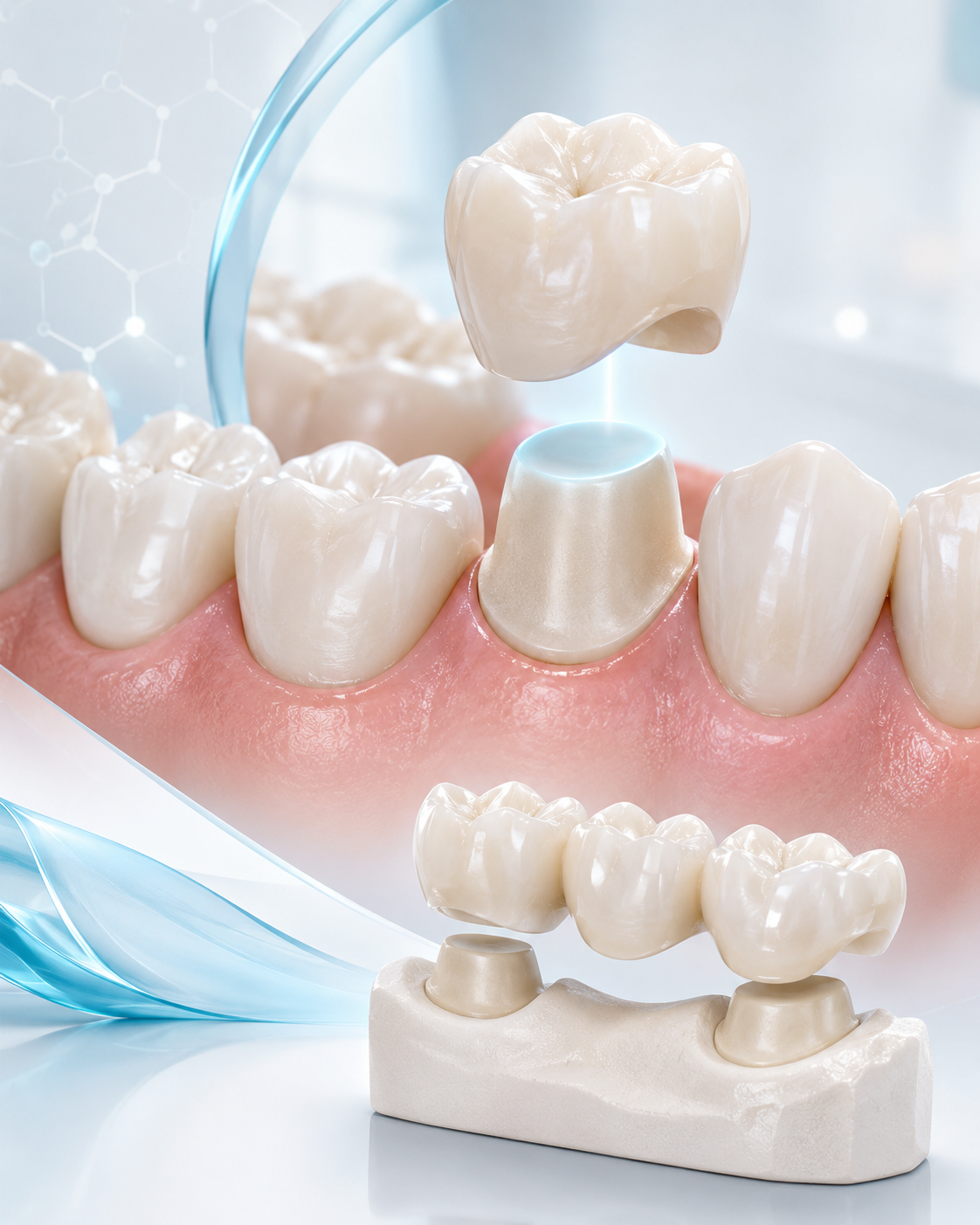
Zirconia crowns in Busan Seomyeon — armour for teeth worth keeping.
A crown’s whole purpose is saving a tooth that still has a future — and the price of that rescue is published: zirconia ₩450,000 back teeth, ₩500,000 front teeth (esthetic PFZ ₩600,000), with PFM (₩500,000) and gold (₩850,000) for the cases that honestly suit them. Root kept, gum kept, tooth back on duty.
Ask about your tooth.
Tap what fits — we’ll open WhatsApp with your message ready to send.Nothing sends until you press send in WhatsApp. A photo and any X-rays help us give an honest tier read — Straumann-warranted, or KS-sufficient.
What does a crown cost in Busan — and when is it actually the right call?
Published, per tooth: zirconia ₩450,000 (posterior) / ₩500,000 (anterior), esthetic PFZ ₩600,000, PFM ₩500,000, gold ₩850,000, with a temporary crown (₩100,000) bridging the fabrication days where needed. A crown is right when a tooth is too damaged for a filling or inlay but its root is still sound — large fracture, deep decay, or the standard armour after a root canal leaves a tooth strong-rooted but brittle-crowned.
The principle underneath every crown decision here: your own root beats any replacement. A crowned natural tooth keeps its ligament, its gum architecture, its bite feedback — things even an excellent implant approximates rather than equals. So where a crown can honestly save the tooth, that’s our recommendation; where the tooth is honestly past saving, we say that too. The material choice inside that decision gets a full comparison below, because “zirconia or gold” deserves reasons, not defaults.
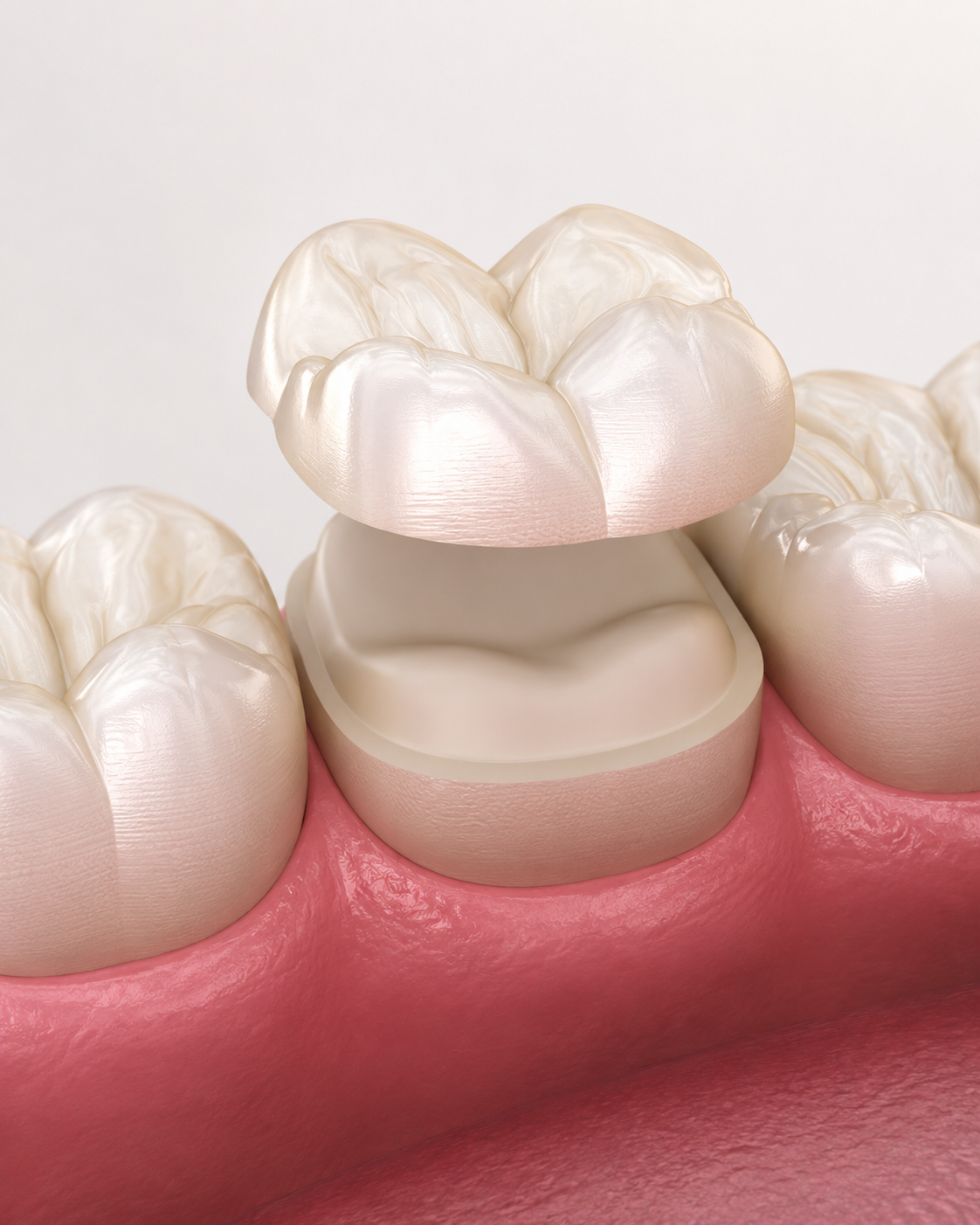
A crown is a rescue — engineered to the tooth it saves.
A crown is a full-coverage cap, custom-made to replace a tooth’s entire visible structure while the root underneath keeps doing its job. The damaged tooth is shaped into a stable core, the crown is fabricated to fit it within fractions of a millimetre, and once cemented, the assembly works as one tooth — your root supplying the anchorage and feedback, the crown supplying the armour and the appearance.
A bridge extends the same engineering across a gap: crowns on the teeth either side become pillars carrying a connected replacement tooth between them. It’s the classic alternative to an implant for a single missing tooth — faster and surgery-free, at the honest cost of shaping the two neighbours into pillars. When those neighbours already need crowns of their own, a bridge is genuinely elegant; when they’re untouched and healthy, we’ll usually argue for sparing them — and show you both prices while we argue.
The craft that separates crowns is invisible on day one: the precision of the margin where crown meets tooth (the gap bacteria audit for a living), the bite’s tuning, and the shade work — especially up front, where a crown must pass the same portrait exam as any anterior restoration.
Six teeth that ask for crowns — and one that shouldn’t get one.
The root-canal graduate
The classic caseA root canal saves the root but leaves the tooth above it dehydrated and brittle — an unprotected back tooth after treatment is a fracture waiting for the wrong almond. The crown is the treatment’s second half, not an optional extra.
The cracked workhorse
Catch it before it splitsA cracked molar — that zing on biting, the sensitivity that comes and goes — is a tooth asking for a hoop around the barrel. Crowned early, the crack is contained for years; ignored, it propagates below the gum where saving ends and extraction talk begins.
More filling than tooth
The re-restoration ceilingWhen old fillings have been patched and re-patched until little original wall remains, the next “filling” has nothing to hold onto. A crown resets the structure — one engineered shell instead of a fourth patch on three patches.
The broken front tooth
Rescue with a portrait examA fractured front tooth with a living or treatable root is a crown case before it’s an implant case — and the anterior zirconia (₩500,000) is shade-layered to pass in photographs, because keeping your own root also keeps the gum frame no surgery matches.
The gap between two tired teeth
Bridge territoryMissing tooth flanked by neighbours that already carry big fillings or need crowns anyway? A bridge puts their inevitable crowns to double use — the one scenario where the pillar trade costs nothing you weren’t already spending.
The tooth that needs less
Then we prescribe lessModerate damage with strong remaining walls is inlay/onlay territory (₩300,000) — more conservative, less grinding, tooth structure banked for the future. Crowning a tooth an onlay would serve is over-treatment, and we’ll route you to the smaller page ourselves.
How a crown actually goes.
Assessment & the save verdict
Exam and imaging (CT ₩30,000 where needed) grade the tooth honestly: crown-saveable, smaller-restoration territory, or past rescue. Material recommendation comes with reasons — and the written price before any drilling.
Preparation day
Under local anaesthesia, the tooth is shaped into its core — decay removed, structure conserved wherever engineering allows — and a precise digital or physical impression captures the geometry the crown must match.
The temporary chapter
A temporary crown (₩100,000) protects the core and keeps you presentable while fabrication runs — functional, tooth-coloured, and under back-tooth table manners for its short career.
Fit, tune, cement
The final crown is tried in, its margin checked where crown meets tooth, contacts and bite adjusted in fractions — then cemented. The fitting fuss is the quality; crowns rushed at this step come back as problems.
Back on duty
A day or two of new-tooth awareness, then the crown disappears into the team — chewing normally, cleaning normally, checked at routine visits like every other tooth. The rescue’s success is measured in years of being forgotten.
Zirconia, PFM, gold — what each is honestly for.
| Zirconia — ₩450,000 / ₩500,000 esthetic PFZ ₩600,000 |
PFM — ₩500,000 | Gold — ₩850,000 | |
|---|---|---|---|
| What it is | Milled ceramic — metal-free, strong, shade-matched; posterior ₩450,000, anterior ₩500,000. For front teeth where the match has to be invisible, the esthetic PFZ crown (₩600,000) adds hand-built porcelain over a zirconia core | Porcelain fused to a metal core — the previous generation’s standard, still legitimate | Cast gold alloy — dentistry’s oldest crown material, for engineering reasons |
| Strengths | Excellent strength, no metal edge at the gum line, the best aesthetics of the three — our default for most teeth, with the PFZ tier for the most demanding anterior shade work | Proven track record, strong core, familiar to every dentist who’ll ever service it | Gentlest on the opposing tooth, wears like enamel, superb marginal fit — the connoisseur’s molar crown |
| Honest limits | Very hard — heavy grinders get a bite conversation and sometimes a night guard (₩300,000) alongside | The porcelain layer can chip over years, and a grey metal line can appear if gums recede — why zirconia took its throne | It’s gold-coloured — a deal-breaker up front, a badge of pragmatism in the back — and the metal price shows in the fee |
| Sensible when | Almost everywhere — front teeth (anterior spec, or PFZ where the smile line is unforgiving), back teeth, bridge pillars | Replacing an existing PFM, or where its specific mechanics suit the case | Unseen molars in heavy-bite mouths, patients planning decades ahead, grinders who’ve chipped ceramics before |
Our default recommendation is zirconia for the honest reason that it wins most trade-offs at the friendlier price — but “default” isn’t “always.” Gold’s kindness to opposing teeth is real engineering, not nostalgia, and the right material is the one your bite, position and habits actually argue for. The recommendation comes with the reasons attached.
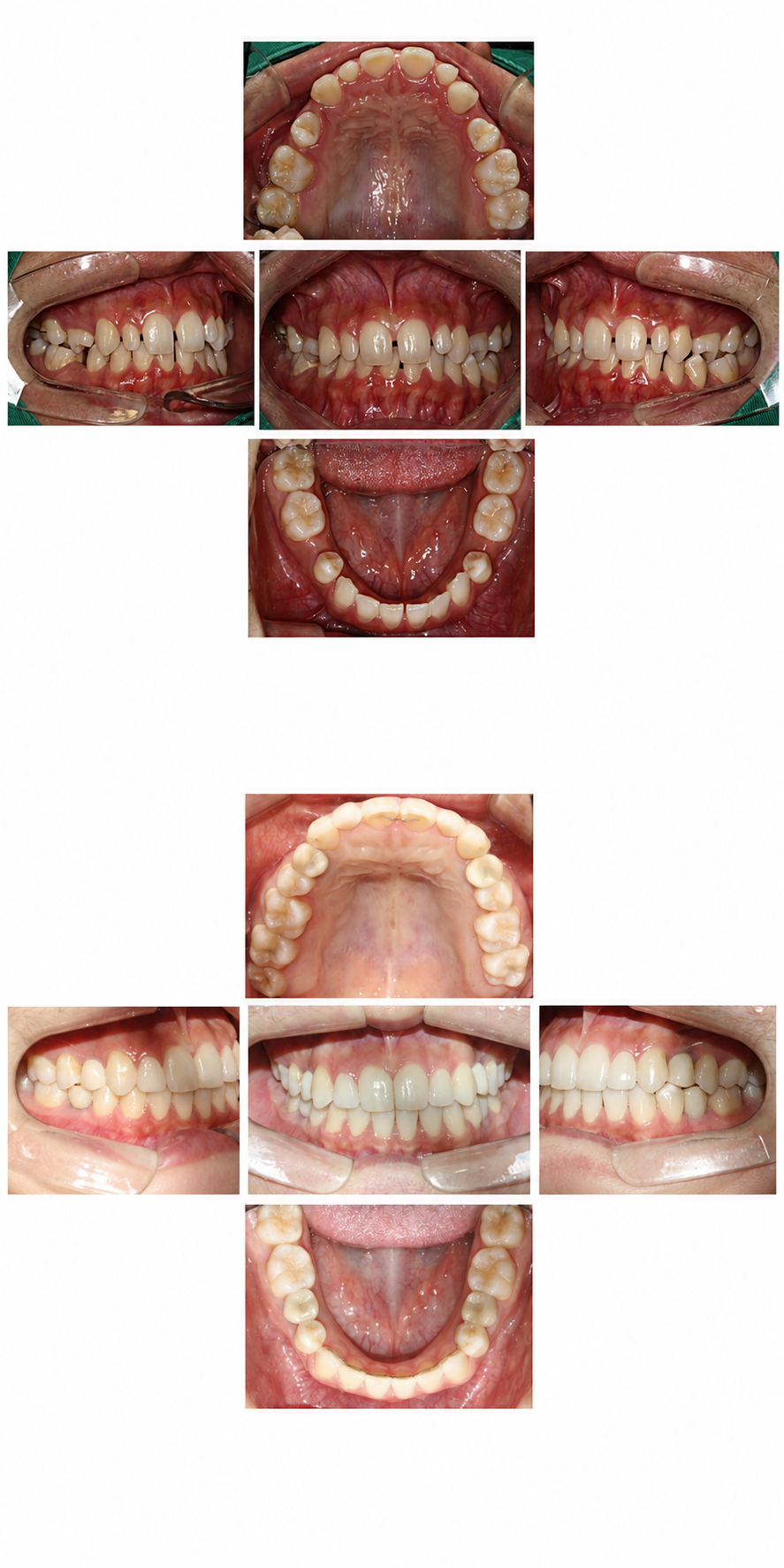
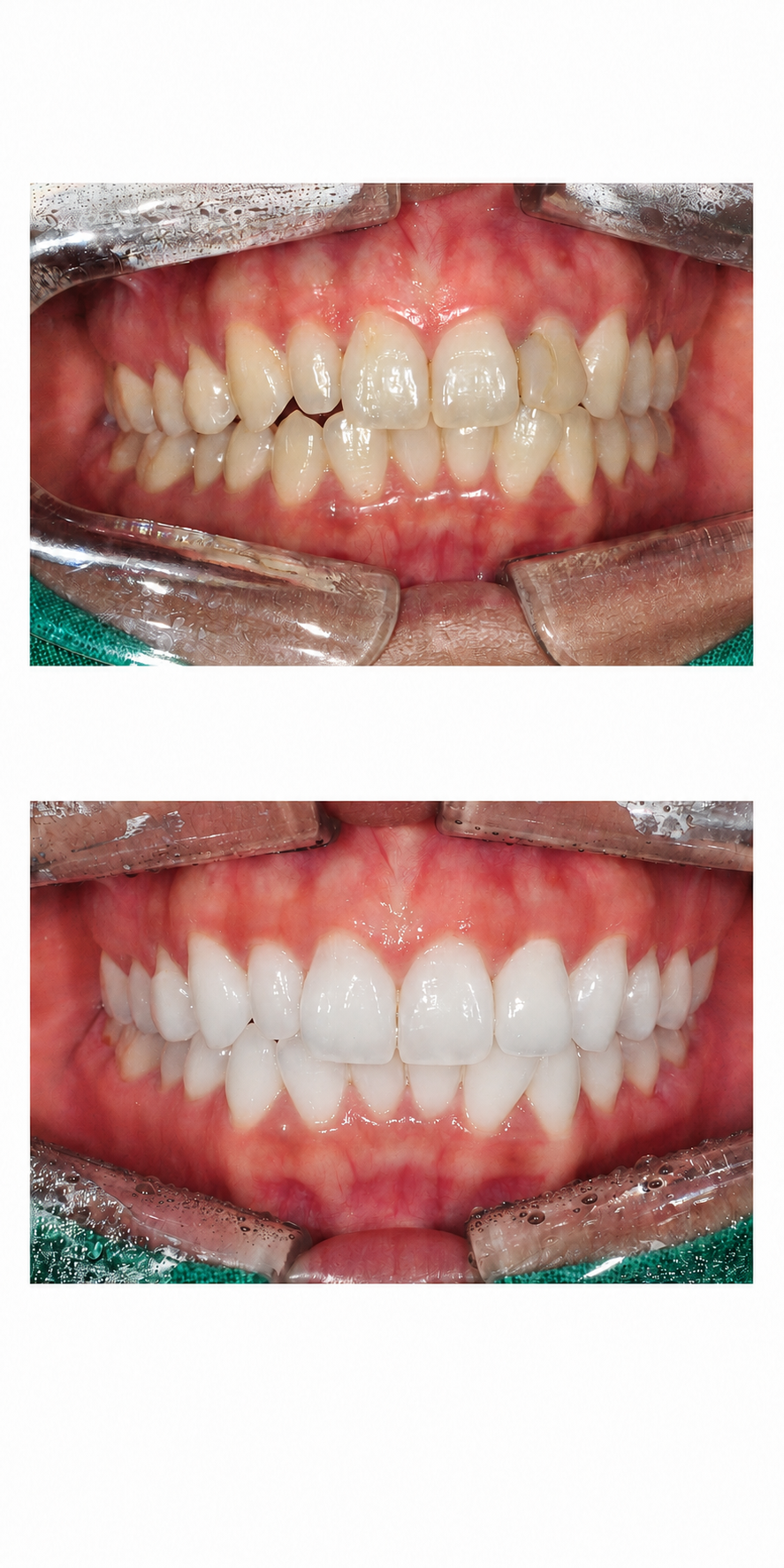
Prosthetic restoration — before and after.
Treated and restored at Baro Dental, photographed the same way before and after. Shown with patient consent; every case is individual and results vary.
The margin — where crowns are won and lost.
Ask what separates a crown that serves fifteen years from one that fails in five, and the answer is rarely the material — it’s a line thinner than a hair, told in four chapters:
Where armour meets tooth
Every crown has a margin — the circumference where the cap’s edge meets your prepared tooth. Done well, it’s a sealed, polished transition measured in microns; done carelessly, it’s a ledge or a gap. Nothing about a crown matters more, and nothing shows less in the mirror.
Bacteria inspect it daily
Plaque colonises any margin it can grip — and a gap invites decay to start under the crown, in the one place you can’t clean and can’t see. “Crowned teeth can’t decay” is the most expensive myth in prosthetics: the crown can’t; its margin absolutely can.
Precision is the product
The unhurried preparation, the fussy impression, the try-in where the fit gets checked and rechecked — that fitting-room tedium is the fifteen-year crown being built. It’s also why suspiciously fast, suspiciously cheap crowns are expensive: the margin is where corners get cut, literally.
Your side of the seam
Daily brushing along the gum line and routine scaling (₩60,000) keep the margin’s auditors unemployed — and periodic check-ups catch the rare margin problem while it’s a repair, not a replacement. A well-made crown plus a maintained margin is how “how long do crowns last” gets its best answers.
How long do zirconia crowns last?
The honest frame: crowns are wear parts with long careers, not permanent installations — well-made zirconia routinely serves for many years, and what actually writes the number is the margin’s seal, your gum health, and your bite’s habits, far more than the ceramic itself. Heavy grinding shortens any crown’s story (a night guard, ₩300,000 protects the investment); maintained margins extend it. We’d rather explain the variables than invent a guarantee.
Crown or implant for my damaged tooth?
The decision has a fixed order: if the root is sound or treatable, the crown wins — your own root keeps its ligament, gum frame and bite feedback, at ₩450,000–500,000 versus an implant’s ₩800,000+. The implant conversation starts only where the root is honestly finished: fractured below the gum, failed re-treatment, resorption. We grade your root on imaging and show you the verdict — and our bias toward saving your tooth is a bias toward the cheaper option, which is a comfortable kind of honesty.
Does getting a crown hurt?
Preparation runs under local anaesthesia and feels like a long filling appointment — vibration and time, not pain. Afterwards, some days of temperature sensitivity and gum tenderness around the new margin are normal and fade. The temporary phase asks for slightly careful chewing; the final cementation visit is the easy one. For teeth already root-canal treated, even the sensitivity chapter mostly doesn’t apply — the nerve has retired.
Why do crown prices vary so much between clinics?
Material tier is the visible variable; the invisible ones move the price more — lab quality, margin precision, whether the quoted number includes the temporary, and whether “zirconia” means layered anterior work or a single-shade mill job. Our structure: published per-position prices (₩450,000 posterior / ₩500,000 anterior), the temporary stated separately (₩100,000), and the same audit question we recommend everywhere — what exactly is in that number? — answered here in writing before we’re asked.
Can you replace my old, ugly, or failing crown?
Yes — crown replacement is routine work: grey-margined PFMs from the recession years, chipped porcelain, margins that check-ups have flagged, or simply shades that never matched. The old crown comes off, the core underneath gets honestly re-assessed (sometimes it needs attention the old crown was hiding — better found now), and the new one is built to current standards. Old crowns from any clinic, any country — same policy as everything here: findings, not lectures.
What’s the difference between a crown and a bridge, cost-wise?
A bridge is priced as its parts: each pillar crown at its material rate, plus the suspended replacement tooth — the pontic, at ₩400,000. So a classic three-unit zirconia bridge on back teeth reads ₩450,000 + ₩400,000 + ₩450,000. Compare that honestly against a single implant (₩800,000, crown included) that spares both neighbours, and you have the real decision — which we’ll price side by side for your actual teeth at the consult.
Care by board-certified specialists in Seomyeon
Both directors are board-certified specialists in Advanced General Dentistry, so your cosmetic treatment is planned with your overall dental health in mind.

- Board-certified specialist, Advanced General Dentistry
- M.S. in Orthodontics, Kyungpook National University
- Focus on natural, alignment-led smile improvement
- Conservative, tooth-preserving approach

- Board-certified specialist, Advanced General Dentistry
- DDS, Dankook University College of Dentistry
- Restorative & aesthetic resin filling work
- Focus: natural, durable results
Small truths about crowns & bridges.
- A crowned tooth still needs flossing — especially a crowned tooth. The margin at the gum line is the crown’s only vulnerability, and floss is its bodyguard. Bridges add one tool: floss threaders or a water flosser for the corridor under the pontic.
- Whiten first, crown second. A crown’s shade is fixed at fabrication and won’t bleach later — if a brighter smile is anywhere in your plans, whitening (₩495,000 for 3 sessions) comes before the shade-matching, not after.
- New-crown bite awareness has a one-week statute. Feeling the newcomer for days is normal; a persistent “I hit this tooth first” sensation is a two-minute bite adjustment — come back, it’s free of drama and usually free of anaesthesia.
- The temporary is a stand-in, not an understudy who can go on forever. Temporaries (₩100,000) are engineered for weeks, not months — wearing one long-term invites the margin problems the final crown exists to prevent. Book the fit visit; the schedule is the treatment.
- Old silver-margin smiles are one visit from retirement. If a grey line at the gum has bothered you for years on an old PFM, the fix is a routine replacement, not a project — the most gratitude-per-effort procedure on this page.
When a crown is right — and when we’ll prescribe smaller or bigger.
The crown is the right call when…
- the root is sound but the tooth above it is fractured, hollowed by decay, or brittle after a root canal
- old restorations have reached the re-patching ceiling — structure needs a reset, not a fourth filling
- a cracked tooth is caught while the crack is still above the gum — the hoop goes on before the barrel splits
- a gap sits between neighbours that need crowns anyway — bridge territory, pillars already paying for themselves
We’ll prescribe differently when…
- an inlay or onlay (₩300,000) honestly serves — conserving structure beats covering it, every time it’s enough
- the root is finished — fractured below the gum or failed beyond re-treatment, the honest conversation moves to implants, prices side by side
- gum disease is active at the site — margins placed on inflamed gums are built on a moving foundation; treatment first
- healthy front teeth are being considered as bridge pillars — grinding sound anterior teeth to span a gap is a trade we’ll argue against, with the implant maths on the table
Crowns & bridges FAQ.
₩450,000 for back teeth and ₩500,000 for front teeth at this clinic — the anterior premium buying the layered, translucency-matched work front teeth demand. PFM runs ₩500,000, gold ₩850,000, the temporary stage ₩100,000, and bridge pontics ₩400,000 per suspended tooth. All published, all stated in your written plan before preparation begins — the number you compare is the number you pay.
The classic rhythm is two: preparation and impression on the first, fit-and-cement on the second, with the temporary crown holding the fort between them while the lab fabricates. Complex cases — root canal first, gum work, bridges with multiple pillars — add their own chapters, mapped in the written plan. For visitors on tight schedules, tell us your dates upfront: the fabrication window is the fixed part, and we plan trips around it honestly rather than optimistically.
Back teeth: yes, unremarkably — posterior zirconia is shade-matched and disappears into the row. Front teeth: yes, with craft — the anterior spec (₩500,000) uses layered zirconia mapped to your neighbours' gradients and edge translucency, checked under more than one light. The honest caveat runs the other way: if you're planning whitening, do it before the shade-match, because the crown keeps the shade it was born with.
It hinges on the neighbours. Healthy, untouched teeth beside the gap argue for an implant (₩800,000, crown included) — no grinding, and the bone under the gap stays employed. Neighbours already carrying large fillings or needing crowns argue for a bridge — their preparation was coming anyway, and the bridge (two pillars plus ₩400,000 pontic) skips surgery entirely. We price both for your actual mouth at the consult and tell you which way our reasoning leans, and why.
Cracks are one-way streets: they propagate under chewing load, and the tooth's fate depends entirely on where the crack stops. Above the gum — crownable, root kept, this page's happy ending. Below the gum — the saving window closes and the conversation becomes extraction and replacement at several times the cost. A crack that "only hurts sometimes" is a crack still deciding which ending it gets; the crown is how you vote.
Frequently yes — the two-visit rhythm compresses well into a single stay when we know your dates in advance and schedule preparation early in the trip, with the fit visit before you fly. Bridges and combination cases (root canal plus crown) need honest planning against your calendar, which is exactly what the WhatsApp pre-consult is for: send photos and dates, get the real visit map before booking flights. Korean lab quality at published Korean prices is much of why dental visitors come to Busan at all.
A crown within one trip.
Send a photo of the tooth and your travel dates on WhatsApp. You’ll get an honest read — crown-shaped, smaller-restoration-shaped, or root-canal-first — and whether your stay fits the two-visit rhythm.
Assessment, the save verdict, material choice with reasons — then preparation and impression, with your temporary crown (₩100,000) fitted the same day. The lab clock starts.
You tour Busan while the lab works — the temporary handles meals under gentle rules, and we’re a WhatsApp message away if anything feels off.
Fit, margin check, bite tuning, cementation — and your crown’s details for any future dentist anywhere. One trip, one saved tooth, one published price.
Find out if your tooth can be saved.
Send a photo on WhatsApp — we’ll tell you honestly whether it reads crown-saveable, smaller-restoration territory, or implant conversation, and what each path costs in writing. In English.
Message us on WhatsAppBaro Dental Clinic · 5F, SJ Medical Building, 698-1 Jungang-daero, Busanjin-gu · Seomyeon Station Exit 2, 4 min
Explore the options in Busan.
Inlay & Onlay
₩300,000 — the conservative rescue when a full crown is more than the tooth needs.
Explore →Root Canal in Busan
The rescue before the armour — saving the root the crown will protect.
Explore →Single Tooth Implant in Busan
The alternative path when the root is honestly finished — priced side by side.
Explore →Teeth Whitening in Busan
₩495,000 for 3 sessions — before the shade-match, never after.
Explore →Medical information on this page is provided for general education and does not replace an individual examination and diagnosis. Whether a crown or bridge suits your tooth — including save-versus-replace assessment, material selection and visit planning — is confirmed at an in-person consultation. The before-and-after photograph shows a real patient of this clinic, published with consent; individual results vary.